

Discover Genuine Hybrid Solar Inverter Parts Website In Pakistan
Genuine parts come from good makers. They fit perfectly and don't waste energy. If you're looking for hybrid solar inverter parts Pakistan, always choose real ones. SunTech Mall has them all. They…

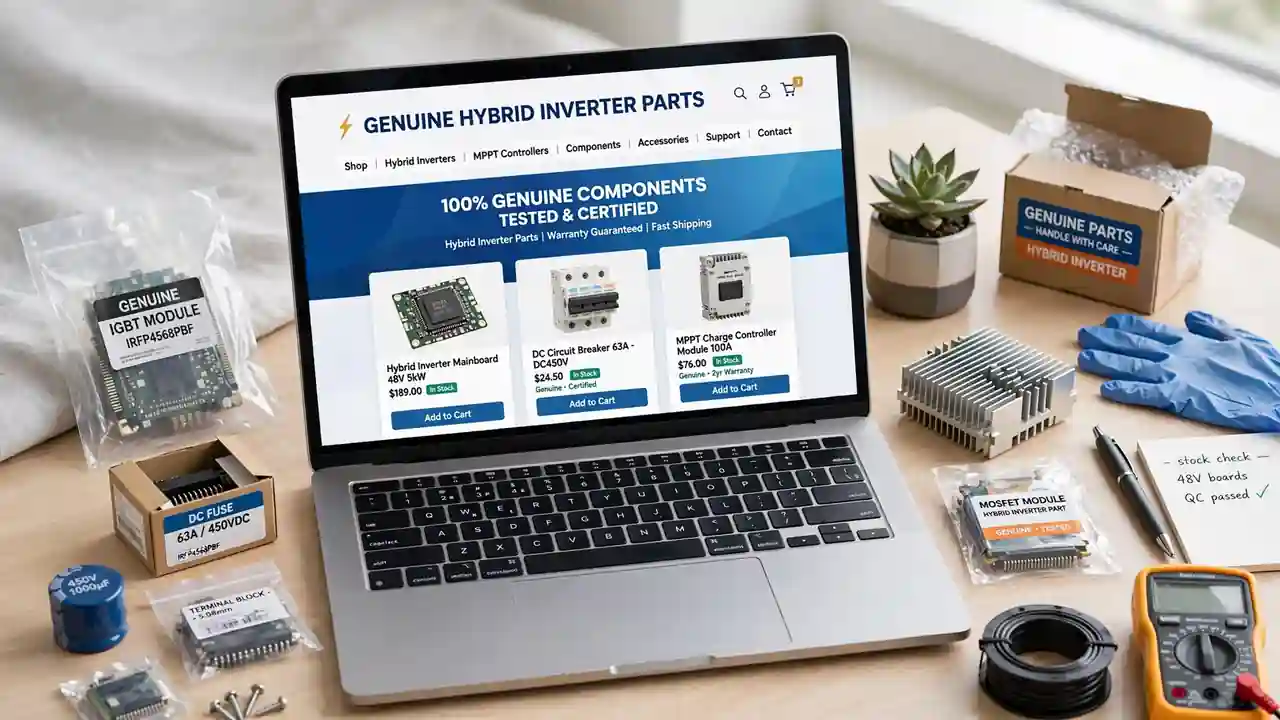
At SunTech Mall, we hear the same painful story monthly: a technician fixes an inverter with a cheap MOSFET. Two weeks later it is back — dead again, and the fake part has burned half the board. The technician loses money, time, and the customer’s trust.
We supply original components to workshops across Pakistan, so we see both sides daily: which parts fail, which fakes flood the market, and which shops thrive by refusing counterfeits. The difference between thriving and struggling shops is rarely skill — it is the parts inside the repair.
The fear is justified: Pakistan’s market is full of convincing fakes. A counterfeit MOSFET looks identical and even works — for a while. Then it fails under load, sometimes violently enough to be a fire risk inside someone’s home.
This guide will protect you. You will learn why genuine parts matter, which inverter parts fail most, how to spot fakes, what every repair shop should stock, and where to source original components.
Let’s start with the uncomfortable truth about what a fake part really costs you.
Everything here comes from real workshop experience and manufacturer datasheets. We sell genuine parts — and we will show you how to verify any part yourself, wherever you buy it.
- Learn Why Genuine Parts Matter More Than Price
- Know the Parts That Fail Most Often
- Spot Fake Components Before They Burn You
- Stock Your Workshop Like a Professional
- Order Parts the Smart Way
- See Why Repair Shops Buy From SunTech Mall
- Frequently Asked Questions
Learn Why Genuine Parts Matter More Than Price
A genuine and fake MOSFET can look exactly the same — shape, markings, packaging. The difference is invisible until the inverter runs at full load on a hot afternoon.
Inside a genuine MOSFET, the silicon die is full size per the datasheet, handling rated current and voltage with margin. Inside a fake, the die is often much smaller — a lower-rated part sanded and relabeled. It works on the bench at low load; it dies in real service.
A fake MOSFET rarely fails quietly — it usually fails shorted, dumping massive current through the board. That can vaporize tracks, crack the board, destroy neighbors, and in the worst case start a fire. A part that saved a few hundred rupees can cause damage worth thousands.
Then there is the callback cost: every failed repair returns to your bench, and you redo it for free. One callback wipes out the “savings” of a dozen cheap parts. Shops using genuine components get fewer callbacks — not luck, arithmetic.
Then reputation — a shop’s most valuable asset. Repairs that last years get recommended; repairs that die in weeks get warned about. Your parts choice is your reputation choice.
A genuine part costs more at the counter and far less everywhere else: fewer callbacks, less collateral damage, no fire risk, a reputation that brings customers in. “Expensive” genuine parts are actually the cheap option.
Know the Parts That Fail Most Often
Hybrid solar inverters are complex machines, but their failures cluster around a handful of components. Learn these, and you can diagnose most dead inverters quickly.
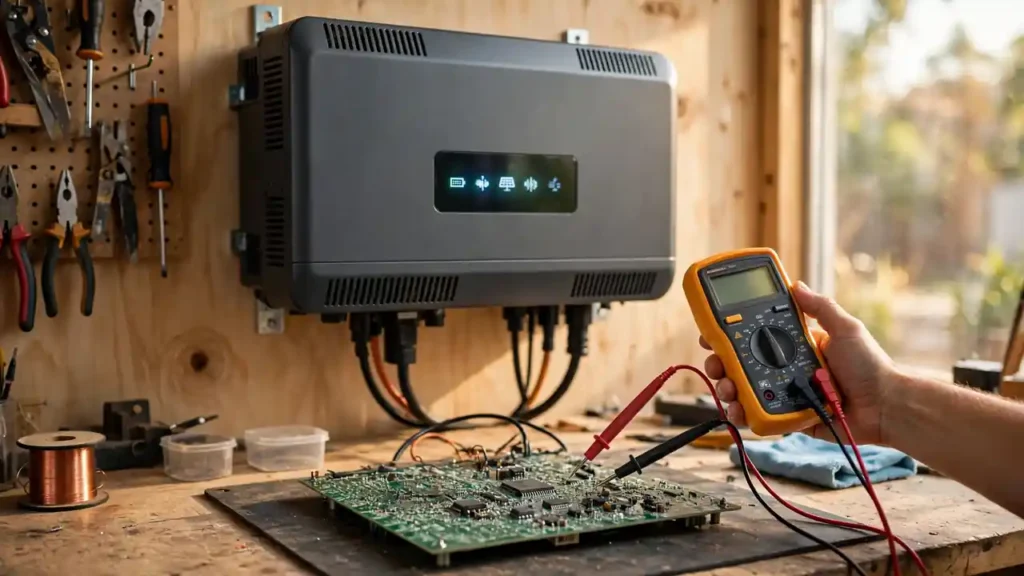
Power MOSFETs are the number one failure point — they do the heavy DC-to-AC switching at high current and speed. Heat, spikes, and gate-driver faults kill them, and one shorted MOSFET often takes neighbors with it: always check the full bank. Our guides on how to choose the right power MOSFET and why inverter MOSFETs burn in Pakistan go deeper.
IGBTs (insulated-gate bipolar transistors) do similar work in higher-power stages. Like MOSFETs, heat and spikes kill them — and they are among the most counterfeited parts, so source carefully.
Electrolytic capacitors age and dry out in hot cabinets, causing maddening intermittent faults: random shutdowns, unstable output, come-and-go fault codes. Our 50V 22uF capacitor guide teaches reading, testing, and replacement.
Bridge rectifiers sit at the AC input and take the first hit from every mains surge. When they short, fuses blow and the inverter goes completely dead. The GBU08 bridge rectifier guide shows you how to test one with a multimeter in two minutes.
Cooling fans are silent killers: a seized fan overheats the whole power stage, killing MOSFETs, capacitors, and rectifiers together. Spin fans by hand at every service — a stiff fan is a future failure.
Control cards and driver ICs fail less often but hurt more. A faulty gate-driver can destroy new MOSFETs in seconds by driving them wrong — if MOSFETs keep dying after replacement, suspect the driver stage.
Heat and power stress kill parts in groups. A good technician checks everything that shared the failed part’s suffering — that habit separates professionals from part-swappers.
Spot Fake Components Before They Burn You
Counterfeits are a real industry problem, and Pakistan’s open markets see more than their share. Here is how to protect yourself.
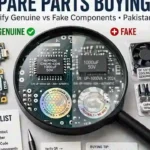
Check the markings first. Genuine parts have crisp laser-etched markings: full part number, logo, date and batch codes. Fakes show blurry inkjet printing, missing logos, wrong fonts, or no date code. Compare against a known-genuine part when you can.
Feel the weight and package. A genuine TO-220 MOSFET has a solid metal tab and clean molding; fakes feel lighter with rough edges. For capacitors, a hollow feel and wrinkled sleeves warn you off.
Look at the legs: genuine leads are evenly tinned with a clean finish. Fakes may have dull, uneven plating or misaligned legs.
Test electrically when you can. A multimeter diode test catches crude fakes — a “MOSFET” that is really a relabeled transistor behaves differently. Comparing measurements against the datasheet takes minutes and has saved countless workshops.
Distrust impossible prices. When a part sells at a third of market price, you are not getting a bargain — you are getting a reject, relabel, or fake. Price is the most honest counterfeit detector ever invented.
Buy from accountable sellers. A specialist serving professionals has a reputation to protect; an anonymous stall with no return policy has nothing to lose selling you fakes.
Bonus Tip: Build a reference collection of known-genuine parts — one real MOSFET, IGBT, and capacitor from a trusted source. Compare suspicious batches side by side; your fingers and eyes learn faster than any guide.
Spotting fakes improves with practice. The workshops that never get burned are not lucky — they are disciplined about verification.
Stock Your Workshop Like a Professional
The shops that repair fastest stock smartest. Every day you wait for a part is a day the customer’s inverter sits dead — and a day they might go elsewhere.
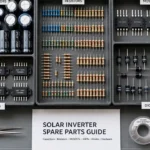
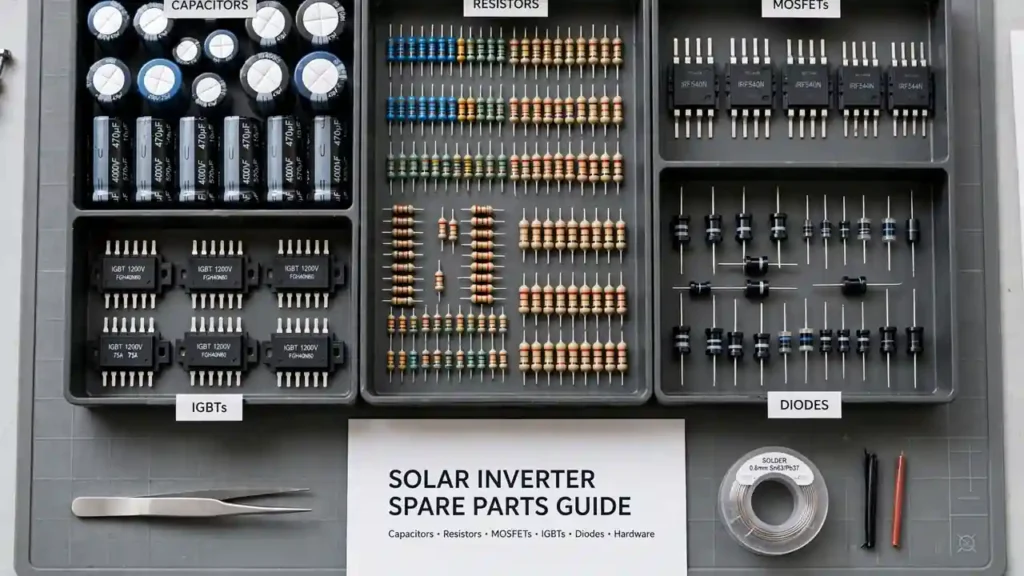
Power MOSFETs: stock the workhorse N-channel types in TO-220 and TO-247 covering most 1–5kW hybrids. Keep several of each — MOSFETs fail in groups and you will need matched sets.
IGBTs: Keep the popular IGBT types for higher-power stages. Fewer varieties than MOSFETs, but each one is expensive — so buy genuine and store them properly.
Bridge rectifiers: The GBU series (including the GBU08 8A/1000V) covers most input-stage needs. Cheap to stock, constantly needed.
Electrolytic capacitors: stock common values — 22uF/50V for control circuits, larger high-voltage values for DC bus filtering, always 105°C. Capacitors age on the shelf, so rotate stock.
Fast-recovery and Schottky diodes: These appear in charger and auxiliary circuits. A small assortment covers most repairs.
Cooling fans: Keep the common 12V and 24V sizes. A seized fan is a five-minute fix if you have the part — and a dead inverter if you do not.
Fuses, NTC thermistors, and varistors: The protection components. They are cheap, they blow often, and having them on hand turns a two-day repair into a two-hour one.
Gate-driver ICs and optocouplers: For the deeper repairs. When MOSFETs keep dying, the driver stage is the suspect — having these in stock saves the job.
Start with your most-replaced parts and expand. After three months, your own usage log is the best stocking guide ever written. Source from one trusted supplier — splitting orders across random sellers is how fakes sneak in.
Order Parts the Smart Way
Ordering components is a skill too. These habits save money and prevent the wrong-part headache.
Match the datasheet, not just the shape. Two TO-220 MOSFETs can differ wildly in voltage, current, and gate characteristics. Match the part number — or a verified cross-reference — and check the datasheet before soldering.
Replace in matched sets. Parallel MOSFETs and IGBTs should come from the same batch — mixing old and new, or different manufacturers, causes uneven current sharing, and the weakest dies first, taking the others with it.
Buy the surrounding parts too. A blown MOSFET often stresses its gate resistor, driver IC, and nearby capacitors — ordering the full set saves a second round of shipping and bench time when the “repaired” inverter fails again.
Check the package and pinout. Number suffixes can mean different packages — a MOSFET in TO-220 will not fit a TO-247 footprint. Confirm before ordering, especially online.
Keep records of which part went into which repair. When a customer returns months later, you will know exactly what was replaced — professional and impressive.
Smart ordering is really about respecting the repair. The board does not care how fast you worked; it cares whether every part in the stressed stage is healthy. Order like a professional, and your repairs will behave like professional work.
Note: If you are new to power-stage repair, start with our foundational guides: choosing the right power MOSFET, testing bridge rectifiers, and capacitor replacement basics. Together they cover the three components you will meet in almost every inverter repair.
See Why Repair Shops Buy From SunTech Mall
We started SunTech Mall to solve exactly the problem this guide describes: technicians in Pakistan needed a source of genuine components they could trust without flying to another country.
We stock genuine parts — MOSFETs, IGBTs, capacitors, rectifiers, fans — sourced as original components. We stake our business on it, because you stake your reputation on every repair.
We understand repair work. We speak your language — datasheets, packages, cross-references — and help you find the right part for the board on your bench.
We deliver across Pakistan — order online from Peshawar, Lahore, Karachi, or any small town, with no trips to distant markets or unknown sellers.
We keep prices honest. Genuine parts cost what they cost — we keep margins fair so your workshop profits from good parts instead of bleeding money on them.
Hundreds of technicians already source their critical components from us. Join them: visit SunTech Mall, browse the categories, and stock your bench with parts you never have to second-guess.
Also read our lithium vs lead-acid battery guide — the batteries connected to the inverters you repair matter as much as the parts inside them.
Frequently Asked Questions
How can I be sure a MOSFET is genuine?
Check crisp laser-etched markings with logo and date codes, solid weight, clean molding, and even lead tinning. Compare against a known-genuine sample and verify behavior against the datasheet. Above all, buy from an accountable specialist.
Are all cheap components fake?
Not always — some budget brands are legitimate. But a branded part far below normal market price is a strong warning sign; genuine parts have real manufacturing costs.
Can a fake part damage other components?
Yes — this is the real danger. A shorted fake MOSFET can destroy tracks, neighboring MOSFETs, driver ICs, and capacitors in milliseconds. Collateral damage often costs far more than the genuine part.
Should I replace all MOSFETs in a bank or just the burnt one?
Replace the full bank as a matched set. Survivors have suffered stress, and mixing old with new causes uneven current sharing. Matched replacement is standard practice.
How should I store sensitive components?
Keep MOSFETs and ICs in anti-static packaging until use. Store capacitors in a cool, dry place — heat ages them even on the shelf. Keep everything organized and labeled; a well-kept stock is a fast repair.
Do you sell to individual hobbyists or only shops?
Both — workshops and home repairers across Pakistan get the same genuine quality from SunTech Mall.
What if I order the wrong part?
Double-check part number, package, and pinout before ordering. Unsure? Contact us with the original part number and a board photo, and we will help you match it.
Final Thoughts
You now know what most buyers never learn: why genuine parts matter, which parts fail and why, how to spot fakes, what to stock, and how to order professionally. That knowledge protects every future repair.
Think about the technician at the start of this guide — the one doing free rework on a repair killed by a fake part. That does not have to be you. Not anymore.
Your next step is simple: audit your current stock, throw out the suspicious parts, and rebuild your bench with components you trust. Start at SunTech Mall — genuine hybrid solar inverter parts, honest prices, delivered across Pakistan.
Keep sharpening your craft with our related guides: why MOSFETs burn, MOSFET selection, and where solar inverter technology is heading. Build your reputation one genuine part at a time.
1 Comment
[…] actually own. The megawatt world fascinates, but revenue comes from home and shop hybrids — our genuine inverter parts guide tells you what to […]