



Power MOSFET Selection Guide: Choose the Right MOSFET for Your Project
You know that sharp, acrid smell of burning plastic? If you have ever powered up a solar inverter after a repair and caught that smell, you know the sinking feeling. A brand-new…

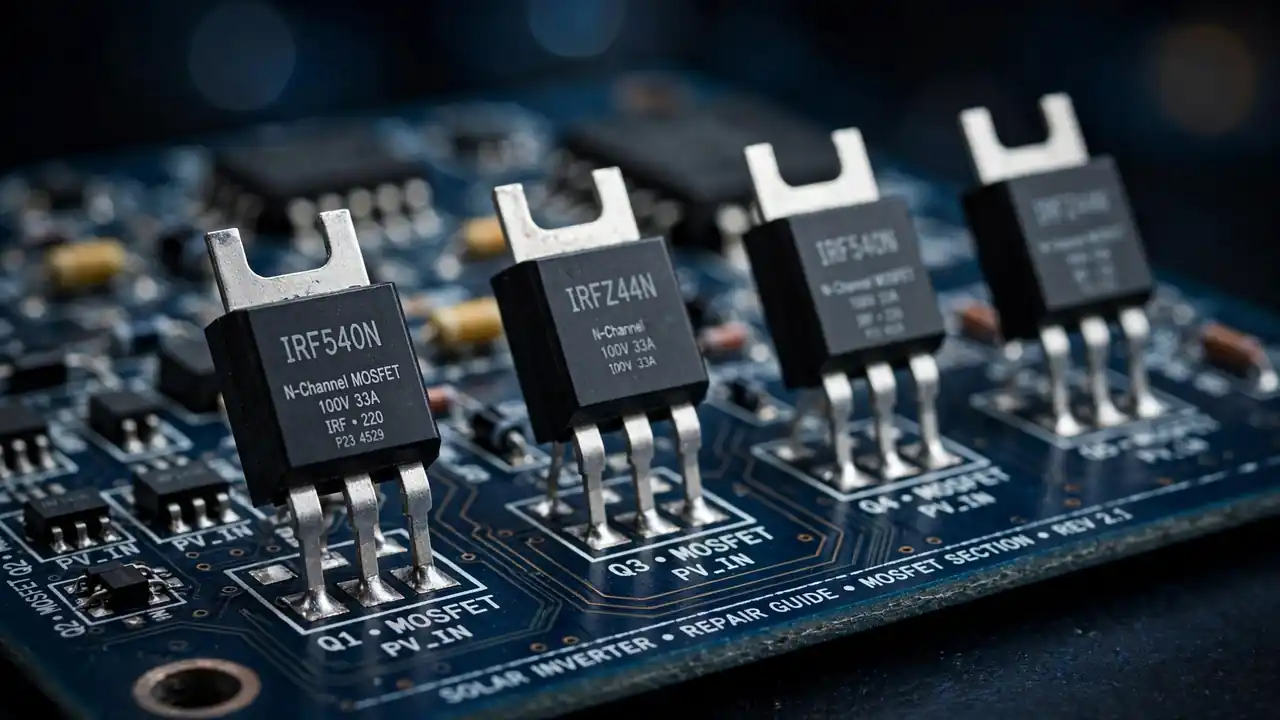
You know that sharp, acrid smell of burning plastic? If you have ever powered up a solar inverter after a repair and caught that smell, you know the sinking feeling. A brand-new MOSFET — bigger and “better” than the original — can fail in seconds if even one specification is wrong. That single wrong part can take out neighboring components with it.
Here is the good news: almost every MOSFET failure in a repair comes down to the same root cause — choosing the wrong replacement part. Not bad luck. Just a mismatch between the part and the circuit. Once you understand five key specifications from the datasheet, you can match any MOSFET correctly, every time.
This guide is for you if datasheets overwhelm you, or if your replacement parts keep failing. Whether you repair solar inverters, work on UPS systems, or build switching circuits, you will learn the exact five numbers that matter — in plain, simple words.
The promise: by the end, you will be able to read any power MOSFET datasheet, check five specifications, and know with confidence whether that part belongs in your circuit. No more guessing. No more burning smell.
Let us start with what a MOSFET actually does.
Note: Every technical fact here comes from standard MOSFET datasheets and published electronics references. No invented stories, no made-up prices — just the specifications and test methods technicians actually use.
What You Will Learn in This Guide
- What a MOSFET actually does — in plain words
- How to match the voltage rating with a safety margin
- How to read the current rating honestly
- Why Rds(on) decides whether your MOSFET runs cool or cooks
- How to match gate characteristics to your driver
- How to confirm package and pinout before buying
- How to test a MOSFET with a multimeter
- The 5 mistakes that kill MOSFETs
Step 1: What a MOSFET Actually Does (In Plain Words)
A MOSFET is an electronic switch. Think of the light switch on your wall — your finger flips it on and off. A MOSFET works the same way, except a small voltage on its “gate” pin does the flipping. Apply the right gate voltage and current flows from the “drain” pin to the “source” pin. Remove it, and current stops.
The magic is speed. A MOSFET can switch thousands of times per second. Inside a solar inverter, this rapid switching — typically around 20,000 times per second (20 kHz) — converts DC battery power into AC power for your home.
Here is why a wrong choice is so destructive: when a MOSFET fails, it usually fails “shorted” — stuck ON. Current rushes through uncontrolled, heat builds, plastic melts, and nearby parts get damaged. That single fact explains why matching specifications matters so much.
The takeaway: a MOSFET is a precision switch, not a generic part. Learn the five numbers below and datasheets stop looking scary.
Step 2: Match the Voltage Rating — With a Safety Margin
Many beginners see a 55V MOSFET and assume it suits a 48V system. It does not. Not even close.
The voltage rating — Vds or Vdss on datasheets — is the maximum voltage the MOSFET can block between drain and source. The critical rule: never run a MOSFET near its maximum rating.
The standard rule of thumb: choose a rating at least 1.5 times your circuit’s maximum voltage. A 48V solar system can reach about 60V during charging, so a 100V MOSFET is the sensible minimum. For a 12V system, 55V or 60V parts give comfortable headroom.
Why the margin? Real circuits produce voltage spikes. When a MOSFET switches off fast, wiring inductance creates brief spikes above normal voltage. Do the math: a 48V system with 25V of spikes briefly hits 73V. A 75V MOSFET lives on the edge; a 100V MOSFET does not even notice. That margin separates a repair that lasts years from one that fails in weeks.
Bonus Tip: When in doubt, go higher on voltage. A 100V MOSFET works perfectly in a 48V circuit. A 60V MOSFET in the same circuit is asking for trouble.
Step 3: Check the Current Rating — Continuous vs. Pulsed
Datasheets love big numbers. You will see “110A” printed prominently — but that number has fine print.
Every power MOSFET has two ratings: continuous drain current (Id) and pulsed drain current (Idm). Continuous is what the part can carry all day. Pulsed is what it survives for a fraction of a second. The big bold number is usually the pulsed one.
What to do: find the continuous rating (Id) at 25°C, then mentally halve it for real-world use. Your inverter is not running at 25°C in a lab — it runs at 50–60°C inside a metal box in a Pakistani summer, and current capacity drops as temperature rises.
Example: the popular IRF3205 lists 110A continuous. That is measured at 25°C with ideal cooling. In a real hot inverter, treating it as a 55A part is honest and safe. Still plenty for most jobs — but realistic.
Ever wondered why a “110A” MOSFET burned in a 60A circuit? Now you know. Ignore the pulsed number for sizing; it covers surge events, not steady operation.
Step 4: Look at Rds(on) — The Hidden Heat Generator
Rds(on) is the MOSFET’s resistance when fully turned on. Think of water in a pipe: a wide pipe (low resistance) flows easily; a narrow pipe (high resistance) builds pressure. In a MOSFET, that pressure becomes heat.
The math is unforgiving: Power loss = Current² × Resistance. A MOSFET with 8 milliohms carrying 50 amps wastes 50 × 50 × 0.008 = 20 watts as heat. The same circuit with a 4-milliohm part wastes only 10 watts. Half the heat from one specification — the difference between a part that runs cool for years and one that cooks itself.
The rule: for power work, choose the lowest Rds(on) available. The price gap between 8-milliohm and 4-milliohm parts is usually small; the reliability gap is enormous.
Note: Rds(on) rises with temperature. A part rated 8 milliohms at 25°C may read 12 milliohms at 100°C. Check the datasheet’s temperature graph, not just the headline number.
Step 5: Verify the Gate Characteristics
The gate is the control pin. Get its requirements wrong and your MOSFET never fully turns on.
Two numbers matter: Vgs(th) (gate threshold voltage) and gate charge (Qg). The threshold is where the MOSFET just begins to turn on — but “just begins” is not enough. You must drive the gate well past the threshold to reach full low-resistance operation.
Here is the deal: if your circuit drives the gate with 10V, pick a threshold of 2–4V. If it provides only 5V (typical for microcontroller outputs), you need a “logic-level” MOSFET with a 1–2V threshold.
The failure mode is sneaky: a standard MOSFET (4V threshold) on a 5V drive will “work” — but never fully turn on. Rds(on) stays far above the datasheet value, heat builds, and the part dies early. Quick check: choose a threshold less than half your actual gate drive voltage.
Gate charge (Qg) measures the energy each switching event costs. Lower is better at high frequencies — in a 20 kHz inverter, high gate charge overworks the driver circuit.
Step 6: Confirm the Package and Pinout
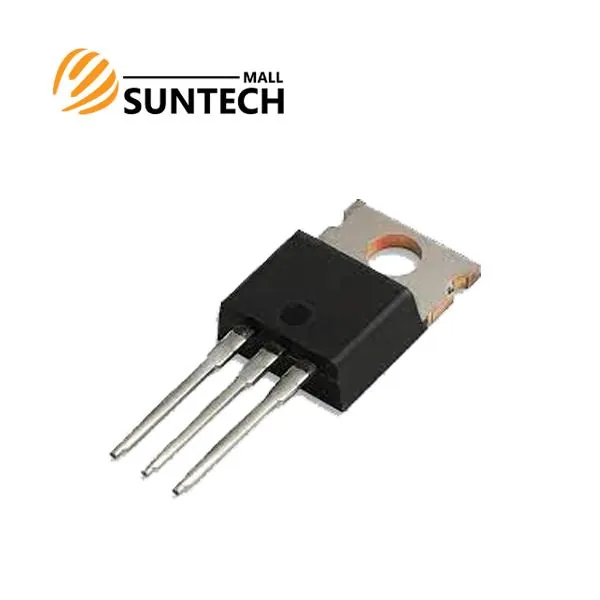
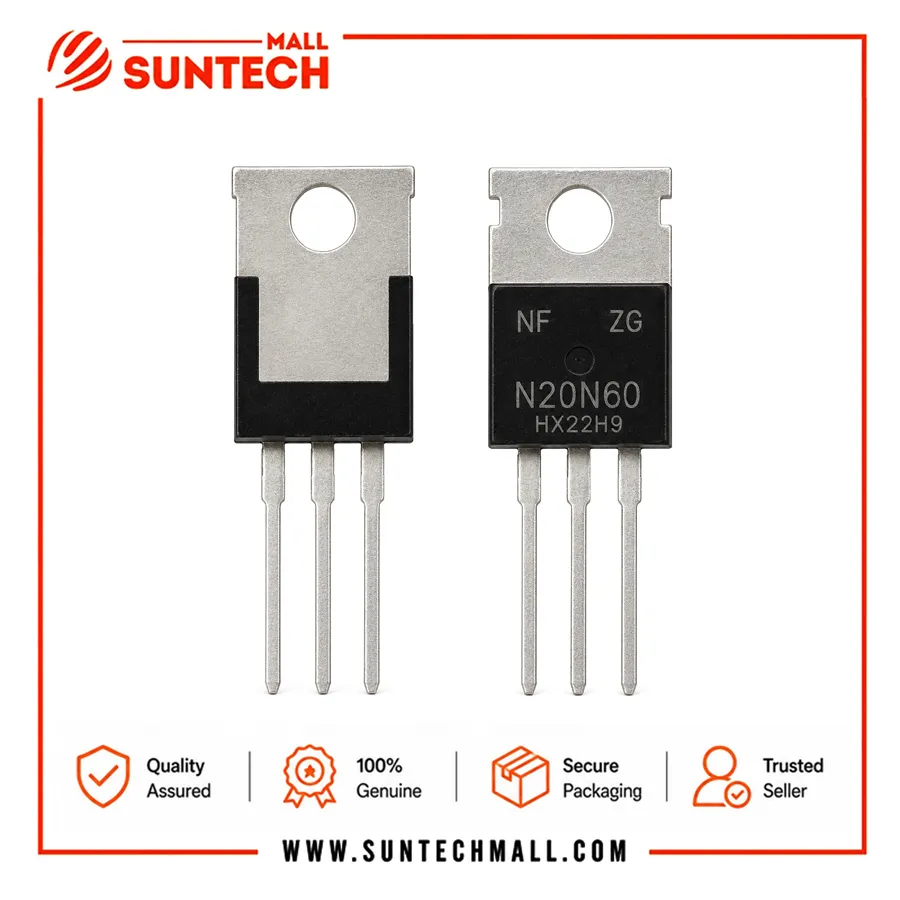
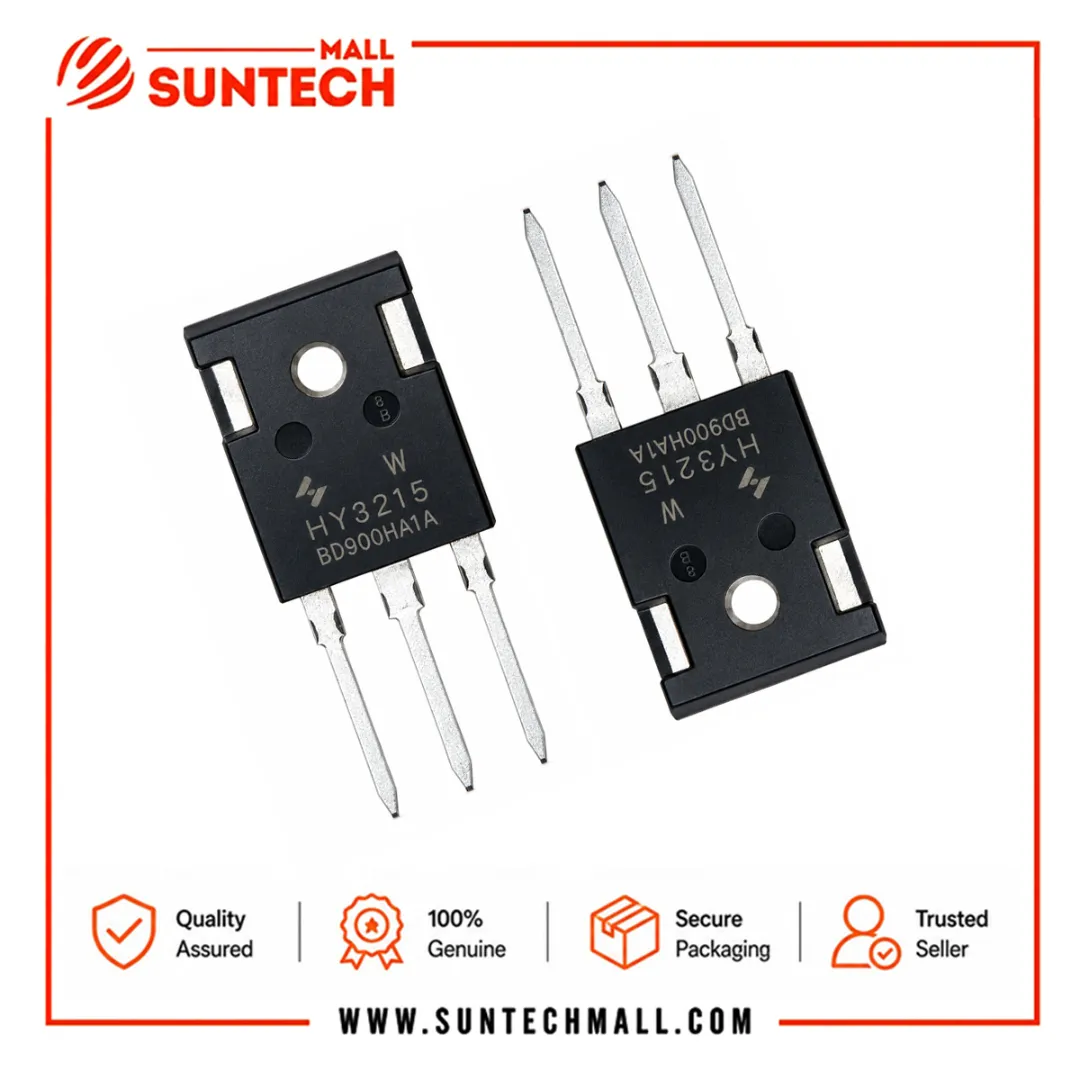
The package is the MOSFET’s physical shape; the pinout is which pin is gate, drain, and source. Common power packages — TO-220, TO-247, DPAK, SO-8 — are not interchangeable. A TO-220 will never fit a DPAK footprint.
Always verify:
- Package matches your PCB footprint
- Pinout matches — gate, drain, source in the right spots
- Through-hole vs. surface-mount mounting
- Heatsink compatibility — if the original was bolted to a heatsink, the replacement needs the same metal tab
Bonus Tip: photograph the original MOSFET before removing it — part number, package, and orientation. Thirty seconds that prevents ordering the wrong package, a surprisingly common and expensive mistake.
Bonus: Test Every MOSFET With a Multimeter Before Soldering
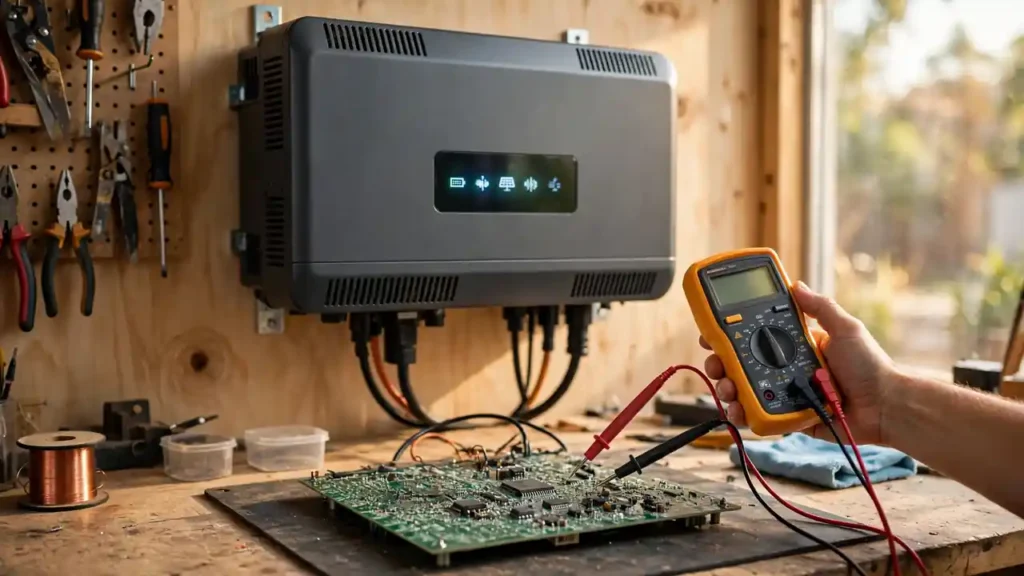
Counterfeit and damaged MOSFETs are common in local markets. A two-minute multimeter check catches most bad parts before they touch your board. For more on spotting fakes across all component types, see our guide to most-used solar inverter spare parts.
Test 1 — Gate isolation: diode mode, probes between gate and source — expect open circuit (no beep). Repeat gate to drain — also open. Any reading means damaged gate insulation. Reject the part.
Test 2 — Body diode: between drain and source you should see a diode drop (about 0.4–0.7V) one way and open circuit the other way. That is the internal body diode — it belongs there.
Test 3 — Component tester: a transistor tester identifies N-channel vs. P-channel and shows measured threshold voltage. Compare with the datasheet; a big mismatch signals a counterfeit.

The 5 Mistakes That Kill MOSFETs in Repairs
Mistake 1: Choosing by amps alone. A 100A part is not automatically better than a 75A original if its Rds(on) is higher or its gate threshold mismatches. Check all five specs together.
Mistake 2: Ignoring the gate drive. A standard-threshold MOSFET on a weak gate drive runs hot and dies early. Match the threshold to your real gate voltage.
Mistake 3: Skipping the heatsink. The original was bolted to a heatsink with thermal compound; the replacement goes in bare. Restore the heatsink, insulating pad, and fresh compound — the thermal path is part of the design.
Mistake 4: Static damage. MOSFET gates are extremely ESD-sensitive. Keep parts in anti-static packaging until installation and avoid touching the gate pin. One invisible zap can cause a failure days later.
Mistake 5: Buying counterfeits. Too-good-to-be-true deals usually are. Counterfeits are relabeled small-die parts that cannot meet printed ratings. Buy from reputable suppliers and run the multimeter tests above on every part.
Frequently Asked Questions
Can I use a higher-voltage MOSFET than the original?
Yes — often a good idea. A 100V part can replace a 60V part if the other specs match; the extra rating is free safety margin. Just confirm Rds(on), current, gate threshold, and package are equivalent or better.
What is the difference between N-channel and P-channel?
N-channel devices switch the negative side of a circuit; P-channel switch the positive side. They are not interchangeable. Nearly all solar inverter power stages — about 95% of power applications — use N-channel.
Why did my new MOSFET fail immediately?
Three usual suspects: the part was counterfeit or damaged (test before installing); the gate drive voltage was too low (check the driver); or another circuit fault killed the original and has now killed the replacement. Always find the root cause before fitting a new part.
Can I parallel two smaller MOSFETs instead of one big one?
Technically yes, but not recommended for repairs. Paralleled devices rarely share current equally — one hogs current and fails. A single MOSFET meeting your specs is simpler and more reliable.
How do I spot a fake MOSFET?
Buy from reputable suppliers, then verify: a component tester comparing measured threshold voltage against the datasheet; inspection of markings (fakes often show blurry etching or wrong fonts); and comparison against a known-genuine part.
Do I need a heatsink on the replacement?
If the original had one, absolutely. Even with low Rds(on), watts of heat need somewhere to go. Refit the heatsink with fresh thermal compound and the correct insulating pad.
Final Thoughts: Match the Specs, Skip the Smoke
Choosing a MOSFET means matching five numbers to your circuit: voltage with margin, honest continuous current, low Rds(on), a gate threshold your driver can handle, and the correct package. Get all five right and the repair runs cool for years.
Try this today: pick any MOSFET from your parts bin, open its datasheet, and check those five numbers against a circuit you know. If you can explain each one, you have mastered the skill. If not, re-read that section — it saves real money in blown parts.
Questions about a specific MOSFET or a tricky replacement? Leave a comment — and share this guide with anyone still guessing at MOSFET selection. If you are starting out in repair work, our easy spare parts repair guide covers the other components you will meet inside an inverter.
Need genuine MOSFETs for your next repair? Browse SunTech Mall’s electronic parts — stocked for Pakistan’s repair shops with nationwide delivery. Also see our solar inverter error code guide and MOSFET burn prevention guide.
9 Comments
[…] The switching heart of every inverter. Heat, voltage spikes, and poor cooling kill them first. If you repair inverters, you already know the pain of a shorted MOSFET taking out its neighbors. Learn how to pick the right one in our power MOSFET selection guide. […]
[…] you are learning how these power stages are built, our guide on choosing the right power MOSFET explains the switching devices that work alongside transformers like this […]
[…] One caution I always give: that 110A rating assumes a 25°C case, which you will never have in a real Pakistani summer. At a 100°C case temperature the rating falls to 75A. Design for the hot number, not the pretty one. If you want a deeper walkthrough of picking parts the right way, read our power MOSFET selection guide. […]
[…] and one shorted MOSFET often takes neighbors with it: always check the full bank. Our guides on how to choose the right power MOSFET and why inverter MOSFETs burn in Pakistan go […]
[…] body does not just read wrong — it blinds the protection circuit. Overcurrent goes undetected, MOSFETs burn, and a cheap repair turns into a dead power stage. This guide shows you how wirewound […]
[…] current is interrupted. Fast diodes clamp these spikes, protecting MOSFETs and ICs. Our guide on power MOSFET selection explains the switching devices these diodes […]
[…] To understand the power electronics inside these machines, see our MOSFET selection guide. […]
[…] clamps spikes that would punch through the gate oxide. Given how often we discuss MOSFETs in our power MOSFET guide, this protection role deserves […]
[…] the methodology of choosing between power MOSFETs, our MOSFET selection guide walks through the decision process step by […]