


Solar Inverter MOSFET Burn Pakistan | Causes, Damage and Easy Prevention
Technicians warn that solar inverter MOSFET burn problems are increasing in Pakistan and causing expensive repairs.

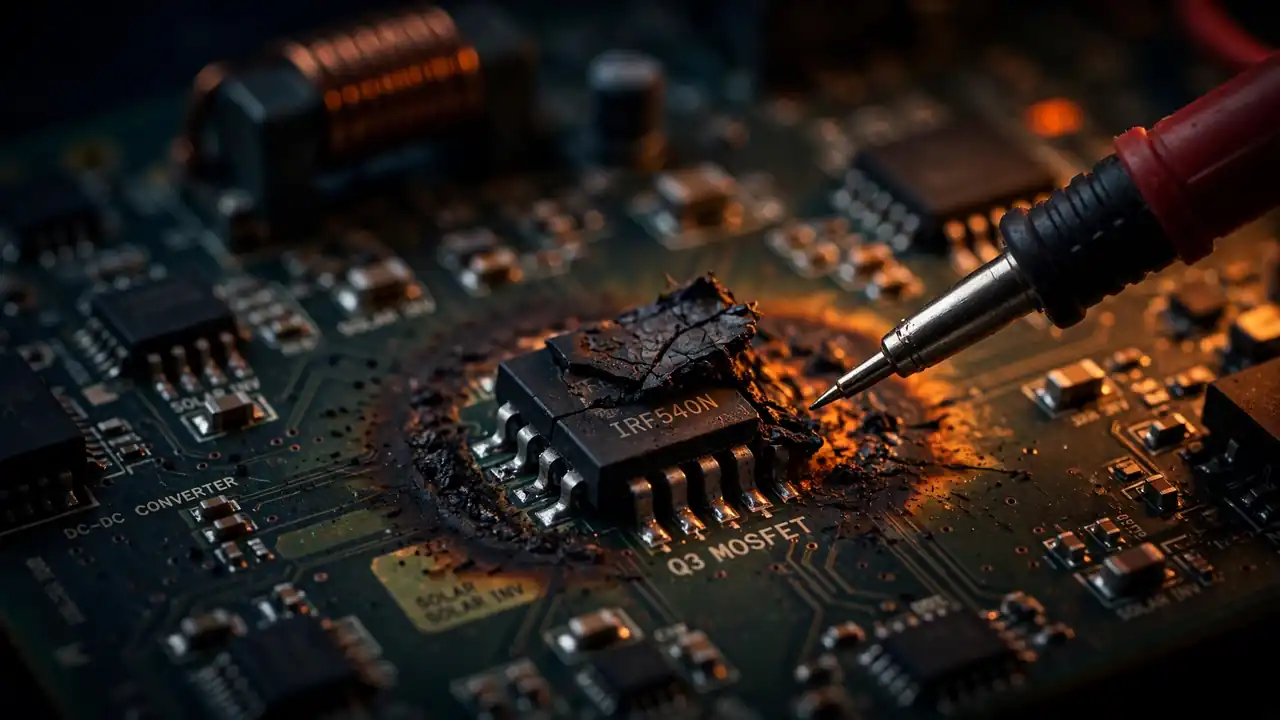
It starts with a smell — sharp, chemical, unmistakable. Or sometimes with a pop and smoke from inside the inverter cabinet. Then silence: no solar output, no backup during load shedding, and a repair bill that grows the longer you wait.
That is a burned MOSFET. And across Pakistan, repair technicians see more of these failures every summer. The pattern is consistent: a single overheated switching transistor dies, and because it usually fails shorted, it drags down gate drivers, resistors, fuses, and sometimes the PCB itself.
Here is what most people get wrong: they treat the burned MOSFET as the whole story. It is the symptom. The real story is whatever killed it — overload, heat, poor cooling, a weak driver, or a counterfeit replacement from a previous repair. Replace the MOSFET without fixing the cause and you will replace it again.
This guide explains, in plain words, why MOSFETs burn in solar inverters, what damage they cause, how to prevent it, and how to make sure a repair actually lasts. Whether you are a homeowner, a shop owner, or a technician, you will know exactly what to watch for.
Let us start with what a MOSFET does — and why it is the part that burns first.
Note: This guide describes standard failure mechanisms documented in power electronics practice. No invented statistics — just the causes and prevention methods that technicians deal with every day.
What You Will Learn in This Guide
- What a MOSFET does inside your inverter
- The 6 reasons MOSFETs burn in Pakistan
- Why heat is the number one killer
- How cheap and counterfeit parts make it worse
- How one burned MOSFET damages everything around it
- What MOSFET burn really costs you
- Warning signs most people ignore
- How to prevent MOSFET burn: the complete checklist
- How to make sure a repair actually lasts
What a MOSFET Does Inside Your Inverter
A MOSFET is a high-speed electronic switch. Inside a solar inverter, banks of these switches turn on and off around 20,000 times per second, chopping DC power from your batteries and solar panels into the AC power your home uses.
Every switching event generates a tiny amount of heat. Under normal conditions, heatsinks and cooling fans carry that heat away and the MOSFETs run for years. But when something upsets that balance — too much current, too little cooling, a weak gate drive — heat builds faster than it can escape. Silicon fails fast once it overheats, and a MOSFET that dies usually dies shorted: stuck ON, passing uncontrolled current.
That is the moment of the pop, the smoke, and the smell. Understanding this chain — stress, heat, short, collateral damage — is the key to both prevention and proper repair.
The 6 Reasons MOSFETs Burn in Pakistan
1. Overload — the most common cause
An inverter rated for 3kW cannot continuously run 4kW of appliances. Yet during load shedding, households pile on air conditioner, pump, refrigerator, and iron at once. The MOSFETs carry current beyond their design, heat climbs, and the weakest device fails. Respecting the rating — or oversizing the inverter — eliminates this entire category.
2. Heat and poor ventilation
Pakistani summers push past 40°C. An inverter in a closed storeroom, against a sun-heated wall, or buried under stored items cannot shed heat. As a rule of thumb, every 10°C of extra heat roughly halves the long-term life of power semiconductors.
3. Failed or weak cooling fans
Inverters depend on forced-air cooling. When a fan’s bearings wear out, it spins slower, moves less air, and eventually stalls — often silently. Dust caked on heatsink fins has the same effect. The MOSFETs do not get a warning; they just get hotter every day until one gives up. A fan that sounds different than it used to is already telling you something.
4. Voltage spikes and unstable supply
Switching transients, loose battery connections, and grid fluctuations create voltage spikes that stress MOSFETs beyond their ratings. A part run near its voltage limit has no margin left for spikes — which is why proper voltage derating during selection matters so much. Our MOSFET selection guide explains the safety margins.
5. Counterfeit or underrated replacement parts
This one is frustrating because it comes from a previous “repair.” A counterfeit MOSFET — a relabeled small-die part — cannot handle the printed ratings. An underrated substitute (wrong voltage, higher Rds(on), wrong gate threshold) runs hot from day one. When it burns, people blame the inverter. The real blame belongs to the part. Always verify replacements against the datasheet.
6. Driver circuit faults
MOSFETs do not switch themselves — a gate driver circuit controls them. If the driver weakens, the MOSFET switches slowly, spending more time half-on where it dissipates maximum power. The MOSFET burns, but the driver was the killer. Good technicians test the driver stage before fitting new power devices.

Why Heat Is the Number One Killer
Almost every cause above ends at the same place: heat. Overload creates heat. Blocked cooling traps heat. Weak drivers generate heat. Counterfeits cannot handle heat.
The physics is simple: a MOSFET’s power loss equals current squared times on-resistance (P = I² × R). Double the current, quadruple the heat. The heatsink and fan are sized for the designed heat — not for overloads, dust blankets, or dead fans.
Practical meaning: anything that raises current or traps heat shortens MOSFET life. Keep loads within ratings, keep air moving, keep heatsinks clean. These three habits prevent more failures than any other intervention.
Bonus Tip: Put your hand near (never on) the inverter’s exhaust during peak load. If the air feels dramatically hotter than it used to, something has changed — dust, a slowing fan, or rising load. Investigate before it becomes a repair.
How Cheap and Counterfeit Parts Make It Worse
A genuine power MOSFET is built to its datasheet: the right die size, real ratings. A counterfeit is a smaller, cheaper die in a convincing package — it may work for weeks, then fail under real load.
The damage does not stop at the fake part. When a counterfeit MOSFET shorts, the surge often kills the gate driver IC, burns gate resistors, blows fuses, and scars the PCB. A “cheap repair” becomes an expensive one — and if nobody found the original cause, the replacement dies too.
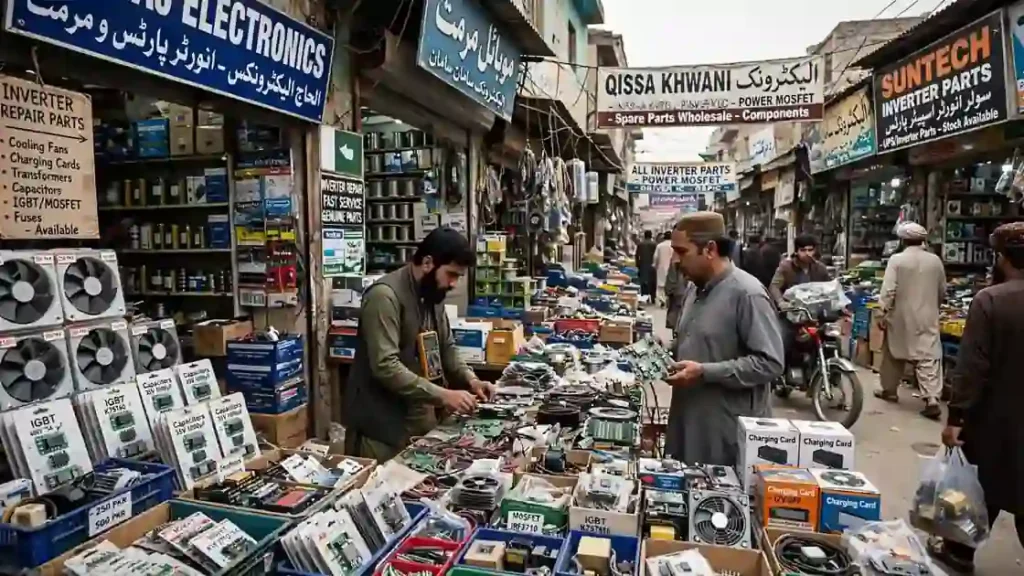
Protect yourself: buy from reputable suppliers, compare markings against known-genuine parts, and test every power MOSFET with a multimeter before soldering. If a price looks impossibly low next to the market, walk away. For verified components, SunTech Mall’s electronic parts section stocks parts chosen for Pakistan’s repair market.
How One Burned MOSFET Damages Everything Around It
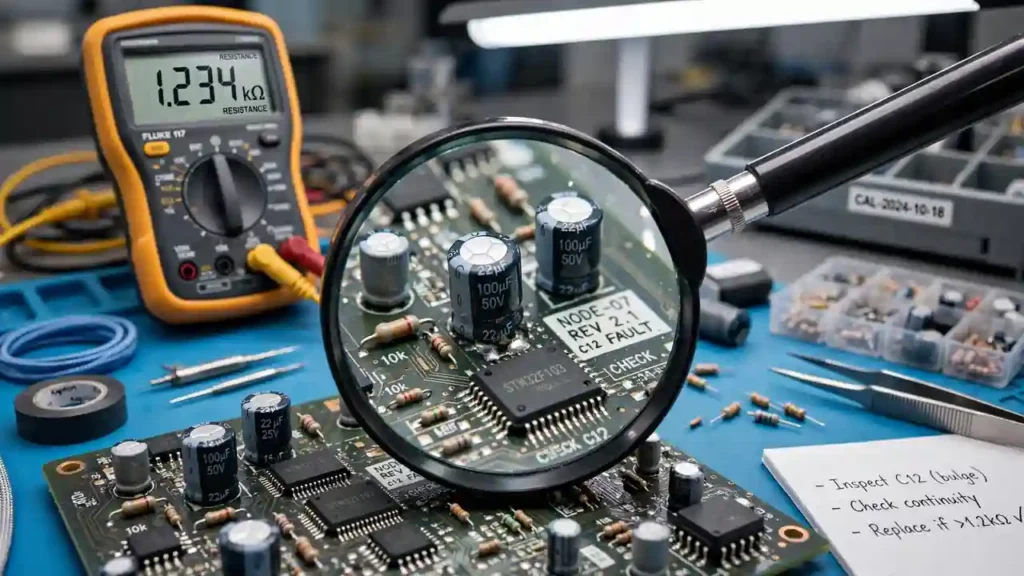
A MOSFET rarely dies alone. The typical blast radius: the gate driver IC (short feeds voltage back into it); gate resistors (burn open); current-sense resistors and fuses; neighboring MOSFETs; PCB traces (vaporize or carbonize — and carbonized board conducts, causing repeat failures); nearby capacitors stressed by heat and surge.
This is why a “one MOSFET” repair estimate so often grows. A technician who only swaps the visibly burned part — without checking drivers, resistors, and board condition — is setting up the next failure. Our error code guide explains how to diagnose before replacing.
What MOSFET Burn Really Costs You
For home users, the cost is not just the repair bill. It is the days without backup power during load shedding — food spoiling, work disrupted, sleep lost in summer heat. A preventive fan cleaning costs almost nothing; a burned power stage costs days of normal life.
For shops and offices, downtime is direct business loss. A single day without power can cost more than the inverter’s annual maintenance. Business owners who schedule preventive checks treat it as insurance — because it is.
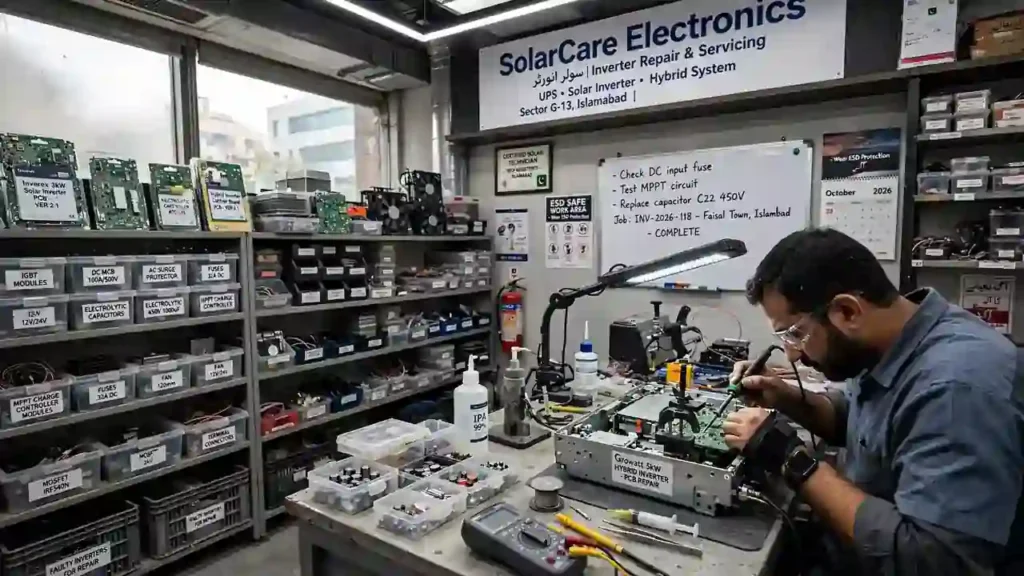
For technicians, callbacks are the hidden cost. A rushed repair that fails again costs a free revisit and a damaged reputation. Diagnosing the root cause the first time is always cheaper than the second visit.
The pattern is consistent: early attention costs little; delayed repair costs multiples. A struggling fan replaced today prevents a burned power stage next month.
Warning Signs Most People Ignore
MOSFETs rarely fail without warning. Watch for: unusual heat from the cabinet; changed fan sound (louder, grinding, or silent); any burning or hot-plastic smell — never ignore this; error codes for over-temperature, over-current, or bus faults; shutdowns under loads that used to be fine; dust caked on vents; discolored casing near ventilation slots.
Any one of these deserves attention now. A ten-minute inspection today beats a ten-day repair later.
Note: If you smell burning or see smoke, switch the inverter off via its approved shutdown procedure and disconnect loads. Do not open the unit while it is connected to PV, battery, or AC.
How to Prevent MOSFET Burn: The Complete Checklist
Respect the load rating. Add up your real appliance wattages — including motor startup surges — and keep the total comfortably below the inverter’s continuous rating. Leave headroom; running at 100% continuously is asking for trouble.
Give it air. Mount the inverter in a shaded, ventilated spot with clear space on all sides. Never stack items on or against it. Keep it out of direct sun and rain.
Clean cooling paths. Every few months, clear dust from vents, fans, and heatsink fins (power off, following the manual). In dusty areas, check more often.
Listen to the fans. Fans are wear items. A noisy, slow, or stopped fan is a repair that cannot wait — it protects every power device in the box.
Use proper wiring. Undersized or loose battery and AC cables cause voltage drops, heating, and spikes. Correct wire gauge and tight connections protect the entire system.
Install protection. Proper DC fuses and breakers between panels, battery, and inverter stop faults from cascading. They cost far less than a power stage.
Do not ignore early warnings. Error codes, heat, and smells are the inverter asking for help. Answer promptly.
How to Make Sure a Repair Actually Lasts
If the damage is done, a lasting repair follows this order: find the cause (load, heat, fan, driver, part quality?); test the surrounding stage (drivers, gate resistors, fuses, neighboring devices, PCB); fit genuine parts matched to the datasheet; restore cooling (clean heatsinks, working fans, fresh thermal compound); test under load gradually before full service.
Skip any step and the repair is a gamble. Follow all five and the inverter gets a genuine second life. Technicians building a reliable repair practice keep genuine spares on hand — commonly used spare parts like MOSFETs, drivers, and capacitors — so urgent jobs never wait on sourcing.
Frequently Asked Questions
Why do MOSFETs burn more in summer?
Higher ambient temperatures leave less thermal headroom. The same load that is safe in winter can overheat power devices in a 45°C storeroom, especially with dust-clogged cooling.
Can I prevent MOSFET burn without technical knowledge?
Yes. Respect the load rating, keep the inverter ventilated and dust-free, listen for fan problems, and call a technician at the first warning sign. Those four habits prevent most failures.
Is a burned MOSFET always the real problem?
No — it is usually the symptom. Overload, failed cooling, driver faults, or counterfeit parts are the typical root causes. Replacing only the MOSFET without finding the cause invites a repeat failure.
How do I know if my replacement MOSFET is genuine?
Buy from reputable suppliers, inspect markings for clean laser etching, and test with a multimeter or component tester before soldering. Suspiciously low prices are the biggest red flag.
Should I repair or replace an inverter with burned MOSFETs?
If the damage is limited to the power stage and the PCB is intact, repair is usually economical. If board traces are extensively carbonized or the control section is damaged, compare repair cost against replacement honestly.
How often should I service my inverter to prevent this?
A basic check every few months — vents, fans, heat, wiring tightness — plus professional inspection annually. In very dusty areas, clean cooling paths more frequently.
Where can I get genuine MOSFETs and spare parts in Pakistan?
SunTech Mall stocks genuine power MOSFETs and inverter spare parts with delivery across Pakistan — so repair shops and homeowners get the right part without market guesswork.
Final Thoughts: Small Care Today Prevents Big Repair Tomorrow
MOSFET burn looks sudden, but it is almost always the end of a long chain: a little extra load, a little less airflow, a slightly weak fan, a questionable part — compounding silently until silicon gives up. Every link in that chain is under your control.
Keep loads honest. Keep air moving. Keep parts genuine. And when something smells wrong — literally — act immediately. The cheapest repair is the one you never need.
Found this useful? Share it with someone whose inverter is working hard this summer. Technicians — what is the most common burn cause you see? The comments are open.
Need genuine MOSFETs, drivers, or cooling fans? Visit the SunTech Mall shop — original spare parts for solar inverters and UPS systems, delivered across Pakistan. Also read our easy repair guide for more component know-how.
3 Comments
[…] repairing solar inverters with burnt MOSFETs find these resistors in the current-sense path of the power stage. If the sense resistor itself has […]
[…] and filters. Repair technicians meet them everywhere: on home appliance control boards, in inverter control sections near the MOSFET drivers, and across the power pins of every […]
[…] with it: always check the full bank. Our guides on how to choose the right power MOSFET and why inverter MOSFETs burn in Pakistan go […]