
Solar Inverter Spare Parts Shortage in Pakistan Is Causing Delays and High Repair Costs
Technicians say solar inverter spare parts are hard to find in Pakistan, causing long repair delays and higher bills.

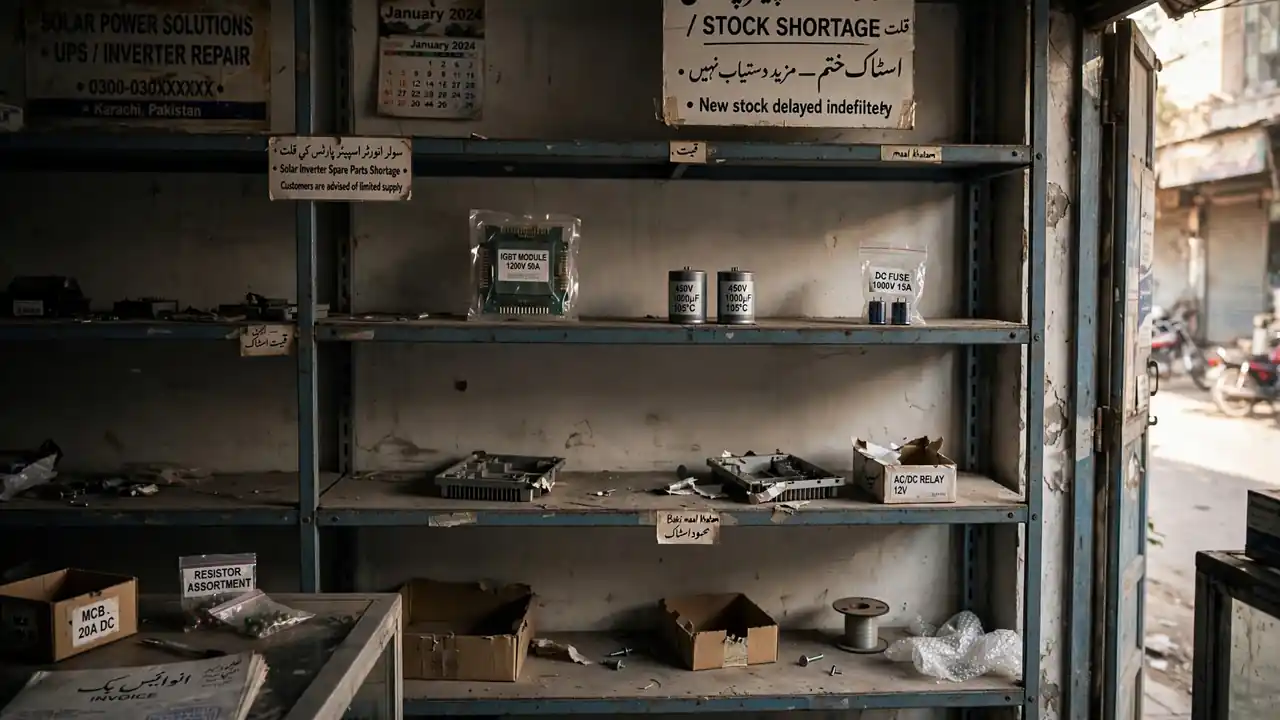
Three weeks. That’s how long a technician friend in Lahore waited for a single driver IC last month. The customer’s hybrid inverter sat on his bench the whole time — a dead 5kW unit in a house with no backup power, during load shedding season. The customer blamed the technician for “delaying.” But the market was the real problem.
I deal with Pakistan’s solar spare parts supply chain every week, so I’ve watched this shortage build in real time. Parts that used to arrive in days now take weeks. Prices that were stable for years keep creeping up. And here’s the fear every inverter owner should take seriously: a shortage doesn’t just delay your repair — it turns small faults into big ones while you wait.
In this article, I’ll show you exactly why the shortage is happening (it’s not one cause, it’s five), how it quietly inflates your repair bill, and the practical steps that protect you — homeowner, shop owner, or technician. The section on “shortage-proofing” your inverter could save you from ever waiting three weeks for a part.
An honest nudge before we dive in: some sellers use “shortage” as an excuse to overcharge. That’s why this article separates real supply problems from sales tactics. You’ll learn which parts are genuinely scarce, which prices are fair, and how to tell when someone is using the shortage story against you.
Your Roadmap: What This Article Gives You
- The 5 real causes of the 2026 shortage — from global chip markets to local import policy
- Which parts are hardest to find right now — so you can plan ahead
- How shortages secretly inflate your repair bill — the hidden costs of waiting
- What delays do to a faulty inverter — why waiting makes everything worse
- How to shortage-proof your system — practical steps that actually work
- Where to find reliable parts despite the shortage — suppliers who keep stock
The 5 Real Causes of the 2026 Shortage
When customers ask me why parts are late, I don’t give them one reason. I give them five. Because the shortage isn’t bad luck — it’s five pressures landing at the same time.
1. Pakistan’s solar boom outran the parts pipeline. Solar installations have exploded across the country — an industry review published in 2026 estimated around 51 gigawatts of solar operating in Pakistan by March 2026. Every new inverter installed today is a future repair customer. But the spare parts pipeline was built for a much smaller market. Demand for MOSFETs, IGBTs, capacitors, and control cards now regularly outstrips what importers bring in.
2. The world is fighting over the same chips. This part is global, not local. Industry analysts describe 2026 as a year of “structural tightness” in power semiconductors — the IGBT and SiC devices used in inverters face long lead times as electric vehicles, AI data centers, and solar inverters compete for the same factory capacity. When global factories prioritize bigger buyers, small markets like Pakistan’s repair trade feel it first.
3. China changed the cost math. In January 2026, China announced the complete withdrawal of VAT export rebates on photovoltaic products, effective April 1, 2026 — the roughly 9% rebate on modules was canceled outright, with battery rebates phasing out by 2027. Pakistan imports the vast majority of its solar equipment from China, so this policy shift raised costs across the supply chain. Higher costs mean importers order less, and leaner inventories mean empty shelves when demand spikes.
4. Import duties keep climbing. Pakistan’s June 2026 budget proposed higher sales tax on solar modules and higher duties on batteries and inverters. Every duty increase makes importers more cautious. They stock less, order later, and pass the risk to the market. For repair parts — already a thin-margin business — that caution translates directly into shortages.
5. Almost nothing is made locally. Pakistan’s cumulative solar equipment imports were estimated at over $9 billion between 2017 and 2025, with more than $2 billion of that in inverters and related components. When nearly every critical part must cross an ocean before reaching a repair bench, any disruption — policy, shipping, or currency — hits the local market within weeks.
Note: These pressures won’t vanish overnight. Analysts expect power-device supply to stay tight well into 2027 for high-grade parts. Plan your repairs and stocking around that reality — not around hope.
Which Parts Are Hardest to Find Right Now
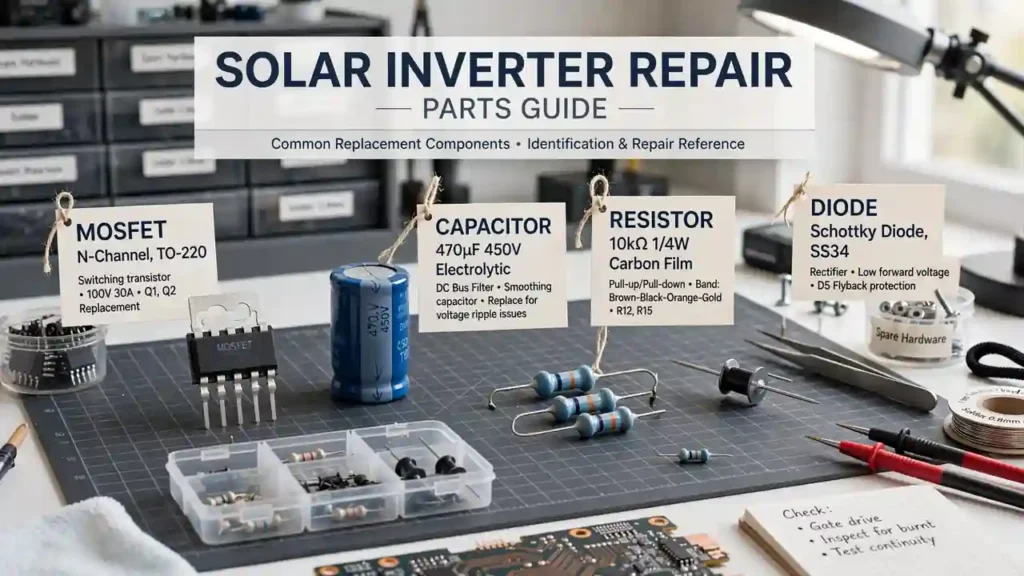
Not everything is scarce. Basic fuses, standard capacitors, and common cooling fans are usually available. The pain concentrates in model-specific, high-value parts — exactly the ones you can’t substitute.
Driver ICs and control cards top every technician’s complaint list. These are brand- and model-specific, so a shortage of one part number can’t be solved by buying a different one. When a popular inverter model’s driver IC dries up, every repair of that model stalls.
IGBT modules for higher-capacity inverters are the next bottleneck. Global demand from EVs and industrial drives competes directly with the repair market, and importers can’t always justify stocking expensive modules that might sit for months.
Model-specific transformers and display boards round out the list. These aren’t universal parts — each inverter design needs its own. Low volumes plus import dependence equals long waits.
The pattern is clear: the more specific the part, the worse the shortage. Generic components flow fine. Anything tied to a particular inverter model is where repairs die waiting.
How Shortages Secretly Inflate Your Repair Bill
Here’s what the shortage really costs you — and most of it never appears as a line item on any bill.
First, scarcity pricing. When a part is hard to find, the few sellers who have it charge more. Technicians buy at inflated rates and pass the cost on. You pay extra without anyone doing anything wrong — it’s simple supply and demand.
Second, the waiting damage. This is the cruelest cost. A faulty inverter that sits for three weeks doesn’t just wait — it degrades. A weak MOSFET stresses its neighbors. A struggling capacitor leaks onto the board. By the time the part arrives, one failed component has become three. Your “small repair” is now a big one.
Third, the fake-part temptation. When genuine parts are unavailable, the market fills the gap with copies. A technician under pressure — and a customer demanding their inverter back — may accept a questionable part just to finish the job. That fake fails in weeks, and you pay for the same repair twice. Our guide to spotting genuine parts shows how to protect yourself when options are thin.
Fourth, lost power and lost business. For a home, three weeks without backup means three weeks of load-shedding misery. For a shop, it means lost customers and income. Nobody invoices you for this, but it’s often the biggest cost of all.
What Delays Do to a Faulty Inverter
I want to be blunt about this, because most inverter owners don’t realize it: a broken inverter is not a stable object. It doesn’t sit quietly and wait for parts. It gets worse.
Heat is the main villain. A partially failed power section runs hotter than normal, cooking nearby components day after day. Capacitors near a hot MOSFET dry out faster, solder joints weaken, and a driver IC running on the edge eventually gives up entirely.
Moisture is the second villain, especially in humid months. An inverter that’s opened for diagnosis and left waiting collects dust and moisture on exposed boards. Corrosion starts quietly and shows up later as “another fault” that wasn’t there before.
The lesson is simple: every week of delay raises the final bill. Fast repair isn’t just convenient — it’s cheaper. Which brings us to the most useful part of this article.
How to Shortage-Proof Your System
You can’t fix the global chip market. But you can make yourself nearly immune to it. Here’s how smart inverter owners and technicians are doing it:
Get small faults fixed immediately. A strange noise, a warning light, reduced backup time — these are early warnings. Early repair needs fewer parts, and fewer parts means less exposure to shortages. The customer who calls on day one waits days; the customer who waits a month waits weeks.
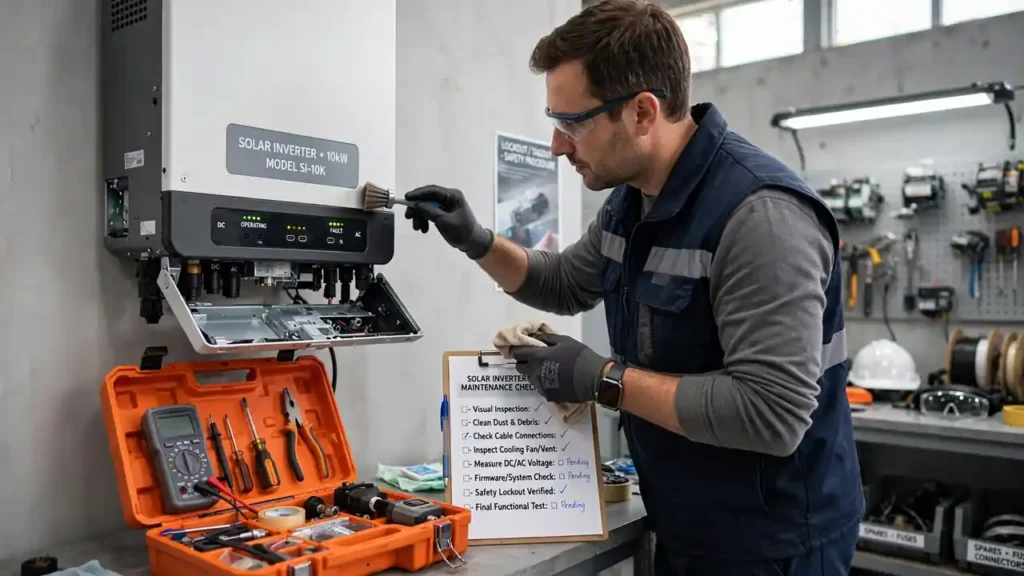
Keep the inverter clean and cool. Dust and heat cause a huge share of failures. Clean dust from vents every few months, keep the installation area ventilated, and never overload the unit. Every failure you prevent is a repair you don’t need parts for. Simple solar system care beats the best supply chain.
Technicians: stock the critical parts now. If you repair inverters for a living, keeping driver ICs, MOSFETs, and capacitors for popular models in your workshop is no longer optional — it’s your competitive edge. The technician with stock finishes jobs; the one without makes excuses. Buy from suppliers with consistent availability, like SunTech Mall’s electronic parts section, and reorder before you run out.
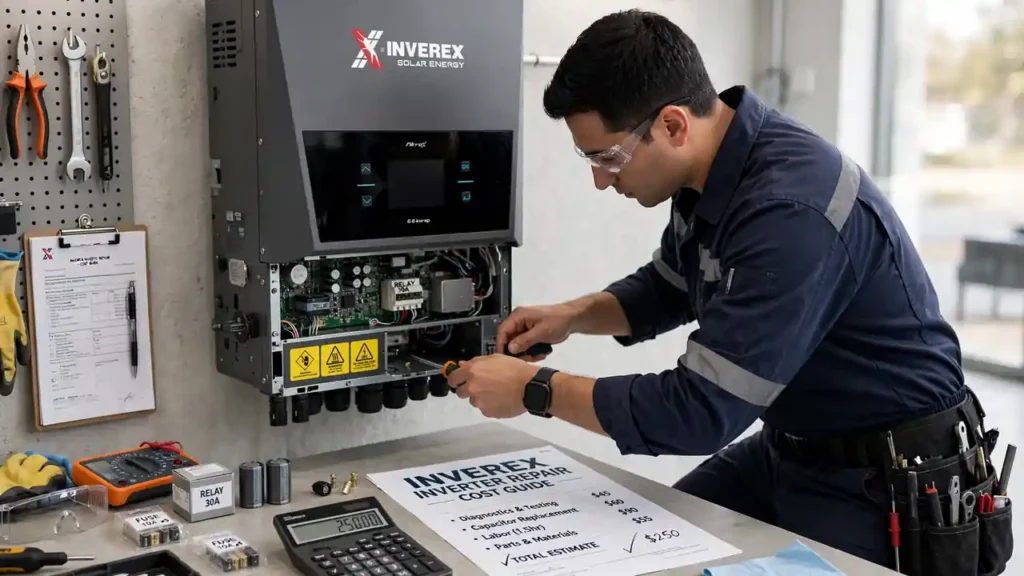
Bonus Tip: If your inverter model is popular in Pakistan (Inverex, Fronus, and similar widely-sold brands), parts availability is usually better because importers stock for volume. Before buying a new inverter, ask about spare parts availability — not just the warranty. A five-year warranty means little if the service center waits months for parts.
Where to Find Reliable Parts Despite the Shortage
Shortages punish disorganized buyers and reward prepared ones. The suppliers who keep stock through tight markets share three traits: they specialize in repair components, they serve technicians who reorder regularly, and they’re transparent about what’s in stock versus on order.
SunTech Mall was built around this reality. We stock genuine solar inverter and UPS spare parts — electronic components, charger and inverter parts, and batteries — with the consistency that repair work demands. Because technicians depend on us for same-week repairs, keeping shelves stocked isn’t a marketing claim; it’s how we keep our customers.
Browse the shop for current availability, or contact us at info@suntechmall.com / +92 306 2244820 if you need a specific part number sourced. If we don’t have it, we’ll tell you straight.
Related Guides Worth Reading
- Solar Inverter Spare Parts in Pakistan – Easy Repair Guide
- Local Solar Inverter Spare Parts in Pakistan
- Day Solar Inverter Spare Parts in Pakistan
- How to Find Genuine UPS Spare Parts Near You
Frequently Asked Questions
Why are solar inverter spare parts hard to find in Pakistan?
Five pressures combine: booming solar demand, global competition for power chips, China’s withdrawn export rebates, rising import duties, and near-total dependence on imported components. Together they create shortages especially for model-specific parts like driver ICs and control cards.
How long do inverter repairs take during the shortage?
It depends on the part. Common components may take days; model-specific driver ICs or control cards can take weeks if no local stock exists. Ask your technician which part is needed and whether it’s in stock before authorizing the repair.
Will spare parts prices come down soon?
Probably not quickly. Global power-device supply is expected to stay tight, and import costs have structurally increased. The best strategy is preventive care to avoid repairs, plus buying from suppliers with stable pricing.
Are fake parts more common during shortages?
Yes. Scarcity creates opportunity for counterfeits — when genuine parts are unavailable, copies fill the gap. Verify markings, use the acetone wipe test on printed labels, and buy from suppliers with a reputation to protect.
What should I do if my inverter fails and parts aren’t available?
Get a proper diagnosis so you know exactly which part is needed — don’t guess. Check multiple suppliers, including online stores with wider stock. Meanwhile, switch the inverter off if it’s behaving erratically; don’t keep running it in a faulty state while you wait.
Which inverter parts should technicians keep in stock?
Driver ICs, MOSFETs, and electrolytic capacitors for the most popular inverter models in your area. These cover the majority of repairs. Reorder before you run out — during a shortage, “I’ll order when I need it” means “I’ll wait when the customer is angry.”
Does buying a popular inverter brand help with parts availability?
Generally yes. Widely-sold brands have better parts availability because importers stock components for volume models. Before buying any inverter, ask specifically about spare parts availability — not just the warranty length. Parts availability determines how fast warranty service actually happens.
Final Thoughts
Let’s be honest about where things stand. Pakistan’s solar boom is one of the country’s best energy stories — millions of people with cheaper, more reliable power. But a boom built on imported parts has a weak link, and right now that weak link is the spare parts shelf.
The good news: you’re not powerless. Early repairs, clean and cool installations, a technician with stocked shelves, and a supplier who plans ahead — these four things make the shortage someone else’s problem. Congratulations — you now understand this market better than most people selling in it.
If you need parts now, check SunTech Mall’s current stock — genuine components, transparent availability, nationwide delivery. Stuck waiting on a part? Write to info@suntechmall.com or +92 306 2244820. In a shortage, honest answers are the rarest part of all.