
Complete Solar Inverter Repair and Spare Parts Guide in Pakistan
Imagine this. It is 2pm in July in Lahore. The load shedding starts, and your solar inverter is supposed to take over. But nothing happens. The ceiling fan stops, the room turns…

Imagine this. It is 2pm in July in Lahore. The load shedding starts, and your solar inverter is supposed to take over. But nothing happens. The ceiling fan stops, the room turns into an oven, and your whole family looks at you. That inverter was supposed to be your backup plan.
This is why solar inverters matter so much in Pakistan. Rising electricity costs and daily load shedding have made inverters part of almost every home, shop, and office.
Now here is the fear every technician knows. You fit a cheap spare part to save money. Two weeks later the customer is back, angry, and that part has damaged another component. You have lost money and your reputation.
This guide will stop that. You will learn what a solar inverter does, the types used in Pakistan, the most common faults and their causes, the key components behind every repair, how to choose genuine spare parts, and the maintenance habits that keep inverters running for years.
Keep reading, and by the end you will know how to diagnose faults faster and pick the right parts the first time.
I know what you are thinking. Repair sounds too technical, and genuine parts sound expensive. But most inverter faults come from a short list of causes you can learn quickly. And genuine parts last longer and fail less, which means fewer return visits. That is cheaper in the long run.
Table of Contents
- Understand What a Solar Inverter Actually Does Inside
- Pick the Right Inverter Type for Every Customer
- Spot the Most Common Faults Before They Get Expensive
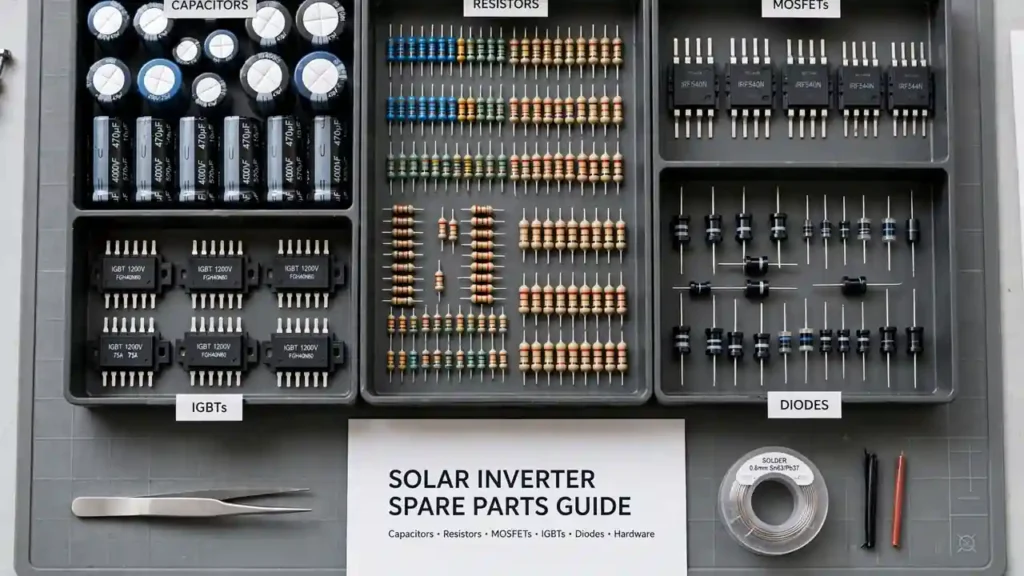
- Know the Parts Behind Every Successful Repair
- Learn Why Genuine Parts Beat Cheap Copies Every Time
- Choose the Right Spare Part on the First Try
- Keep Inverters Running Longer with Simple Maintenance
- Buy from a Store That Stands Behind Its Parts
Understand What a Solar Inverter Actually Does Inside
Picture this: the sun hits your solar panels and they produce DC (direct current), which flows in one direction only. Your fan, fridge, and lights run on AC (alternating current), which switches direction many times per second. The inverter is the translator between the two.
Here is the thing: an inverter does much more than flip DC into AC. It manages battery charging, keeps voltage and frequency stable, and protects appliances from surges. It also squeezes the most energy from your panels through MPPT technology, which tracks the best power point of the panels through the day.
Most inverters in Pakistan produce pure sine wave output, the clean power your appliances were designed for. Once you understand these jobs, diagnosis gets easier, because every symptom points to one of these jobs failing.
Pick the Right Inverter Type for Every Customer
Picture this: a customer walks into your shop and says, “Give me a solar inverter.” If you pick the wrong type, no repair will ever make them happy.
Hybrid inverters are the most common choice in Pakistan. They work with solar panels, batteries, and grid electricity together, and are ideal for areas with frequent load shedding.
Off-grid inverters work without any WAPDA connection. They are popular in remote areas where the grid does not reach.
On-grid inverters connect to the grid and feed extra electricity back to it. They do not use batteries, and only make sense where the grid supply is fairly stable.
Day solar inverters run straight from solar panels during daylight hours, without batteries or the grid. Shops that only need daytime power often use these.
Now the good part: once you know which type is in front of you, the fault list shrinks. A battery charging fault on an on-grid inverter? That cannot happen, because there is no battery.
Bonus Tip: Before you open any inverter, ask the customer three questions: what type is it, when did the fault start, and what was the inverter doing at that moment? These answers guide half your diagnosis before you pick up a screwdriver.
Spot the Most Common Faults Before They Get Expensive
Picture this: a customer brings in a dead inverter and says, “It just stopped.” Here are the faults you will see again and again.
Inverter not turning on. This usually points to the power supply section or a blown fuse. Check the DC input from the battery first. No DC in means no AC out.
No output power. The display lights up, but nothing comes out. The output stage, built on MOSFETs or IGBTs, is the first suspect. These handle heavy current and are the most common burnout points.
Overheating. Blocked vents, dead cooling fans, or dusty heat sinks trap heat, which kills capacitors and switching devices.
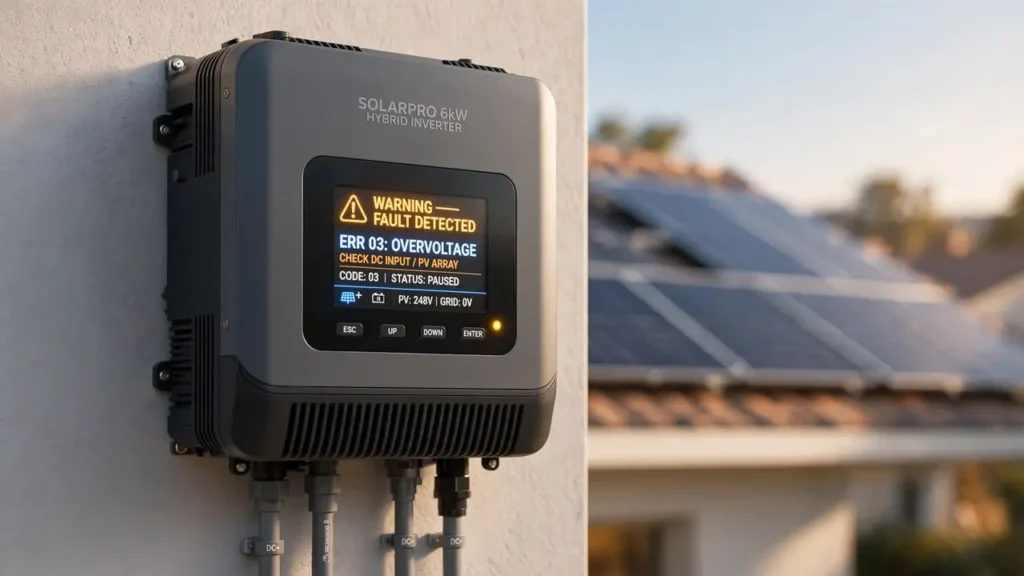
Error codes on the display. These point to overvoltage, overcurrent, battery faults, or temperature problems. Check the manual for the exact model first.
Battery charging failure. The inverter runs fine but the batteries never charge. Suspect the charger circuit, bad battery terminals, or dead batteries.
Fan noise or fan failure. Cooling fans are cheap, but ignoring a noisy or dead fan lets heat destroy parts that cost far more.
Burnt MOSFETs or IGBTs. Open an inverter and smell burnt plastic, and you will usually find blackened MOSFETs or IGBTs near the heat sinks.
Faulty transformers or PCBs. The transformer steps voltage up or down, and the control board (PCB) is the brain. A cracked solder joint or burnt trace can stop the whole machine.
Note: Never replace a burnt component without asking why it burnt. A shorted MOSFET often takes its driver circuit with it. Fix the cause first, or the new part will burn within days.
Know the Parts Behind Every Successful Repair
Picture this: you have diagnosed the fault, and now you need parts. Here are the parts behind almost every inverter repair.
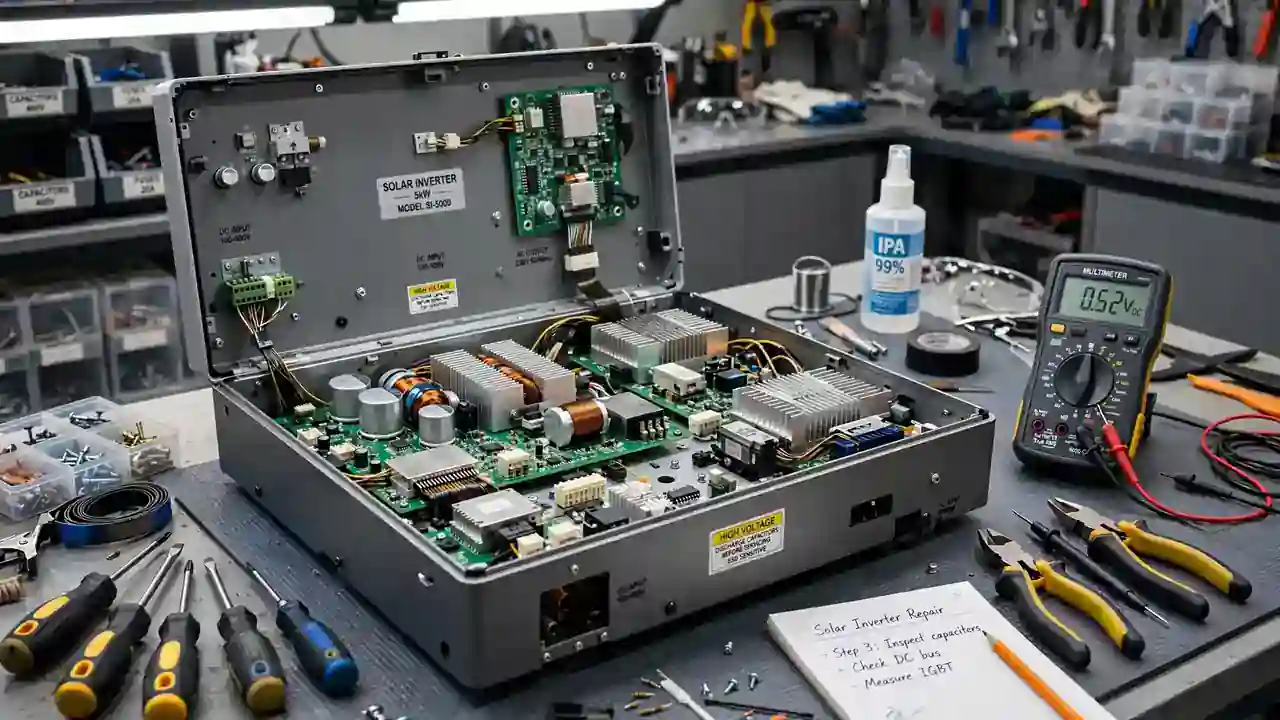
MOSFETs and IGBTs. The muscle of the inverter, switching current thousands of times per second. Always match the voltage and current ratings. Find them in our MOSFET collection.
Capacitors (AC and DC). Heat dries them out over time. Swollen tops or leaking seals mean replacement is overdue. Browse our electronic parts range for the right values.
Transformers and chokes. These handle power conversion and filtering. Match the turns ratio and core size to the original.
Cooling fans. Small, cheap, and vital. Match the size, voltage, and airflow direction.
Control boards (PCBs). The brain of the inverter. When a board is beyond repair, a compatible replacement saves the whole unit.
Voltage regulators, relays, and sensors. Regulators feed stable low voltage to control circuits. Relays switch heavy loads like grid bypass, and sensors watch temperature and current. A stuck relay or dead sensor can shut the inverter down.
Here is the thing: these parts work as a team. One weak link stresses the rest. That is why a cheap copy often brings the same failure back.
Bonus Tip: Keep a small stock of the most-used parts on your workbench: common MOSFETs, popular capacitor values, and a few cooling fans. Then you repair the same day instead of making customers wait.
Learn Why Genuine Parts Beat Cheap Copies Every Time
Picture this: two MOSFETs look identical. One has proper branding and specs. The other is cheaper with no markings you can trust. Which one goes into a customer’s inverter?
Genuine parts give you higher efficiency, better heat handling for Pakistani summers, stable voltage output that protects appliances, and fewer breakdowns.
A fake MOSFET might work for two weeks, then fail and take the driver circuit with it. Now your repair has become a bigger repair, and the customer blames you, not the part.
Now the good part: genuine parts are how good repair shops grow. Every inverter you fix properly becomes a walking advertisement. Cheap parts buy you one job. Genuine parts buy you a reputation.
Choose the Right Spare Part on the First Try
Picture this: the part is in your hand, but will it fit and work? A small mistake can damage the whole system. Run through this checklist every time.
Match the exact model and rating. Read the part number off the old component. A similar name with a different rating is not the same part.
Check voltage and current specifications. The replacement must handle at least the same voltage and current as the original.
Verify the brand and authenticity. If a deal looks too good to be true on a branded part, it usually is.
Avoid reused or refurbished parts. A pulled component from a dead board has unknown history. It may work for a week and die in the customer’s home.
Buy from a trusted supplier. A reliable store gives you correct specifications, proper packaging, and someone to call when a part misbehaves. Explore our full range in the SunTech Mall shop.
Note: When a part number is worn off or unreadable, do not guess. Note the inverter model and board revision, then ask a technical supplier. Guessing wrong can destroy a good board.
Keep Inverters Running Longer with Simple Maintenance
Picture this: two identical inverters, installed the same month. One gets basic care, the other gets none. Three years later, the cared-for one runs fine, while the neglected one is on your workbench.
Keep the area clean and dust-free. Dust blocks vents and coats heat sinks. A quick wipe-down every few months makes a real difference.
Ensure proper ventilation. Do not push inverters into closed cupboards or stack boxes around them. Hot air must escape.
Clean cooling fans and tighten connections. Dust on fan blades slows them down. Vibration and heat also loosen terminals, creating sparks and heat that burn insulation.
Check battery terminals. Corroded terminals drop voltage and confuse the charger. Clean them and apply petroleum jelly to slow corrosion.
Update inverter firmware if available. Manufacturers release updates that fix bugs and improve charging behavior.
Here is the thing: maintenance takes minutes and costs almost nothing, yet it prevents most overheating and connection faults.
Buy from a Store That Stands Behind Its Parts
Picture this: you order parts online and receive the wrong values in flimsy packaging, with no one to answer your questions. Your repair is delayed, and the customer waits. Now picture the opposite: correct parts, safe packaging, and support a call away. That is why the store matters as much as the part.
A trusted store gives you original products with correct specifications, safe packaging, and reliable after-sales service.
SunTech Mall is Pakistan’s No.1 online store for solar inverters, UPS systems, and original spare parts, serving repair shops and technicians across the country for 5 years with nationwide delivery.
Need parts? Explore our electronic components and shop, or contact us at info@suntechmall.com or +92 306 2244820. We will help you get the right part the first time.
FAQs
How long does a solar inverter last?
A good-quality solar inverter typically lasts 8 to 15 years with proper maintenance. Heat, dust, and poor-quality repairs are what shorten that life.
Can solar inverters be repaired?
Yes. Most faults can be repaired if diagnosed early and fixed with genuine spare parts. Only severe damage, like a fully burnt control board, makes repair impractical.
Is it safe to use cheap inverter parts?
No. Cheap or fake components cause repeated failures and can damage other sections of the inverter. They may work briefly, then fail and take neighboring parts down with them.
Why does my inverter keep overheating?
The usual causes are blocked ventilation, dead or dusty cooling fans, and dust on heat sinks. Overloading the inverter also causes overheating. Fix the cooling first, because heat destroys capacitors and switching devices.
What should I check first when an inverter does not turn on?
Check the DC input from the battery and the main fuse. If the battery voltage is missing or the fuse is blown, the inverter cannot start.
Why do MOSFETs keep burning in my repairs?
Usually because the cause was never fixed. Check the driver circuit, look for shorted components nearby, and confirm the replacement matches the original ratings. Avoid cheap copies.
How do I know if a spare part is genuine?
Buy from trusted suppliers, check for proper branding and markings, and compare specifications with the manufacturer’s datasheet. If the price is far below the market rate for a branded part, treat it with suspicion.
Final Thoughts
A solar inverter is a long-term investment for every home and shop in Pakistan. Now you know the full picture: what it does, which type suits which customer, the faults you will face, and the parts behind repairs.
Every fault you diagnose correctly and every genuine part you fit builds your name as the technician people trust. That trust turns into repeat business and referrals.
Congratulations. You now know more about solar inverter repair and spare parts than most people in this business. You are ready to repair faster, choose parts with confidence, and give your customers inverters that keep running through the hottest summers.
When you need genuine parts for your next repair, SunTech Mall is here. Explore the shop for original components with nationwide delivery, or reach us at info@suntechmall.com and +92 306 2244820. Let us keep Pakistan’s inverters running.