
Solar Inverter Error Codes in Pakistan 2026 – Complete Troubleshooting Guide
Solar inverter showing an error or warning? This complete Pakistan-focused guide explains common fault categories, safe troubleshooting steps, Fronus code examples, repair decisions, and the inverter parts most often checked by technicians.

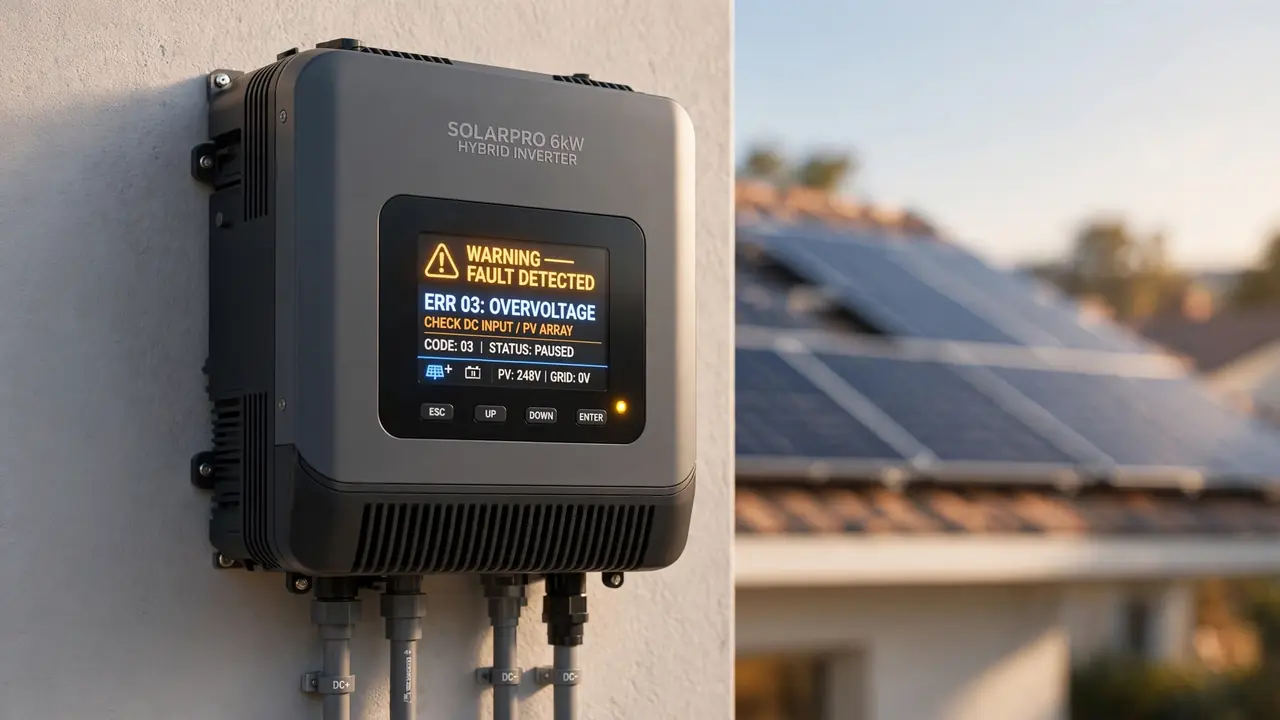
What Do Solar Inverter Error Codes Mean in Pakistan?
When your solar inverter shows an error code in Pakistan, the code is the machine telling you exactly which protection tripped. Most codes on the hybrid inverters sold here follow one family of numbers, the Voltronic type used by Fronus, Inverex hybrids, and many rebrands. Code 04 means the battery is too low. Code 07 means overload. Code 09 means the inside power stage failed to start. This guide to solar inverter error codes Pakistan owners see most explains every common code in plain words, what you can safely check yourself, and when to stop and call a technician.
How do you read the display when a fault appears?
First, do not panic. A code on the display is useful information, not a death sentence. Most faults Pakistani solar owners see are simple: a loose battery terminal, an overloaded circuit, or a fan choked with dust.
When a code appears, write down three things before you touch anything. Write the exact code number. Write what was happening at that time. Was the main power off? Was the load too high? Was the sun very strong, or was the battery low? And take a photo of the display. These three facts help a technician a lot. In our workshop, these are the first three questions we ask for every fault.
Also note the beep and the lights. Solar inverter error codes Pakistan hybrids show usually come with a beep sound and a red light, and the power stops. A warning is different. The inverter still gives power, but it wants to tell you something is not right. Knowing which one you have changes everything you do next.
One warning before we start. Codes differ between brands. There is no universal list. The popular Voltronic-family hybrids sold in Pakistan typically show codes like 01, 02, 04, 07, and 59. On-grid brands use completely different maps. Fronius, for example, uses codes like 301, 302, and 307. Those codes do not apply to a Fronus inverter, even though the names sound alike. Always confirm a code against your own unit’s manual before acting. If your manual disagrees with this guide, the manual wins.
What is the difference between a warning and a fault?
A warning means the inverter still gives power, but something needs attention. A fault means the inverter stopped giving power to protect itself, the board, and your home. That is the first thing solar inverter error codes Pakistan owners should learn — warning or fault.
Common solar inverter error codes Pakistan hybrids show as warnings are: 01, fan locked while the inverter is on; 03, battery over-charged; 04, low battery; 07, overload; 10, output power derating, which means the inverter is deliberately giving less power to protect itself; 15, PV energy low; and 16, high AC input during bus soft start. A warning beeps in a pattern. For example, low battery beeps once every second, and overload beeps once every half second.
A fault is more serious. When a fault shows up, the inverter stops giving power. It does this to keep the board and your home safe. For a fault, first take some load off. Load means the fans, lights, and machines that use power from the inverter. Then follow the steps in this guide.
Here is an easy way to tell them apart. If a code shows up but the inverter still gives power, it is more like a warning. If the code comes with a beep sound and the power stops, it is a fault.
Which battery faults can you fix yourself?
Battery faults are the single most common category of solar inverter error codes Pakistan owners face, and most have innocent causes.
Code 03 means battery voltage is too high. The charging voltage exceeds the safe limit for your battery bank. Check the charge setting and the battery wires. A wrong charge setting can cause this. The setting must match your battery type. Check the manual before you change a setting.
Code 04 means battery voltage is too low. The battery is over-discharged, or the inverter cannot see it. The hidden cause installers find most often is a loose battery terminal. Under heavy load, even a slightly loose connection creates enough voltage drop to trip the fault. Switch the system off, then check that every terminal is clean and tight. Let solar or grid charge the battery, and check the battery fuse.
Code 56 means battery connection is open — one of the solar inverter error codes Pakistan owners see most. The inverter cannot find the battery at all. Do not worry when you see this code. Most of the time, the cause is very small. A battery terminal may be loose. A cable lug may be bad. A lug is the metal end fixed to a wire. Or the battery fuse may be blown. Check both battery terminals. Is any terminal white or green in colour? Does the wire lose contact when you move it? Then check the battery fuse.
If the fuse is blown, change it with a fuse of the same rating. Never use a bigger fuse. A bigger fuse is not safe. If the wires and fuse look fine but the code comes back, check the battery voltage. If the voltage is very low, the battery needs to be charged on its own first.
Why does the inverter shut down under load?
Overload and output faults are the solar inverter error codes Pakistan homes see most when the inverter is asked to deliver more than it can handle.
Code 07 means overload time out. You are running more load than the inverter’s rating. The classic trigger in Pakistani homes is a motor starting up. A water pump or an AC compressor can draw several times its running current for a few seconds. Switch heavy appliances off one by one until the fault clears, then check whether your load plan fits your inverter.
Code 05 means output short circuited, or over temperature detected by internal converter components. Disconnect all loads and restart. If the code returns with no load connected, the fault is inside the inverter or its output wiring. Call your installer.
Code 06 means output voltage is too high. On smaller models the manual says output voltage is abnormal. Take the load off and show it to a technician.
Code 51 means over current or surge. A surge is a sudden jump in power. When output current jumps too high all at once, the inverter shuts down to save itself. Take the load off and restart. If the code came only one time and then went away, a sudden load jump may have caused it. If it keeps coming back, get the board checked.
Code 58 means output voltage is too low. The cause can be too much load, or it can be an inside fault. First, take load off and check the battery. If the voltage is still not right after you take load off, show the board to a technician.
Code 59 means PV voltage is over limitation. Too many panels are wired in series for the inverter’s input range. This happens most in winter, when cold weather pushes panel voltage higher. Shorten the string to fit the input range, and ask your installer to recheck the string size.
What do the inside power-stage faults mean?
Some solar inverter error codes Pakistan technicians see point inside the board, to the power stage that handles heavy power. These are technician jobs, not home fixes.
Code 08 means bus voltage is too high. Inside the inverter there is a DC bus. Think of it as a main power road inside the machine. Restart one time and watch. If the code keeps coming back, get the board checked.
Code 09 means bus soft start failed. When the inverter starts, the DC bus must power up in a smooth, step-by-step way. Fault 09 means that smooth start did not work. This code often comes back even after a restart. In our workshop, the most common cause is the power stage. Its MOSFET or IGBT parts can go short. Short means power flows the wrong way inside the part. Restart one time in the safe way. If the code comes back, do not keep restarting. Turning it on again and again can hurt the board even more. Keep the inverter off and give it to a technician.
Code 52 means bus voltage is too low. Restart once. If it comes back, call a technician.
Code 53 means inverter soft start failed. Like code 09, it is an inside code. The inside power part did not start right. If the code comes back after a restart, the board must be opened and tested.
Code 55 means over DC voltage in AC output. Stop using the inverter and contact service. This is an internal fault.
Code 57 means current sensor failed. A sensor is a small part that measures something. The current sensor measures how much current flows. When it gives a wrong reading, the inverter shuts down in a safe way. You cannot fix this at home. The board must be tested, and the sensor or a linked part must be changed.
Code 11 means main relay failed. The main relay is the big switch inside the inverter. This is a service centre job.
Code 01 means fan is locked when the inverter is off. The cooling fan cannot spin, usually because of dust buildup or an obstruction. With the unit switched off, check the fan grille and clear it. If the fan runs with stops and jerks, it is better to change it.
Code 02 means over temperature. The inverter has shut down to protect itself. Take load off, give it open air, and let it cool down. An inverter needs open air around it. If it sits in a closed room, close to a wall, or in direct sun, it heats up fast.
Full table: Voltronic-family fault codes
This table of solar inverter error codes Pakistan hybrids show follows the fault reference code in the Voltronic Axpert user manuals, the same code family used by Fronus hybrid inverters and many Inverex hybrids sold in Pakistan. Codes can change a little from one model to another, and with firmware. Always check your own manual.
| Code | What it means | First thing to do |
|---|---|---|
| 01 | Fan is locked when inverter is off | Clean the fan, clear anything that blocks it, then restart |
| 02 | Over temperature | Take load off, let air flow, let it cool down |
| 03 | Battery voltage is too high | Check the charge setting and the battery wires |
| 04 | Battery voltage is too low | Charge the battery, check wires and fuse |
| 05 | Output short circuited, or over temperature inside | Take the load off, look for a short in the wires |
| 06 | Output voltage is too high | Take the load off, show it to a technician |
| 07 | Overload time out | Take load off, then restart |
| 08 | Bus voltage is too high | Restart once, if it comes back, call a technician |
| 09 | Bus soft start failed | Restart once, then call a technician |
| 11 | Main relay failed | Call a technician, service centre job |
| 51 | Over current or surge | Take load off, restart, if it comes back, get the board checked |
| 52 | Bus voltage is too low | Restart once, if it comes back, call a technician |
| 53 | Inverter soft start failed | Restart once, if it comes back, get the board checked |
| 55 | Over DC voltage in AC output | Stop using it, call a technician |
| 56 | Battery connection is open | Check battery wires, terminals and fuse |
| 57 | Current sensor failed | Call a technician, the sensor or board needs work |
| 58 | Output voltage is too low | Take load off, check the battery, then call a technician |
| 59 | PV voltage is over limitation | Shorten the panel string, ask your installer |
From this table of solar inverter error codes Pakistan owners use most, you can tell at once if the problem is outside or inside. Outside problems are things like a battery wire, too much load, or a stuck fan. You can often fix those yourself. Inside problems are things like 09, 51, 53, or 57. Those live inside the board. They need a technician.
How do Nitrox on-grid inverters show faults differently?
Inverex Nitrox on-grid inverters use a different family of solar inverter error codes Pakistan on-grid owners see. Their codes start with the letter F, from F01 to F64, and they come from the Nitrox manual for three-phase on-grid models. Do not mix these with the Voltronic number codes above. A code that looks similar can mean something completely different.
Here are the Nitrox F-codes verified from the Inverex Nitrox manual. Grid faults: F35 means no AC grid, which is load shedding, a tripped AC breaker, or a voltage protector. F36 means grid phase fault. F37 means three-phase AC voltage imbalance. F41 to F46 mean line overvoltage or undervoltage on the three phase pairs. F47 and F48 mean grid frequency too high or too low.
DC and solar faults: F01 means DC input polarity reverse, a string connected the wrong way round. F02, F24, and F27 mean DC insulation impedance fault, so the solar wiring has too little insulation to earth. F03 and F21 mean DC leakage current fault. F23 means AC leakage current transient overcurrent. F25 means DC reverse current failure. F26 means DC busbar unbalanced. F55 and F56 mean DC bus voltage too high or too low, linked to solar input voltage being too high or too low.
Inside faults: F05 and F06 mean memory read or write error. F15 and F18 mean AC overcurrent. F33 and F34 mean AC overcurrent or AC overload. F57 means backflow of current on the AC side. F64 means IGBT heat sink over-temperature.
The rule is the same for every brand. On-grid and hybrid lists differ. Older Inverex ranges such as Yukon II or Veyron II use their own codes. Check the manual that came with your exact unit. If your manual disagrees with any guide, the manual wins.
What do Fronus X1 Genki codes mean?
The Fronus X1 Genki uses its own three-digit codes, separate from the Voltronic numbers above. These are part of the solar inverter error codes Pakistan owners see on Genki units, so do not mix them with the hybrid list.
Code 215 means internal fan failure — the fan inside the unit has stopped. Codes 240, 241, and 242 mean external fan failure — the outside cooling fans have stopped. Code 246 means meter loss — the unit cannot read the meter. Code 247 means CT loss — the current transformer signal is missing. Code 248 means NTC loss — the temperature sensor signal is missing. Code 249 means BMS communication lost — the unit cannot talk to the battery management system. For these codes, check the fans, the meter and CT wiring, and the battery communication cable first. If the code stays, give the unit to a technician.
How do you restart safely after a fault?
Restarting also has a right way. A wrong restart does not help. Follow these steps in order.
- Take the load off first. Switch off the heavy appliances on the inverter output.
- Turn off the breaker for the solar panels.
- Take the battery wires off, or switch off the battery breaker.
- Turn off the AC input. AC input is the main grid power that comes into the inverter.
- Wait a few minutes so the power inside the board fades away.
- To turn it back on, do the steps in reverse. First, join the battery. Then turn solar on. Then give AC input. Last, add the load.
- Leave a few seconds between each step. This way, the inverter starts in a calm way, and you learn the true state of the code.
Do not restart more than two times when solar inverter error codes Pakistan inverters show keep coming back. Each restart puts stress on the board. If the code stays, the best choice is to keep the inverter off and call a technician. Before you restart, take a photo of the code. Note the display, the beep sound, and the load at that time. When you show this photo to a technician, the problem becomes much easier to understand.
When must you call a technician?
You can do these jobs yourself. Check wires. Change a fuse. Clean a fan. Take load off. Restart in the safe way. These jobs are safe. You do not need to open the board for them.
Give it to a technician when solar inverter error codes Pakistan inverters show keep coming back, when you smell burning from inside the board, when a part looks swollen or black, or when you see an inside code like Fault 09, 51, 53, 55, or 57. Opening the board and testing with a multimeter is a technician job. Touching power parts by guess can be risky.
Also call a technician for insulation or earth faults, often shown as ISO, E-LEAK, or G-fault. Current is leaking where it should not. Damaged cable insulation or moisture in rooftop wiring are typical causes. Switch off the DC isolator immediately. Do not restart.
If you have a multimeter and you know how to test a MOSFET, test the part before you fit a new one. Also check the gate drive circuit before you fit a new part. The gate drive is the small circuit that tells the MOSFET when to switch. If the drive is bad, the new part can burn too. Our guide on why MOSFETs burn in solar inverters explains this failure chain, and our Fronus PV 7200 error codes guide covers the same code family for one popular model in detail.
Frequently Asked Questions
What does Fault 09 mean on my solar inverter?
On Voltronic-family hybrids, Fault 09 means bus soft start failed. The inside DC bus did not power up in the smooth, step-by-step way. Restart one time in the safe way. If the code comes back, keep the inverter off and give it to a technician. Most of the time, this code means a MOSFET or IGBT part has gone short.
Can an error code fix itself?
Some codes can go away on their own. Overload or too much heat can clear when you take load off or let the machine cool. But inside codes like Fault 09, 51, 53, and 57 most often do not fix themselves.
Is it fine to restart again and again?
No. Do not restart more than two times. Each restart puts stress on the board. If the code stays after two safe restarts, keep the inverter off and call a technician.
Why does my inverter show an error code only in winter?
Cold weather pushes solar panel voltage higher. If the string voltage goes past the inverter’s limit, you get Code 59, PV voltage over limitation, or Code 08, bus voltage too high. Ask your installer to recheck the string size for cold weather.
Are Fronius error codes the same as Fronus error codes?
No. Fronius is a brand from Austria. Its codes look like 301, 302, or 307. Fronus is a hybrid inverter sold in Pakistan, built on a Voltronic-type platform. Its codes look like 01, 02, 09, 51, or 56. Do not use Fronius codes for a Fronus inverter. A wrong code table leads to a wrong fix.
What should I do first when any error code appears?
Take the load off, take a photo of the display, and note what was happening at the time. Then check the code in this guide to solar inverter error codes Pakistan owners see and in your own manual. Simple outside causes, like a loose battery wire or too much load, come first. Inside codes mean call a technician.
SunTech Mall supplies spare parts and everything you need at wholesale prices across Pakistan.
Parts you need
These are the parts solar inverter error codes Pakistan repairs use most. Live price and stock are shown on each product page — check there before you order.
- GBU08 1000V 8A bridge rectifier — the AC-to-DC bridge in inverter power stages, often changed when inside fault codes point to the power stage. Live price aur stock product page par dekho.
- 35V 680uF aluminum electrolytic capacitor — the small rail capacitor that dries out with heat and causes random resets and strange faults. Live price aur stock product page par dekho.
Final thoughts
An error code is your inverter talking to you. Learn to listen. Write the code down, note what was happening, check the simple outside causes first, and restart only in the safe way. Inside solar inverter error codes Pakistan technicians fix daily mean a technician, not a guess.
The technicians who fix inverters fastest are not the ones who restart the most. They are the ones who read the solar inverter error codes Pakistan displays show, find the real cause, and fit the right part the first time.
If your inverter shows a code that keeps coming back, send a photo of the display to SunTech Mall and order the genuine part your repair needs, with delivery across Pakistan.
Related Products & Categories
Related Technical Guides
 Category:
General
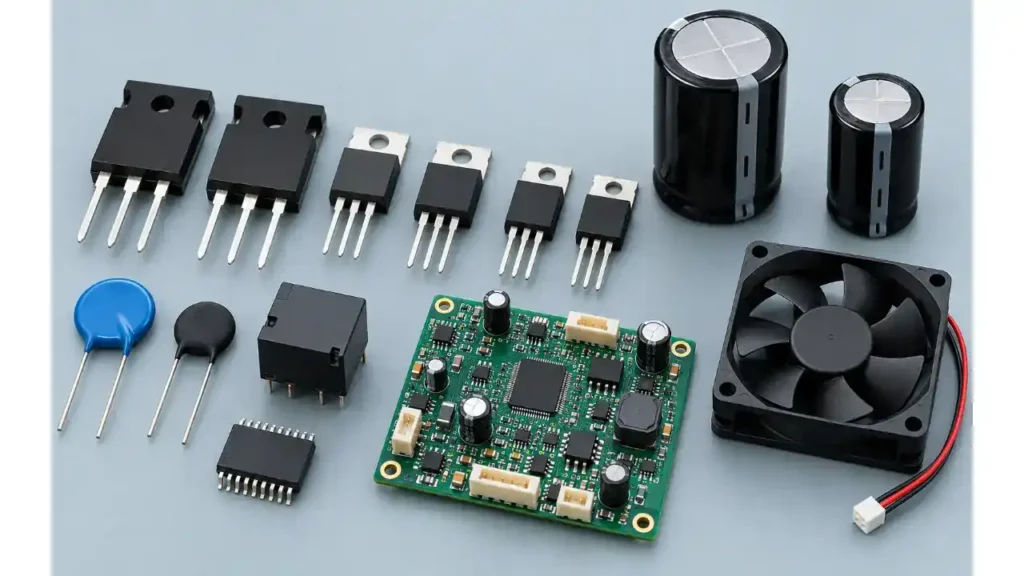
Original vs Fake Inverter Spare Parts 2026: 8 Hands-On Checks Before You Fit a Part
Check a part before you fit it, not after the inverter fails again. Compare its markings, surface, pins, size, and meter readings…
 Category:
General
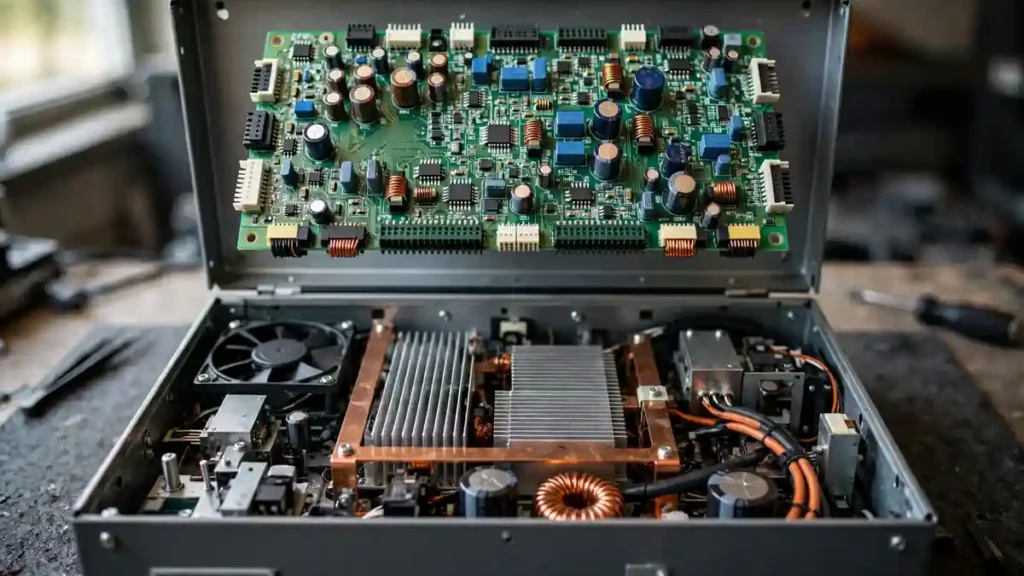
When Should You Replace a Hybrid Inverter System Card? 6 Clear Signs
Change the system card when your inverter keeps showing the same fault, stops charging the battery, or will not start even after…
 Category:
General
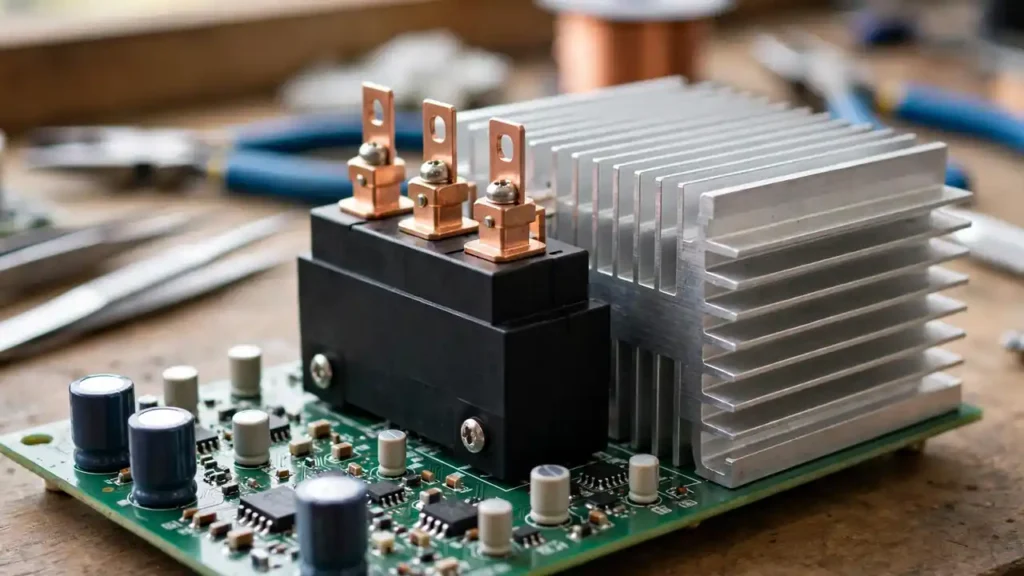
Why Does an IGBT Burn Out? 7 Reasons and How to Stop It
An IGBT burns when heat or current passes its limit. In most inverter repairs, seven causes explain it: weak cooling, weak gate…
3 Comments
[…] popular MOSFETs, all sourced from authorized distributors. For solar inverter repairs, check our troubleshooting guide and parts identification […]
[…] Solar Inverter Error Codes in Pakistan 2026 – Complete Troubleshooting GuideOctober 6, 2026 […]
[…] our solar inverter error codes guide to decode what your display shows. A code points you to the faulty section instead of testing the […]