
Chopper Transformer Failure 2026: Why Your Hybrid Inverter Goes Completely Dead
As Pakistan embraces solar energy to combat frequent power outages and soaring electricity costs, hybrid solar inverters have become a cornerstone for energy independence. Central to their performance is the genuine chopper…

Published on 20 August 2025. Updated on 13 November 2026.
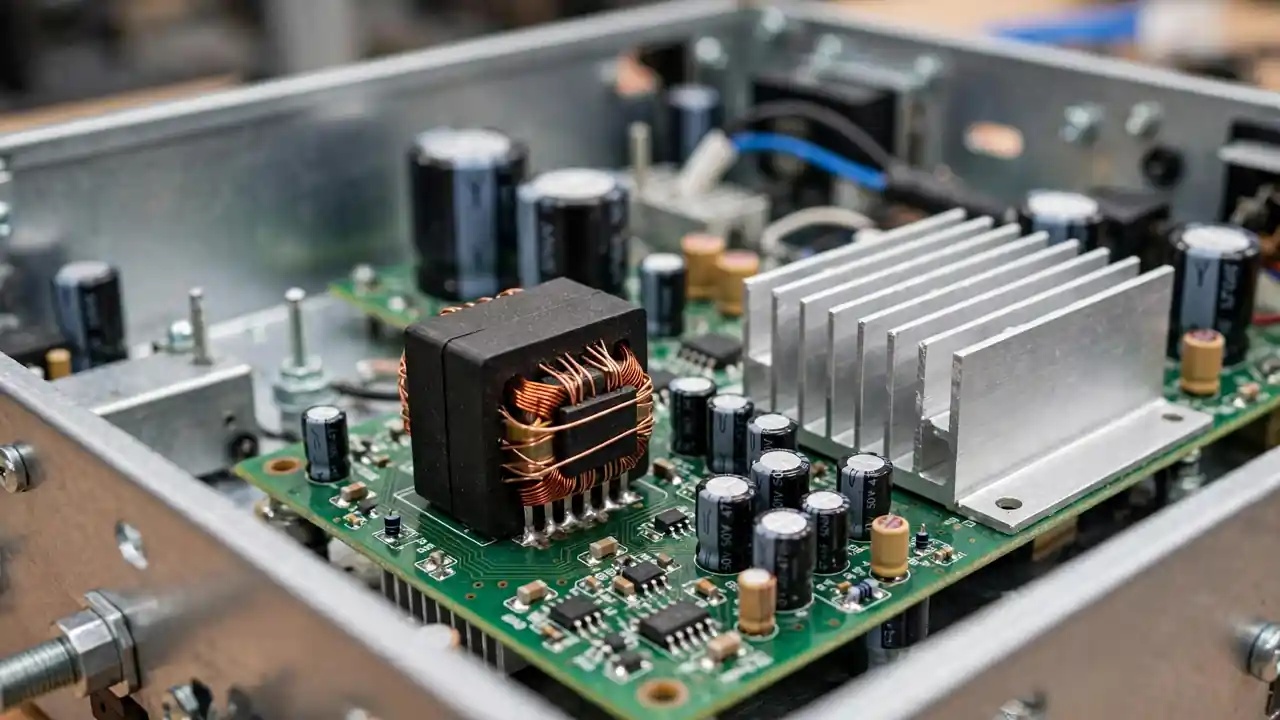
A chopper transformer failure is one of the most common reasons a hybrid inverter goes completely dead with no display, no lights, and no fan. This small transformer feeds low voltages to the control board, so when it fails, the inverter loses its brain power and cannot start at all.
Last month, a man brought his hybrid inverter to our repair centre. One morning it simply did not wake up. No display. No lights. No fan sound. He had already checked the battery and the solar wires, and all looked fine. He was sure the whole inverter was finished. On the bench, we found the real fault in less than an hour. It was a small transformer, no bigger than a matchbox, hidden inside the power supply. We fitted a genuine replacement, and the inverter came back to life that day.
This story is common in Pakistan: a hybrid inverter that goes completely dead is not always a big fault. Often it is one small part that feeds power to the brain of the machine. This guide explains that part. You will learn why your inverter needs it, how it works, how a technician finds the fault, and how to match the right replacement.
Trust nudge: This guide comes from SunTech Mall, a solar inverter spare parts store in Pakistan. Our repair team opens dead hybrid inverters every day, and these are the same checks we use on the bench.
In This Guide
Why Is My Hybrid Inverter Completely Dead? — the brain has no power What Does the Chopper Transformer Actually Do? — one part feeds every low voltage What Is Push-Pull Topology, in Plain Words? — two switches share the work How Do I Diagnose a Dead Chopper Transformer in 5 Steps? — the order a technician follows What Does That Ticking Sound Mean? — the small sound with a big meaning
What Do the Symptoms Mean? — match what you see to the cause How Do I Match a Genuine Replacement Chopper Transformer? — five things that must match How Do I Protect My Chopper Transformer From Failing Again? — simple habits that add years When Should I Take My Inverter to a Repair Shop? — know when to stop
Why Is My Hybrid Inverter Completely Dead?
Think about what a hybrid inverter does every second. It balances power from your solar panels, your battery, and the grid, and it decides where energy should flow to keep your home running. That is clever work, and clever work needs a brain.
The brain is a small control chip called a microcontroller. It makes every smart decision in the inverter: tracking the solar power, managing the battery charging, keeping the output in step with the grid, and watching for faults.
The microcontroller runs on only 5 volts, the gate driver circuits that switch the big power parts need 12 to 15 volts, and the display, the sensors, the communication parts, and the protection circuits each need their own clean, steady low voltage.
Your solar panels and battery give hundreds of volts of DC power. You cannot feed that straight into a 5 volt chip: it would die in a flash. So the inverter needs its own small power supply inside, which steps the high voltage down to many safe low voltages and keeps the dangerous high-voltage side apart from the safe low-voltage side. That separation is called isolation, and it keeps the control board and the user safe.
That internal power supply is a switched-mode power supply, or SMPS for short, and the chopper transformer is its heart. Every job the inverter does depends on control circuits, and every control circuit depends on the chopper transformer. So when this one small part fails, the whole machine loses its brain power at once: the display stays dark, the fan stays still, and no button gets any answer. The inverter looks finished, but often only this one part is dead.
Before you give up on the unit, check the power supply section. If your inverter will not turn on at all, start with our guide on why a solar inverter does not turn on, which walks through the outside checks first, before any inside work begins.
What Does the Chopper Transformer Actually Do?
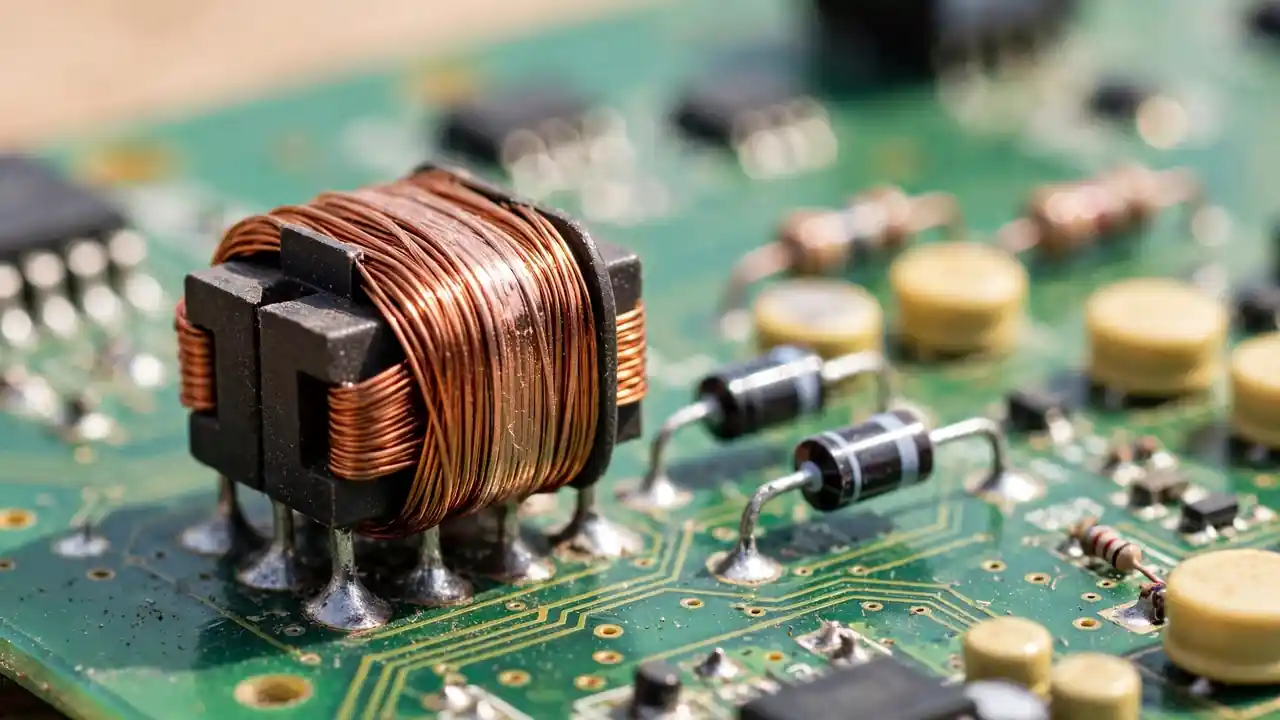
The idea is simple. A switching transistor chops the high-voltage DC into fast pulses, tens or hundreds of thousands of times every second. Those pulses flow through the primary winding of the chopper transformer, and the magnetic field carries the energy across to several secondary windings, where each winding’s number of turns sets its output voltage. Fast diodes then turn each output back into DC, small capacitors smooth it, and the control circuits get their clean power.
The high frequency is the secret behind the small size. A normal 50Hz transformer doing the same job would need a heavy iron core weighing kilograms, but at 50kHz or 100kHz, the same energy moves through a ferrite core small enough to hold between your fingers. Ferrite is a ceramic magnetic material that handles high frequencies well, where iron would waste energy as heat. That is why the chopper transformer is small enough to fit on a crowded circuit board.
The same chopper idea sits inside almost every modern power supply, and a university lesson on SMPS transformer design from IIT Kharagpur explains it in engineering words: SMPS cores use ferrite because it keeps losses low at high frequency, while ordinary power transformers use silicon steel, and the transformer gives both isolation and the voltage scaling the circuit needs.
High frequency brings a second gift: the control chip watches the output voltage many thousands of times per second and holds it steady, so the brain gets clean power even when the solar input or battery voltage jumps. An engineering guide from Analog Devices on high-frequency push-pull DC/DC converter design makes the same point: higher switching frequency leads to smaller transformers and lower output ripple.
So the chopper transformer does three jobs at once: it steps the voltage down, gives each circuit its own voltage, and keeps the high-voltage side safely apart from the low-voltage side. Lose it, and all three jobs stop together.
What Is Push-Pull Topology, in Plain Words?
Many hybrid inverter power supplies use a plan called push-pull topology, and the idea is easy, even if the name sounds hard. Instead of one switching transistor, push-pull uses two, working in turns: one pushes current through the transformer primary in one direction, then the other pulls it in the opposite direction. Push, then pull, then push again, thousands of times every second.
Why two transistors? Because two switches use the transformer core in both magnetic directions. Think of rowing with two oars instead of one: each oar does half the work, and the boat moves straighter. In the same way, push-pull gets more power from a smaller core and gives a cleaner output with less ripple, which is the small wobble left in the output voltage.
The trade is more complexity: two switching parts need exact timing and must never turn on at the same moment, or they would short the power supply. The transformer also needs a center-tapped winding, which has a connection in the middle so each transistor can drive its own half. A clear guide from Coilcraft on push-pull transformers explains it the same way.
For a technician, the practical lesson is simple and saves real money. When you check a push-pull power supply, always check both switching transistors, because they often fail together. If you replace only one, the other bad one kills the new part at once.
Also check that the PWM controller is giving proper drive signals to both sides. PWM stands for pulse width modulation, which is just the controller changing the width of the pulses to control the power. If the controller is stuck with one output high, it will destroy that side’s transistor very fast. A bad driver chip can do the same damage, so read our guide on TLP350H gate driver failure signs whenever a power switch keeps dying in the same spot.
How Do I Diagnose a Dead Chopper Transformer in 5 Steps?
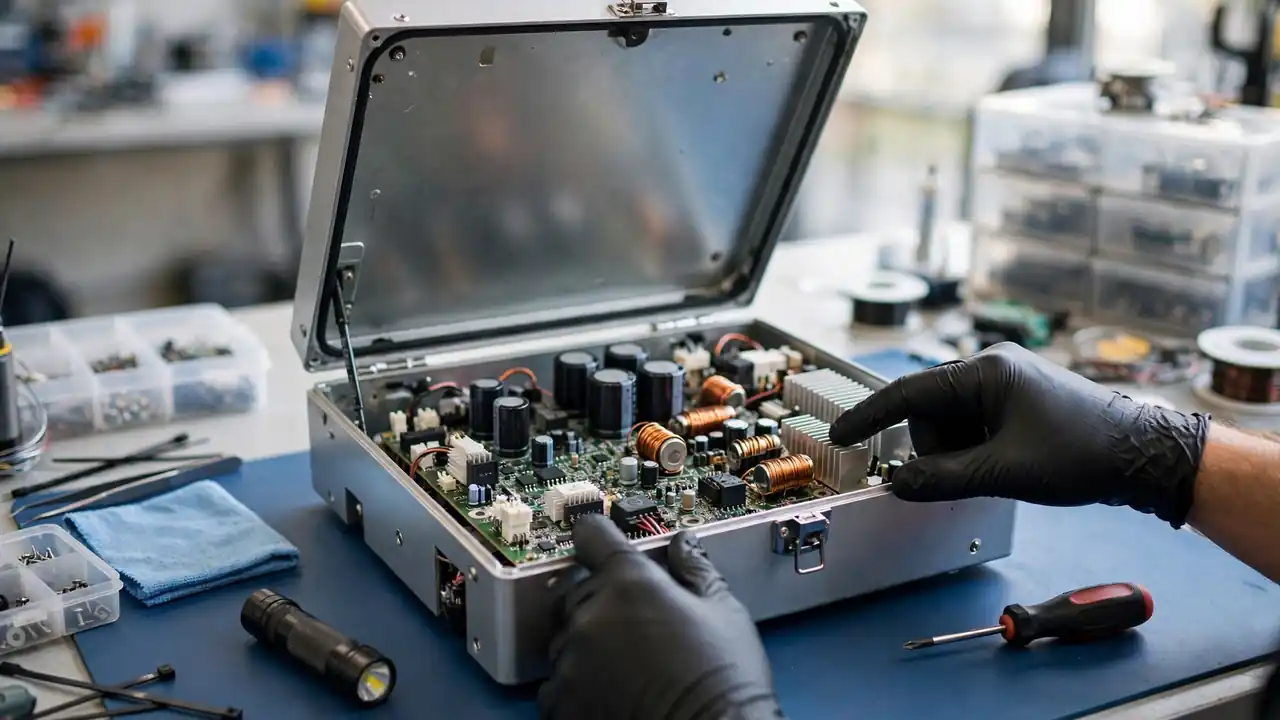
A hybrid inverter with a chopper transformer failure looks completely dead: no display, no lights, no fan, and no answer to any button. But other faults give the same look, so never guess. The checks below run from the simplest and cheapest cause to the hardest one, and they belong to a trained technician, because they need the case open.
Note: Only a trained technician should open the inverter case. High DC voltage stays inside even after you switch the unit off, and the big capacitors hold a dangerous charge long after the power is gone. They must be discharged first with the right tools, and the voltage checked as zero before anyone touches the board. Never apply power to a power supply with a suspected short without current limiting: a series light bulb or a current-limited bench supply stops a small fault from turning into a board-destroying event. Without the training and the tools, every step below is a repair shop job, not a home job.
- Check the input fuse. This is the simplest cause. A blown fuse means something shorted, so do not just fit a new fuse and switch on. Find what blew it first, or the new fuse dies at once. A fuse that blows again and again means a short is still on the board.
- Check the start-up resistors and circuits. Many power supplies use high-value start-up resistors to wake the PWM controller. They run hot and fail open over time. An open start-up resistor gives exactly the same dead look as a failed transformer, but it costs almost nothing to fix. That is why the order matters: a technician checks the cheap parts before blaming the transformer.
- Inspect the chopper transformer. Look for a cracked ferrite core, dark or melted bobbin plastic, a burnt smell from the windings, or a scorched board around the transformer. With the power off and the capacitors discharged, measure each winding with a multimeter: an open winding means the transformer has failed. Compare with a known-good transformer when you can. A short between windings, or between a winding and the core, is also a failure.
- Check the switching transistors and the controller. Test the power MOSFETs in the power supply section. A MOSFET is a fast electronic switch, and our guide on how to test a MOSFET with a multimeter shows the three meter tests that catch a bad one. In a push-pull supply, test both transistors, not just one, then check whether the PWM controller chip is getting its start-up voltage. A dead controller gives the same dead symptoms as a dead transformer, and it is a much cheaper fix.
- Check the output rectifiers and filters. A shorted output diode can stop the whole supply from starting because it overloads the output, so test each output rail for a short before you blame the transformer. Also look at the small capacitors on the output rails: a dried-out capacitor can make the supply unstable or stop it from starting, as our guide on inverter capacitor bulging signs shows.
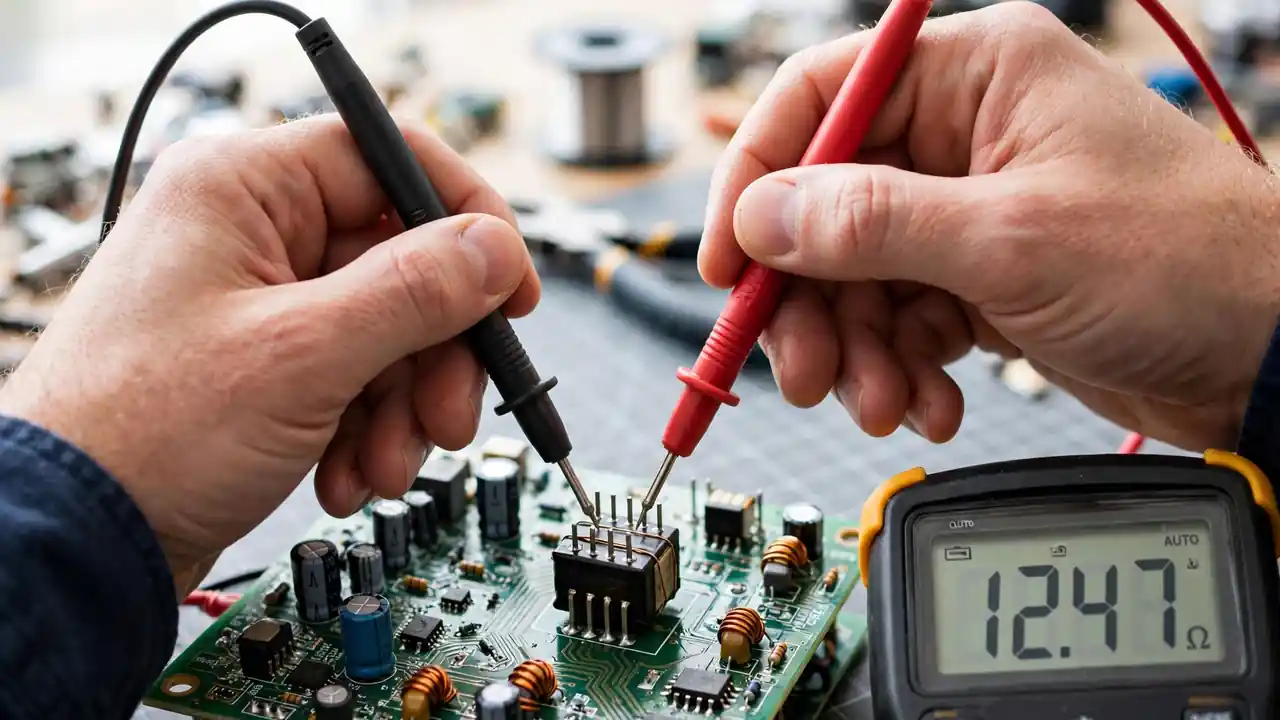
Work the steps in order and write down what each step shows. That short note saves the next technician a lot of time, and it stops the most common repair mistake: replacing the most expensive part first, then finding out a small resistor was the fault.
What Does That Ticking Sound Mean?
A dead inverter is not always fully silent. If you put your ear close to the power supply area, you may hear a faint, repeated ticking sound. That ticking is the best clue the inverter can give you.
The PWM controller is trying to start: it sends a few pulses, then it sees too much current or too little voltage, and it shuts down to protect itself. Then it tries again, and again. Each try makes a soft tick. The controller is alive, but something on the output is stopping it.
Bonus Tip: A ticking power supply usually means the transformer itself is still alive. The fault is more often a short on one of its outputs, such as a shorted diode or capacitor, or shorted turns inside the transformer that pull too much current. So never condemn the transformer on the ticking sound alone: test the output rails for shorts first. Many ticking inverters come back to life with a small diode or capacitor, not a new transformer.
No ticking at all, with no display and no fan, means the supply may not be starting in the first place. That points back to the fuse, the start-up resistors, the controller, or the transformer itself. Either way, a good technician listens for the ticking before touching a single part.
What Do the Symptoms of a Chopper Transformer Failure Mean?
The same dead look can come from several faults. The table below matches the symptom you see to the most likely cause and the first check a technician makes, so read the row that fits your inverter.
| Symptom | Likely cause | Check first |
|---|---|---|
| Completely dead, no display, no lights, no fan | Failed chopper transformer or dead start-up circuit | Input fuse, start-up resistors, winding resistance |
| Faint repeated ticking from the power supply area | Controller trying to start but hitting a short | Each output rail for a shorted diode or capacitor |
| Inverter starts, then dies again in seconds | Weak output capacitor or overloaded rail | Output filter capacitors and load on the rails |
| Burnt smell or scorched board near the transformer | Shorted turns or a surge that burnt the windings | Look for cracks, dark bobbin, burnt tracks |
| Works after cooling down, then dies when hot | Heat damage to insulation or nearby parts | Ventilation, fan, and heat marks on the transformer |
One symptom alone never proves the fault, but two together point much more strongly: a burnt smell plus a dead display points at the transformer far more than a dead display alone. That is why a technician reads the symptoms first and tests second, instead of replacing parts and hoping.
How Do I Match a Genuine Replacement Chopper Transformer?
Chopper transformers are not general parts: each one is made for a particular power supply design, and five things must match the original. Get one wrong, and the new transformer can give wrong voltages, fail to start, or damage the control board.
Turns ratio comes first: the ratio between the primary turns and each secondary turn count sets the output voltage. The wrong ratio means wrong voltages, and the control circuits either misbehave or die. There is no close enough here.
Primary inductance comes next. It affects the switching frequency and how much power moves through the transformer, so a big mismatch upsets the whole supply: the controller may fail to regulate, or the supply may run hot and unstable.
Core type and size matter just as much. The core must handle the power level without saturating, which means it cannot carry any more magnetic energy: when that happens the transformer draws huge current, overheats, and fails. An undersized core dies early, and it must be the right ferrite type for the frequency the supply runs at.
Pinout is the physical side of the match. The pins must sit in the same places as the old transformer, or the part cannot be fitted to the board. Even a perfect transformer on paper is useless with the wrong footprint, so compare the pin layout against the old part before you order.
Isolation rating is the safety side of the match. The transformer must give proper safety isolation between the high-voltage primary and the low-voltage secondaries. A part with weak isolation puts high voltage where it must never go, which endangers the board and people.
Note: If the number on the old transformer is burnt off or unreadable, do not guess. Take the inverter model and a clear photo of the old part to a technician: a wrong guess costs a part, and sometimes a board. Order the transformer made for your inverter model, or ask an expert to identify a matching unit from the board. Generic parts sold as will fit are a gamble with the inverter’s brain at stake.
How Do I Protect My Chopper Transformer From Failing Again?
A new transformer can last for years, but only if what killed the old one is fixed too. Prevention is cheaper than a second repair.
Surge protection comes first: lightning and grid surges are a leading killer of power supply sections in Pakistan, so proper AC and DC surge protection give the transformer a much better chance in a storm. One bad night can undo years of good service.
Ventilation comes second: keep the inverter cool, with free air on all sides, never in a closed cabinet, and never in direct sun. Heat slowly cooks the transformer insulation, and cooked insulation breaks down early. A clean fan and clear vents cost nothing and add real life.
Clean power comes third: severe grid swings stress every component on the board, not just the transformer, so a stable installation with good wiring and good earthing keeps spikes away from the power supply. If your area has wild voltage swings, ask a technician what suits your setup.
Quality parts around the transformer come last: the transformer does not fail alone, so when the power supply section is serviced, fit genuine gate driver parts, quality capacitors, and proper cooling parts alongside it. A weak gate driver or a dried-out capacitor can stress the transformer and kill the new one too. Our guide on TLP350H gate driver failure signs shows how a small driver fault takes down much bigger parts. Readers in the north can also see how workshops in their own cities source genuine parts, in our Peshawar spare parts guide and our Mardan spare parts guide.
When Should I Take My Inverter to a Repair Shop?
Some jobs belong to a repair shop, and this is one of them. Take the inverter to a trained technician when it is completely dead and the outside checks show nothing wrong, when you hear ticking from inside, smell burning, see scorch marks, or when a fuse blows again after you fit a new one. All of these point to a fault inside the case, where high voltage lives.
Do not keep switching a dead inverter on and off in the hope that it wakes up: each try can push a small fault into a bigger one. Switch it off and let a technician open it on the bench, with the discharge tools, the current-limited supply, and the test gear to find the fault without making it worse.
A good repair shop will also say honestly when a repair is not worth it: if the board is badly burnt, or if several parts have failed together, a repair can cost more than it saves. That honest answer is worth as much as the repair itself. At SunTech Mall, our repair team gives that answer every day.
Frequently Asked Questions
What is a chopper transformer in a hybrid solar inverter?
It is the high-frequency transformer at the heart of the inverter’s internal switched-mode power supply. It turns high-voltage DC into the low voltages the control circuits need, such as 5V, 12V, and 15V, to run the control chip, the display, the gate drivers, and the protection circuits. Without it, the inverter cannot start.
Why is my hybrid inverter completely dead with no display?
The most likely causes sit in the auxiliary power supply: a blown fuse, failed start-up resistors, a chopper transformer failure, failed MOSFETs, or a dead PWM controller chip. Check them in that order, simplest and cheapest first, as each one gives the same dead look from outside. If the outside checks in our inverter not turning on guide show nothing wrong, the fault is inside, and a technician should open it.
Can I rewind a burnt chopper transformer?
An expert can rewind one, but matching the original turns count, wire size, insulation, core gap, and winding layout is very hard, and a wrong rewind gives wrong voltages or unreliable operation. A genuine replacement is more reliable, and usually cheaper once you count the labour time.
What is push-pull topology?
It is a switching circuit plan that uses two transistors working in turns to drive a center-tapped transformer. It uses the magnetic core in both directions, so it gives more power from a smaller transformer with cleaner output. It is common in inverter auxiliary power supplies, and a clear maker guide from Coilcraft on push-pull transformers explains it in the same plain terms.
How do I test a chopper transformer?
Only a trained technician should test it, with the power off and the capacitors safely discharged. First a visual look for cracks, dark marks, or burning, then a multimeter reading of each winding’s resistance, where an open winding means failure, then a check for shorts between windings and between the windings and the core. Compare with a known-good transformer of the same type when you can.
What kills chopper transformers?
Lightning and grid surges lead in Pakistan, then long heat that breaks down the insulation, cheap units with shorted turns, and age itself, which slowly weakens the insulation. Proper surge protection and good ventilation are the best defences.
Final Thoughts
The chopper transformer is the quiet helper behind everything your hybrid inverter does. It never appears in the sales brochure, yet without it the most advanced power electronics are lifeless. A dead inverter is often not a finished inverter: one small part gave up, and a small part can be replaced.
You now know what that part does, why the inverter’s brain cannot live without it, how a technician finds a chopper transformer failure, what the ticking sound means, and what must match in a replacement. The next time an inverter goes completely dead, you will know where the search starts, and when to stop and hand it to a technician.
Get a genuine chopper transformer from SunTech Mall: Browse the Choppers category for genuine chopper transformers for hybrid solar inverters, with delivery across Pakistan. Send us your inverter model and symptoms and we will help you pick the right one. WhatsApp 0306-2244820 or email info@suntechmall.com. Check the live price on the website before you order.
Related Technical Guides
 Category:
Electronic Parts
How to Find Genuine UPS Spare Parts Near You in Pakistan
Looking for genuine UPS spare parts in Pakistan? Learn how to check original UPS spare parts and where to buy trusted UPS…
 Category:
Electronic Parts
Most Used Solar Inverter Spare Parts in Pakistan – 2026 Update
Learn about most used solar inverter spare parts in Pakistan in 2026. Find which solar parts fail most and where to buy…
 Category:
Electronic Parts
Top Solar and UPS Spare Parts Suppliers in Peshawar
Looking for solar and UPS spare parts suppliers in Peshawar? Learn how to find trusted suppliers and where to buy original spare…
4 Comments
[…] the parts inside these machines, see our chopper transformer guide and our solar inverter parts […]
[…] turn on at all, read Solar Inverter Not Turning On 2026. For a related switching-part fault, read Genuine Chopper Transformer for Hybrid Solar Inverter. For battery-side context, read Lithium Battery vs Tubular Battery […]
[…] the parts inside, see our chopper transformer guide and our solar inverter parts […]
[…] list the power switches by size, and the capacitors section lists the board capacitors. The chopper transformer guide explains what the chopper does. A part price on the website is the live price for that part, not a […]