
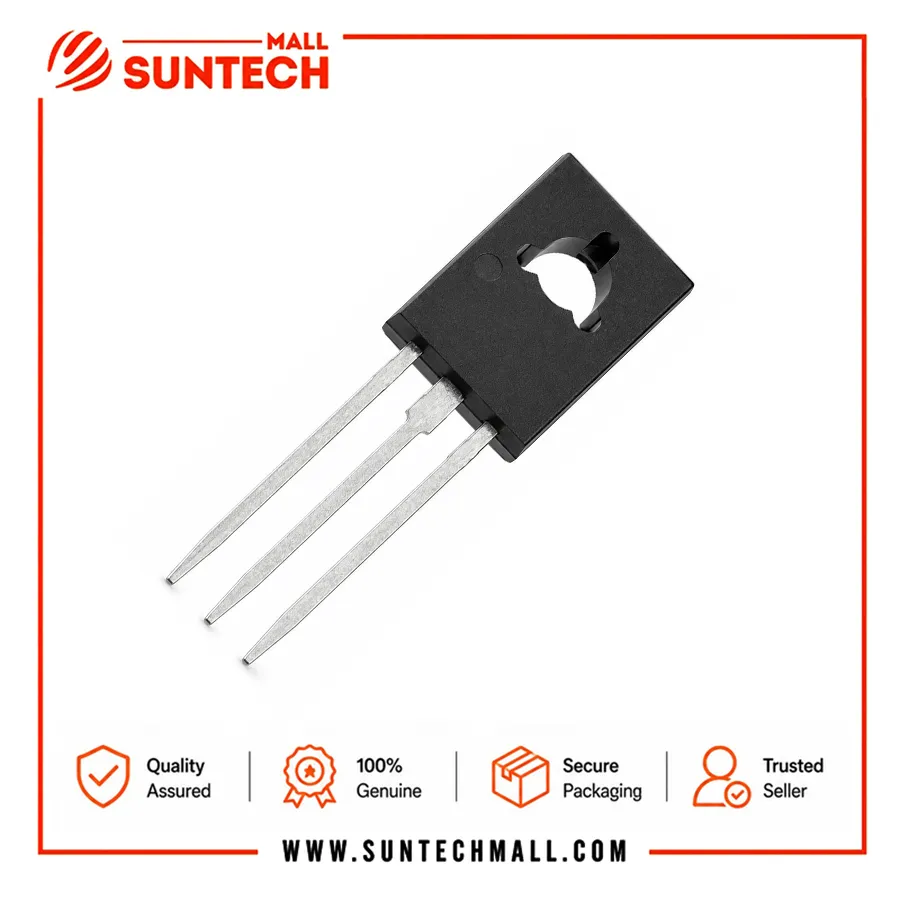
If your board needs a high-voltage NPN transistor in a TO-126 package, and the old part is a 2SC5353BL, this is the part to order. It is an 800V NPN transistor that can switch up to 3 A, made for switching regulators and high-voltage switching work. It does not fit jobs that need more than 800 V, more than 3 A of steady collector current, or a different package or pin order. Check the checks below before you order, so the voltage, the current, the package, and the pins all match your board.
This is an original, high-quality part.
What it does
An NPN transistor is a three-leg switch and amplifier. A small current into the base leg lets a much larger current flow from the collector leg to the emitter leg. This 2SC5353 TO-126 part is built for high voltage: it can stand 800 V from collector to emitter and 900 V from collector to base. Repair techs use this kind of part in switching power supplies, where it turns on and off fast — its rise time is 0.7 microseconds at most and its fall time is 0.5 microseconds at most — so the supply wastes less power as heat.
The TO-126 package has a metal tab with a hole, so you can bolt it to a heatsink. With the case held at 25 °C it can shed up to 20 W. Without a heatsink it can shed far less, so work out the heat from your real current and voltage before you order.
Key features
- NPN silicon transistor for high-voltage switching and amplification
- 800 V collector-emitter voltage, 900 V collector-base voltage
- 3 A steady collector current, 5 A pulse collector current
- TO-126 package with mounting tab for a heatsink
- Fast switching: 0.7 microseconds rise time at most, 0.5 microseconds fall time at most
- Low saturation drop: 1.0 V at most at 1.2 A collector current
- 20 W power dissipation with the case at 25 °C
Checks before you order
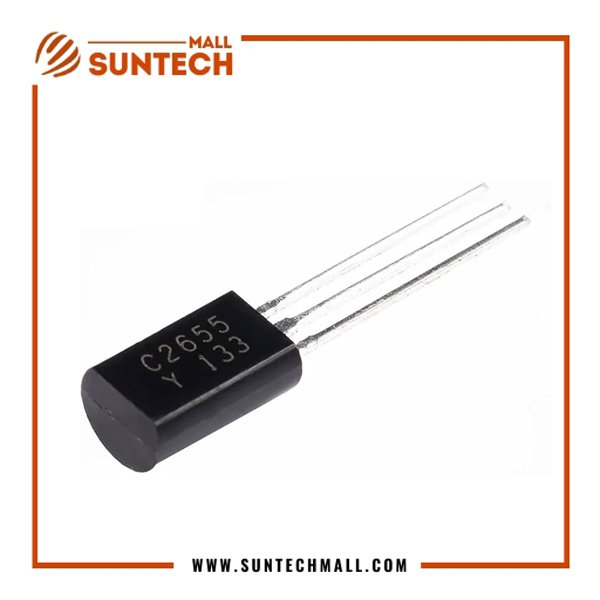
- Part code: the old part must be a 2SC5353 type. The short body mark for this part is C5353. If your old part shows a different full code, stop and check your board list again.
- Pin order: hold the part with the markings facing you and the legs pointing down. Pin 1 is the base, pin 2 is the collector, pin 3 is the emitter. The collector is also joined to the metal tab. If your board print shows a different order, this part will not fit that board as it stands.
- Package: your board footprint must be TO-126 with a mounting hole. This is a through-hole part with three legs. It is not a surface-mount part, and it is not the same size as a TO-220 part, even though the two look alike at a glance.
- Voltage: the voltage across the part must stay at or below 800 V from collector to emitter, and at or below 900 V from collector to base. Above that, this part is the wrong pick.
- Current and heat: the steady collector current must stay at or below 3 A, and the power must stay well inside the 20 W limit in the table below. At 1.2 A the drop is up to 1.0 V, so work out the heat from your real current before you order, and fit a heatsink if the heat needs one.
- Base drive: the base current must stay at or below 1 A, and your drive circuit must give enough base current for the collector current you need. The datasheet gain figures are minimums only (10 at 1 mA, 15 at 0.15 A), so do not plan a circuit that needs more gain than that.
Specifications
All figures below are from the official datasheet at case temperature 25 °C unless noted. No figure here was guessed.
| Type | NPN silicon transistor, single |
| Package | TO-126, 3 leads, through hole |
| Pin 1 | Base (B) |
| Pin 2 | Collector (C), joined to the tab |
| Pin 3 | Emitter (E) |
| Collector-base voltage | 900 V |
| Collector-emitter voltage | 800 V |
| Emitter-base voltage | 7 V |
| Collector current, steady | 3 A |
| Collector current, pulse | 5 A |
| Base current | 1 A |
| Power dissipation, case at 25 °C | 20 W |
| Collector cutoff current, max | 100 µA at 720 V |
| Emitter cutoff current, max | 10 µA at 7 V |
| DC current gain, min | 10 at 5 V, 1 mA; 15 at 5 V, 0.15 A |
| Collector-emitter saturation voltage, max | 1.0 V at 1.2 A, 0.24 A base current |
| Base-emitter saturation voltage, max | 1.3 V at 1.2 A, 0.24 A base current |
| Rise time, max | 0.7 µs |
| Storage time | 4.0 µs |
| Fall time, max | 0.5 µs |
| Junction temperature | +150 °C |
| Storage temperature | −40 °C to +150 °C |
Other names for the same part (good to know)
Shoppers and repair techs call this same part by a few names. C5353 transistor is the short code printed on the body, because the full part number does not fit on it. 5353 is the shortest form buyers type when they search. 2SC5353 TO-126 is the full code with the package, which is the form to use when you want this exact size. 2SC5353BL is this listing’s full code, with the BL suffix as printed in the listing. 800V NPN transistor is the plain name buyers use for this kind of high-voltage NPN part. If you see C5353 on a TO-126 body, and your circuit needs 800 V and 3 A with base-collector-emitter pins, this page is the right match. Do not judge by the code alone — check the package size and the pin order too.
Frequently Asked Questions
What does C5353 mean on this transistor?
C5353 is the short code printed on the body of the 2SC5353 transistor. When you see C5353 on a TO-126 part, it tells you the part is a 2SC5353 type. Match the package and the pin order as well, not just the code.
What is the pin order of this TO-126 part?
Pin 1 is the base, pin 2 is the collector, and pin 3 is the emitter. The collector is also joined to the metal mounting tab, so the tab sits at collector voltage and must be kept clear of other metalwork unless your circuit plans for that.
What voltage and current can this part handle?
It handles up to 800 V from collector to emitter, 900 V from collector to base, 3 A of steady collector current, and 5 A in short pulses, with up to 20 W of power when the case is held at 25 °C. Stay inside all of those limits at the same time.
What does the BL suffix mean?
BL is part of this listing’s full part code, 2SC5353BL. The datasheets read for this package give only minimum gain figures for the part (10 at 1 mA, 15 at 0.15 A) and no BL-only gain range, so no BL-only range is claimed here. Match voltage, current, package, and pin order rather than judging by the suffix alone.
Is the TO-220 size the same part?
The same part family is also made in other packages, but this page is the TO-126 size only. The other sizes shed heat differently and take up a different footprint, so order the TO-126 size if your board and heatsink are made for TO-126.
Does this part need a heatsink?
It depends on your heat. The 20 W figure holds only when the case is kept at 25 °C, which in real use means a heatsink. Work out the heat from your real voltage drop and current: if the heat is more than a bare TO-126 body can shed on its own, fit a heatsink before you run the circuit.
Use note kept from the old page: this part was listed before for reliable switching and amplification, for power control, audio amplification, voltage regulation, and general-purpose electronic designs, with good thermal performance and stable operation in a compact TO-126 package, and that use still stands.


Mohammad Hafeez
Highly recommended for everyone.
Umar Sharif
Pakistan mein aisi service rare hai.
Ijaz Ahmed Khan
Bohot hi premium aur achi cheez.
Sajid Khan
Reliable and fast delivery service.