



Best 50V 22uF Capacitor in Peshawar: Great Quality, Good Price
Are you searching for a reliable 50V 22uF capacitor to power your solar inverter or other electronic projects? Look no further! At SunTech Mall, you can find the best 50V 22uF capacitor…


At SunTech Mall, we see dead solar inverters come in for repair almost every week. And here is the surprising part: many of them die because of a tiny part that costs almost nothing. That part is often a small electrolytic capacitor, like the common 50V 22uF capacitor.
We work with repair shops and technicians across Pakistan every day, and small capacitors sit at the top of their most-failed list. When they age or overheat, they can take down power supplies, chargers, and even expensive inverter boards.
The fear is real: you open a device, see a small black cylinder, and cannot tell if it is the culprit. Worse, you fit a cheap fake and the device dies again within weeks — wasting your money, your time, and your customer’s trust.
This guide will fix that. By the end, you will know what 22uF and 50V mean, what this capacitor does, how to spot a failing one, and how to pick a genuine replacement. No engineering degree needed.
Let’s start with the two numbers printed on every capacitor, because everything else builds on them.
This guide is built on real component datasheets and daily feedback from technicians across Pakistan — practical knowledge for your next repair, no guesswork.
- Read Any Capacitor Label Like a Pro
- Understand What This Small Part Does in Your Circuit
- Know Where 22uF/50V Capacitors Are Used
- Spot a Failing Capacitor Before It Kills Your Board
- Pick a Replacement That Actually Lasts
- Buy a Genuine Capacitor in Pakistan Without Getting Fooled
- Install Your Capacitor Without Damaging the Board
- Frequently Asked Questions
Read Any Capacitor Label Like a Pro
The label on a capacitor looks cryptic at first. But it only tells you two important things.
22uF is the capacitance — the size of the part’s energy bucket. The symbol “uF” means microfarads. Twenty-two microfarads is a small-to-medium value, ideal for filtering and signal work in power circuits.
50V is the voltage rating. This is the maximum voltage the capacitor can safely handle. Go above it, and the capacitor can bulge, leak, or burst. This is the single most important number for safe replacement, and we will return to it later.
You may also see a temperature rating like 85°C or 105°C — how much heat the part can survive. In Pakistan’s summers and inside hot inverter cabinets, this number matters more than most people think.
One more thing: electrolytic capacitors are polarized — they work one way only. The negative side is marked with a stripe down the body. Connect it backwards and it will fail fast, sometimes with a pop and a smell you will never forget.
So a capacitor label really gives you three answers: stored energy, voltage limit, and direction. Read those, and you already know more than half the buyers in the market.
Understand What This Small Part Does in Your Circuit
A capacitor works like a tiny, super-fast rechargeable battery. It charges up in a fraction of a second and releases its energy just as fast.
Its most common job is filtering. When AC becomes DC inside a power supply, the DC comes out bumpy and rippling. The capacitor smooths those ripples like a shock absorber — without it, your circuit gets noisy, unstable power.
Its second job is decoupling. Chips switch thousands of times per second, each switch demanding a quick gulp of current. The nearby capacitor delivers it instantly, keeping sensitive electronics stable.
Its third job is coupling in audio and signal circuits: a 22uF capacitor blocks DC voltage while letting AC signals pass through. That is why you find these parts in amplifiers and radios.
Here is the key insight: a weak capacitor rarely stops a circuit outright — it makes it work badly. Ripples grow, chips get confused, and heat builds up in other parts. That is why a dying capacitor causes the strange, intermittent faults that drive technicians crazy.
Understanding this changes how you repair. You stop looking only for burnt parts and start checking the quiet little capacitors that keep everything stable.
Know Where 22uF/50V Capacitors Are Used
This value sits in a sweet spot: big enough to filter power, small enough to fit almost anywhere. That is why it appears in so many devices.
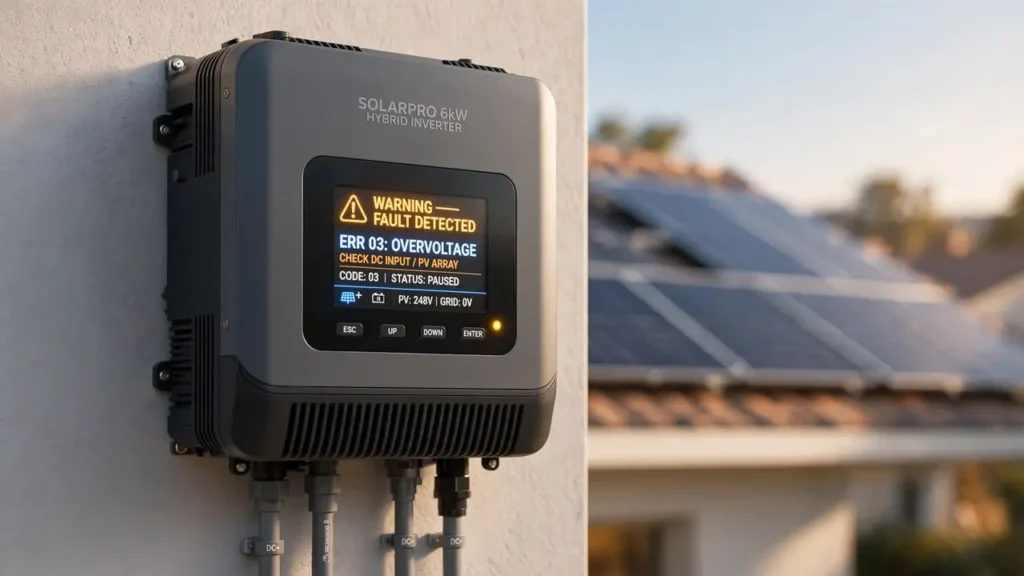
Solar inverters and UPS systems use them in control and driver circuits, near MOSFET gate drivers and control chips, keeping switching signals clean. When these fail, expect random shutdowns, fault codes, or weak output.
Power supplies and chargers use them to smooth DC on the output side. Laptop chargers, LED drivers, and mobile chargers all depend on them.
Audio equipment uses 22uF capacitors for coupling signals between amplifier stages. If your amplifier hums or one channel sounds weak, a dried-out coupling capacitor is a classic suspect.
Control boards and automation circuits use them near microcontrollers for stable, noise-free power. A reset-happy microcontroller often traces back to a tired decoupling capacitor.
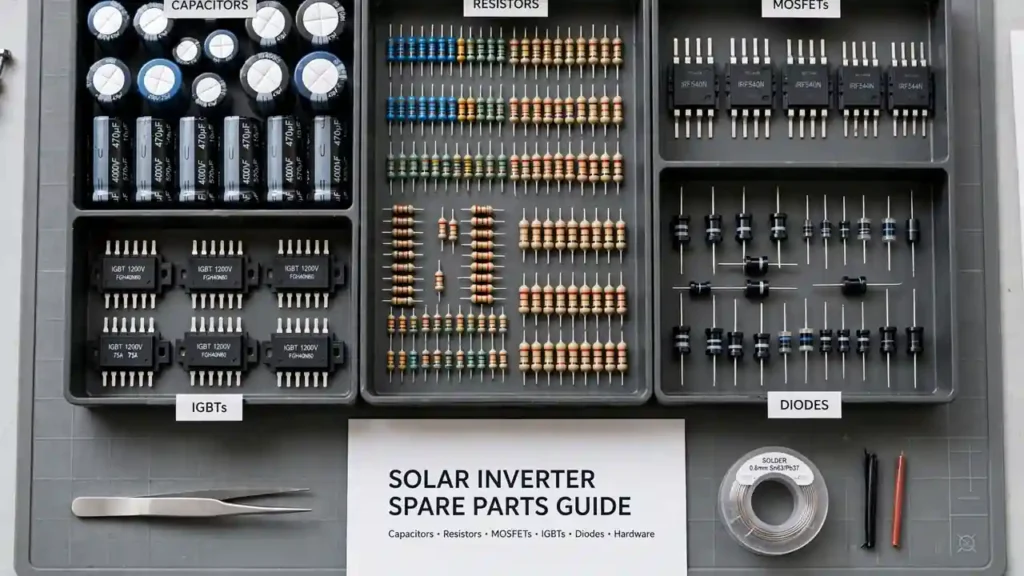
If you repair electronics in Pakistan, you will meet this part constantly. Keeping genuine 22uF/50V capacitors in stock is one of the smartest moves a repair shop can make — our guide on genuine hybrid solar inverter parts in Pakistan lists what else belongs on your shelf.
Spot a Failing Capacitor Before It Kills Your Board
Electrolytic capacitors age, and heat speeds that aging: the liquid electrolyte inside slowly dries out, and the part loses its ability to do its job.
The most obvious sign is bulging. Look at the top of the capacitor. A healthy one has a flat top. A failing one pushes upward into a dome shape. Many capacitors even have a scored “X” or “K” on top — a safety vent designed to split open if pressure builds up inside.
Leaking is the next stage: brown or yellow crust around the base or top. That crust is dried electrolyte — the capacitor is dead, and you should check whether the liquid damaged nearby copper tracks.
But many capacitors fail with no visible sign. Inside, their ESR (equivalent series resistance) has risen too high to filter properly. Only an ESR meter catches these — good repair shops test suspicious capacitors in-circuit before replacing anything.
A basic multimeter also helps. In resistance mode, a good capacitor shows a low reading that climbs as it charges. Near zero that stays there means shorted; an instant open with no charging behavior hints at a dried-out part. Rough, but it catches the worst offenders.
Remember this rule: in any device older than five years that runs hot, capacitors are suspects until proven innocent. Test them early in your diagnosis, not last.
Bonus Tip: When you open a dead power supply, inspect capacitors first, not last. A five-minute visual check for bulging tops saves hours of fault-hunting — and means fewer callbacks.
Pick a Replacement That Actually Lasts
Choosing a replacement capacitor is simple if you follow four rules. Getting any of them wrong is how good repairs turn bad.
Rule 1: Match the capacitance. Replace 22uF with 22uF. Tolerance is usually ±20%, so stay close to the original value in filtering jobs. Do not jump to 47uF or 100uF unless you understand the circuit — bigger changes timing and inrush current.
Rule 2: Match or exceed the voltage rating. Replace 50V with 50V or 63V — never lower. A 25V part in a 50V position will fail, sometimes violently. Slightly higher voltage is safe and smart in hot environments.
Rule 3: Choose 105°C temperature rating. An 85°C capacitor ages fast in a hot inverter cabinet; a 105°C part from a good brand lasts far longer. In Pakistan’s climate, always pick 105°C when you can.
Rule 4: Check the size. Higher ratings mean a bigger body — confirm the replacement fits the board space and mounting holes before you buy.
One more rule that matters: buy from a brand you can name. No-name capacitors often carry fake ratings — a part labeled 105°C but built as 85°C dies young, and you will blame the circuit instead of the part.
Get these four rules right, and your repair will outlast the original part. That is how you build a reputation as the technician whose fixes stay fixed.
Buy a Genuine Capacitor in Pakistan Without Getting Fooled
The Pakistani market is full of capacitors. Unfortunately, it is also full of fakes. Here is how to protect yourself.
First, check the markings. Genuine parts have sharp printing with brand, value, voltage, temperature rating, and a batch code. Fakes show blurry printing, misspelled brands, or missing ratings.
Second, feel the weight. Genuine capacitors feel solid; fakes often feel light and hollow. The sleeve should fit tightly, with no wrinkles or bubbles.
Third, watch the price. A part sold at a fraction of the normal price is almost certainly counterfeit or a rejected batch — genuine parts cost what they cost.
Fourth, buy from a trusted source. A component specialist who stands behind their stock beats the cheapest market stall every time — anonymous sellers are where fakes thrive.
At SunTech Mall, we source components for repair professionals. Every capacitor we sell is genuine stock for real repairs — check the current price and availability on SunTech Mall, and read our genuine hybrid solar inverter parts guide before building workshop stock.
Your customers trust you with their expensive equipment. That trust starts with the parts you put inside it.
Install Your Capacitor Without Damaging the Board
A good part installed badly is still a bad repair. These tips keep your work clean and safe.
Discharge before you touch. Even unplugged, capacitors can hold charge — make it a habit to short the legs with a resistor or insulated screwdriver before handling.
Respect the polarity. The stripe marks the negative leg — match it to the board’s negative marking (shaded half-circle or minus sign). Reversed polarity causes gas buildup and failure. Double-check before soldering.
Do not overheat while soldering. Use a hot iron so solder flows fast, and get in and out quickly — two to three seconds per joint. Ten seconds on the joint cooks the part from inside.
Keep it upright and secure. Seat it flat without leaning on neighbors; in vibrating devices like fan-cooled inverters, a dab of silicone stops tall capacitors cracking their solder joints.
Note: In a solar inverter, check surrounding parts too — MOSFETs and bridge rectifiers share the same heat that killed the capacitor. Our guides on why inverter MOSFETs burn in Pakistan and the GBU08 bridge rectifier show you how to check the whole stage.
Take your time with installation. A careful five-minute solder job beats a rushed one that brings the device back to your bench next month.
Frequently Asked Questions
Can I replace a 50V capacitor with a 25V one?
No. Never use a lower voltage rating than the original. The replacement must be rated for the same voltage or higher. A 25V capacitor in a 50V position will overheat, bulge, and fail — sometimes within days.
Is it safe to use a 63V capacitor instead of 50V?
Yes. Using a higher voltage rating is safe and often better, especially in hot environments. Just make sure the larger body still fits on the board.
How long do electrolytic capacitors last?
It depends on heat. A good 105°C capacitor in a cool circuit can last 10 years or more. The same part in a hot inverter cabinet may last 3 to 5 years. Heat is the biggest killer — every 10°C of extra heat roughly halves the lifespan.
Can I test a capacitor with a normal multimeter?
Partly. A multimeter’s resistance mode shows the charging behavior of a good capacitor, and it catches shorted ones easily. But it cannot measure ESR, which is how most capacitors actually fail. For serious repair work, an ESR meter is worth the investment.
Why do you recommend 105°C capacitors?
Because Pakistan is hot, and inverter cabinets are hotter. A 105°C capacitor is built with better materials and lasts much longer under heat stress than an 85°C part. The price difference is small; the lifespan difference is large.
Final Thoughts
You started unsure about two little numbers on a tiny part. Now you can read any capacitor label, understand its job, spot failure early, and choose a genuine replacement with confidence — real technician skill that saves money on every repair.
Take a moment to appreciate that. Most people never learn what is inside their devices. You just did — and you can explain it simply enough for anyone to follow.
Next step: check your workshop stock. If you are low on genuine 22uF/50V capacitors or any inverter spares, visit SunTech Mall for original components at honest prices — your repairs deserve parts you can trust.
For more repair knowledge, explore our guides on choosing the right power MOSFET, lithium vs lead-acid batteries, and utility-scale solar inverters. Keep learning, keep repairing, and keep Pakistan powered.
1 Comment
[…] The result is full-wave rectified DC: still bumpy, pulsing 100 times per second, but all flowing one way. A capacitor after the rectifier smooths those pulses into steady DC — the filtering job in our 50V 22uF capacitor guide. […]