

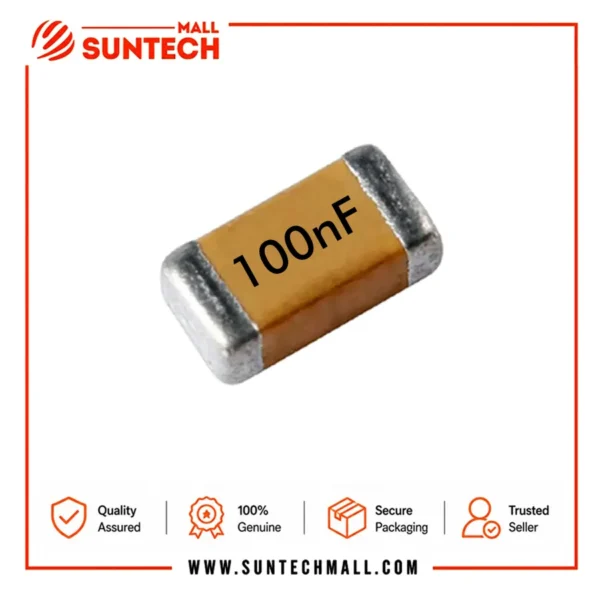
If your board needs a 104pf ceramic disc capacitor, and the old part is a 50V disc marked 104, this is the part to order. Read the code first: 104 does not mean 104 picofarads. Under the standard 3-digit code, 104 means 10 followed by four zeros in picofarads — 100,000 pF, which is 100 nF or 0.1 µF. So this is a 100 nF disc capacitor rated at 50V, in a through-hole disc body, built for signal filtering, noise suppression, and voltage regulation. It fits inverter control boards, power supplies, and signal processing circuits that need a fixed 100 nF value at up to 50V. It does not fit jobs that need a different capacitance value, a higher voltage rating, or a surface-mount body. Check the checks below before you order, so the value, the voltage, and the body all match your board.
This is an original, high-quality part.
What it does
A capacitor stores electrical energy and releases it again. A ceramic disc capacitor does that job with a ceramic disc as the insulator between two metal layers, which gives a small, tough part for filtering and smoothing work. This 104pf disc capacitor holds 100 nF within 20%, so a board that calls for 100 nF gets between 80 and 120 nF. In a circuit it works as a 100nf capacitor for filtering, where it lets the wanted signal pass and blocks the noise, and for noise suppression, where it soaks up the small spikes that would disturb the next stage.
Repair techs use a part like this as a 104pf ceramic disc capacitor for signal filtering and noise suppression in solar inverter repairing, and for voltage regulation, where it smooths the voltage so the next stage sees a steady level. It is a through-hole disc, so it mounts through holes on a board with two radial leads, not on the surface. The disc body is small and the part is non-polar, so it fits either way round — there is no positive or negative lead to get wrong.
Key features
- 100 nF (0.1 µF) capacitance — code 104 = 100,000 pF
- 50V rated voltage
- ±20% tolerance
- Ceramic disc construction, radial leads, through-hole mounting
- Non-polar — fits either way round
- For filtering, noise suppression, and signal smoothing
Checks before you order
- Value — read the code: your board list must call for 100 nF (0.1 µF), which is the part marked 104. If your board list calls for 104 picofarads, that is a different, far smaller part — stop and check the board list again. The code 104 is 100,000 pF, not 104 pF.
- Voltage: the voltage across this part must stay at or below 50V. Above 50V this part is the wrong pick — a higher-voltage disc is a different job, not a swap.
- Tolerance: the real value may sit up to 20% away from 100 nF. If your circuit needs tighter than 20%, this part is the wrong pick — do not hope the part you get sits near the middle.
- Body and fit: your board must take a through-hole disc body with two radial leads. Measure the old part and match it against the holes and the space on your board. A 50V 0.1uF SMD capacitor with the same 100 nF value is a surface-mount part for a different board, not a swap for this disc.
- Fit for the job: this part suits filtering and smoothing in low-voltage circuits. If your job needs a polarised capacitor or a much larger value for bulk energy storage, this disc is the wrong pick — a 50V 10uF electrolytic capacitor is a different type for a different job, not a swap for this one.
Specifications
All figures below are from the ceramic disc series documents and the live page’s own spec. No figure here was guessed. The maker and the dielectric of the exact part on this page are not stated on the live page, so the publisher should confirm the series figures against the Download file at publish time (see the gates note). No temperature range is claimed, because it depends on the dielectric, which is not stated.
| Type | Ceramic disc capacitor, radial leads, through-hole |
| Capacitance | 100 nF (0.1 µF) — code 104 = 100,000 pF |
| Rated voltage | 50V |
| Tolerance | ±20% |
| Polarity | Non-polar |
| Mounting | Through-hole |
Other names for the same part (good to know)
Shoppers and repair techs call this same part by a few names. 104pf is the name from the code printed on the part — but remember it means 100 nF, not 104 picofarads. 100nf capacitor is the plain name from its true value. Ceramic disc capacitor is the name for its construction type. 50v 104pf capacitor is the short name that carries the voltage and the code together. If your board list calls for 100 nF at 50V in a disc body, this page is the right match. Do not judge by the code alone — check the true value and the voltage too.
Frequently Asked Questions
What does 104 mean on a capacitor?
It means 100,000 picofarads, which is 100 nF or 0.1 µF. The first two digits are the value (10) and the third digit is the number of zeros to add (four), all in picofarads: 10 followed by four zeros is 100,000 pF.
Is this a 104 pF capacitor?
No. That is the common mistake with this code. A part truly rated 104 pF would be marked 101. This part is marked 104, which is 100,000 pF — about a thousand times larger. If your board needs 104 pF, do not order this part.
What does ±20% mean?
It is the tolerance: the real capacitance may sit up to 20% above or below 100 nF, so between 80 and 120 nF. If your circuit needs tighter than 20%, this part is the wrong pick.
Is this capacitor polarised?
No, a ceramic disc capacitor is non-polar, so it has no positive or negative lead and fits either way round on the board. Do not mix it up with an electrolytic capacitor, which is polarised and must be fitted the right way round.
How do I fit a ceramic disc capacitor?
Push the two leads through the matching holes on the board and solder them. Check the spacing of the holes against the lead spacing before you solder, and keep the disc clear of parts that cannot take heat.
What is the price of this part?
Check the live price on the website. The price shown on the product page is the current one.
Use note kept from the old page: this part was listed before as a 50V 104-code ceramic disc capacitor for stable and efficient signal filtering, noise suppression, and voltage regulation in solar inverter repairing and other electronic applications, for high-frequency circuits, inverter control boards, power supplies, and signal processing, a small component that stores and releases electrical energy, used for filtering, noise reduction, and signal smoothing in power supplies and electronic devices, and in PCB designs and solar inverter repair — and that use still stands.



Noman Farooq
Fast, easy, and reliable
Ijaz Ahmed
My order arrived earlier than expected
Fahad Mustafa
Great value for money
Ahmad Cheema
Five stars for fast delivery
Dr Ahmad Nawaz
Everything was perfect. Will buy again
Hassan Raza
Reliable service and good prices
Ehsan Ali
Simple process, fast delivery
Owais Shah
Highly satisfied with both product and service
Saad Ahmed
Product exceeded my expectations
Irfan Hussain
Product exceeded my expectations
Nabeel Qureshi
Har cheez 100% original hai.
Asad Shafiq
Har baar ki tarah best service.