
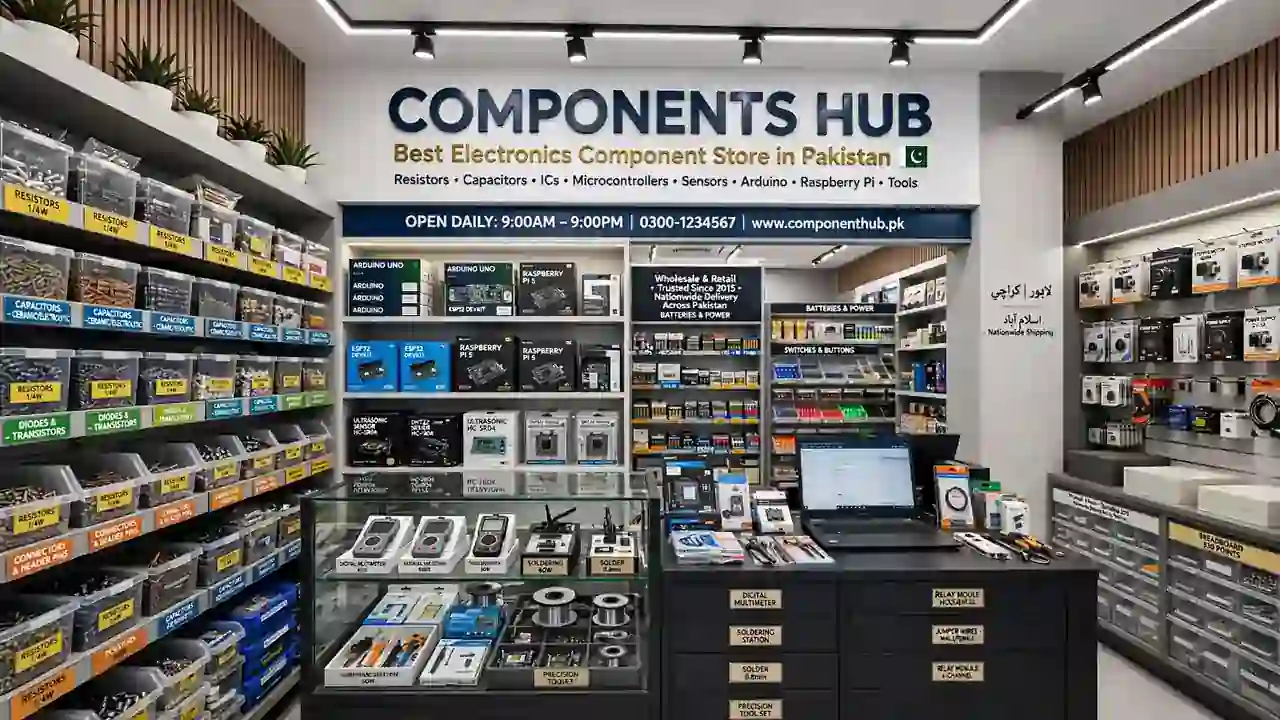
Best and Reliable Electronics Component Store in Pakistan
In the rapidly evolving world of technology, finding the best electronics component store in Pakistan can make all the difference for hobbyists, engineers, and businesses alike. Whether you're building a DIY project,…

Two years ago, I watched a friend lose a week of work — and a customer’s trust — over a single fake component. He’d repaired a solar inverter with a MOSFET from a random market stall. It looked identical to the original, right down to the printed part number. But it was counterfeit, and it blew within three days — taking two neighboring components with it. The repair cost him triple, and the customer never came back. That MOSFET taught me: the store matters as much as the part.
I’ve spent years sourcing electronic components in Pakistan — for repairs, for builds, and for the shelves of SunTech Mall itself. In this guide, I’ll show you how to choose a reliable electronics component store: the five-point test I use to vet any supplier, how to spot counterfeit parts before they reach your bench, the questions to ask before ordering, and how to buy safely online. By the end, you’ll never again wonder whether the part in your hand is genuine.
Here’s my promise, plain and simple: no supplier — including us — deserves your blind trust. What you deserve is a method for checking. This guide gives you that method, and it works whether you buy from SunTech Mall, a Lahore market, or any online store.
What You’ll Learn in This Guide
- See the real cost of fake parts — why a “cheap” component is usually the most expensive one
- Use the 5-point trust test — vet any electronics store in under ten minutes
- Spot counterfeit components — the visual inspection cues engineers rely on
- Ask the right questions — what to ask a supplier before spending a rupee
- Pick online vs. local — the right buying channel for your project and city
- Order safely the first time — a low-risk method for beginners and bulk buyers
Why a Fake Part Costs More Than a Real One
My friend’s story isn’t unusual. I’ve heard versions of it from repair shops in Karachi, Peshawar, and Multan. The pattern never changes: someone saves a few hundred rupees on a component, the part fails early, and the real bill arrives later — in rework time, damaged neighboring parts, and lost customers.
Counterfeits hurt you three ways. They fail early — a fake MOSFET rarely meets its printed ratings, runs hotter, and dies young, sometimes taking the circuit with it. They waste your time — every hour re-diagnosing a “repaired” board is lost paying work. They cost you trust — when a customer’s device fails a week after your repair, they blame you, not the part.
Engineers who study counterfeiting point to one root cause: if you can’t trace a part’s journey back to its original manufacturer, the fake risk rises sharply. That’s why the store matters. A reliable supplier maintains that chain — manufacturer or authorized distributor, to their shelf, to your hands. A random stall with no sourcing story leaves the risk on you.
Note: I’m not calling every market seller dishonest — many are hardworking people. I’m saying that without traceability, you carry the risk. A trustworthy store takes it off your shoulders by standing behind what it sells.
The 5-Point Test for Any Electronics Component Store
Whenever I evaluate a supplier — website or physical shop — I run the same five checks. Ten minutes, and they’ve saved me from bad purchases more times than I can count.
1. Can they tell you where the part comes from? Ask about sourcing — manufacturer direct, authorized distributor, or importer with a paper trail. Vague answers (“it’s original, don’t worry”) are a red flag. Specific answers are a green flag.
2. Do listings show real specifications? Open a product page. Does it list voltage, current, package, part number — or just a name and price? Stores that publish specs and datasheets respect your intelligence. At SunTech Mall’s electronic parts section, every listing carries its specs, because that’s how engineers actually shop.
3. Is there a clear return and support policy? Parts get damaged in shipping; wrong parts get ordered. A trustworthy store has a written return policy and a real human to contact. Ours is simple: info@suntechmall.com and +92 306 2244820. If a store won’t give you a straight way to reach them, don’t give them your money.
4. Do they serve your kind of buyer? Hobbyists need small quantities and guidance. Repair shops need consistent stock month after month. Businesses need bulk pricing and invoices. A good store says upfront who it serves.
5. Does the price make sense? Compare against two or three sellers. Genuine parts sit in a fairly narrow price band — manufacturing costs are real. As industry watchdogs put it: if a price seems too good to be true, it likely is. A small discount is normal; a 60% discount on a branded IC is a warning siren.
Bonus Tip: Run this test on us too. Browse suntechmall.com, check our specs, read our policies, compare our prices — then decide. A store confident in its sourcing won’t flinch at being checked.
How to Spot Counterfeit Parts Before They Reach Your Bench
Counterfeiters are often not very good at their craft — real manufacturers hold quality standards that fakers can’t cheaply copy. Engineers have documented the visual cues that give fakes away, and you can use them with just your eyes and a magnifying glass.
- Markings: genuine parts have crisp, consistent print. Watch for misspellings, wrong fonts, crooked text, or logos that differ from the manufacturer’s. If markings wipe off with solvent, it’s likely a remarked part.
- Date and lot codes: codes should be plausible — not in the future, not impossibly old. Be suspicious if one lot code claims different countries of origin.
- Pins and leads: clean, uniform, evenly spaced. Watch for pre-soldered pins (pulled from an old board), oxidation, or spacing that’s slightly off.
- Package quality: the body should match the datasheet — right material, dimensions, clean molding. Sanded surfaces or rough edges suggest original markings were ground off.
- Packaging: reputable makers use branded reels, tubes, or anti-static bags with labels. Loose parts in a plain bag with a handwritten label deserve scrutiny.
Beyond visuals, there’s electrical testing: measure the part against its datasheet. A capacitor far off its marked value, or a diode with abnormal forward voltage, is telling you something. Sampling each batch is cheap insurance for critical repairs.
Note: Visual inspection catches most fakes — but the most sophisticated ones need lab equipment like X-ray to detect. That’s why the supplier test matters more than any single inspection trick. Buy from a traceable source and you rarely need to play detective. For inverter-specific guidance, see our article on genuine hybrid solar inverter parts in Pakistan.
Ask These Questions Before You Place an Order
Early on, I bulk-ordered capacitors without asking a single question. Half arrived with the wrong voltage rating — my fault for not checking, but a good supplier would have confirmed specs before shipping. Now I ask first. So should you.
“Is this part new and unused?” Pulled components are common in grey markets. Refurbished is fine if disclosed and priced accordingly — the problem is refurbished sold as new. A straight answer reveals the store’s honesty.
“Can you share the datasheet?” Every genuine component has a manufacturer datasheet. If the store can link or send it, they know what they’re selling.
“What if the part arrives defective?” You’re asking about their dead-on-arrival policy. Reliable stores replace or refund without a fight — it’s a normal business cost for them. Evasive answers mean you’ll fight for every rupee.
“Do you offer bulk or repeat-order pricing?” If you’re a repair shop, this separates hobby shops from professional suppliers. Stores that serve repair shops expect this question.
“How long is delivery to my city?” Get a straight answer on shipping time and cost before you order, not after — especially outside big cities.
None of these are confrontational — they’re what professional buyers ask routinely, and a good supplier welcomes them. Wondering how we answer? Write to info@suntechmall.com or call +92 306 2244820 and ask directly. We’d rather earn trust with answers than slogans.
Online Store vs. Local Market: What Wins for Whom
Pakistan has both — bustling electronics markets and growing online stores. Neither is automatically better; they serve different needs.
The local market wins on immediacy (walk out with the part today), haggling, and inspecting the component before paying. Need one resistor this afternoon? The market is unbeatable.
The online store wins on selection (thousands of parts no single stall can hold), specifications (proper listings with datasheets), traceability, and convenience — especially outside big cities. A repair shop in a smaller town often can’t find specialized parts like IGBTs or gate driver ICs locally at all.
For most serious buyers the answer is both: the market for urgent small needs, a trusted online store for planned purchases, bulk orders, and anything where authenticity matters. Inverter repairs fall squarely in the second category — “probably genuine” isn’t good enough with a customer’s inverter on your bench.
Bonus Tip: Keep a simple record — supplier, part number, date, batch. If a part fails months later, that record tells you whether it was a bad batch or a one-off. Five seconds of habit, years of payoff.
Place Your First Order the Smart Way
Never ordered components online in Pakistan? Here’s the low-risk sequence I recommend to every first-time buyer.
Step 1: Start small. Order a handful of common parts you know well. This tests packaging quality, delivery time, and spec accuracy with little money at risk.
Step 2: Inspect on arrival. Run the counterfeit checklist — markings, pins, packaging. Measure a few parts against datasheet values if you can.
Step 3: Test in a real circuit. Put the parts in a non-critical project first and confirm they behave as expected.
Step 4: Scale up. Once a supplier passes the test order, they’re your supplier. Repeat customers get better support, faster answers, and often better pricing — no leap of faith, just a methodical test.
Frequently Asked Questions
How can I tell if a component is genuine?
Inspect visually: crisp markings, correct logos and fonts, plausible date codes, clean uniform pins, proper branded packaging. Then verify electrically against the datasheet. But the strongest protection is a traceable supplier — inspection is your backup, not your main defense.
Why are some components so much cheaper from certain sellers?
Sometimes it’s legitimate — bulk buying or lower overhead. But dramatically lower prices on branded parts are the most common warning sign of counterfeits. Compare two or three sellers before concluding a deal is real.
Is it safe to buy components online in Pakistan?
Yes, if you vet the store first — sourcing, specs, return policy, contact details. Start with a small test order and use buyer-protected payment methods while building trust.
What should I do if I receive a counterfeit part?
Document it: photos of markings, packaging, and test results. Contact the seller for a replacement or refund. If they refuse, warn your community — and for branded parts, notify the manufacturer. Never install a suspect part just because you paid for it.
Do I need branded parts for every project?
For anything involving mains voltage, batteries, solar inverters, or a customer’s device — yes, always genuine. For a personal breadboard prototype, the stakes are lower. Match authenticity to the project’s consequences.
What’s a franchised distributor?
An authorized distributor buying directly from the manufacturer under contract — clean chain of custody. Independent sellers source from anywhere, which can be fine but carries higher counterfeit risk. For critical parts, authorized channels are the gold standard.
Can SunTech Mall supply parts in bulk for my repair shop?
Yes — repair shops and repeat buyers are exactly who we built SunTech Mall for. Send your parts list to info@suntechmall.com or call +92 306 2244820 for a quote on genuine components with consistent stock.
How should I store components?
Keep them in original packaging until use, in a cool dry place, and respect moisture-sensitivity labels on ICs. Good storage preserves the part — but no storage fixes a counterfeit, so buy genuine first.
Final Thoughts
Back to where we started: my friend’s dead MOSFET, the triple-cost repair, the customer who never returned. None of it was bad luck — it was a sourcing decision, made casually, with expensive consequences. The painful part? Completely avoidable.
You now have everything he didn’t: the five-point test to vet any store, the visual cues to spot fakes, the questions that reveal a supplier’s honesty, and a safe first-order method. For a repair shop, that’s not shopping advice — it’s business protection. Congratulations; most people learn this the expensive way, and you just learned it free.
Here’s my honest invitation: if you’re tired of gambling on parts, give SunTech Mall the test order. Browse the electronic parts and electrical & solar categories, run our listings through the five-point test, and judge us by what arrives at your door. Questions about any component? Write to info@suntechmall.com or call +92 306 2244820. Helping you buy right is literally our job.

1 Comment
[…] SunTech Mall shop, or reach us at info@suntechmall.com or +92 306 2244820. You can also read our guide to choosing a reliable electronics component store. We would be glad to help you find the exact part your UPS […]