



100 Ohm 1W 2512 1% SMD Resistor – Best and Reliable
Surface-mount technology has revolutionized the electronics industry, offering compact and efficient solutions for modern circuit designs. Among these, the 100 Ohm SMD Resistor stands out as a versatile component, widely used across…

At SunTech Mall, we talk to two kinds of buyers every week. The first grabs the cheapest 100-ohm resistor on the shelf. The second asks, quietly, “is this really 1%?” — because they have been burned before. We care about this question because we have seen the difference it makes: a measurement circuit built with sloppy 5% parts reads wrong from day one, and an industrial controller drifts and triggers false alarms. The technician blames the design, but the real culprit was a resistor that never met its label.
Here is what goes wrong if you get this wrong: in precision circuits, a resistor that is 5% off does not just make a small error — it multiplies through every calculation the circuit performs. A current measurement reads high, a protection circuit trips late, and in the worst case a MOSFET that should have been protected burns out. This guide covers what 2512 means, what 1% really guarantees, Ohm’s law examples, heat handling, and where precision actually matters.
If “tolerance” and “E96 series” sound like engineer-speak, do not worry. The whole idea fits in one sentence: a 1% resistor is guaranteed to be within 1 ohm of 100 ohms. Everything below unpacks that idea with real examples.
Table of Contents
- Decode the part number: what 2512 and 1% actually mean
- See when 1% matters and when 5% is fine
- Read the markings: 1000, 01A, and tolerance letters
- Run Ohm’s law calculations with worked examples
- Understand heat dissipation in the 2512 package
- Learn how temperature shifts the value (TCR)
- Choose the right jobs: automotive and industrial uses
- Solder and handle precision resistors correctly
- Buy genuine 2512 1% resistors in Pakistan
- Frequently Asked Questions
Decode the Part Number: What 2512 and 1% Actually Mean
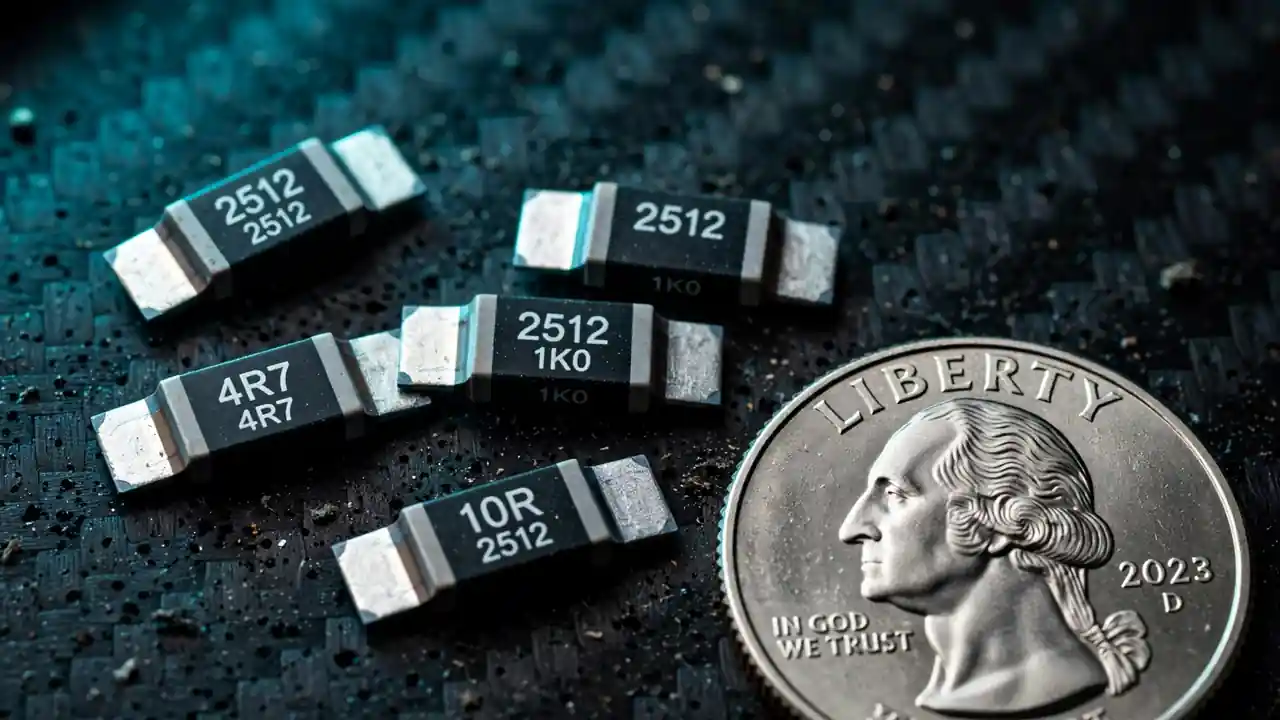
Every digit in “100 ohm 1W 2512 1%” is a promise. 100 ohm is the resistance. 1W is the maximum power it can turn into heat. 2512 is the package size: 0.25 × 0.12 inches, or about 6.3 × 3.2 mm. And 1% is the tolerance — the guaranteed accuracy.
The 2512 is the big sibling in the SMD family. Compare: an 0805 handles 0.125W, a 1206 handles 0.25W, and the 2512 handles a full watt. That large ceramic body is not for show; it is a heatsink. If someone sells you a “1W” resistor in a 1206 body at a standard rating, the physics does not add up — our guide to the 100 ohm 1W SMD resistor explains this package trap in detail.
The 1% tolerance is a factory guarantee: the actual resistance sits between 99Ω and 101Ω at room temperature. Manufacturers achieve this with laser trimming — each resistor is measured and trimmed during production until it lands inside the band. That extra step is why genuine 1% parts cost a little more, and why fakes rarely meet the spec.
So the part number tells a complete story: value, power, size, accuracy. Next: where that accuracy earns its keep — and where it does not.
See When 1% Matters and When 5% Is Fine
Not every circuit needs precision. A 5% resistor is perfectly fine for LED current limiting, pull-ups, and basic protection — jobs where “about 100 ohms” is good enough. Paying extra for 1% there is wasted money. But some circuits genuinely need the tighter band.
Voltage dividers feeding an ADC are the classic case. Imagine two 100Ω resistors splitting 10V so a microcontroller measures 5V. Worst case with 5% parts — top at 105Ω, bottom at 95Ω — gives 10 × 95 ÷ 200 = 4.75V, a 5% error before you even start. With 1% parts the worst case is 10 × 99 ÷ 200 = 4.95V, just 1% off. That single percent can be the difference between a sensor reading you trust and one you do not.
Current measurement and feedback loops are the second case. If a resistor sets the current limit protecting a solar inverter’s power stage, a 5% error means protection trips 5% late — possibly after damage. E24 vs E96: E24 is the 5% series (24 values per decade), E96 the 1% series (96 values). The value 100Ω exists in both — but only the E96/1% version carries the accuracy guarantee.
The rule of thumb: if the resistor’s exact value changes what the circuit decides — a measurement, a trip point, a limit — buy 1%. If “roughly right” is enough, 5% is fine.
Bonus Tip: Mixing tolerances in one divider is a classic mistake. A 1% top resistor with a 5% bottom resistor gives you 5% accuracy, not 1%. Precision is set by the weakest link — match your tolerances.
Read the Markings: 1000, 01A, and Tolerance Letters
A 1% 100-ohm resistor is usually marked 1000 — the 4-digit code where 100 are the value digits and the final 0 adds no zeros. Still 100Ω. Do not read it as “one thousand”; that trailing zero is a multiplier, not part of the value.
On very small packages you may see the EIA-96 code 01A: “01” means 100, “A” means multiply by 1. A tolerance letter sometimes appears too — F means ±1%, J means ±5%. Unsure? Measure out of circuit: a genuine 1% part reads 99–101Ω.
One warning from the repair bench: blurry, off-center, or easily scratched-off printing is a red flag. Genuine laser marking is crisp. If the “1000” wipes off with your thumbnail, the part’s authenticity is as thin as its ink. Markings read — now the math that sizes the circuit.
Run Ohm’s Law Calculations With Worked Examples
Two formulas run every resistor decision: I = V ÷ R and P = V² ÷ R.
Example 1 — 5V logic line: A 100Ω resistor in series with a 5V signal. Current = 5 ÷ 100 = 50mA. Power = 25 ÷ 100 = 0.25W. That is a quarter of the 1W rating — comfortable, with plenty of margin. This is the kind of everyday calculation where the 2512’s headroom shines.
Example 2 — the divider: 10V across two 100Ω resistors. Total 200Ω, current = 50mA. Each resistor drops 5V and dissipates 0.25W — well within 1W, and because both are 1%, the midpoint stays within 1% of 5V. This is precision earning its keep.
Example 3 — the trap: 100Ω across a 24V industrial supply. Current = 240mA, power = 576 ÷ 100 = 5.76W — nearly six times the rating. The resistor becomes a tiny heater and fails fast. The 1W rating is generous for signal work but tiny against 24V directly. Always do the ten-second math before powering up.
Notice the pattern: the resistor is happiest when power stays under half its rating. That is how the 2512 package earns its size — by shedding heat.
Understand Heat Dissipation in the 2512 Package
A resistor does not “use up” power — it converts it to heat, and that heat has to go somewhere. The 2512’s large ceramic body and wide end caps pass heat into the PCB’s copper pads, which act as a radiator. Bigger package, bigger radiator, higher rating. That is the entire secret.
Wide copper traces connected to the pads carry heat away — the same resistor on thin traces runs noticeably hotter. Airflow matters too: a resistor in a sealed box runs hotter than one in moving air. When replacing a burnt resistor in an inverter or home appliance board, check that vents are not clogged with dust. Datasheets rate the 1W at 70°C ambient with a derating curve above that — in a Pakistani summer a closed cabinet can exceed 60°C, which eats your margin fast.
Note: Need to measure current rather than limit it? That job belongs to a low-ohm shunt, not a 100Ω part. Our guide to the 0.1 ohm 5W wirewound resistor shows how current-sense resistors work with a simple V = IR example.
Learn How Temperature Shifts the Value (TCR)
Even a perfect 1% resistor changes value as it heats up. The temperature coefficient (TCR), typically ±100 ppm/°C for standard thick-film parts, tells you how much: 0.01% per degree. Heat the resistor 50°C above room temperature and it drifts 0.5% — that is 0.5Ω on a 100Ω part, enough to exceed the tolerance band in operation.
Practical takeaway: if a precision circuit misbehaves only when hot, suspect TCR drift before you suspect the design. Let the board cool, remeasure, and compare. For hot environments, critical designs use low-TCR thin-film parts (±25 ppm/°C or better) and keep them cool.
Choose the Right Jobs: Automotive and Industrial Uses
The 100Ω 1W 2512 1% is at home in automotive electronics — engine control units, sensor interfaces, infotainment power stages. Cars vibrate, freeze, and bake; the 2512’s large solder joints resist cracking far better than tiny packages, and automotive-grade parts carry AEC-Q200 qualification proving they survived stress testing.
In industrial controls — PLCs, motor drives, factory sensors — the story is similar: 24V environments, electrical noise, and equipment expected to run for a decade. The 1W rating gives headroom against surges, and 1% keeps calibration honest. Technicians servicing battery systems and inverters meet these in charge-controller feedback networks, where a wrong reading means a wrong charging voltage. In telecom and instrumentation, 100Ω 1% parts set gain and terminate lines where reflections would corrupt signals. Wherever the value decides something, the 1% 2512 belongs.
Solder and Handle Precision Resistors Correctly
Precision parts demand a little extra care — sloppy work erases the accuracy you paid for. Use a clean iron at around 320°C, flux, and tweezers. Tin one pad, place the part, solder the second side, then return to the first. Keep heat under three seconds per joint, and do not bake the body — prolonged heat can shift a laser-trimmed value slightly.
Two more tips: let it cool before measuring, because a resistor fresh off the iron reads differently than at room temperature. And store strips sealed against humidity — corroded terminations solder badly, and a bad joint adds unknown resistance in series with your precision part, defeating the whole point.
Buy Genuine 2512 1% Resistors in Pakistan
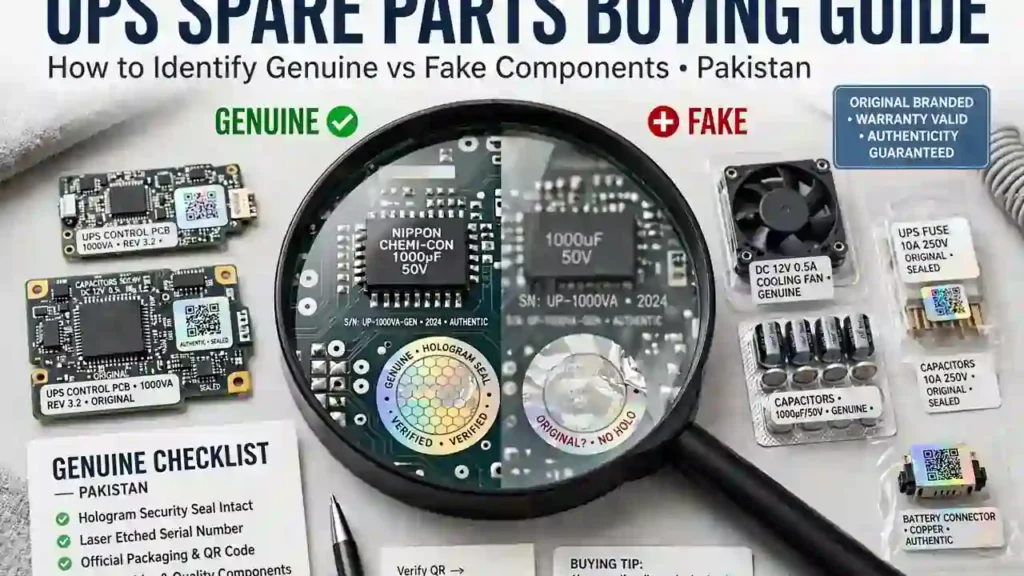
A 1% label is only worth something if the part was actually laser-trimmed and tested. Counterfeit “1%” resistors are common in bargain bins — same body, same “1000” print, but nobody ever verified the value. The test is simple: measure ten parts out of circuit. Genuine 1% parts cluster tightly around 100Ω; fakes scatter.
At SunTech Mall, our 2512 1% stock comes from trusted manufacturers with real series numbers and datasheets — the traceability repair shops need when a customer asks why the repair holds. We verify value, marking, and package before anything ships.
Pair them with companion parts from the same verified stock: ceramic disc capacitors for decoupling and electrolytic capacitors for power filtering. Prices vary by brand and quantity — check the current price on SunTech Mall. Order genuine precision resistors from SunTech Mall, delivered anywhere in Pakistan.
Frequently Asked Questions
What does 2512 mean in a resistor part number?
It is the package size in inches: 0.25 × 0.12 inches, about 6.3 × 3.2 mm. In standard thick-film series, the 2512 package is rated 1W — the largest common chip size.
Is a 1% resistor always better than a 5% resistor?
More accurate, not always “better.” Use 1% where the value affects measurements, trip points, or calibration. For LEDs and pull-ups, 5% is fine and cheaper.
What is the E96 series?
The 96 standard values per decade used for 1% resistors (vs 24 in the E24/5% series). Finer steps mean you can get closer to any target value.
How do I test if my “1%” resistor is genuine?
Measure several parts out of circuit. Genuine 1% 100Ω parts read 99–101Ω and cluster tightly. Wide scatter means fake or damaged parts.
Can a 2512 resistor really handle 1W continuously?
It is rated 1W at 70°C ambient, but good design stays under 0.5–0.6W. Above 70°C the rating derates, so keep margin — especially in hot cabinets.
What does AEC-Q200 mean?
It is a stress-test qualification standard for automotive-grade passive components — temperature cycling, vibration, humidity, and more. If your circuit lives in a vehicle, ask for AEC-Q200 qualified parts.
Why does my precision circuit drift when hot?
Usually TCR drift: a ±100 ppm/°C part shifts 0.5% over a 50°C rise, which can exceed the tolerance band in operation. Improve cooling or switch to a low-TCR thin-film part.
Final Thoughts
Look how far you have come. You can decode “2512 1%” without blinking, you know why a divider built with 1% parts measures honestly, you can run the power math that catches the 24V trap, and you understand heat and TCR the way working technicians do. That is genuine precision literacy — the kind that shows up in repairs that stay fixed.
Congratulations: the next precision circuit on your bench will not intimidate you. You will check the tolerance, verify the marking, do the math, and choose the part with confidence. That confidence is what separates a parts-swapper from a technician — and SunTech Mall stocks the genuine parts worthy of it, delivered anywhere in Pakistan.

1 Comment
[…] the precision version in this exact package, see our guide to the 100 ohm 1W 2512 1% SMD resistor, which covers tolerance, E24/E96 series, and heat dissipation in depth. An undersized resistor does […]