


100V 1000uF Capacitor – The Best and Reliable Deal in Peshawar
In the electronics market of Peshawar, finding high-quality components at affordable prices is a priority for hobbyists, engineers, and businesses alike. Among the essential components, the 100V 1000uF capacitor stands out as…

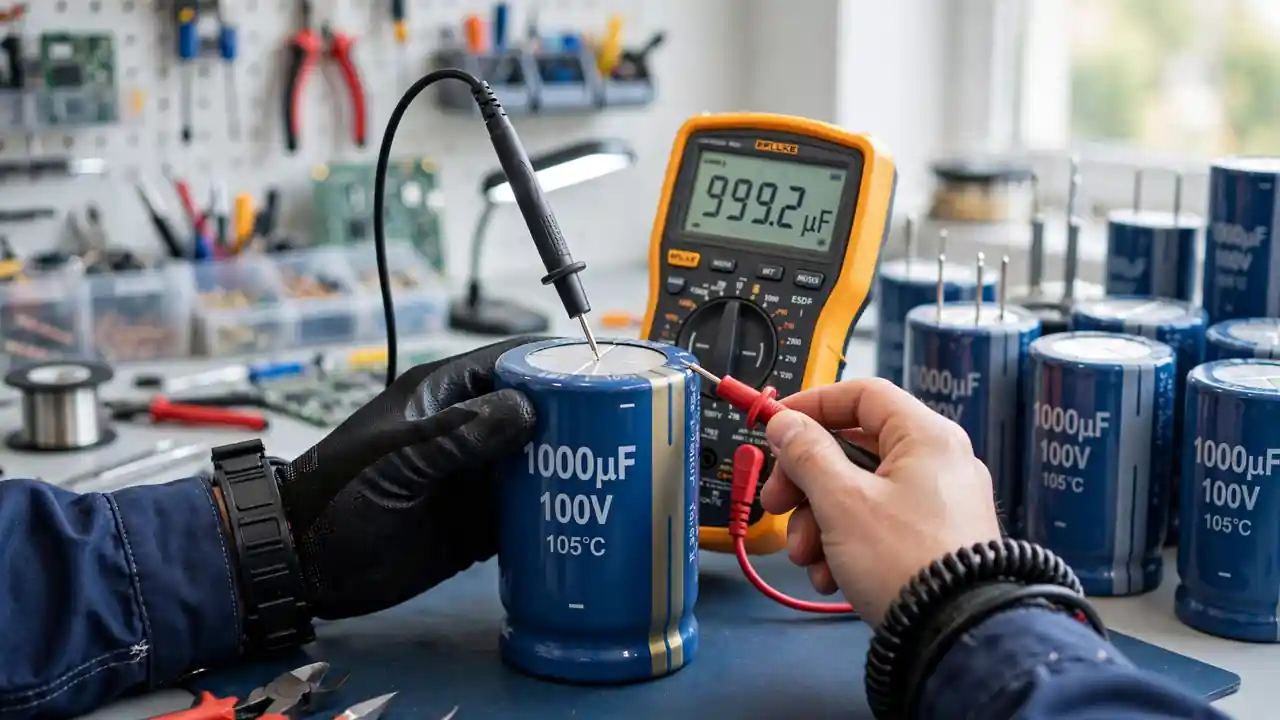
At SunTech Mall, we sell capacitors to the people who fix Pakistan’s power equipment — inverter technicians, UPS repair shops, and audio builders. The 100V 1000µF capacitor is one of our most asked-about parts because it sits at the heart of power supplies. We have seen the same failure a hundred times: a supply that “just died,” an inverter humming strangely, an amplifier with a loud buzz — and every time, the culprit is a tired electrolytic capacitor.
Here is the fear worth taking seriously: a capacitor ages even while doing its job. Heat dries its insides, filtering gets worse, and one day it bulges, leaks, or shorts — sometimes taking the power transistors with it. A wrong replacement (too low voltage, too high ESR, a counterfeit) fails even faster. This guide covers what 100V and 1000µF really mean, the ripple-current spec beginners ignore, ESR in plain words, why 105°C outlives 85°C, where this capacitor works, how to spot a dying one, and how to buy genuine parts in Peshawar and across Pakistan.
If “ESR” and “ripple current” sound intimidating, stay with me. Each idea gets one short section and one real example. By the end, you will read a capacitor like a technician.
Table of Contents
- Understand what 100V and 1000µF actually mean
- See how an electrolytic capacitor works
- Learn ripple current — the spec beginners ignore
- Grasp ESR in plain words
- Choose 105°C vs 85°C and win years of life
- Know where this capacitor does its work
- Spot a dying capacitor before it kills the board
- Respect polarity — the one unbreakable rule
- Buy genuine capacitors in Peshawar and Pakistan
- Frequently Asked Questions
Understand What 100V and 1000µF Actually Mean
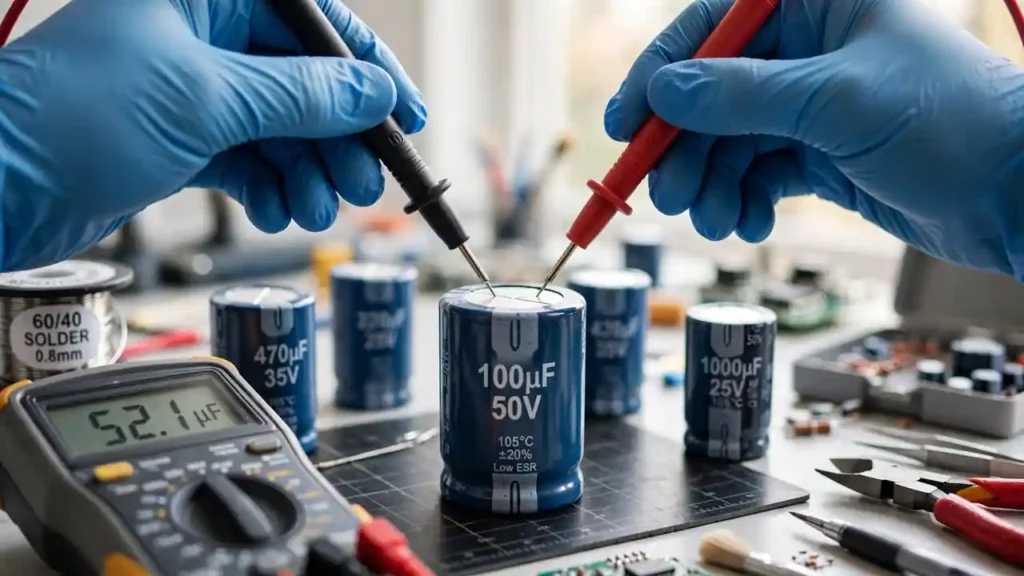
1000µF (1000 microfarads) is the capacitance — how much electric charge the part can store. Bigger capacitance means a bigger “tank” for smoothing out voltage dips. In power supplies, 1000µF is a serious tank: it holds the output steady when the load suddenly demands more current.
100V is the maximum DC voltage the capacitor can safely handle — its pressure limit. Exceed it and the internal insulation breaks down, permanently. Here is the professional habit: never run a capacitor near its limit. Keep the working voltage at 70–80% of the rating or less. On a 100V capacitor, that means circuits up to about 70–80V. A 48V inverter bus or a 60V power rail is a perfect fit; a 90V rail is asking for a short life.
Voltage margin is the cheapest reliability you can buy. A capacitor run at half its rating lasts dramatically longer than one run at 95%. When technicians ask why a replacement failed in months, a rail spiking near the limit is suspect number one. Now — what is inside the can?
See How an Electrolytic Capacitor Works
Inside the aluminum can are two long foil strips separated by paper soaked in a conductive liquid called electrolyte, all rolled up like a Swiss roll. The electrolyte is the secret: it lets the capacitor pack huge capacitance into a small can — far more than a ceramic or film capacitor of the same size. That is why electrolytics dominate power supplies.
The trade-off is polarity: it has a positive and a negative leg and must be connected the right way round (getting it wrong is dramatic — more later). The other trade-off is aging: heat slowly dries the electrolyte, capacitance drops, internal resistance rises. Every electrolytic has a lifespan. Your job is to give it a long one.
Typical specs: 1000µF, 100V DC, −40°C to +105°C, and a lifetime rating like “2000 hours at 105°C.” That last number confuses everyone — let us decode the specs that decide reliability, starting with the most ignored one.
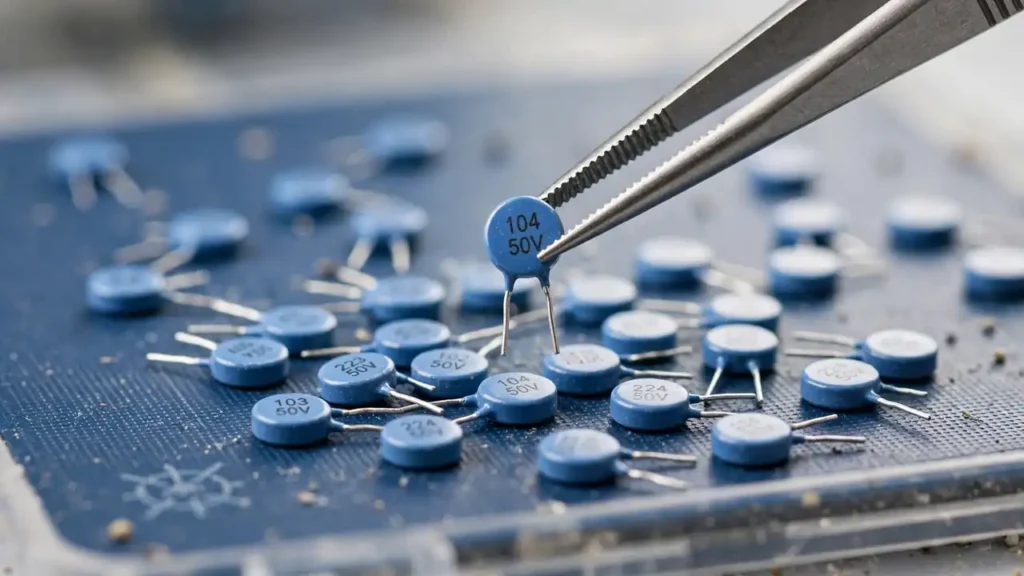
Bonus Tip: Need small, fast capacitors for high-frequency decoupling around ICs instead of bulk storage? That is a different job — see our guide to the 50V 104 ceramic disc capacitor, the classic bypass part.
Learn Ripple Current — the Spec Beginners Ignore
In a power supply, the capacitor does not see pure DC — it sees DC with an AC wobble on top, the ripple left over from rectification and switching. That wobble is a real alternating current flowing in and out of the capacitor: ripple current. It flows through the capacitor’s internal resistance and makes heat (P = I² × ESR). Too much ripple current cooks the capacitor from the inside, drying the electrolyte years early. Every datasheet lists a maximum ripple-current rating — always check it; low-ESR series rate higher than general-purpose ones.
Here is the practical lesson: when a capacitor fails in a switch-mode supply, do not just match capacitance and voltage — check that the replacement’s ripple-current rating matches or beats the original. Upgrading a dead general-purpose part to a low-ESR 105°C type often makes the repair outlast the original. The capacitance was never the problem; the heat was.
Ripple current makes the heat. ESR decides how much heat that current makes. Let us meet ESR properly.
Grasp ESR in Plain Words
ESR — Equivalent Series Resistance — is the tiny unwanted resistance inside every real capacitor. Think of it as a small resistor hiding in series with your perfect capacitor. In a 100V 1000µF part, ESR might be a fraction of an ohm when new.
Two things go wrong as ESR rises with age. First, filtering gets worse: output voltage gets noisier — the hum in an amplifier, the instability in a supply. Second, heating increases: the same ripple current makes more heat (I² × ESR), which dries the electrolyte faster, which raises ESR further. It is a death spiral — the standard way electrolytics die.
This is why repair shops use ESR meters: a capacitor can read a perfect 1000µF while its ESR is ten times normal — filtering badly and running hot. If you repair power supplies seriously, an ESR meter pays for itself within weeks. Measure with power off and the part discharged, and replace anything far out of spec.
Low-ESR series exist specifically for switch-mode supplies, where ripple currents are brutal. They cost a little more and last far longer in that job. Match the series to the circuit, not just the numbers on the can. Heat, meanwhile, is the master variable behind everything.
Note: A failing capacitor often takes neighboring parts with it. In solar inverters with burnt MOSFETs, dried-out bus capacitors are a common root cause — the ripple they stopped filtering hammered the transistors instead. Always check the big electrolytics when a power stage has failed.
Choose 105°C vs 85°C and Win Years of Life
Capacitors come in temperature ratings — commonly 85°C and 105°C. This is not just “how hot it can get.” It is a lifespan rating, and the difference is enormous because of one rule of thumb: capacitor life roughly doubles for every 10°C cooler it runs.
Do the math: a capacitor rated 2,000 hours at 105°C does not die in three months — nobody runs it at 105°C continuously. At 65°C (40° cooler) its expected life multiplies by roughly 2⁴ = 16: about 32,000 hours, or nearly 4 years of continuous operation. An 85°C-rated part in the same hot spot starts shorter and suffers the same cruel math.
The practical rule for Pakistan’s climate: always choose 105°C for power supplies, inverters, and warm cabinets. The price difference is small; the life difference is years. Keep capacitors away from heat sources — that glowing 5W wirewound resistor nearby silently shortens their lives.
Temperature handled. Now the fun part: where does this capacitor actually work?
Know Where This Capacitor Does Its Work
Switch-mode power supply outputs are job number one. After rectification, the 1000µF capacitor smooths pulsing DC into a steady rail — and you often see two or three in parallel, which adds capacitance and shares ripple current so each runs cooler.
Solar inverter DC buses use high-voltage electrolytics to stabilize the bus feeding the power MOSFET stage. Audio amplifiers use them for supply smoothing — weak capacitors mean audible hum and muddy bass. Motor drives and UPS systems use them to ride through load surges. When servicing battery and inverter systems or home appliances, the 100V 1000µF is a first suspect behind vague symptoms — random resets, humming, failure under load.
Spot a Dying Capacitor Before It Kills the Board
Electrolytics usually give warnings. Learn them and you will catch failures before they cascade.
The bulged top. The can’s top has scored vent lines — a deliberate weak spot. When internal pressure builds, the top domes upward instead of exploding. Any bulge means immediate replacement. Leaking electrolyte — brownish crust around the base or vent — is the next stage. A tilted capacitor suggests pressure has been pushing it off its pads.
Then there is the silent killer: a capacitor that looks perfect but has high ESR. No bulge, correct capacitance — yet the supply hums or resets under load. This fools beginners into replacing every other part first. An ESR meter finds it in seconds.
When you replace, match capacitance, voltage (equal or higher), temperature (105°C), and series type (low-ESR for switch-mode). A higher voltage rating in the same can size is always safe. And observe the stripe — which brings us to the rule you must never break.
Respect Polarity — the One Unbreakable Rule
Electrolytic capacitors are polarized: the can has a stripe marking the negative leg; the longer lead is positive. Connect it backwards and it heats rapidly, builds pressure, and vents with a bang. The habit: before soldering, check the stripe against the board’s marking — boards print a + sign or shaded half-circle. Three seconds of checking prevents the most embarrassing failure in electronics.
One more polarity-adjacent warning: discharge before touching. A 100V 1000µF capacitor can hold a painful charge long after power-off. Short it through a resistor (a 100Ω 1W resistor works perfectly) — never with a screwdriver, which can pit the terminals and startle you. Safe habits, correct parts — now where to buy them.
Buy Genuine Capacitors in Peshawar and Pakistan
Peshawar’s electronics markets are full of capacitors — and full of counterfeits. Fake electrolytics are often relabeled lower-voltage parts, or old stock with dried electrolyte sold as new. They test fine on a capacitance meter on day one and fail within months, because capacitance was never the problem — ESR, ripple rating, and age were.
How to protect yourself: buy from a supplier who names the manufacturer series, stocks 105°C low-ESR types for power duty, and turns stock over fast so you never get five-year-old parts. Ask for the series — a genuine supplier answers; a mystery seller changes the subject.
At SunTech Mall, every electrolytic we stock is sourced from trusted manufacturers, with real series and datasheets — the traceability that repair shops need when a warranty is on the line. We verify ratings before dispatch and ship across Pakistan, including Peshawar and Mardan. Prices vary by brand and series — check the current price on SunTech Mall. Order genuine capacitors from SunTech Mall and stop reinstalling the failure you just removed.
Frequently Asked Questions
What does 100V 1000µF mean on a capacitor?
1000µF is the capacitance (charge storage); 100V is the maximum safe DC voltage. Keep working voltage at 70–80% of the rating for long life.
Can I replace a 100V capacitor with a 63V one?
Only if the circuit stays well under 63V with margin. Going up in voltage is always safe; going down risks breakdown.
What is ESR and why does it matter?
Equivalent Series Resistance — unwanted internal resistance. High ESR means poor filtering and extra heating. An ESR meter detects it in seconds.
Is 105°C really better than 85°C?
Enormously. Life roughly doubles for every 10°C cooler the part runs, and 105°C parts start with longer rated life. Always choose 105°C for power duty.
Why do capacitors bulge?
Heat and overstress generate gas inside the can; the scored vent domes upward to release pressure safely. A bulged capacitor is finished — replace it.
Can I use a ceramic capacitor instead of electrolytic?
Not for bulk filtering — ceramics cannot reach 1000µF practically. Use ceramics for high-frequency decoupling alongside electrolytics.
How do I discharge a big capacitor safely?
Short it through a resistor (100Ω 1W works well) for a few seconds, then verify near-zero volts. Never use a screwdriver on high-voltage capacitors.
Final Thoughts
Think about what you can do now: read a capacitor’s ratings with understanding, not just recognition. You know why ripple current cooks parts from the inside, why ESR is the silent killer, why 105°C buys years, and why the stripe demands respect. That is working knowledge.
Congratulations. The next humming power supply or bulging capacitor on your bench will not be a mystery; it will be a ten-minute fix with the right part. Fixes done right are what bring customers back.
Get the right parts from a source that verifies them. Order genuine 100V 1000µF capacitors from SunTech Mall — real series, real ratings, delivered anywhere in Pakistan.