


0.1 Ohm 5W 5% Fix Wire Resistor – Best And Reliable
When it comes to building reliable and efficient electronic circuits, selecting the right components is crucial. The 0.1 ohm 5w resistor is a standout choice for hobbyists, engineers, and professionals seeking a…

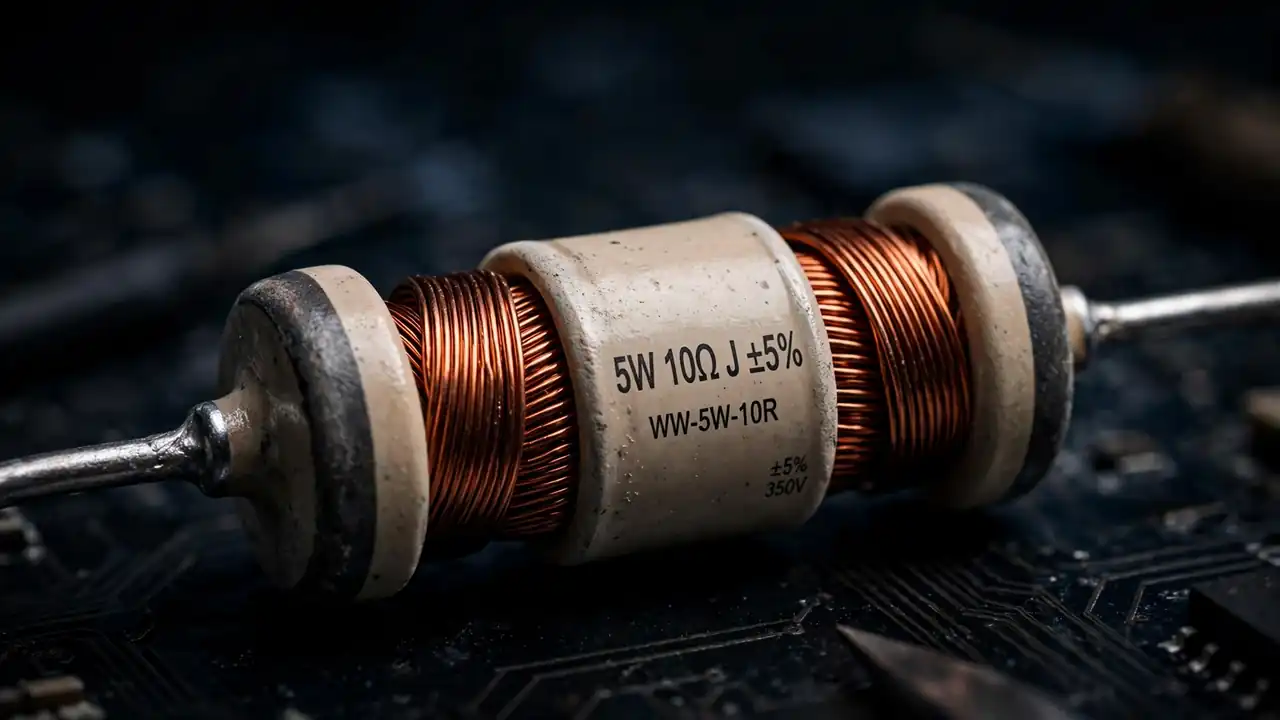
At SunTech Mall, inverter technicians ask us for this part by description, not by name: “the white rectangular one, very low ohms, for the current section.” They mean the 0.1 ohm 5W wirewound resistor — and we care about it because it sits in one of the most critical spots in a power circuit. This little resistor is often the component that measures the current flowing through an inverter, a power supply, or a motor driver. When it fails, the equipment loses its ability to protect itself.
Here is the fear you should take seriously: a current-sense resistor with the wrong value, a fake power rating, or a cracked body does not just read wrong — it blinds the protection circuit. Overcurrent goes undetected, MOSFETs burn, and a cheap repair turns into a dead power stage. This guide shows you how wirewound construction works, why 0.1Ω is the classic sensing value, how much current 5W really allows, where these resistors work, and how to test one with a multimeter. Simple math, real examples.
If “current sensing” sounds advanced, here is the whole idea in one line: a tiny resistor creates a tiny voltage that tells the circuit how much current is flowing. That is it. Everything below is that idea, made practical.
Table of Contents
- Understand what a 0.1Ω 5W wirewound resistor is
- Learn why 0.1Ω is the classic current-sensing value
- Calculate the safe current for a 5W rating
- See where it works: inverters, PSUs, motor drivers
- Know its strengths — and its one weakness
- Test a 0.1Ω resistor with a multimeter
- Read the markings on wirewound resistors
- Buy genuine wirewound resistors in Pakistan
- Frequently Asked Questions
Understand What a 0.1Ω 5W Wirewound Resistor Is
A wirewound resistor is built exactly like it sounds: a resistive metal wire — usually a nickel-chromium alloy — wound around a ceramic or fiberglass core, then coated in cement or silicone. The white rectangular “cement resistor” you see in Pakistani markets is this type. The 0.1 ohm 5W wirewound resistor has a resistance of just 0.1Ω, handles up to 5 watts of heat, and carries a ±5% tolerance.
That 5% tolerance means the real value sits between 0.095Ω and 0.105Ω. For current sensing, that band is usually fine — the circuit is calibrated around the nominal value, and 5% error in a protection threshold is acceptable in most designs. Where tighter accuracy is needed, 1% wirewound parts exist, but 5% is the workhorse.
Why wirewound instead of the film resistors used for normal values? At 0.1Ω, a film layer would need to be impractically thick to carry several amps. A solid wire handles high current naturally, survives surge overloads that would vaporize a film resistor, and stays stable over a wide temperature range (typically −55°C to +155°C). It is the right construction for a brutal job. And the job itself is beautifully simple.
Learn Why 0.1Ω Is the Classic Current-Sensing Value
Here is the trick: put a very small resistor in series with the load, and measure the voltage across it. Ohm’s law (V = I × R) turns that voltage into a current reading. With R = 0.1Ω, the math is almost embarrassingly easy — just move the decimal point.
1 amp through 0.1Ω makes 0.1V across the resistor. 2 amps makes 0.2V. 5 amps makes 0.5V. The circuit’s controller reads that small voltage, divides by 0.1, and knows the current. When the voltage crosses a set threshold — say 0.7V, meaning 7A — the controller shuts things down before damage happens. That is overcurrent protection, built from one resistor.
Why not use 1Ω or 10Ω? Because a bigger resistor wastes more power and steals voltage from the load. At 5A, a 1Ω sense resistor would burn 25W and drop 5V — absurd. The 0.1Ω resistor at 5A burns only 2.5W (P = I²R = 25 × 0.1) and drops just 0.5V. It watches the current without disturbing it. That is the whole art of current sensing: measure without interfering.
Technicians repairing solar inverters with burnt MOSFETs find these resistors in the current-sense path of the power stage. If the sense resistor itself has drifted or cracked, the protection misreads current — and the new MOSFETs you just installed burn again. Always check the sense resistor when a power stage has failed. But first, make sure you know its limits.
Bonus Tip: For higher-value general-purpose work where you limit current instead of sensing it, the companion part is the 100 ohm 1W SMD resistor — same Ohm’s law, completely different job.
Calculate the Safe Current for a 5W Rating
The 5W rating is a heat limit, not a current limit — but current creates the heat, so let us convert. From P = I²R: I = √(P ÷ R) = √(5 ÷ 0.1) = √50 ≈ 7.07A. That is the absolute maximum continuous current at room temperature.
Absolute maximum is not a target. Professionals derate power resistors to 50–60% of rating for continuous duty — about 2.5–3W here. At 2.5W the safe current is √(2.5 ÷ 0.1) = 5A, a clean number. Practical rule: this resistor measures current up to about 5A continuously, and survives brief surges toward 7A.
Surges deserve respect. Motors draw several times their running current at startup, and a wirewound resistor handles brief overloads gracefully — the wire’s thermal mass absorbs the hit. But “brief” means milliseconds to seconds, not minutes. A motor stalled for a minute at 10A will cook even a rugged 5W part. Size for the continuous current, and let the surge rating cover the transients.
Heat needs an exit path: these resistors run hot by design, so give them air space and keep them off heat-sensitive parts. Now let us tour the circuits where they earn their keep.
See Where It Works: Inverters, PSUs, Motor Drivers
Solar inverters are the biggest user. The sense resistor sits in the DC path of the power stage, and the controller watches its voltage to detect overloads and short circuits. When a short occurs, current spikes, the sense voltage spikes, and the controller kills the drive in microseconds — saving the power MOSFETs. No sense resistor, no protection.
Switch-mode power supplies use them the same way: the controller measures current cycle-by-cycle to regulate output and shut down on faults. Motor drivers use them both for protection and for control — the driver measures winding current to regulate torque. Battery chargers, including chargers for lithium batteries, use sense resistors to enforce charge-current limits.
You will also find them in audio amplifiers (output stage current limiting) and LED drivers (constant-current regulation). Anywhere the circuit needs to know the current rather than just carry it, a low-ohm wirewound is the standard answer. Rugged part, critical job — which is why its one weakness matters.
Note: A wirewound resistor is a coil of wire, so it has a little inductance. At very high frequencies that inductance can distort fast current measurements. For switch-mode circuits below a few hundred kHz it is rarely a problem — but for RF or ultra-fast sensing, designers use non-inductive or metal-strip shunts instead.
Know Its Strengths — and Its One Weakness
Wirewound strengths are real: surge tolerance (the wire absorbs overloads that kill film resistors), thermal stability across −55°C to +155°C, high power in a small body, and low cost. That combination is why the 5W cement resistor has survived decades of newer technologies.
The weakness, as noted above, is inductance. A coiled wire is an inductor, and it resists fast current changes — which can distort measurements at high frequencies. For the inverters, chargers, and motor drives in Pakistani workshops, frequencies are low enough that it simply does not matter. The other practical weakness is heat: a 5W resistor at full load runs too hot to touch, so give it air space and keep it away from electrolytic capacitors — heat shortens their life, as our guide to the 100V 1000µF capacitor explains.
Test a 0.1Ω Resistor With a Multimeter
Testing a 0.1Ω resistor has one trap: your meter leads themselves have resistance. Touch the probes together and most meters read 0.1–0.3Ω — more than the part you are measuring. Here is the professional method.
First, remove the resistor from circuit (or at least lift one leg). In-circuit measurements lie because parallel paths corrupt the reading. Second, touch the probes together and note the reading — say 0.2Ω. If your meter has a REL (relative) button, press it with the probes shorted to zero out the lead resistance. Third, measure the resistor and subtract: if it reads 0.3Ω with 0.2Ω of lead resistance, the part is 0.1Ω. Good.
What do failures look like? Open circuit (OL) means the wire has broken — the most common failure after a massive overload. Far above 0.105Ω means partial damage or corrosion. And visual inspection counts: cracks in the cement body, scorch marks, or a loose lead all mean replacement.
When you replace it, match all three specs: 0.1Ω, 5W, and wirewound construction. A film resistor of the same value will not survive the same abuse. Which raises the question — how do you read what is printed on the body?
Read the Markings on Wirewound Resistors
Through-hole wirewound resistors are big enough for plain printing. You will typically see “0R1” or “0.1Ω” for the value, “5W” for the power, and “5%” or “J” for tolerance. R1-style marking uses R as the decimal point: 0R1 = 0.1Ω, just as 4R7 = 4.7Ω.
Cement resistors often print the value directly: “0.1Ω 5W”. If the printing is burnt off — common on failed parts — measure as described above, or read the schematic. Never guess a sense resistor’s value: installing 1Ω where 0.1Ω belongs makes the protection ten times too sensitive (constant false trips), while 0.01Ω makes it ten times too lax (no protection at all).
Markings understood, testing mastered. One thing remains: getting a part you can trust.
Buy Genuine Wirewound Resistors in Pakistan
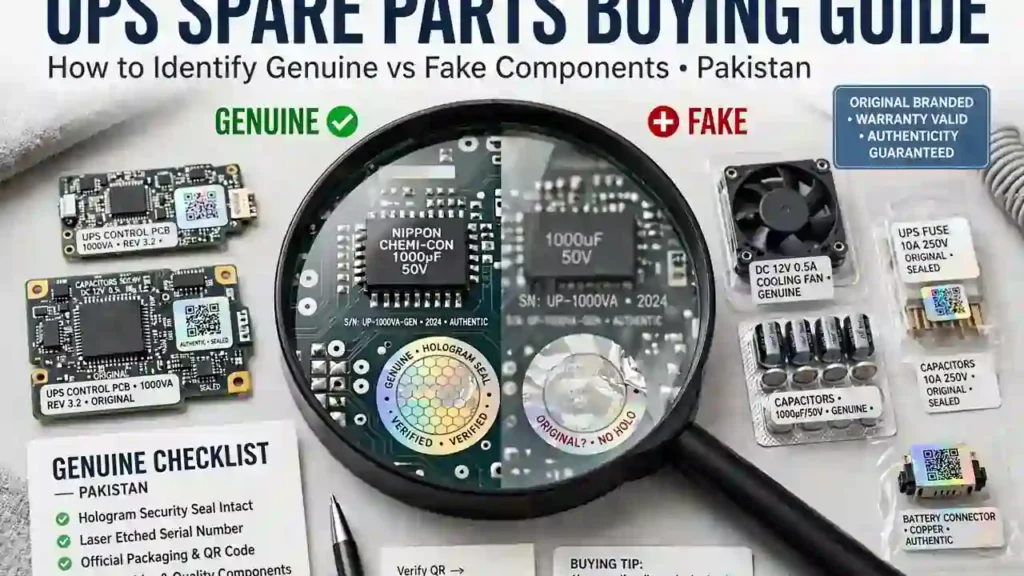
Fake power resistors are dangerous in a way fake signal resistors are not. A counterfeit “5W” part with thin wire or a hollow body overheats at 3W, its value drifts, and the protection circuit it serves starts lying. In an inverter, that lie can cost a full power stage.
At SunTech Mall, our wirewound stock is sourced from trusted manufacturers and checked before dispatch — correct value, real 5W construction, solid cement body. We supply the repair shops that stake their reputation on every inverter they return to a customer, and we hold ourselves to the same standard.
Stock the full repair kit from one verified source: sense resistors here, precision SMD resistors for control circuits, and ceramic capacitors for decoupling. Prices vary by brand and quantity — check the current price on SunTech Mall. Order genuine power resistors from SunTech Mall, delivered anywhere in Pakistan.
Frequently Asked Questions
What is a 0.1 ohm resistor used for?
Mainly current sensing: it creates a small voltage (V = I × R) proportional to current, which the circuit measures for regulation or overcurrent protection. It is also used for inrush limiting in motor and power circuits.
How much current can a 0.1Ω 5W resistor handle?
Maximum ≈ 7.07A (from √(5 ÷ 0.1)), but design for about 5A continuous to keep the part at half its rating for reliability.
Why does my multimeter read 0.3Ω on a 0.1Ω resistor?
Lead resistance. Short your probes and note the reading (often 0.1–0.3Ω), then subtract it — or use the REL button to zero it out. Always measure the part out of circuit.
Can I replace a wirewound resistor with a film resistor?
Not for power and sensing duty. Film resistors cannot handle the same current and surge overloads. Match the construction type, not just value and wattage.
What does 0R1 marking mean?
R is the decimal point: 0R1 = 0.1Ω. Similarly, 4R7 = 4.7Ω and 1R0 = 1.0Ω.
Why did my sense resistor burn?
Usually a massive overcurrent event — a shorted MOSFET or stalled motor — pushed far past 7A. Replace it, but also find and fix the fault downstream, or the new one will burn too.
Does a wirewound resistor’s inductance cause problems?
Only at high frequencies. For inverters, chargers, and motor drives operating below a few hundred kHz, the small inductance is negligible. RF and ultra-fast designs use non-inductive shunts instead.
Final Thoughts
You now understand one of the cleverest tricks in power electronics: measuring amps with a resistor worth a tenth of an ohm. You can do the V = IR math in your head, you know the 5A practical limit, you can test the part properly despite lead resistance, and you know why matching the wirewound construction matters.
Congratulations — the next dead inverter on your bench just got less mysterious. Check the sense resistor early, trust your meter, and fix the real fault instead of just the symptom. That is how technicians earn repeat customers.
For the genuine parts those repairs deserve, order from SunTech Mall — verified 0.1Ω 5W wirewound resistors and everything around them, delivered anywhere in Pakistan.