


50V 104pF Ceramic Disc Capacitor – Best Price And Reliable
Welcome to the world of dependable electronic components! If you're searching for a capacitor that delivers outstanding performance and unmatched reliability, the 50V 104pF ceramic disc capacitor is your go-to choice. As…

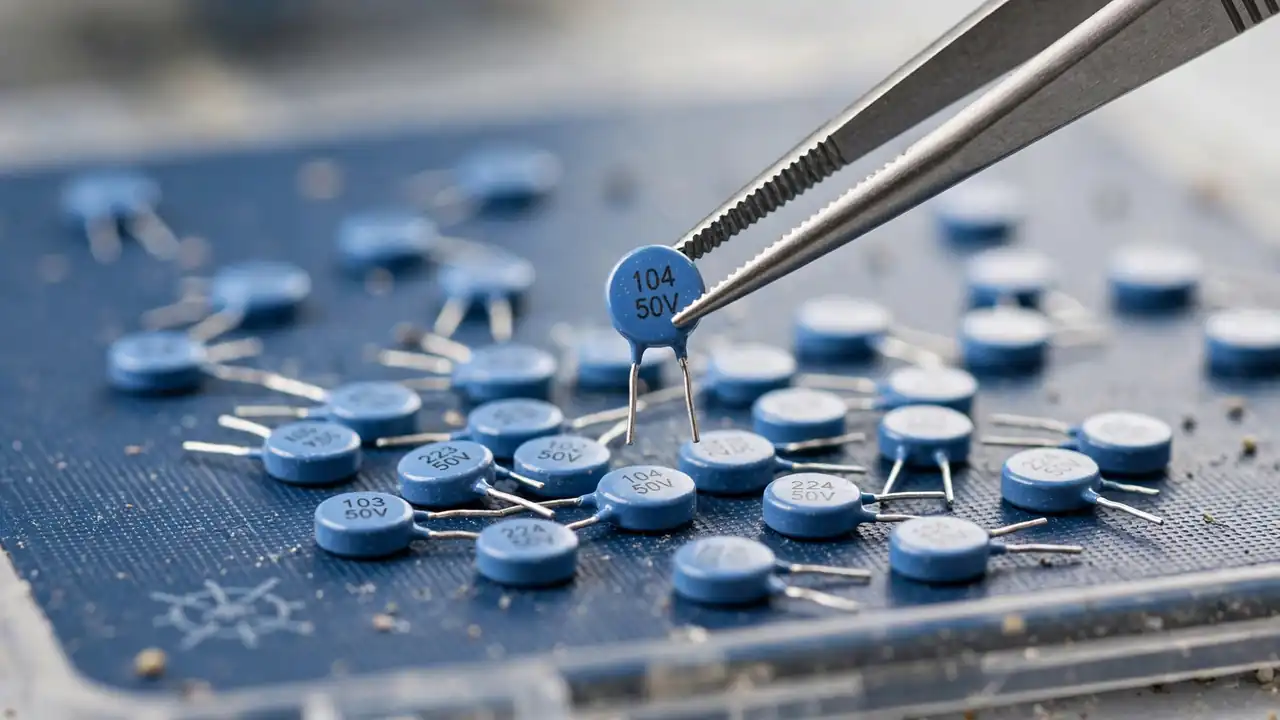
At SunTech Mall, customers constantly hold up a little brown disc stamped 104 and ask for “a 104 picofarad capacitor.” Here is the honest truth: 104 does not mean 104 picofarads. It means 100 nanofarads — nearly a thousand times more. We have seen hobbyists order the wrong part, wait a week for delivery, then wonder why their circuit misbehaves. One misunderstood code wastes time, money, and patience.
The fear is simple: in electronics, one wrong component value can make a circuit fail in confusing ways. A decoupling capacitor with the wrong value does not explode — it just quietly fails to do its job, and you chase ghosts: a microcontroller that resets randomly, a sensor with noisy readings, an audio circuit with a mysterious whine. This guide fixes the confusion permanently. You will learn to read the “104” code in seconds, understand what the 50V rating really allows, see why this capacitor is on nearly every circuit board ever made, learn ceramic vs. electrolytic differences, and solder these discs without cracking them.
Capacitor codes look like secret handshakes — this guide breaks the code in the first section, then gets practical. Let us decode it.
Table of Contents
- Decode “104”: what the code really means
- Understand what a ceramic disc capacitor is
- Master its most important job: decoupling
- Compare ceramic vs. electrolytic capacitors
- Learn what the 50V rating really allows
- Know why two identical discs behave differently
- Solder ceramic discs without cracking them
- See where these capacitors work every day
- Buy genuine ceramic capacitors in Pakistan
- Frequently Asked Questions
Decode “104”: What the Code Really Means
Capacitor codes work like SMD resistor codes: the first two digits are the value, the third digit is the number of zeros to add — and the answer is always in picofarads (pF). So 104 means 10 followed by four zeros: 100,000 pF.
Now convert: 1,000 pF = 1 nF, so 100,000 pF = 100 nF. And 1,000 nF = 1 µF, so 100 nF = 0.1 µF. One marking, three correct names: 100,000 pF = 100 nF = 0.1 µF. What it is not is 104 pF — that would be marked 101 (10 plus one zero). This single misunderstanding causes more wrong orders than any other in the capacitor world.
More examples so the system sticks: 103 = 10,000 pF = 10 nF. 102 = 1,000 pF = 1 nF. 101 = 100 pF. 474 = 470,000 pF = 470 nF = 0.47 µF. Once you see the pattern, you can read any ceramic capacitor ever printed. When you order, say “104 — that’s 100 nanofarad” and the supplier knows you know what you are doing.
Code cracked. Now what is the little brown disc itself?
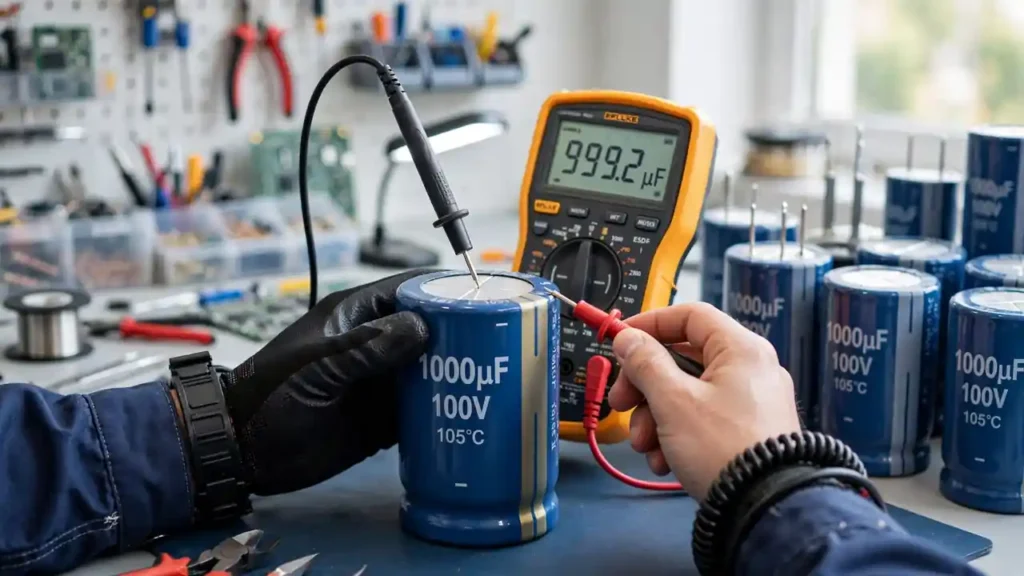
Bonus Tip: For larger bulk-storage jobs where ceramics cannot reach, you need electrolytics instead. Our guide to the 100V 1000µF electrolytic capacitor covers capacitance, ripple current, and ESR in plain words.
Understand What a Ceramic Disc Capacitor Is
A ceramic disc capacitor is exactly what it looks like: a small disc of ceramic material with metal on both faces, two wire leads, and a protective coating — usually brown, orange, or blue. The ceramic is the dielectric (the insulator between the plates), and different ceramic recipes give different behavior, which we will come to.
Three properties define it. First, it is non-polarized — no positive or negative leg, so you can install it either way round. Second, it has very low internal resistance (ESR) and stays effective at high frequencies where electrolytics give up. Third, it is cheap, tough, and tiny — the reason you find it by the dozen on almost every circuit board.
The 104 disc (100 nF) is the single most common ceramic value in electronics — the default choice for a job called decoupling, which is where this little part becomes a hero. Time to meet that job.
Master Its Most Important Job: Decoupling
Every digital chip — microcontrollers, logic ICs, voltage regulators — draws current in sharp, fast gulps as its internal transistors switch. Those gulps create tiny voltage dips and high-frequency noise on the power lines. Left alone, the noise spreads: one chip’s gulps become another chip’s glitches.
The fix is a decoupling (bypass) capacitor: a 104 ceramic placed right across each chip’s power pins, as close as physically possible. It acts as a tiny local reservoir, supplying those fast gulps instantly so the main supply lines stay clean. Think of it as a water tower next to a factory — the town reservoir is far away, but the tower handles sudden demand on the spot.
The classic symptom of missing decoupling is random resets: a microcontroller fine on the bench that crashes when a motor or relay switches nearby. The fix is simple — a 104 disc across the MCU’s VCC and GND, leads short, placed close. Remember this: every IC gets a 104.
Why ceramic and not electrolytic for this job? Speed. The noise is high-frequency, and only a low-ESR ceramic can respond fast enough. An electrolytic is a big slow tank; the ceramic is a small fast one. Circuits need both — which is exactly the next comparison.
Compare Ceramic vs. Electrolytic Capacitors
These two capacitor families are partners, not rivals. Ceramics are non-polarized, low-ESR, excellent at high frequencies, but impractical above roughly 10–100 µF. Electrolytics reach thousands of microfarads for bulk storage but are polarized, slower, and age with heat.
On a real power supply you will see both side by side: a big 1000µF electrolytic smoothing the main ripple, with little 104 ceramics scattered around the ICs killing high-frequency noise. Remove the electrolytic and the output sags under load; remove the ceramics and the chips glitch. Each covers the other’s weakness.
The buying implication: never substitute one family for the other by value alone. A 0.1µF electrolytic cannot replace a 104 ceramic for decoupling (too slow, and it is polarized), and no practical ceramic replaces a 1000µF bulk capacitor. Match the family to the job. With that settled, what does the 50V actually limit?
Note: Ceramic discs also appear in timing and filter circuits alongside resistors. If you are pairing them with resistors, our guides to the 100Ω 1W SMD resistor and the 100Ω 2512 1% precision resistor cover reading values and choosing packages.
Learn What the 50V Rating Really Allows
50V is the maximum DC voltage the capacitor should ever see. Like all ratings, it wants margin: keep working voltage comfortably below it. On 5V logic, 12V systems, and 24V industrial rails, a 50V disc is perfectly at home with room to spare.
Where it does not belong: directly across a 48V bus. That leaves almost no margin for spikes — and real circuits spike. A motor switching off or a relay opening can briefly push a 48V rail well past 50V. For 48V systems, step up to a 100V-rated ceramic. The 50V part is for low and medium voltage work, and it is superb at it.
One more voltage subtlety: some cheap ceramic dielectrics lose capacitance as voltage rises — a 100nF disc at 40V DC bias might behave like 60nF. This is a dielectric issue (next section), not a fault, but it is why critical designs use better dielectrics or higher voltage ratings than strictly needed. Speaking of dielectrics — why do two identical-looking discs behave differently?
Know Why Two Identical Discs Behave Differently
Not all ceramics are equal. The ceramic recipe — the dielectric — decides how stable the capacitance is. Two common families dominate the disc market:
X7R is the stable, well-behaved dielectric. Its capacitance stays fairly constant across temperature (−55°C to +125°C) and voltage. When accuracy matters — timing, filters, precision decoupling — X7R is the right choice, and it costs only slightly more.
Y5V / Z5U are the cheap, high-capacity dielectrics. They pack more capacitance per disc but drift badly: capacitance can drop 50% or more at temperature extremes or under DC bias. For rough decoupling where “about 100nF” is fine, they work. For anything fussy, they do not.
Practical rule: precision job — ask for X7R; rough decoupling — Y5V is acceptable. A supplier who can name the dielectric knows their stock. Now, how do you get these onto a board without breaking them?
Solder Ceramic Discs Without Cracking Them
Ceramic discs are through-hole parts: bend the leads, push them through the board, solder from below. Simple — with one enemy: thermal shock. Ceramic cracks when heated or cooled too suddenly, and a cracked disc can fail open, shorted, or intermittently (the worst kind).
Heat the pad and lead together, not the disc body. Iron around 320°C, joint in 2–3 seconds, cool naturally — never blow on it. Leave a tiny stress-relief loop in the leads so board flex does not crack the ceramic.
For decoupling duty, keep leads short — long leads add inductance, which defeats the high-frequency performance you chose ceramic for. Push the disc close to the board, trim excess lead, and you get both mechanical strength and electrical performance. Installed correctly, a ceramic disc outlives the product around it. Let us see the jobs it does.
See Where These Capacitors Work Every Day
Microcontroller boards: a 104 across every IC’s power pins — the decoupling job you now know by heart. Power supplies: small ceramics at regulator inputs and outputs for stability, alongside the big electrolytics. Audio circuits: coupling and tone filtering, where non-polarized construction is essential for AC signals.
Motor and relay drivers: snubbing noise from switching transients — the same noise that causes those random MCU resets. RF and timing circuits: with stable X7R dielectric, in oscillators and filters. Repair technicians meet them everywhere: on home appliance control boards, in inverter control sections near the MOSFET drivers, and across the power pins of every regulator.
Diagnostic habit: when a board glitches erratically, check the little ceramics first. They crack from board flex and heat — a cracked 104 can measure fine at DC yet fail at the high frequencies where it works. When in doubt, replace it; it costs almost nothing.
Buy Genuine Ceramic Capacitors in Pakistan
Ceramic discs are so cheap that counterfeiting seems pointless — yet the market has its own version: mislabeled values and unknown dielectrics. A bin of “104” discs where half are actually 103, or Y5V sold where X7R was promised. At these prices nobody tests them, so the errors persist into finished boards.
Protect yourself the simple way: buy from a supplier who states the value, voltage, and dielectric — “104, 50V, X7R” — instead of just “104 capacitor.” That one extra word, the dielectric, separates a parts seller from a parts expert.
At SunTech Mall, our ceramic stock is specified completely and verified before dispatch — correct code, correct voltage, stated dielectric. We supply the repair shops and builders who cannot afford mystery parts, from Mardan to Karachi. Prices vary by dielectric and quantity — check the current price on SunTech Mall. Order genuine ceramic capacitors from SunTech Mall, delivered anywhere in Pakistan.
Frequently Asked Questions
Does 104 mean 104 picofarads?
No — this is the most common capacitor mistake. 104 means 10 followed by four zeros = 100,000 pF = 100 nF = 0.1 µF. A 104 pF capacitor would be marked 101.
What is a 104 capacitor used for?
Mostly decoupling/bypass: placed across IC power pins to filter high-frequency noise. Also used in timing circuits, filters, and coupling.
Are ceramic disc capacitors polarized?
No. They work in either direction, unlike electrolytics. Install them any way round.
Can I use a 50V capacitor on a 12V circuit?
Easily — 12V is well within the 50V rating with healthy margin. The rating is a maximum, not a requirement.
What is the difference between X7R and Y5V?
X7R is stable across temperature and voltage; Y5V drifts badly (can lose half its capacitance). Use X7R for precision work, Y5V only for rough decoupling.
Why does my microcontroller reset randomly?
Often missing or bad decoupling. Add a 104 ceramic directly across the MCU’s VCC and GND pins, as close as possible, with short leads.
How do I test a ceramic disc capacitor?
A capacitance meter should read near 100 nF for a 104. But cracks hide at DC — if a board glitches, just replace the disc. It costs almost nothing.
Final Thoughts
You will never misread “104” again — and that alone puts you ahead of half the hobbyists ordering parts online. You know it is 100 nF, you know why every IC wants one across its power pins, you know ceramic from electrolytic, you respect the 50V limit, and you can solder a disc without cracking it. Small part, complete understanding.
Congratulations — the next randomly-resetting microcontroller or noisy sensor will not send you in circles. You will check the decoupling first, fix it in minutes, and look like the expert you are becoming. That is how reputations get built: one clean fix at a time.
Stock your bench with parts you can trust. Order genuine 104 ceramic capacitors from SunTech Mall — correct value, stated dielectric, delivered across Pakistan.