

Black vs Blue Solar Panels: Which Solar Panel is Best for You?
When choosing between black vs blue solar panels, it’s essential to consider efficiency, cost, and aesthetics. Black solar panels, made from monocrystalline silicon, are highly efficient, perform better in low-light conditions, and…

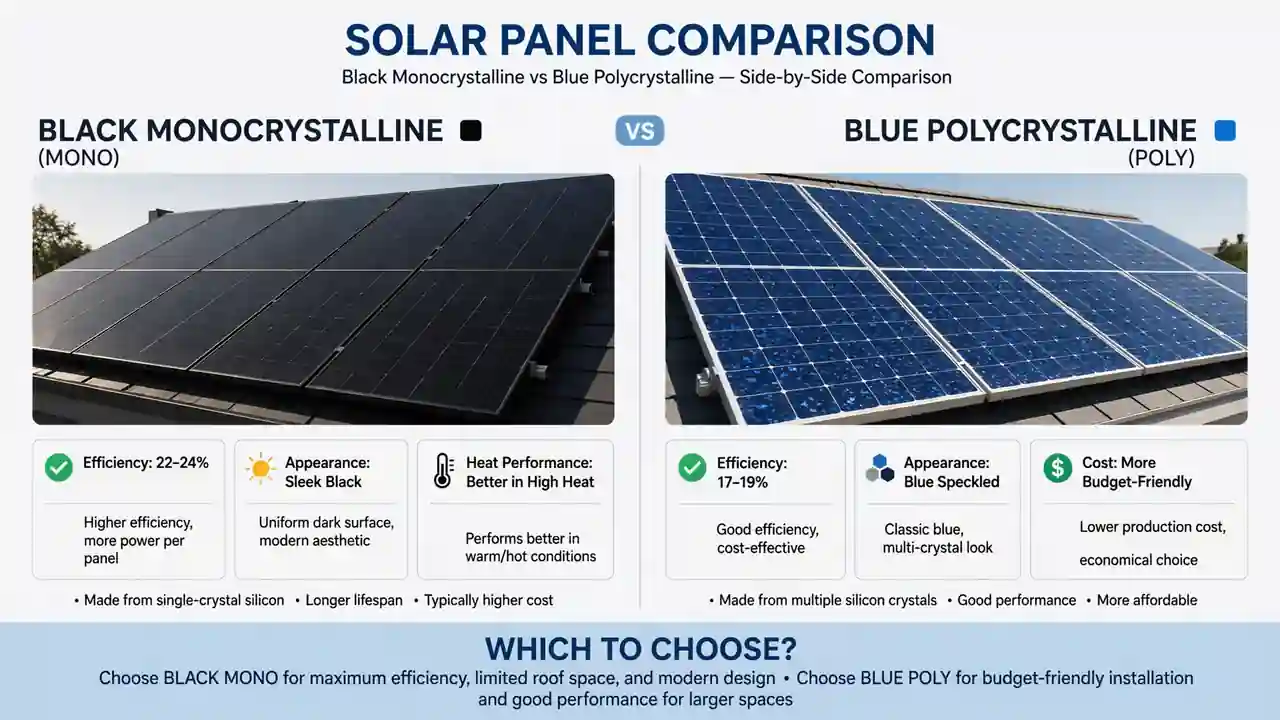
Walk through any solar market in Pakistan and you will hear the debate. “Black panels are better.” “Blue panels are cheaper, same thing.” A customer stands between two stacks of panels, confused, while two shopkeepers give opposite advice. I have watched this scene play out dozens of times.
At SunTech Mall, we deal with solar equipment daily, and customers ask us this exact question every week. The honest answer is not “black always wins” or “blue is just as good.” It depends on your roof, your budget, and your priorities. Anyone who gives you a one-word answer is selling, not advising.
Here is the fear behind the question: solar panels are a big investment. You will live with your choice for 20-plus years. Pick wrong, and you either overpaid for performance you did not need, or you are stuck with weak output on a small roof that cannot fit more panels.
In this guide, I will explain the real difference between black and blue solar panels, with honest numbers on efficiency, price, heat behavior, and looks. By the end, you will know exactly which type suits your home in Pakistan, and why.
Let us start with what the colors actually mean, because most people get this wrong.
A Quick Note Before You Trust This Guide
Solar panel technology keeps improving, and the gap between panel types keeps shrinking. The figures in this guide reflect the mainstream market, not laboratory records or the cheapest no-name panels. Use this guide to understand the trade-offs, then compare actual datasheets before buying.
In This Guide: What You Will Be Able to Do
- Understand what makes a panel black or blue at the cell level
- Compare real efficiency numbers honestly
- Know how each type behaves in Pakistan’s summer heat
- Judge whether the price difference is worth it for your roof
- See through common sales myths about panel colors
- Match the panel type to your available roof space
- Buy with confidence instead of confusion
What the Colors Actually Mean
The color difference comes from how the silicon cells are made. This is the foundation everything else rests on.
Black panels are monocrystalline. Each cell is cut from a single, pure crystal of silicon. The uniform crystal structure gives the cell its dark, even black appearance. Because the silicon is so pure and uniform, electrons flow through it with minimal obstruction.
Blue panels are polycrystalline. Each cell is made from silicon melted together from multiple crystal fragments. The many crystal boundaries scatter light differently, creating the characteristic shimmering blue look. Those same boundaries slightly impede electron flow.
The color is a side effect, not the point. Nobody engineers a panel to be black or blue for fashion. The color simply reveals the manufacturing process. What matters is what that process means for efficiency, and that is where the real comparison begins.
Efficiency: The Honest Numbers
Efficiency means what percentage of sunlight hitting the panel becomes electricity. Here is where the two types genuinely differ.
Monocrystalline (black) panels: roughly 20 to 23 percent. Mainstream black panels in today’s market commonly achieve around 20 to 22 percent efficiency, with premium models reaching higher. The pure crystal structure wastes less of the incoming light.
Polycrystalline (blue) panels: roughly 15 to 17 percent. Blue panels typically sit a few percentage points lower. The crystal boundaries in the cell cost some efficiency.
What this means on your roof: For the same wattage, a black panel is physically smaller than a blue one. A 550-watt black panel and a 550-watt blue panel produce the same power under identical test conditions, but the blue panel takes up more roof space to do it. If your roof is large, this may not matter. If your roof is small, it matters enormously.
Note: Always compare panels by their datasheet wattage and efficiency, not just by color. A high-quality blue panel can outperform a poor-quality black one. Color tells you the cell technology; the datasheet tells you the actual performance.
Price: What You Actually Pay For
Blue panels cost less per watt. The polycrystalline manufacturing process is simpler and wastes less silicon, so blue panels are generally cheaper. For buyers on a tight budget with plenty of roof space, this is a genuine advantage.
Black panels cost more per watt. Growing single crystals is slower and more expensive. You pay a premium for the higher efficiency.
Think in terms of cost per unit of energy, not cost per panel. I will not invent prices here, because the market moves constantly. Instead, use this method: divide the panel’s price by its wattage to get cost per watt, then consider how many panels your roof can fit. Sometimes the “expensive” black panel is cheaper overall because you need fewer of them, less mounting hardware, and less wiring.
Check current panel prices on SunTech Mall’s website to run these numbers with real figures for your own situation.
Heat Performance: Critical for Pakistan
This section matters more in Pakistan than almost anywhere else, because our summers are brutal.
All panels lose efficiency as they heat up. Solar panels are tested at 25 degrees Celsius, but on a Pakistani rooftop in June, cell temperatures can exceed 65 degrees. Every panel’s output drops as temperature rises. The rate of this drop is called the temperature coefficient, and it is printed on every honest datasheet.
Monocrystalline panels generally handle heat slightly better. Black panels typically have a slightly better (less negative) temperature coefficient than blue ones. The difference is small per degree, but across a 40-degree temperature rise on hundreds of watts, it adds up to real energy.
Ventilation matters as much as panel type. Panels mounted with an air gap underneath run cooler than panels flat against a hot roof. Whatever color you choose, proper mounting with airflow is free performance.
Looks and Practical Differences
Black panels look sleeker. Most homeowners prefer the uniform black appearance, especially on visible rooftops. If aesthetics matter to you or your housing society has appearance rules, black wins.
Blue panels show dirt less. A minor practical point: dust and grime are slightly less visible on the textured blue surface. In dusty areas, this is a tiny, honest advantage.
Low-light behavior slightly favors black. On cloudy mornings and hazy evenings, monocrystalline cells tend to harvest a little more from weak light. Over a year, this adds a small bonus to black panels.
Durability is about build quality, not color. Frame strength, glass quality, and junction box sealing decide how long a panel survives. A well-built blue panel outlasts a poorly built black one. Check certifications and warranty terms, not just color.
Which Should You Choose? A Decision Framework
Choose black (monocrystalline) if: your roof space is limited, you want maximum energy from the available area, you prefer the look, or you want slightly better heat and low-light performance. This is the right choice for most urban Pakistani homes with constrained rooftops.
Choose blue (polycrystalline) if: you have plenty of space, your budget is tight, and you want the lowest cost per watt. For large rural installations or farmhouses with big open roofs, blue panels remain a sensible, honest choice.
Either way, size your inverter correctly. The panels are only half the system. A quality hybrid inverter and proper batteries decide how well your solar investment actually serves you. Explore our solar equipment range to plan the full system, not just the panels.
Myths Worth Killing
Myth: “Blue panels don’t work in heat.” False. They work fine; they just lose a little more efficiency at high temperatures than black ones. Millions of blue panels operate across hot countries.
Myth: “Black panels are always better.” Misleading. Better at what? Per square meter, yes. Per rupee, not always. The right question is which is better for your specific roof and budget.
Myth: “Color determines quality.” False. Quality is determined by the manufacturer, materials, and certifications. There are excellent blue panels and terrible black ones.
Bonus Tip: When comparing quotes, ask every seller for the panel datasheet and check three numbers: wattage, efficiency percentage, and temperature coefficient. Any seller who cannot provide a datasheet is a seller to avoid.
From Panels to a Complete System
Panels are only the harvesters. What turns their DC output into reliable home electricity is the rest of the system, and it deserves equal attention.
The inverter decides your system’s character. In Pakistan, that almost always means a hybrid inverter with battery backup for load shedding. Our guide on why hybrids suit Pakistan explains the reasoning, and the hybrid inverter comparison shows how to evaluate models fairly without falling for marketing.
Installation order prevents expensive mistakes. Too many families buy panels first and plan later. The correct sequence is bills, roof, sizing, equipment, installer. Our step-by-step installation guide walks through each stage in order.
Consider wind as a complement. If your site has good wind, a small turbine can cover nights and cloudy spells when panels rest. Our honest small wind turbine guide gives realistic output figures without the hype.
Browse complete systems and components in our solar energy collection.
See also: IRFB4115 MOSFET, UF5M diode, home.
Frequently Asked Questions
Which solar panel is best for Pakistan’s climate?
Monocrystalline (black) panels are generally the better match for Pakistan because of their higher efficiency and slightly better heat tolerance, especially where roof space is limited. But polycrystalline (blue) panels remain a valid budget choice for large roofs.
Do black panels produce more electricity than blue ones of the same wattage?
Under identical standard test conditions, a 550W black panel and a 550W blue panel produce the same power. The black panel’s advantage is that it achieves that wattage in a smaller physical size, and it holds up slightly better in heat and low light.
Are blue solar panels outdated?
Not exactly. Their market share has shrunk as monocrystalline prices fell, but blue panels are still manufactured and still make economic sense for large, budget-sensitive installations with ample space.
How long do solar panels last?
Quality panels typically carry 25-year performance warranties, with gradual output decline of around half a percent per year. The panels usually outlive the inverter, which is why choosing a good inverter matters so much.
Can I mix black and blue panels in one system?
It is not recommended. Mixing panels with different electrical characteristics in the same string reduces the whole string’s output to the weakest panel’s level and complicates the design. Keep each string uniform.
Where can I buy genuine solar panels and inverters in Pakistan?
SunTech Mall supplies solar equipment including inverters, batteries, and components. Check our solar collection for current stock, or contact us at info@suntechmall.com or +92 306 2244820 for guidance on sizing your system.
Final Thoughts
Black versus blue is not a battle between good and bad. It is a trade-off between efficiency per square meter and cost per watt. Black monocrystalline panels give you more power from less roof and handle Pakistani heat a little better. Blue polycrystalline panels give you more watts for your rupee when space is not the constraint.
The real mistake is not choosing the “wrong” color. The real mistake is buying without a datasheet, without measuring your roof, and without planning the inverter and batteries that turn panels into actual reliable electricity.
Congratulations on researching before buying. That single habit will save you more money than any panel color ever could. When you are ready to plan your system, SunTech Mall is here with genuine equipment and honest advice at info@suntechmall.com.
1 Comment
[…] MPPT. Check the datasheet’s MPPT voltage range and maximum PV input before buying panels. Our panel comparison guide helps you choose between monocrystalline and polycrystalline for your roof, and the installation […]