

Canadian Solar 630W Anti-Hail TOPCon Panel: What It Really Is
Every hail season in Pakistan, we at SunTech Mall get the same worried calls from installers and homeowners. A dark cloud rolls over Lahore or Peshawar, ice starts hammering the rooftops, and…

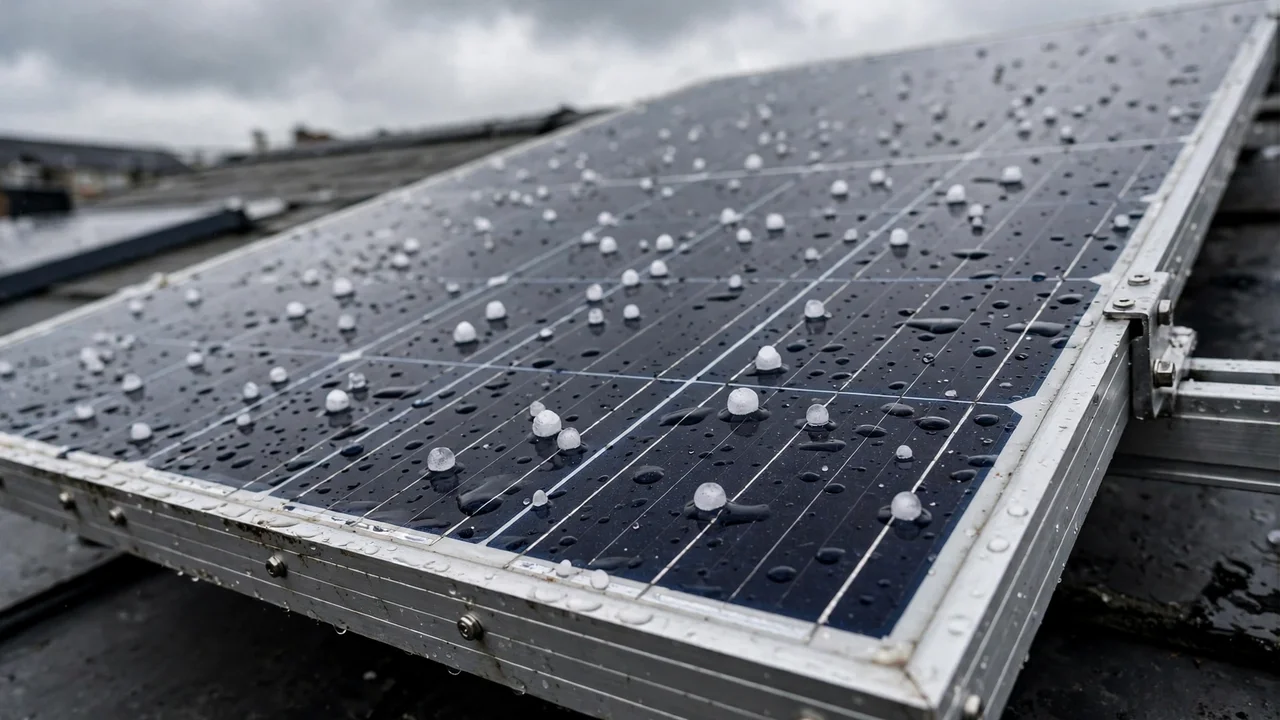
Every hail season in Pakistan, we at SunTech Mall get the same worried calls from installers and homeowners. A dark cloud rolls over Lahore or Peshawar, ice starts hammering the rooftops, and everyone asks one question: will my solar panels survive this?
This guide answers that question honestly. You will learn what Canadian Solar’s 630W anti-hail TOPCon panel actually is, what “anti-hail” really means, and how to judge any hail-resistant panel before you spend money.
Key takeaways
- The panel is a TOPBiHiKu6 model from the CS6.2 series, rated from 600W to 630W, with 132 half-cut N-type TOPCon cells.
- “Anti-hail” is a mechanical upgrade: 2.5mm fully tempered glass on both sides and a 35mm frame, tested with ice balls up to 55mm.
- Anti-hail means more resistant, not hail-proof. Big stones and strong crosswinds can still cause damage.
- Always ask for the datasheet and match the model number on the panel’s back label before you buy.
- For current availability, check the live price on the website — this guide gives no price figure, because launch prices change fast.
What did Canadian Solar actually launch?
Let us clear up the headline first, because headlines love to exaggerate.
Canadian Solar introduced a new variant of its TOPBiHiKu6 module series, built on the CS6.2 platform with 182mm Pro cells. The headline model pushes up to 630 watts, and the series spans roughly 600W to 630W. It uses 132 half-cut N-type TOPCon cells and a bifacial design, so it harvests light from the rear side as well as the front.
The “anti-hail” part is not a magic shield. It is a mechanical upgrade: a thicker 35mm frame and 2.5mm fully tempered glass on both sides. According to the manufacturer, that extra half millimetre allows full tempering, which measurably improves impact resistance. The company reports testing against ice balls up to 55mm in diameter, in line with IEC 61215.
Notice what I did not say: no price, no Pakistan availability date. Anyone who gives you those numbers without a local distributor document is guessing. Check the live price on the website instead.
Bonus Tip: When a dealer quotes a “new launch” panel, ask for the datasheet PDF with the exact model number. If it does not match the label on the panel’s back, walk away.
What is TOPCon, in plain words?
You will see the word TOPCon everywhere, so let us demystify it once and for all.
TOPCon stands for Tunnel Oxide Passivated Contact. It is a smarter way of building the back side of a solar cell. A microscopically thin oxide layer lets electrons tunnel through, while blocking the energy losses that used to happen at the cell’s rear surface. Less loss means more sunlight becomes electricity.
Think of an older PERC cell like a bucket with a small leak at the bottom. TOPCon plugs most of that leak. The practical results are higher efficiency from the same rooftop area, lower first-year degradation, and a better temperature coefficient. That last point matters enormously in a hot country.
A coefficient of -0.29%/°C means each degree above 25°C cell temperature costs 0.29% of output. On a hot afternoon in Multan, cell temperatures can cross 65°C, which means a temporary dip of roughly 11–12%. Older technologies lose even more. In Pakistan’s heat, TOPCon’s temperature behaviour is not a footnote. It is money.
One honest note: TOPCon is now the mainstream, not the exotic future. Treat it as the baseline you should expect, not a miracle.
How does solar hail testing really work?
Every serious solar panel sold internationally must pass IEC 61215. Its hail test uses a pneumatic launcher that fires 25mm ice balls — about one inch — at 23 metres per second, roughly 83 km/h, at 11 specific points across the panel. These points include corners, edges, and cell centres, where the silicon is most vulnerable. The panel passes if there is no visible damage and power loss stays within limits.
Here is the part that surprised me when I first studied it. The lab ice is deliberately denser than natural hail — around 0.92 g/cm³ versus roughly 0.64 g/cm³ for natural hail — so the test hit carries meaningfully more energy than a same-size natural hailstone. The baseline test is tougher than it sounds.
Now, the 55mm figure on the anti-hail datasheet: IEC 61215 allows enhanced testing with larger ice balls beyond the 25mm minimum. A 55mm ice ball is a different beast. It is roughly golf-ball-plus size, carrying many times the energy of the standard test. That is a genuine engineering statement, not just a sticker.
But the test does not promise survival of every storm. Real hail varies wildly in stone size, wind speed, and impact angle. Larger stones or fast crosswinds can still damage a 55mm-tested panel. “Anti-hail” means more resistant, not hail-proof.
Note: If you live in a hail-prone district, ask your installer about mounting angle and structure strength too. A steep tilt sheds hail better than a flat lay, and a weak mounting structure can flex and crack cells even when the glass survives.
Why do the glass and frame matter more than marketing?
Strip away the press release, and anti-hail engineering comes down to two things: glass and frame.
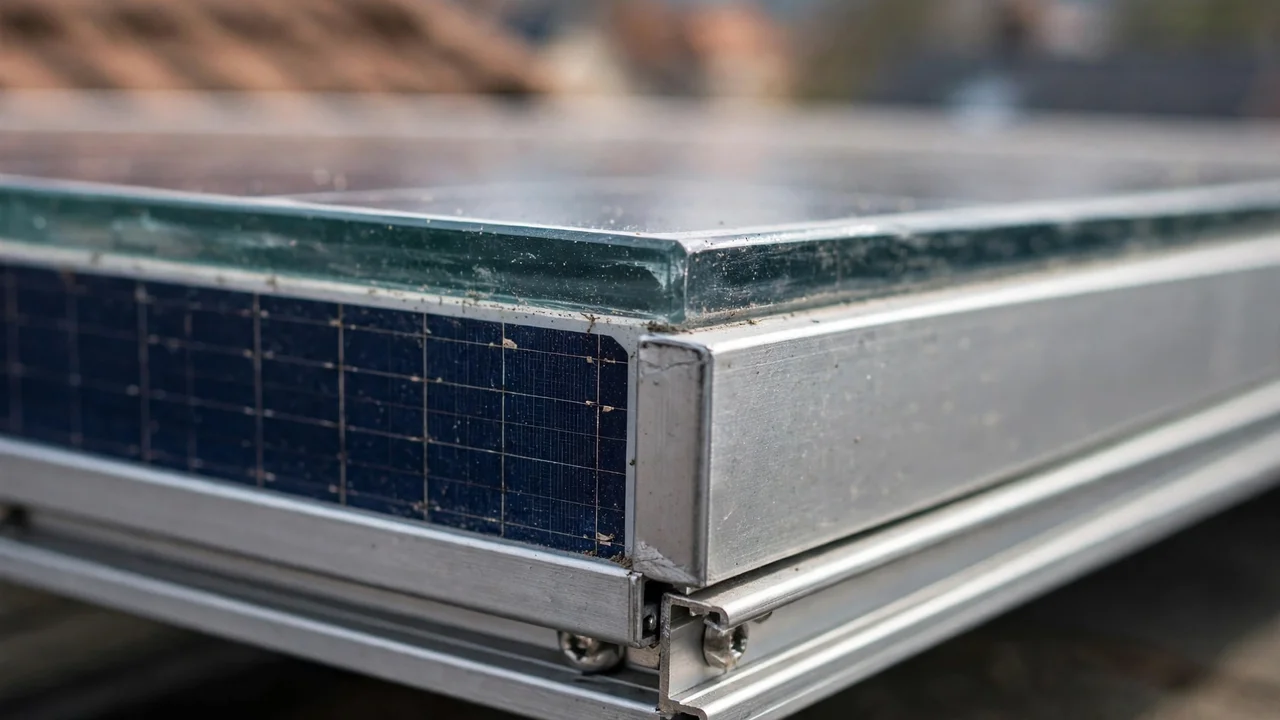
The glass. Standard modern panels often use thinner glass to save weight — sometimes 1.6 to 2.0mm per side on dual-glass designs. The anti-hail variant’s 2.5mm fully tempered glass on both sides is the key upgrade. Tempering makes glass roughly four to five times stronger than ordinary glass, and that extra 0.5mm is what allows full tempering. Thinner glass can only be heat-strengthened, which is weaker.
The frame. The 35mm frame adds stiffness, so the panel flexes less under impact and wind. Flex is what cracks cells even when the glass looks fine — invisible micro-cracks that show up months later as mysteriously dropping output. Heavy snow-load and wind-load ratings on the datasheet are really measuring this same stiffness.
When comparing any two panels, do not just compare watts. Compare glass thickness and type, frame thickness, and mechanical load ratings. Those three numbers tell you more about storm survival than wattage ever will.
What do the datasheet numbers say?
Here are the headline figures, all from Canadian Solar’s public TOPBiHiKu6 Anti-Hail datasheet. Where two versions of the datasheet disagree on load ratings, both wordings are kept and labelled below — they are not silently merged.
| Spec | Datasheet figure |
|---|---|
| Series power range | 600W to 630W |
| Peak efficiency (630W model) | Up to 23.3% |
| Cells | 132 half-cut N-type TOPCon cells |
| Glass | 2.5mm fully tempered, both sides |
| Frame | 35mm |
| Hail test | Ice balls up to 55mm, per IEC 61215 |
| Temperature coefficient (Pmax) | -0.29%/°C |
| Bifaciality | Up to 85% |
| First-year degradation | No more than 1% |
| Annual degradation after year one | No more than 0.4% per year |
| Product warranty | 12 years |
| Linear power warranty | 30 years |
Load ratings — two datasheet wordings, kept separate: one datasheet version lists heavy snow load up to 5400 Pa and wind load up to 4000 Pa; another datasheet version for the same series lists snow load up to 6000 Pa and wind load up to 5400 Pa. If a dealer quotes you a load figure, ask which datasheet version it came from and check it against the model on the label.
What is not in the datasheet: the datasheet does not state a Pakistan launch date or a local price. This guide does not invent either one. Check the live price on the website and ask an authorised distributor for the exact model number and local warranty terms.
Does hail-resistant glass make sense in Pakistan?
Let me be blunt about our local reality.
Pakistan’s northern and central regions — from Peshawar through Rawalpindi to Lahore — get genuine hailstorms, especially in spring. I have seen seasons where installers in hail-belt districts spend weeks replacing cracked modules. A rooftop system is often a family’s biggest investment after their home, and it sits exposed to the sky for 25 years.
There is also a quiet financial angle. As extreme weather gets more common, insurers look harder at asset risk. A panel with documented enhanced hail testing is a more defensible asset — easier to insure, easier to finance.
Does every buyer need anti-hail panels? Honestly, no. Where hail is rare, standard Tier-1 panels installed well will serve you fine. Put the difference into a better hybrid inverter or battery setup instead. But in the hail belt, or on a commercial plant where one storm could wipe out a whole array, the premium is cheap insurance.
Bonus Tip: Ask older installers in your district about the worst hail of the last ten years. Local memory beats national statistics. If they wince, take hail resistance seriously.
How do you read the warranty like a technician?
Warranties are where marketing meets mathematics. Let us decode the numbers on this panel.
12-year product warranty. This covers manufacturing defects: delamination, junction box failures, frame corrosion. Twelve years is the mainstream Tier-1 standard. Note what it typically does not cover: weather damage beyond rated loads, improper installation, and cleaning damage. Read the exclusions. They matter more than the headline number.
30-year linear power warranty. This guarantees slow output decline: no more than 1% in the first year, then no more than 0.4% per year after. On a 630W panel, 25 years of that maths leaves you above roughly 89% of original output — around 560W. That is the real promise, and it is excellent.
But a warranty is only as good as the company behind it and the local channel that honours it. A 30-year promise with no service presence in Pakistan is a piece of paper. Ask the dealer: who handles a warranty claim in Lahore? What is the process? If the answers are vague, the warranty is vague.
How do you buy high-wattage panels without costly mistakes?
Whether you buy this panel or any other 600W-class module, run through this checklist.
Match the panel to your inverter. A 630W panel has an open-circuit voltage around 45–46V — the datasheet range is 45.1V to 46.2V across the series. Check your inverter’s MPPT voltage window before buying. High-wattage panels with 13A+ current also need an MPPT that can accept that current, or you paid for watts you cannot harvest.
Demand the datasheet and match the label. The model number on the panel’s backsheet must match the datasheet exactly. Grey-market relabelled panels are a real problem in our market.
Inspect before installation. For bulk buys, ask for electroluminescence (EL) testing or at minimum a flash-test report. Micro-cracks from transport are more common than factory defects.
Do not neglect the structure. A 630W dual-glass panel weighs roughly 33–40kg. Your mounting structure must handle the weight plus wind load. Weak mounting damages more systems than hail does.
Remember the electronics. Panels last decades, but inverters need service. Build your system with people who can also repair it, using genuine spare components from the electrical and solar range.
Note: Prices for newly launched variants swing wildly in the first months. Never pay a “launch premium” under pressure. Check the live price on the website and compare authorised dealers first.
Frequently asked questions
Is the Canadian Solar 630W anti-hail panel available in Pakistan?
Availability of new variants changes quickly, and I will not invent a launch date or a price. Check the live price on the website or ask an authorised distributor for the exact model number and local warranty terms.
What does “anti-hail” actually guarantee?
Enhanced, tested impact resistance — here, testing with ice balls up to 55mm per IEC 61215 methodology — not immunity to all hail. Think of it as a stronger helmet, not a force field.
What is the IEC 61215 hail test?
It is the international durability standard for solar modules. The baseline hail test fires 25mm ice balls at 23 m/s at 11 points on the panel. Manufacturers may run enhanced tests with larger ice balls, producing figures like 55mm.
Are bifacial panels worth it on a home rooftop?
It depends on your roof. Bifacial gain needs reflected light reaching the rear — light-coloured roofs, elevated mounting, and ground clearance all help. On a dark, flat, low-mounted roof the rear gain is small. On ground-mounted or commercial systems it usually pays off.
Does hail damage void the panel warranty?
Usually, weather damage beyond rated mechanical loads is excluded from product warranties. That is standard across brands. This is exactly why documented hail resistance and proper insurance matter.
Should I wait for anti-hail panels or buy standard panels now?
If you are in a hail-prone district and buying a large system, waiting for or seeking out enhanced hail-tested panels is sensible. If your need is urgent and your area rarely sees hail, a quality standard Tier-1 panel installed well is the better use of your money today. You can explore current solar options in the electrical and solar range.
Verdict: who should buy this panel?
Hail is one of those risks that feels abstract until the sky turns black and ice starts hammering your roof. Then, in about ten minutes, you learn exactly what your panels were made of. The arrival of genuinely hail-tested panels is good news. It pushes the whole industry toward tougher, more honest engineering.
If you made it to the end, congratulations. You now understand hail testing, TOPCon, and panel warranties better than most dealers in the market. That knowledge is worth real money.
Buy the anti-hail variant if you live in the hail belt or you are protecting a large commercial array. Buy a good standard Tier-1 panel if hail is rare where you live, and spend the saving on the inverter, the battery, or the mounting structure. Either way, demand the datasheet, match the label, and check the live price on the website before you commit.
When you are ready to build or expand your system — panels, inverters, or the spare parts that keep everything running — visit SunTech Mall and check the live price there first. We would rather earn your trust with honest engineering than with hype.
1 Comment
[…] Note: I am deliberately not listing this series’ detailed specifications, because specs without an official local datasheet are rumours with formatting. When buying any model, demand the datasheet PDF and match it against the unit’s label — the same discipline I teach in our solar panel buying guide. […]