Solar Inverter Repairing Parts Names and Their Easy Functions
An easy guide explaining solar inverter repairing parts names and what each part does, written in simple English for everyone.

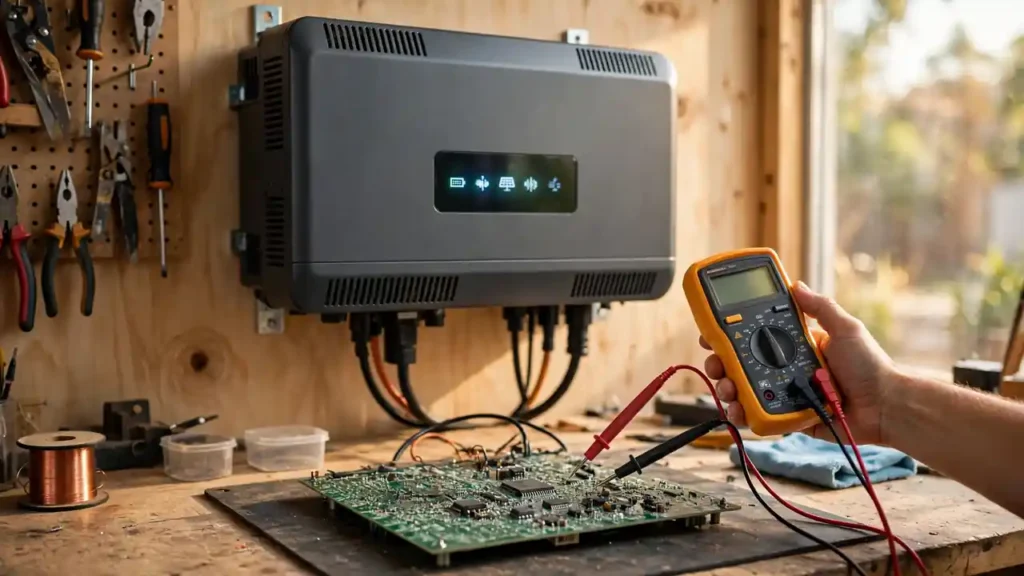
Open a dead solar inverter and you will see a green board covered with small black and silver parts. Most beginners feel the same thing at that moment: confusion. Which part does what? Which one failed? What should you even ask the shopkeeper for?
I write repair guides for SunTech Mall, and our team talks to inverter technicians across Pakistan every week. The same story comes up again and again. A technician opens an inverter, stares at the board, and guesses. Sometimes the guess is right. Sometimes a wrong part gets replaced, money gets wasted, and the inverter still does not work.
Here is the fear every beginner has: what if I buy the wrong part and damage the inverter even more? This guide removes that fear. You will learn the name and job of every important part inside a solar inverter, in simple words that a 10-year-old can understand. No engineering degree needed.
Let us start with the part that does the heaviest work inside your inverter.
Note: You do not need to memorize circuits. You only need to recognize parts and know what each one does. That is exactly what this guide teaches — recognition first, repair second.
What You Will Learn in This Guide
- Meet the power switch: MOSFET and IGBT — the parts that handle all the heavy electricity
- Meet the brain: the control card that gives orders to every other part
- Meet the voltage adjuster: the transformer that keeps power safe
- Meet the smoothers: capacitors that keep electricity steady
- Meet the one-way valves: diodes that stop reverse current
- Meet the current limiters: resistors that protect sensitive parts
- Meet the bodyguard: fuses that sacrifice themselves to save the board
- Meet the lungs: the cooling fan that keeps everything alive
- How to read part numbers without confusion
- Five beginner mistakes that waste money
- Where to buy original parts in Pakistan
Meet the Power Switch: MOSFET and IGBT
Touch the big metal heatsink inside a running inverter and you will feel real heat. That heat comes from the power switches — the hardest-working parts in the whole inverter.
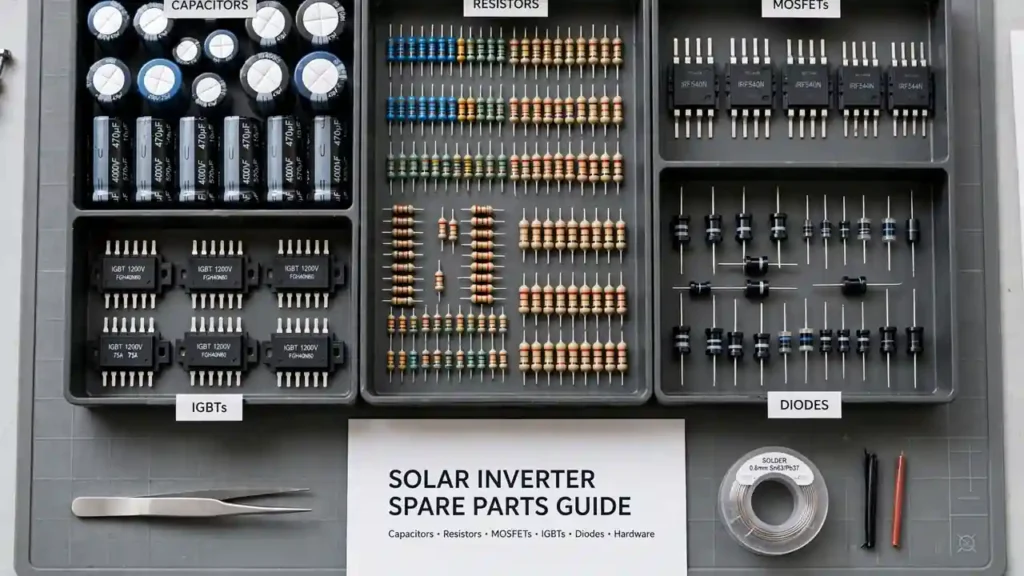
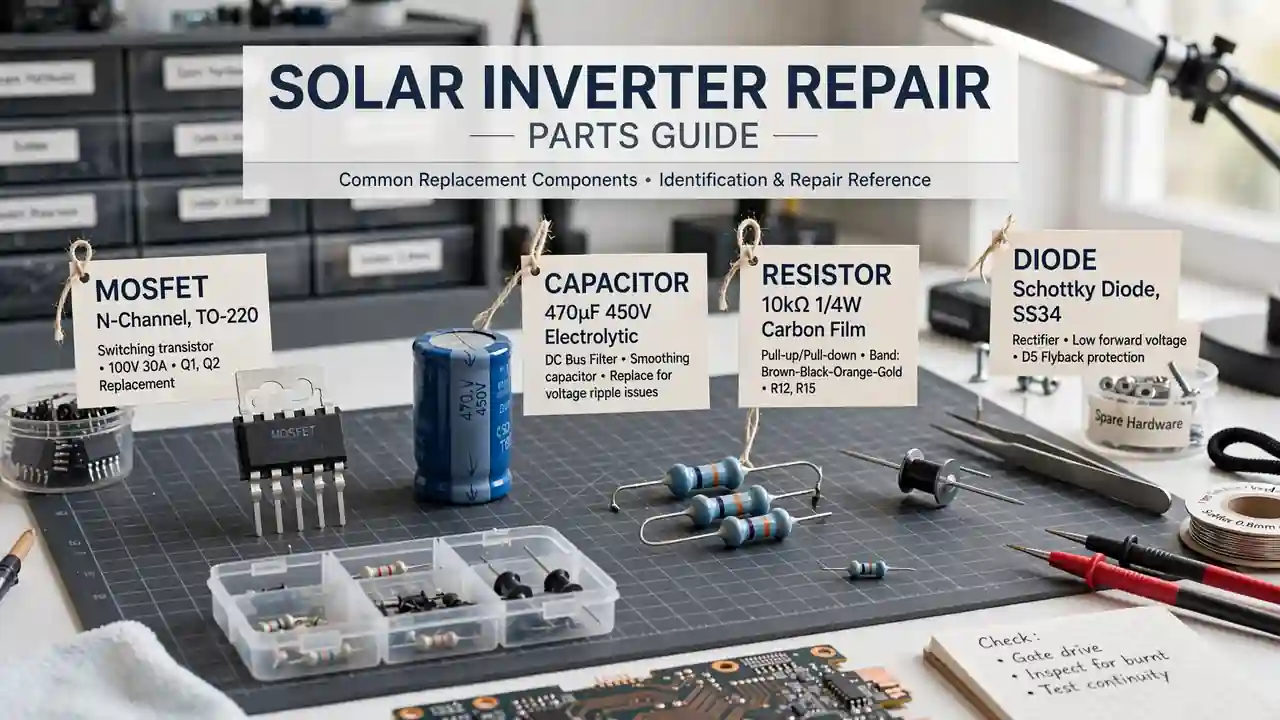
A MOSFET (Metal-Oxide-Semiconductor Field-Effect Transistor) works like a super-fast light switch. It turns electricity on and off thousands of times every second. This rapid switching converts battery DC power into the AC power your home uses. Common part numbers printed on them include IRF3205, IRF3710, and HY3215.
An IGBT (Insulated-Gate Bipolar Transistor) does a similar job but is built for heavier work. You will find IGBTs in larger inverters — typically 5KW and above — where power levels are too high for ordinary MOSFETs.
When they fail, the inverter usually refuses to turn on or blows fuses repeatedly. For deeper learning, read our power MOSFET selection guide and why MOSFETs burn in Pakistani inverters.
Bonus Tip: When a MOSFET fails, it often fails shorted — electricity flows through it even when it should be off. Always replace all parallel MOSFETs together, not just the burnt one, because the survivors are usually stressed too.
Meet the Brain: The Control Card
Every team needs a leader. Inside the inverter, the control card (also called the main board) is that leader. It tells the inverter when to charge the battery, when to switch to solar, and when to shut down for safety. It also watches for problems and shows error codes on the display.
When the control card is damaged, symptoms are confusing. The inverter may show strange errors, behave randomly, or stop working even though all the big power parts test fine. Such faults often follow lightning strikes, severe voltage spikes, or water damage.
Because the control card is specific to each inverter model, always match the exact model number. A card from a different model will not work, even if it looks identical.
Meet the Voltage Adjuster: The Transformer
Look for the heaviest part on the board — usually a big block wrapped in copper-colored wire. That is the transformer. It changes electricity from one voltage level to another, so each section gets the voltage it needs.
Transformers are tough and rarely fail on their own. When they do, something else went wrong first — like a shorted MOSFET. A burnt smell near the transformer is a serious warning sign.
Meet the Smoothers: Capacitors
A capacitor is like a small tank that collects bursts of electricity and releases a smooth, steady flow. Inside an inverter, capacitors smooth out voltage ripples and filter electrical noise. The big cylindrical ones near the MOSFETs are called electrolytic capacitors, and they do the heaviest smoothing work.
Here is the painful truth every technician learns: capacitors are the most common small part to fail. Heat dries out their insides over time, and Pakistan’s hot summers speed this up. A weak capacitor causes unstable output, random shutdowns, or a humming sound. Learn more in our guide on capacitor failure caused by heat.
When replacing capacitors, match capacitance (like 470uF), voltage rating (like 35V), and temperature rating. Never use a lower voltage rating than the original. Browse quality inverter capacitors built to handle heat.
Bonus Tip: A swollen or leaking capacitor is dead — replace it immediately. But even capacitors that look fine can be weak inside. If an inverter restarts randomly and everything else tests good, suspect the capacitors.
Meet the One-Way Valves: Diodes
A diode lets electricity flow in only one direction — like a one-way valve for water. Diodes protect circuits by blocking reverse current. They are essential in the charging section, where they stop battery power from flowing backward into solar panels at night.
The small black cylinders with a silver stripe are diodes — the stripe marks one end. When a diode fails shorted, fuses blow again and again. If a new fuse blows immediately, check the nearby diodes first. Find the right ones in our diode collection.
Meet the Current Limiters: Resistors
A resistor resists the flow of electricity — like a narrow section in a water pipe. Resistors protect sensitive components by keeping current at safe levels.
Resistors rarely fail on their own. A burnt resistor is a clue, not the criminal — something nearby forced too much current through it. Find the real cause, or the new resistor burns again. Explore quality resistors.
Meet the Bodyguard: Fuses
A fuse is the only part whose job is to die. If current goes dangerously high, the fuse wire melts and breaks the circuit — sacrificing itself to save every other part.
Never replace a blown fuse with a thicker wire or higher rating “to stop it blowing.” The fuse is telling you something is wrong. Bypassing it lets fault current destroy the MOSFETs and control card. Replace with the exact same rating, then find what caused it to blow.
Meet the Lungs: The Cooling Fan
Put your hand near the inverter’s vents on a hot afternoon and you will feel warm air pushing out. That airflow is the cooling fan breathing out heat before it cooks the internal parts.
When the fan slows down or stops, overheating begins silently. Read our full warning about inverter overheating linked to fan failure. Fans fail from dust on blades, worn bearings, or cheap replacements that cannot survive summer heat. When replacing, match size, voltage (usually 12V or 24V), and airflow direction.
Note: Clean fan blades and vents every few months, especially before summer. Five minutes of cleaning can prevent a costly repair.
Meet the Helpers: Relays, ICs, and the Display
That click sound when the inverter switches between solar, battery, and grid? That is a relay — an electrically operated switch. When relay contacts wear out, the inverter may fail to switch sources or make repeated clicking sounds. Relay faults are common where load shedding is frequent, because the relay switches far more often than designed.
The small black rectangles with many legs are ICs (integrated circuits) — complete mini-circuits doing specific jobs like driving MOSFET gates or regulating voltage. The gate driver IC is critical: it sits between the control card and MOSFETs, and when it fails, MOSFETs get wrong signals and burn even though they were fine.
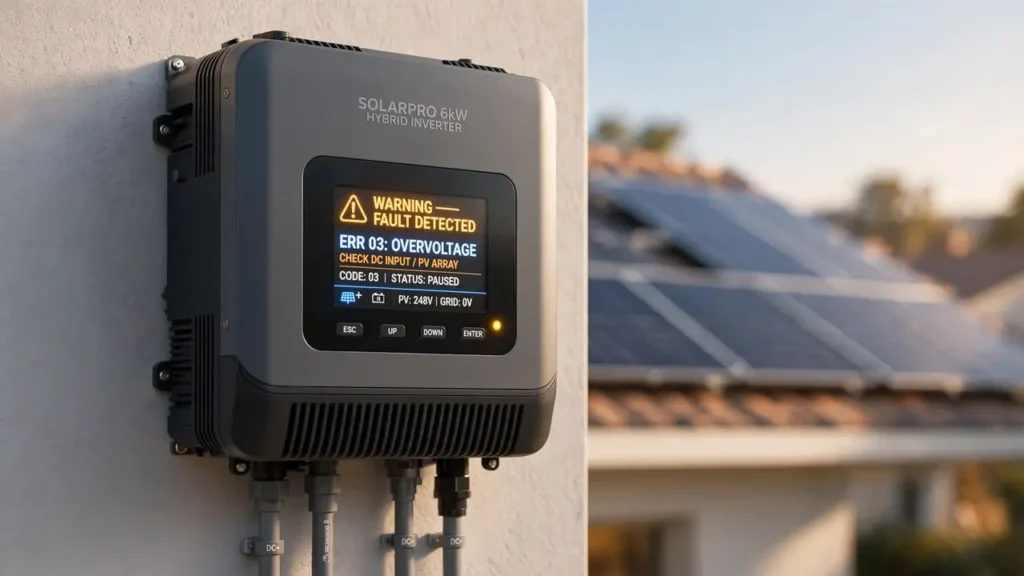
The LCD display on the front only reports — battery level, solar input, error codes. Learning to read error codes is one of the most valuable technician skills: a code points you to the faulty section instead of testing the whole board blindly.
How to Read Part Numbers Without Confusion
Every part has its identity printed on it. MOSFETs show the full number — like IRF3205 — write it down exactly, every letter and number. Capacitors show capacitance and voltage directly (“470uF 35V”); never use a lower voltage rating. Resistors use color bands — learning the color code takes one evening and pays off forever. Diodes show a part number you can search online.
The most common beginner error is judging by shape alone. A transistor and a voltage regulator can look identical but do completely different jobs. Always check the printed number. When in doubt, photograph the part and its markings before removing it — the photo becomes your shopping list.
Bonus Tip: Keep a small notebook with three columns: part name, part number, and where you bought it. After a few months you will have your own parts database that makes every future repair faster.
Five Beginner Mistakes That Waste Money
1. Replacing only the visibly burnt part. The burnt MOSFET is the victim, not always the criminal. A failed gate driver IC or weak capacitor nearby may have caused it. Test surrounding parts or the new one burns again.
2. Using cheap replacement parts. Low-quality capacitors or MOSFETs may work for weeks, then fail — sometimes taking other parts with them. Original parts cost a little more but prevent repeat repairs.
3. Touching boards carelessly. Static from your hands can damage sensitive ICs. Touch grounded metal first, and hold boards by their edges.
4. Skipping the fuse rating. A higher-rated fuse removes the board’s only protection. The next fault destroys expensive parts instead of a cheap fuse.
5. Practicing on live equipment. Never open an inverter connected to power. Large capacitors hold charge even after switch-off. Beginners should never probe live circuits.
Where to Buy Original Parts in Pakistan
Knowing part names is half the battle. The other half is finding original parts — not copies that fail in weeks. SunTech Mall stocks original MOSFETs, IGBTs, capacitors, diodes, resistors, fans, and control accessories for solar inverters and UPS systems, with delivery across Pakistan.
We work with repair shops who cannot afford repeat failures — their reputation depends on parts that last. Browse the full electronic parts collection or visit the SunTech Mall shop. For shops buying in quantity, a reliable supplier means faster turnaround, happier customers, and fewer warranty comebacks.
Frequently Asked Questions
Which part fails most often in a solar inverter?
MOSFETs and electrolytic capacitors fail most often. MOSFETs handle heavy switching current and heat; capacitors age with heat and time. Cooling fan failure is also very common and often triggers the other failures.
Can I replace a MOSFET with a different part number?
Only if the replacement has equal or better voltage, current, and switching specs. A weaker MOSFET will overheat and fail quickly. When in doubt, use the exact original part number.
Why does my inverter keep blowing fuses?
A fuse blows from excess current — almost always a shorted MOSFET or diode. Never bypass the fuse. Find and replace the shorted component first, then fit a new fuse of the exact original rating.
Are all capacitors the same?
No. They differ in capacitance, voltage rating, temperature rating, and type. Always match or exceed the original voltage rating and use the same capacitance. Cheap capacitors fail fast in hot inverters.
How do I know if the control card is faulty?
Signs include strange or changing error codes, random behavior, or everything testing fine while the unit still fails. Such faults often follow lightning, severe voltage spikes, or water exposure.
Can a beginner really learn inverter repair?
Yes — part recognition and simple replacements are learnable with practice on dead boards and guidance from experienced technicians. But get safety training before working on anything connected to power, and start with identification before attempting repairs.
Where can I buy original inverter parts in Pakistan?
SunTech Mall offers original MOSFETs, IGBTs, capacitors, diodes, resistors, fans, and more with nationwide delivery. Visit the SunTech Mall shop to browse.
Final Thoughts
Every expert technician was once a beginner staring at a board full of strange parts. The difference is simple: they learned one part at a time, and they never stopped.
You now know the names and jobs of the parts that matter most — the power switches, the brain, the smoothers, the valves, the bodyguard, and the lungs. That knowledge already puts you ahead of most inverter owners. The next step is practice: open a dead inverter, identify what you see, and let your hands learn what your eyes now know.
And when you need parts you can trust, SunTech Mall is here — original components, honest guidance, delivery anywhere in Pakistan.