



How the 1N6A10 Diode Contributes to Improve Energy Solutions
The 1N6A10 diode revolutionizes energy solutions with efficient power rectification and high-voltage performance. Ideal for solar inverters and battery charging, it boosts energy efficiency and sustainability in modern systems. Explore its specs,…

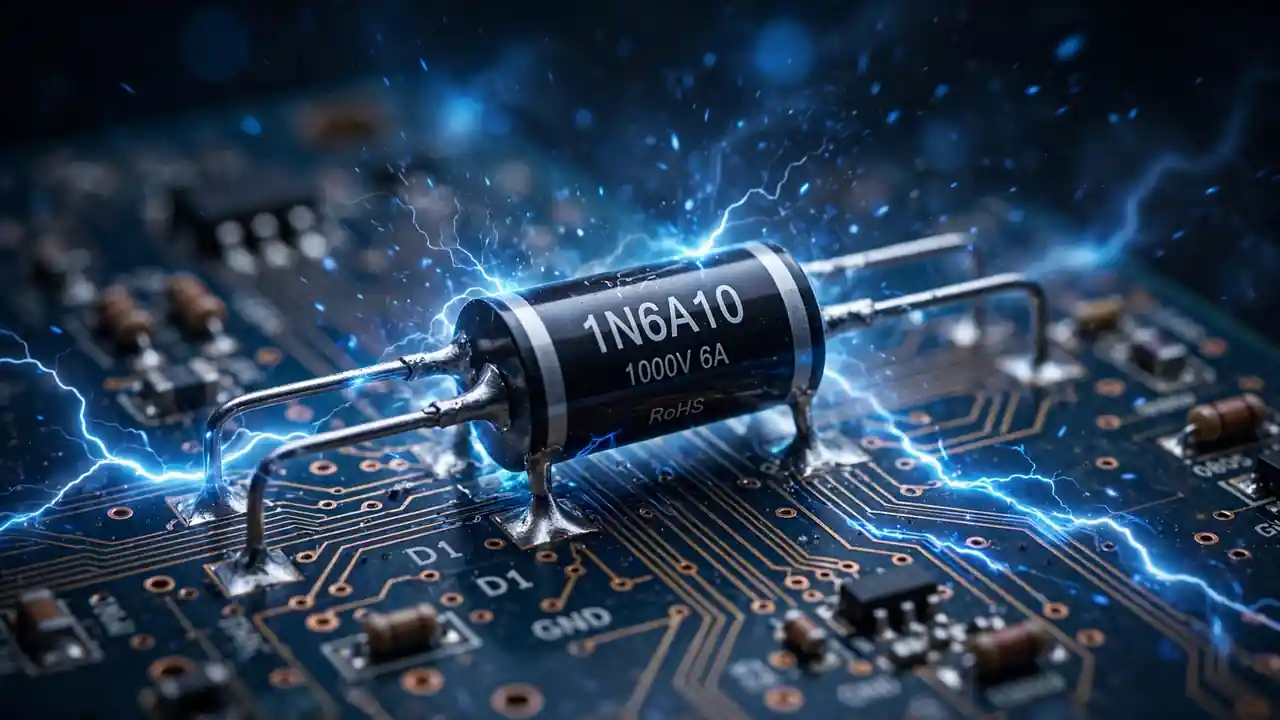
It costs less than a cup of chai, weighs almost nothing, and most people would walk right past it on a circuit board. Yet the 1N6A10 diode carries up to 10 amps of current while blocking 1000 volts — and when it fails, entire inverters shut down instantly. I have seen this humble rectifier diode save systems and destroy them, depending entirely on whether the installed part was genuine or fake. In this guide, I will explain exactly what the 1N6A10 does, why it matters so much in solar inverters and power supplies, how to test it, and how to make sure you are buying the real thing. Small component, big consequences — let us get into it.
My promise: You will understand this diode completely — its specs, its job, its failure modes — and you will never again underestimate a “cheap” component.
What You Will Learn in This Guide
- What the 1N6A10 actually is (decoding the part number)
- Its key specifications in plain language
- Where it works inside solar inverters and power supplies
- How it contributes to energy efficiency and system reliability
- How to test it and spot counterfeits
Decoding the Part Number: What 1N6A10 Means
Electronic part numbers are not random — they are codes. Let me decode this one:
- 1N — the prefix for a two-terminal semiconductor device (a diode) under the JEDEC numbering system used in America. One “N” means one junction.
- 6A10 — this variant encodes the ratings: 6A series family with 10 representing the voltage class.
In practice, the 1N6A10 belongs to the well-known 10A10 family — 10-amp, 1000-volt silicon rectifier diodes in the rugged R-6 axial package. The “10” at the end indicates 1000V peak repetitive reverse voltage (VRRM). Its siblings include the 10A05 (500V), 10A1 (100V), 10A2 (200V), 10A4 (400V), 10A6 (600V), and 10A8 (800V) — same current rating, different voltage classes for different applications.
Why this matters: When you understand the naming, you can substitute intelligently. A 10A10 can replace a 10A06 in most circuits (higher voltage rating is safe), but never the reverse.
Key Specifications in Plain Language
Datasheets intimidate beginners, so let me translate the important numbers:
Average forward current: 10A
This diode can carry 10 amps of current continuously under proper conditions. That is serious power — enough for the main rectification stage of kilowatt-class inverters and UPS systems. Exceed this rating and the diode overheats and fails.
Peak repetitive reverse voltage: 1000V
The diode blocks voltage in the reverse direction up to 1000 volts. This high rating provides safety margin in circuits where voltage spikes occur — which, in Pakistani grid conditions, is essentially always. Higher blocking voltage means the diode survivers transients that would destroy lower-rated parts.
Package: R-6 axial
The R-6 is a large through-hole axial package — bigger than the common DO-41 (1N4007) size. The larger body dissipates heat better, which is exactly what a 10-amp diode needs. Through-hole mounting also provides mechanical robustness in high-vibration environments.
Forward voltage drop: ~0.8–1.0V
Like all silicon diodes, it drops roughly one volt when conducting. At 10 amps, that means about 10 watts of heat to dissipate — which is why these diodes are often mounted with adequate PCB copper area or heatsinking in serious designs.
Bonus Tip: That forward voltage drop is your best counterfeit test. A genuine silicon rectifier reads 0.5–0.8V on a multimeter’s diode test. A reading of 0.2V (Schottky-like) or 1.5V+ on a supposedly new 1N6A10 means something is wrong with the part.
Where the 1N6A10 Works Inside Your Inverter
Input rectification stage
In UPS systems and inverter chargers, incoming AC must be converted to DC for battery charging. Bridge configurations of high-current diodes like the 1N6A10 handle this conversion. They face the full wrath of grid voltage fluctuations, making their 1000V rating genuinely important — not just a datasheet number.
Output and freewheeling applications
In switching circuits, diodes provide freewheeling paths for inductive currents and protect switching transistors from voltage spikes. A failed freewheeling diode lets spikes hit the MOSFET directly — and MOSFETs lose that fight every time. For more on MOSFET failures, see our MOSFET burning guide.
SMPS secondary rectification
In some auxiliary power supply designs, robust rectifier diodes convert the chopper transformer’s high-frequency output back to DC. Learn how the transformer side works in our chopper transformer guide.
Solar blocking and bypass functions
Related diode applications in solar systems include blocking diodes (preventing battery discharge back through panels at night) and bypass diodes (routing current around shaded panel sections). While these often use Schottky types for lower voltage drop, the principle is identical: diodes as one-way valves for electricity.
How It Contributes to Energy Efficiency
“Contributes to improve energy” — the original title’s claim — deserves an honest explanation. A rectifier diode does not create energy. What it does is waste as little as possible while doing its essential job:
Low forward voltage means less heat. Every tenth of a volt dropped at 10 amps is a watt of heat. Quality diodes with consistent, low forward voltage keep efficiency high and temperatures manageable. In a 3kW inverter running for hours, these small savings compound into meaningful efficiency differences.
Fast, clean switching reduces losses. Standard recovery rectifiers like the 1N6A10 are designed for mains-frequency and moderate-speed applications. Used within their intended frequency range, they switch cleanly without excessive reverse-recovery losses that plague misapplied parts.
Reliability is efficiency. Here is the point most people miss: a diode that fails takes the system down. Every hour an inverter sits dead is an hour of solar energy wasted. A genuine, properly-rated diode that lasts years contributes more to total energy harvested than any marginal efficiency specification. Reliability is the efficiency that matters.
Note: For very high-frequency switching (hundreds of kHz), engineers choose fast-recovery or Schottky diodes instead. The 1N6A10 is a standard-recovery rectifier — excellent in its intended applications, wrong for high-frequency SMPS outputs. Using the right diode type for the circuit is part of good design.
Standard vs Fast Recovery: Knowing the Difference
Beginners often wonder why there are so many diode types. The key distinction is reverse recovery time — how quickly a diode stops conducting when voltage reverses:
- Standard recovery (like the 1N6A10): Recovery time in microseconds. Perfect for 50/60Hz mains rectification, battery chargers, and general power applications where switching happens at line frequency. Rugged, cheap, and reliable in their domain.
- Fast recovery: Recovery in tens to hundreds of nanoseconds. Needed in switching power supplies operating at tens of kilohertz, where a slow diode would waste massive energy during each switching transition.
- Schottky: Near-zero recovery time and low forward voltage (~0.3V vs ~0.8V), but limited reverse voltage (typically under 200V). Ideal for low-voltage, high-frequency outputs.
The mistake to avoid: using a standard rectifier like the 1N6A10 in a high-frequency switching position. It will overheat from recovery losses and fail prematurely — not because it is a bad diode, but because it is the wrong diode for that job. Conversely, paying for fast-recovery diodes in a 50Hz bridge rectifier wastes money with zero benefit. Match the diode technology to the switching frequency, and every diode lives a long, cool life.
How to Test a 1N6A10
Testing takes thirty seconds with any digital multimeter:
- Set your meter to diode test mode (the diode symbol).
- Connect red to anode, black to cathode. You should read approximately 0.5–0.8V forward voltage.
- Reverse the leads. The meter should show “OL” (overload/open) — no conduction in reverse.
- Interpret results: Near-zero reading both ways means shorted (dead). “OL” both ways means open (dead). Correct readings mean the diode is at least fundamentally functional.
This basic test catches shorted and open diodes — the two most common failures. It will not catch subtle degradation, but for field diagnosis, it is usually enough to identify the culprit.
Spotting Counterfeit Rectifier Diodes
Even cheap components get counterfeited when volumes are high. Watch for:
- Wrong body size: A genuine R-6 package has specific dimensions. Undersized bodies suggest a smaller die inside — it will overheat at rated current.
- Poor marking: Blurry, uneven, or easily-scratched part numbers.
- Wrong electrical readings: Forward voltage far outside the 0.5–0.8V range.
- Inconsistent batches: Genuine manufacturing is consistent. If ten diodes from one bag give wildly different readings, be suspicious.
For a complete counterfeit-detection system covering all component types, read our guide to spare parts suppliers in Peshawar.
Buy Genuine 1N6A10 Diodes from SunTech Mall
At SunTech Mall, we stock genuine rectifier diodes including the 1N6A10/10A10 family for Pakistan’s repair community. Five years of serving inverter technicians means we understand exactly what you need:
- Verified genuine components — correct ratings, correct packages, no counterfeits.
- Full diode and rectifier range — from signal diodes to high-current bridges.
- Complete repair support — MOSFETs, IGBTs, capacitors, fans, optocouplers like the TLP350H, and transformers in one order.
- Nationwide delivery — contact info@suntechmall.com or +92 306 2244820.
Also explore our MOSFET selection guide and genuine hybrid inverter parts collection.
Frequently Asked Questions
What is the 1N6A10 diode used for?
The 1N6A10 (10A10 family) is a 10-amp, 1000-volt silicon rectifier diode used in power supplies, UPS systems, solar inverters, battery chargers, and industrial equipment — anywhere high-current AC-to-DC conversion or freewheeling protection is needed.
What is the difference between 1N6A10 and 1N4007?
Current rating and size. The 1N4007 handles 1 amp in a small DO-41 package; the 1N6A10 handles 10 amps in the much larger R-6 package. Both block 1000V. They are not interchangeable — a 1N4007 would burn instantly in a 10-amp circuit.
Can I replace a 1N6A10 with a higher voltage diode?
Yes — using a higher voltage rating than required is safe (e.g., a 1000V diode where 600V is needed). But never substitute a lower current rating. Always match or exceed both current and voltage specifications of the original.
How do I know if a rectifier diode is burnt?
Test with a multimeter in diode mode. A shorted diode reads near-zero in both directions; an open diode reads “OL” in both directions. Visually, look for cracked bodies, discoloration, or burnt PCB traces around the diode.
Why do rectifier diodes fail in inverters?
Overcurrent from overloads or short circuits downstream, voltage spikes exceeding the reverse rating, overheating from inadequate heatsinking or blocked airflow, and counterfeit parts that cannot handle their stated ratings.
What is the forward voltage drop of a 1N6A10?
Approximately 0.8 to 1.0 volts at rated current for silicon rectifiers of this type. On a multimeter diode test (which uses small current), expect roughly 0.5–0.8V. Significant deviation suggests a faulty or counterfeit part.
Can I use a Schottky diode instead of a 1N6A10?
Only if the reverse voltage requirement allows it — Schottky diodes typically max out at much lower voltages (often under 200V). For a 1000V application, a standard silicon rectifier like the 1N6A10 is the correct choice. Schottkys excel at low voltage, high frequency; silicon rectifiers excel at high voltage.
Final Thoughts
The 1N6A10 will never be the star of a product brochure. It does its job silently, switching thousands of times per hour, blocking a thousand volts without complaint — until someone installs a fake, and then it becomes the most expensive cheap component you ever bought.
Congratulations — you now understand rectifier diodes at a level most electronics students take semesters to reach. You can decode part numbers, interpret specifications, test components, and spot counterfeits. That is real, practical power electronics knowledge.
For genuine 1N6A10 diodes and every component in your repair arsenal, visit SunTech Mall. Original parts, honest specs, delivered across Pakistan.