

IRF 3710 N-Channel MOSFET – Boost Solar Inverter Efficiency with 100V 57A
When designing a solar inverter, selecting the right MOSFET plays a crucial role in optimizing performance and efficiency. IRF 3710 One such highly efficient and reliable MOSFET, a 100V 57A MOSFET with…

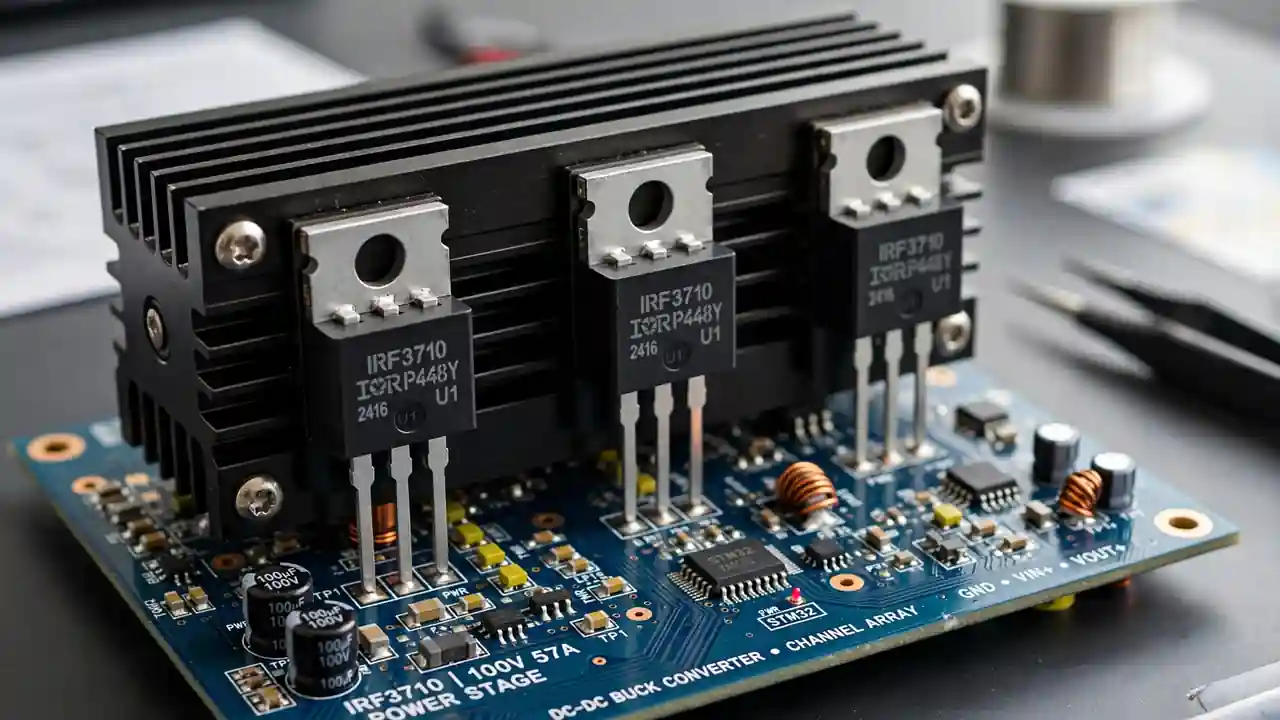
A few years ago, I rebuilt a solar inverter in my workshop and watched the output sag under load. The transformer, battery, and wiring were all fine. The real culprit was hiding in plain sight: the switching MOSFETs were running hot and wasting solar energy as heat. In an inverter, the MOSFET is the heart of the whole machine.
Since then, I have repaired dozens of inverters and power circuits. I have seen cheap MOSFETs burn and counterfeit parts fail in days, while good parts ran for years. The IRF3710 sits firmly in that last group: a genuine HEXFET MOSFET from International Rectifier (now Infineon), with datasheet numbers engineers trust.
Here is the fear every inverter builder shares: pick the wrong MOSFET and you get hot heatsinks, wasted solar power, and an inverter that dies young. Pick the right one and the same circuit runs cooler and lasts longer. In this guide, I will show you exactly what the IRF3710 offers, what its specs really mean, and how to use it correctly. No jargon, no fluff.
So let us start with the big question: why does this one small part decide the fate of your entire inverter?
Trust nudge: I am not here to sell you magic. A MOSFET cannot fix a weak battery or a bad transformer, but it can switch power cleanly and coolly. Every number here comes from the official datasheet, not guesswork.
In This Guide
- Why Your Inverter’s MOSFET Choice Decides Everything
- IRF3710 Specifications, Explained in Plain Words
- How the IRF3710 Boosts Solar Inverter Efficiency
- Keeping the IRF3710 Cool: Thermal Basics That Matter
- Driving the IRF3710 Gate the Right Way
- Where the IRF3710 Works Best
- Buying a Genuine IRF3710 (and Why It Matters)
- Frequently Asked Questions
- Final Thoughts
Why Your Inverter’s MOSFET Choice Decides Everything
The first time I opened a dead inverter, the burnt smell hit me before I even saw the fault. Two MOSFETs had cooked themselves while the rest of the circuit was perfectly fine. That repair cost the owner more than good MOSFETs ever would have.
A solar inverter does one big job: it turns DC from your panels or batteries into AC for your home. That switching happens thousands of times per second, and the MOSFETs do all of it. Every watt that reaches your appliances passes through these small parts.
Here is what most beginners miss. A MOSFET is not a perfect switch. It has a small internal resistance and takes a tiny moment to turn on and off. Both create switching losses, which turn into heat instead of useful power. Like a tap that never fully opens, some energy always leaks as heat.
This is why the IRF3710 is so popular. Its on-resistance is just 23 milliohms maximum, so more of your solar energy reaches the load instead of warming up the heatsink.
For more MOSFET options and learning material, browse the MOSFETs guide at SunTech Mall.
IRF3710 Specifications, Explained in Plain Words
Datasheets can feel overwhelming, so here are the IRF3710’s key specs translated into words that actually make sense.
- Type: N-channel HEXFET power MOSFET
- Drain-source voltage (Vds): 100V maximum
- Continuous drain current (Id): 57A at 25°C case temperature
- On-resistance (Rds(on)): 23mΩ maximum at 10V gate drive
- Gate threshold voltage (Vgs(th)): 2.0V to 4.0V
- Power dissipation (Pd): 200W at 25°C case temperature
- Package: TO-220 through-hole, easy to mount
- Total gate charge (Qg): 130nC maximum at 10V
- Max gate voltage: ±20V, never exceed this
- Operating temperature: -55°C to +175°C junction, fully avalanche rated
Let me unpack the three numbers that matter most. The 100V rating means the MOSFET can safely block up to 100 volts between drain and source, a comfortable margin for 12V or 24V inverter systems against voltage spikes.
The 57A current rating is how much continuous current the part can carry with its case held at 25°C. That is serious capacity for high-wattage inverters and motor drivers, as long as your cooling is good.
And the 23mΩ on-resistance is the star of the show. Resistance turns current into heat, so lower is always better. At 23 milliohms, the IRF3710 wastes very little power even under heavy loads.
Note: The 57A and 200W ratings assume the case is held at 25°C. Real circuits run hotter, so always design with a safety margin. A heatsink is not optional at high currents.
Bonus Tip: To get the full benefit of the 23mΩ rating, drive the gate with a full 10V. A weak gate drive leaves resistance on the table and heat in your circuit.
How the IRF3710 Boosts Solar Inverter Efficiency
During one repair, I swapped a tired set of MOSFETs for IRF3710s. The heatsink that used to burn my finger now felt merely warm. Same transformer, same battery, same load. Only the MOSFETs changed.
The biggest reason is conduction losses. When a MOSFET is fully on, it behaves like a tiny resistor, and wasted heat equals current squared times resistance. At 10 amps through 23 milliohms, the loss is about 2.3 watts, while a higher-resistance MOSFET would waste two or three times more. That wasted power comes straight out of your solar harvest.
The second reason is fast switching. The IRF3710 moves between on and off quickly, spending very little time in the “half-on” zone where losses are worst. Less heat also means a longer life for everything around it.
Bonus Tip: Need more current? Run two IRF3710s in parallel, each with its own small gate resistor, and keep the wiring symmetrical so the current splits evenly.
If you are building or repairing an inverter, you can check the IRF3710 100V 57A MOSFET on SunTech Mall and see the current price and availability.
Keeping the IRF3710 Cool: Thermal Basics That Matter
I once saw a hobbyist’s new inverter board with the MOSFETs standing alone and no heatsink. “They are rated for 200 watts,” he said. A five-minute test run with my thermometer told a different story.
That 200W number is the absolute maximum at a perfect 25°C case temperature. This is where thermal derating comes in: as temperature rises, the safe power limit falls. The IRF3710 helps because its junction-to-case thermal resistance is only 0.75°C per watt, so heat escapes to the metal tab very efficiently.
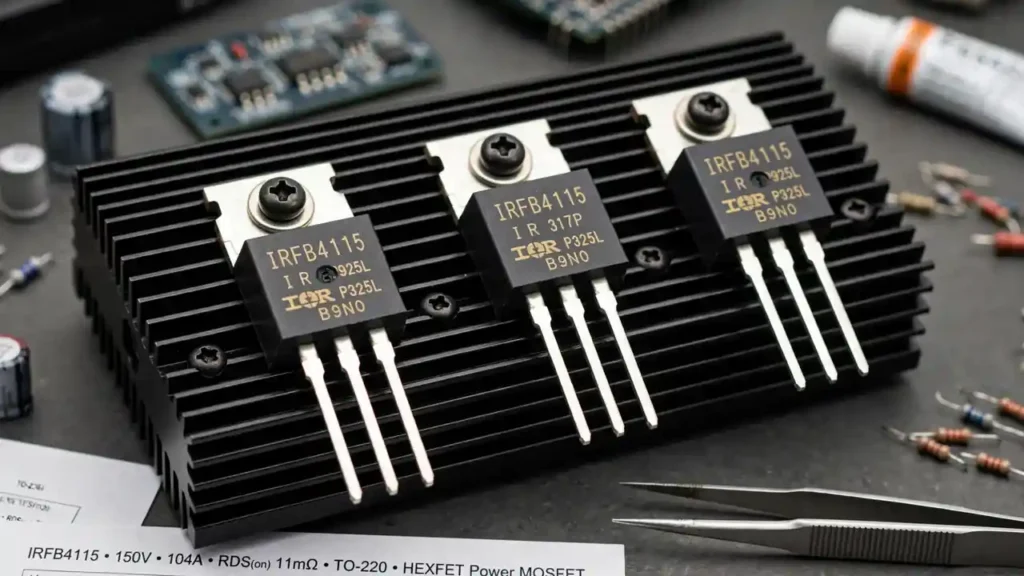
Still, give that heat somewhere to go. Bolt the TO-220 tab to a proper aluminium heatsink with a thin layer of thermal paste and a snug screw. The junction can survive up to 175°C, but surviving is not thriving. Keep the part as cool as you reasonably can, and it will reward you with years of quiet service.
Note: If your heatsink is too hot to touch comfortably after ten minutes of full load, your cooling is not enough. Add a bigger heatsink or a small fan before the MOSFET pays the price.
Driving the IRF3710 Gate the Right Way
Early in my repair days, I made an embarrassing mistake. I drove a power MOSFET straight from a 5V logic pin and wondered why it ran hot. The datasheet had the answer: the threshold starts turning the part on at 2 to 4 volts, but full turn-on needs much more.
That threshold confuses many beginners. Vgs(th) of 2.0V to 4.0V only marks where the MOSFET begins to conduct, and at that voltage it is barely awake. To reach the advertised 23mΩ, you need a proper gate drive voltage of around 10V. Driving the gate with only 5V lets current flow, but resistance stays far above 23mΩ.
Two rules keep your circuit safe. Never let the gate exceed ±20V, or you will destroy the thin gate oxide. Use a small gate resistor, typically 10 to 47 ohms, and keep the wiring between driver and gate short.
Bonus Tip: When you probe a running circuit, check the gate waveform with an oscilloscope if you have one. A clean, square 10V swing with fast edges means the drive is healthy. A slow, rounded slope means the driver is weak or the gate resistor is too large.
Where the IRF3710 Works Best
Over the years I have reached for the IRF3710 in more projects than I can count. Its sweet spot is high-current switching at voltages up to around 100V, which covers a huge range of real-world circuits.
The most obvious application is solar inverters, where 100V blocking, 57A current handling, and low on-resistance convert DC from panels or batteries into AC for your home. Here are the other places where this MOSFET shines:
- Solar inverters: the main switching element in DC-to-AC conversion
- Motor drivers: controlling DC motors in industrial and DIY equipment
- Switched-mode power supplies: efficient regulation in SMPS designs
- Battery chargers: high-power charging circuits with low losses
- Load switches: switching heavy DC loads cleanly on and off
- DC-DC converters: stepping voltage up or down with minimal waste
Its fully avalanche-rated, rugged HEXFET design also forgives the occasional voltage spike, which is a blessing in motor and inductive-load circuits where spikes are a fact of life.
Explore more power components in the MOSFETs category to find the right part for every stage of your build.
Buying a Genuine IRF3710 (and Why It Matters)
Let me tell you about the saddest repair I ever did. A customer brought in an inverter that had failed twice in three months. The MOSFETs were marked IRF3710, but they were fakes with far higher on-resistance, so they cooked themselves no matter how good the design was.
Counterfeit power components are a real problem. A fake may look identical, but it runs hotter and fails exactly when you need it most. The safest defence is simple: buy from a supplier you trust. Genuine parts save you from repeat repairs and damaged equipment.
At SunTech Mall, we stock genuine electronic components for builders, repair shops, and engineers across Pakistan. When you order the IRF3710 from us, you get the real HEXFET part with real datasheet performance. To check current prices and stock, visit the IRF3710 product page or browse the full range at suntechmall.com.
Note: If you repair inverters for customers, keep a small stock of genuine IRF3710s on hand. One failed fake part can cost you a customer; a drawer of genuine parts protects your reputation.
Have questions about choosing the right MOSFET? Reach out at info@suntechmall.com or call/WhatsApp +92 306 2244820. We are happy to help you pick the right part before you buy.
Frequently Asked Questions
Is the IRF3710 good for solar inverters?
Yes, it is an excellent choice. Its 100V rating, 57A current handling, and very low 23mΩ on-resistance suit the switching stage of solar inverters, so less heat is wasted and more solar energy reaches the output.
What voltage and current can the IRF3710 handle?
The IRF3710 handles up to 100V drain-to-source and 57A continuous drain current at a 25°C case temperature, and it can dissipate up to 200W under the same ideal cooling. Always design with a safety margin below these maximums.
Can I drive the IRF3710 directly with a 5V microcontroller pin?
Not for power circuits. The threshold is 2 to 4V, so 5V only partially turns it on and resistance stays far above 23mΩ. Use a MOSFET driver that delivers around 10V to the gate for full performance.
Does the IRF3710 need a heatsink?
At anything beyond very light loads, yes. The TO-220 tab is designed to bolt onto a heatsink with thermal paste. Without proper cooling, the part will overheat and fail.
What is the Rds(on) of the IRF3710?
The maximum on-resistance is 23 milliohms, measured at 10V gate drive and 28A drain current. This low value is why the IRF3710 runs so efficiently in high-current applications.
Which package does the IRF3710 come in?
The standard IRF3710 comes in the TO-220AB through-hole package, which is easy to solder and mount on a heatsink. Surface-mount variants exist under different part numbers, but the classic TO-220 remains the most popular for repair and DIY work.
Final Thoughts
Looking back at that first burnt inverter on my workbench, I wish someone had explained MOSFETs to me the way I have tried to explain them to you today. One small part and a few key numbers decide whether an inverter struggles or sings.
The IRF3710 is not the newest MOSFET on the shelf, and it does not need to be. Its 100V rating, 57A capacity, and 23mΩ on-resistance are proven numbers from a trusted HEXFET design. It switches cleanly, forgives the odd voltage spike, and fits the TO-220 package every repair shop knows by heart.
If you have read this far, congratulations. You now understand this MOSFET better than most people who use it: what the specs mean, why gate drive voltage matters, and how heat kills parts. That knowledge will save you money and frustration on every build and repair from here on.
When you are ready to build, repair, or upgrade, get your genuine IRF3710 from a supplier you can trust. Visit SunTech Mall, check the IRF3710 product page for current prices, or explore the SunTech Mall blog for more practical guides. If you ever feel stuck, write to info@suntechmall.com or message +92 306 2244820. We would love to hear what you are building.