

Top Electronic Components Shop For Solar Inverter In Pakistan
Hybrid solar inverters are becoming a game-changer in Pakistan, helping homes and businesses save energy and reduce electricity bills. These devices combine solar power and battery storage to provide reliable electricity, especially…

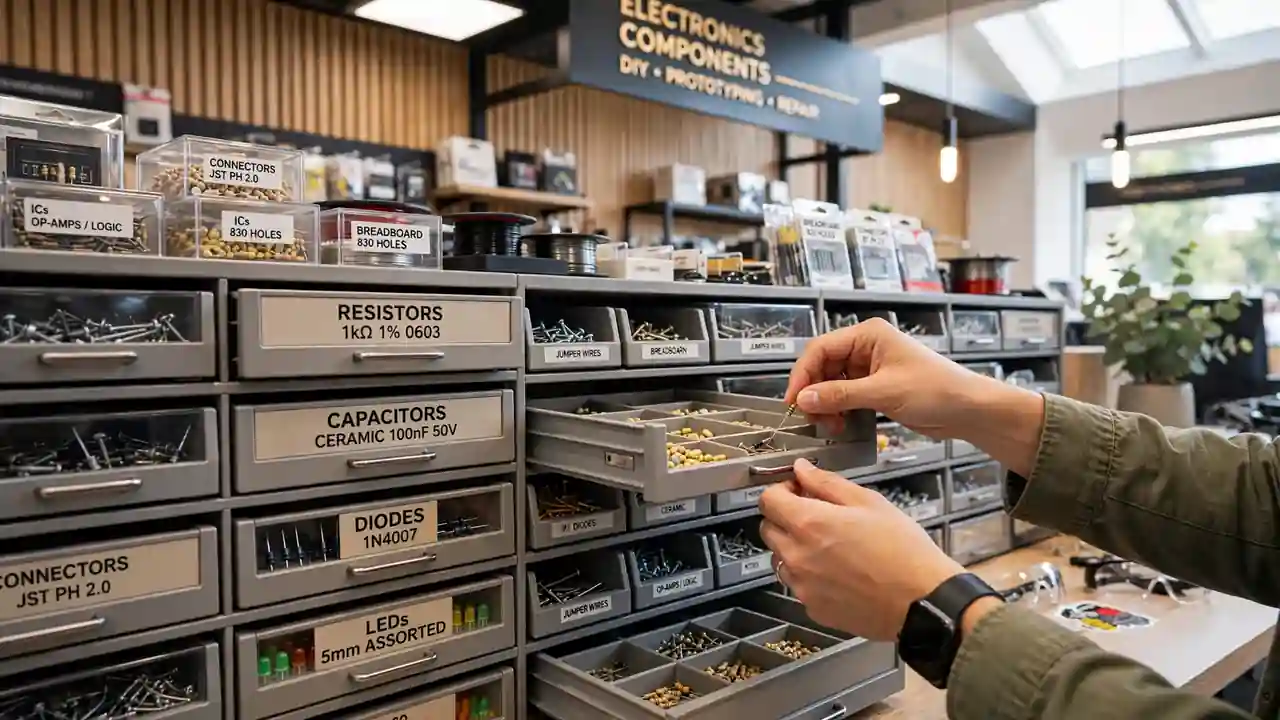
Hybrid solar inverters are the most sophisticated machines in Pakistan’s residential power landscape. They juggle three power sources — solar panels, batteries, and the grid — switching between them seamlessly to keep your home running. Inside that metal box is a small city of electronic components: power transistors switching at blinding speed, capacitors smoothing violent electrical pulses, transformers the size of your thumb handling kilowatts, and microcontrollers making a thousand decisions per second. When any of these components fail, you need a replacement that is exactly right — not approximately right. In this guide, I will show you what makes an electronic components shop worthy of your trust, which components matter most for hybrid inverters, and how to buy with confidence in 2026.
My promise: You will learn to judge any components supplier like a professional buyer — and you will know exactly where Pakistan’s repair community sources its most critical parts.
What You Will Learn in This Guide
- Why hybrid inverters demand better components than ordinary electronics
- The critical component categories and what each one does
- 5 tests of a trustworthy components shop
- How to read specifications like a technician
- Online vs local: making the smart choice for each situation
Why Hybrid Inverters Demand Better Components
A hybrid inverter lives a harder life than almost any other home electronic device. Consider what it endures: it switches kilowatts of power continuously, often in ambient temperatures exceeding 45°C. It faces grid voltage that swings wildly, lightning-induced surges during monsoon season, and dust that infiltrates every vent. Its components cycle thermally every day — heating under load, cooling at night — which stresses every solder joint and semiconductor die.
This brutal environment means component quality is not a luxury; it is survival. A capacitor that would last a decade in an air-conditioned office might last two years in a rooftop inverter cabinet. A counterfeit MOSFET that survives bench testing can explode within weeks under real switching stress. Every component in a hybrid inverter earns its place — or destroys its neighbors when it fails.
The technicians who thrive in this business share one trait: they are ruthless about component sourcing. They would rather wait three days for a genuine part than install a questionable one today. Their callback rate proves the wisdom.
The Critical Components and What Each One Does
Power MOSFETs and IGBTs — the muscle
These switching transistors are the heart of power conversion. MOSFETs typically handle the high-frequency switching stages; IGBTs handle the high-power output in larger units. They must be genuine, correctly rated, and properly cooled. A wrong or fake power transistor is the most expensive mistake in inverter repair — it often destroys the driver circuit when it fails. Master selection with our MOSFET selection guide and understand failure modes in our MOSFET burning guide.
Gate driver optocouplers — the precision timing
Components like the TLP350H translate the microcontroller’s logic signals into the powerful, precisely-timed gate drive pulses that MOSFETs and IGBTs need — while maintaining thousands of volts of electrical isolation between control and power sections. Degraded drivers cause mistimed switching, overheating, and catastrophic power device failure.
Chopper transformers — the internal power supply
These small high-frequency transformers power the inverter’s own control electronics. When they fail, the inverter goes completely dead. Our chopper transformer guide and hybrid inverter transformer guide cover everything you need to know.
Electrolytic capacitors — the smoothers
DC bus capacitors absorb ripple current; smaller capacitors filter every power rail in the machine. Heat is their enemy — always specify 105°C rated parts for inverter service, and check ESR (equivalent series resistance) when diagnosing aging units.
Rectifier diodes — the one-way valves
High-current diodes like the 1N6A10 handle AC-to-DC conversion and freewheeling protection. Simple, rugged, and absolutely essential.
Cooling fans — the guardians
Brushless DC fans keep everything above alive. A failed fan is a death sentence for power semiconductors. See our DC fan replacement guide.
Relays, fuses, and protection components
The unsung safety net. Quality protection components prevent small faults from becoming fires. Never bypass a fuse “temporarily” — temporary has a way of becoming permanent, right up until something burns.
Bonus Tip: When stocking a workshop, prioritize in this order: MOSFETs/IGBTs, capacitors, fans, diodes, gate drivers, then everything else. This matches real-world failure frequency and keeps your most common repairs same-day.
5 Tests of a Trustworthy Components Shop
Test 1: Specification transparency. A trustworthy shop lists exact part numbers, voltage and current ratings, package types, and manufacturer information. Vague listings (“power MOSFET, high quality”) are a red flag. You should know precisely what you are buying before you pay.
Test 2: Genuine sourcing commitment. The shop should explicitly guarantee original components — not “compatible,” not “equivalent,” not suspiciously silent on the question. Counterfeit electronics are a global crisis; your supplier should be your shield, not another risk.
Test 3: Technical competence. Ask a technical question — about gate charge, capacitor ripple current rating, or optocoupler CMTI. A shop that understands its products answers confidently. A shop that sells boxes without understanding them cannot help you when a substitution question arises.
Test 4: Consistent availability. Anyone can get lucky with one batch. A real supplier stocks the same critical parts month after month. Consistency proves supply chain depth.
Test 5: Accountability. Real business address, real contact details, invoices with every order, and a reputation visible in the repair community. When something goes wrong — and occasionally it will — accountability is what makes it right.
Note: Price matters, but it is the last test, not the first. The cheapest supplier who fails the other four tests is the most expensive supplier you will ever use — measured in callbacks, burnt boards, and lost customers.
How to Read Specifications Like a Technician
You do not need an engineering degree, but you need these basics:
- Voltage ratings must meet or exceed the original part. Higher is generally safe; lower is never acceptable.
- Current ratings must meet or exceed the original. Undersized parts overheat and fail.
- Package type (TO-220, TO-247, D2PAK, DIP-8, etc.) must match the PCB footprint and heatsink. Different packages are not interchangeable without board modification.
- Speed characteristics (switching times, recovery times) should be similar to the original. A much slower MOSFET in a high-frequency circuit will overheat even if voltage and current ratings look fine.
- Temperature ratings matter enormously in Pakistan. 105°C capacitors, high-temperature semiconductors, and adequate thermal margins are not optional.
When in doubt, match the original part number exactly. Substitution is a skill built on understanding — until you have it, exact replacement is the safe path.
Understanding Datasheets Without Fear
Many technicians avoid datasheets because they look intimidating. But you only need to find five numbers, and every datasheet puts them in a “Maximum Ratings” or “Electrical Characteristics” table:
- VDS or VCE — the maximum voltage the transistor can block. For MOSFETs this is drain-to-source voltage; for IGBTs, collector-to-emitter. Must exceed your circuit’s worst-case voltage with margin.
- ID or IC — the maximum continuous current. Must exceed your circuit’s normal operating current, ideally with comfortable headroom.
- RDS(on) or VCE(sat) — how much the device resists current when fully on. Lower means less heat wasted. This is the efficiency number.
- Qg (total gate charge) — how much charge the gate needs to switch. Lower means faster switching and less driver stress. Critical in high-frequency circuits.
- Package and pinout — must physically fit. A TO-247 will not fit a TO-220 heatsink pattern without modification.
Find these five, compare against the original part, and you can substitute with confidence. Ignore the other fifty parameters until you need them — they matter to designers, but these five decide whether a replacement survives.
Online vs Local: The Smart Approach
Use local markets for emergencies — when a customer is waiting and you need a common part today. Inspect carefully, test what you can, and accept that returns are unlikely.
Use trusted online suppliers for everything else: planned stock, critical semiconductors, and any part where authenticity is non-negotiable. The delivery wait is the price of certainty — and certainty is worth it when a fake IGBT can destroy a driver board.
The best technicians I know run a hybrid sourcing system: local for speed, online for trust. Their workshops are stocked, their repairs last, and their customers return.
For regional sourcing intelligence, see our guides to Peshawar suppliers, Peshawar inverter parts, and Mardan parts shops.
SunTech Mall: Built for Pakistan’s Repair Community
SunTech Mall is Pakistan’s dedicated online store for original solar inverter, UPS, and electronic components. For five years, we have done one thing: supply genuine parts to the people who keep Pakistan powered.
- Original components, guaranteed: Every part verified genuine. No counterfeits, ever.
- Complete specifications: Exact part numbers, ratings, and packages — published before you buy.
- Technical understanding: We know what a gate driver does and why CMTI matters. Ask us anything: info@suntechmall.com, +92 306 2244820.
- Nationwide delivery: From Karachi to Khyber, workshops trust our supply chain.
- Full ecosystem: From hybrid inverter parts to local spare parts to choppers and magnetics — one supplier for your entire bench.
Frequently Asked Questions
What is the best online shop for solar inverter components in Pakistan?
Look for suppliers with transparent specifications, guaranteed genuine sourcing, technical knowledge, consistent stock, and real accountability. SunTech Mall has served Pakistan’s repair community for five years with original components and nationwide delivery.
Which components fail most in hybrid solar inverters?
Power MOSFETs and IGBTs (heat and voltage stress), electrolytic capacitors (heat aging), cooling fans (dust and bearing wear), rectifier diodes, gate driver optocouplers, and chopper transformers. These categories cover the large majority of field failures.
How do I choose the right MOSFET for my inverter?
Match the original part number when possible. If substituting, ensure voltage and current ratings meet or exceed the original, the package fits the heatsink and PCB, and switching characteristics suit the circuit. Our detailed MOSFET selection guide walks through the complete process.
Are online electronic components genuine?
From reputable suppliers, yes. The key is choosing sellers who explicitly guarantee authenticity, publish full specifications, and have a track record in the repair community. Avoid sellers with vague listings and impossible prices.
What should I stock in a new inverter repair workshop?
Start with common power MOSFETs and IGBTs, electrolytic capacitors in popular values (105°C rated), 12V DC cooling fans, rectifier diodes, fuses, relays, and one or two gate driver optocouplers. Expand based on the specific inverter brands you service most.
Why do inverters fail more in summer?
Heat accelerates every failure mechanism: capacitor electrolyte dries faster, semiconductor thermal stress increases, fan bearings wear quicker, and dust accumulation worsens. Good ventilation, regular cleaning, and not overloading the inverter are the best summer defenses.
Can I get components delivered outside major cities?
Yes. SunTech Mall delivers across Pakistan, including smaller cities and towns. Contact info@suntechmall.com or +92 306 2244820 for delivery details to your area.
Final Thoughts
Behind every reliable solar inverter is a chain of quality components — and behind every quality component is a supplier you can trust. The technicians who understand this do not chase the lowest price; they build relationships with suppliers whose parts never let them down.
Congratulations — you now know what separates a real components shop from a box-mover: specification transparency, genuine sourcing, technical competence, consistent stock, and accountability. Apply these five tests to any supplier, and you will never be fooled.
When you want a supplier that passes all five tests, visit SunTech Mall. Five years. Thousands of workshops. One standard: original parts, every time.

1 Comment
[…] Read this post also: Top Electronic Components Shop For Solar Inverter In Pakistan […]