


Best 400V 82uF Capacitor in Charsadda Reliable and Efficient
When working on any electronic project—whether for home appliances, solar systems, or industrial machinery—selecting the right electronic components is essential. Among these, the 400V 82uF capacitor is one of the most popular…

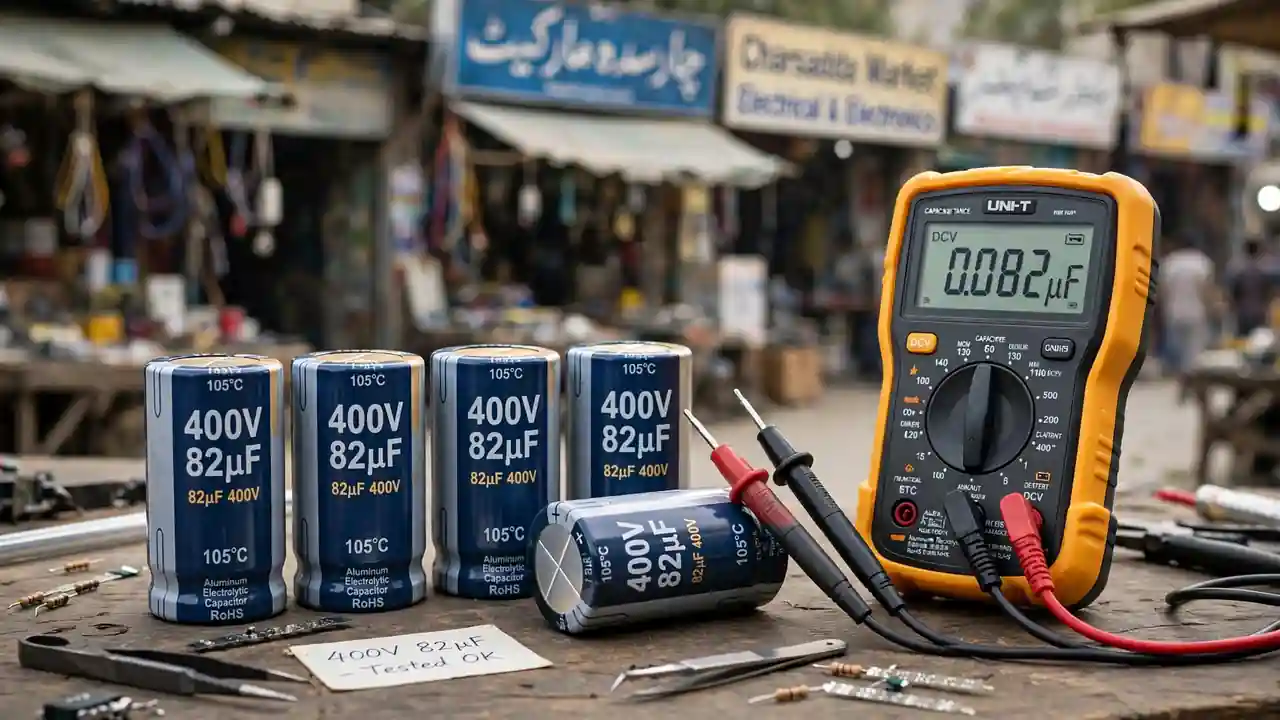
>There is a special kind of frustration that comes from a repair that almost works. The inverter powers up, the display lights, everything looks normal — and then the output wavers, or the unit resets under load. I have traced this exact behavior to the 400V 82uF capacitor more than once, hiding in the auxiliary or PFC section, doing a job nobody notices until it stops doing it well.
At SunTech Mall, we supply original electronic components to repair professionals across Pakistan. The 400V 82uF aluminum electrolytic capacitor is one of those mid-size parts that rarely gets discussed but frequently needs replacement. It is not the biggest capacitor on the board, but the circuit depends on it more than its size suggests.
The worry with any capacitor replacement is simple: buy the wrong specification and you have wasted money; install it wrong and you have created a hazard. On a 400V-rated part, both mistakes carry real consequences.
In this guide, you will learn what the 400V 82uF capacitor does, where it lives in power circuits, how to test it with basic tools, how to replace it safely, and how to source genuine ones in Charsadda. Let us start by decoding the label.
A Quick Note Before You Trust This Guide
Everything here — the tests, the selection rules, the buying checks — works regardless of where you purchase the part. I would rather you buy the right capacitor from a competitor than the wrong one from us. Knowledge first, shopping second.
In This Guide: What You Will Be Able To Do
- Read and understand every marking on a 400V 82uF capacitor
- Know where this value is typically used in power electronics
- Test capacitance and check for failure with a multimeter
- Recognize the symptoms of a degraded 82uF capacitor
- Replace it safely with correct polarity and specifications
- Buy genuine stock in Charsadda with confidence
Decoding the Markings: 400V 82uF
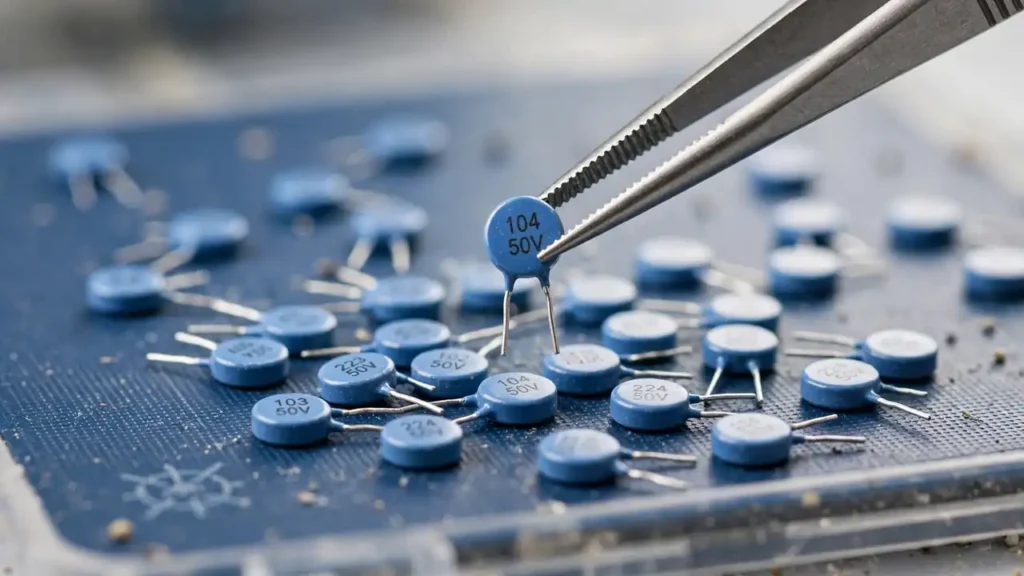
Capacitor markings are compact datasheets. Here is the translation.
82uF is the capacitance — 82 microfarads. This sits in the middle range for electrolytics: larger than the small decoupling capacitors on control boards, smaller than the bulk DC bus capacitors. Values like 82uF are chosen when the circuit needs meaningful energy storage but the designer is balancing board space and cost.
400V is the maximum DC voltage rating. Apply the standard 20 percent derating rule: for reliable long-term service, keep the working voltage at or below 320V. This rating places the capacitor in the family of parts used on rectified-mains circuits, where the nominal DC sits around 311V (from 220V AC) plus surge headroom.
Aluminum electrolytic construction means polarized — the striped side is negative. It also means the standard electrolytic characteristics apply: ±20 percent capacitance tolerance is normal, ESR matters for ripple applications, and lifetime depends heavily on operating temperature.
Temperature rating — insist on 105°C for power electronics. The price difference between 85°C and 105°C parts is small; the lifetime difference in a hot inverter enclosure is enormous.
Bonus Tip: 82uF is not a “standard” E-series value that you will find in every catalog — it is a value chosen deliberately by circuit designers for specific filtering requirements. If your board calls for 82uF, try to match it rather than rounding to 100uF, though 100uF is usually an acceptable substitute in non-critical filtering positions.
Where the 400V 82uF Capacitor Works
You will most often find this capacitor in power factor correction (PFC) circuits and auxiliary power supplies within inverters, UPS units, and switch-mode power supplies. In PFC stages, it smooths the boosted DC bus; in auxiliary supplies, it filters the high-voltage rail feeding the control electronics.
It also serves in startup circuits, where it stores the initial charge that wakes up the controller before the main supply stabilizes. A degraded capacitor here produces the classic “tries to start, then dies” behavior.
Another common position is snubber and clamp networks across switching devices, where the capacitor absorbs voltage spikes. In these roles, the capacitor sees high-frequency ripple current, which makes ESR and ripple current rating — not just capacitance — critical to longevity.
Note: When a capacitor serves in a high-ripple position, a replacement must match or exceed the original’s ripple current capability, not just its capacitance and voltage. Two capacitors with identical 400V 82uF markings can have very different ripple ratings depending on series and construction. This is one reason brand and series matter.
Symptoms of a Failing 82uF Capacitor
Because this capacitor often supports control or PFC circuitry, its failure signature is indirect — the symptoms point everywhere except at the capacitor.
Unstable output under load is a leading indicator. The unit behaves at no load but falters as load increases, because the degraded capacitor cannot maintain the rail it is supposed to smooth.
Repeated resets or restarts, especially when warm, suggest a capacitor whose ESR climbs with temperature. The circuit works while cool, then the rising ESR starves the rail it filters.
PFC fault codes on inverters with power factor correction often trace to the PFC bus capacitor. If the service manual points at the PFC stage, check its capacitors before replacing expensive semiconductors.
Visual signs — bulging top, electrolyte residue, discolored sleeve — are definitive. On an 82uF can, the bulge can be subtle; sight along the top from the side to catch it.
Testing: The Five-Minute Verdict
Discharge safely first. Use a 10K ohm 5W resistor across the terminals, wait several seconds, then confirm zero volts with your meter. A 400V capacitor deserves full respect.
Inspect visually. Flat top, clean base, intact markings. Any deviation is grounds for replacement.
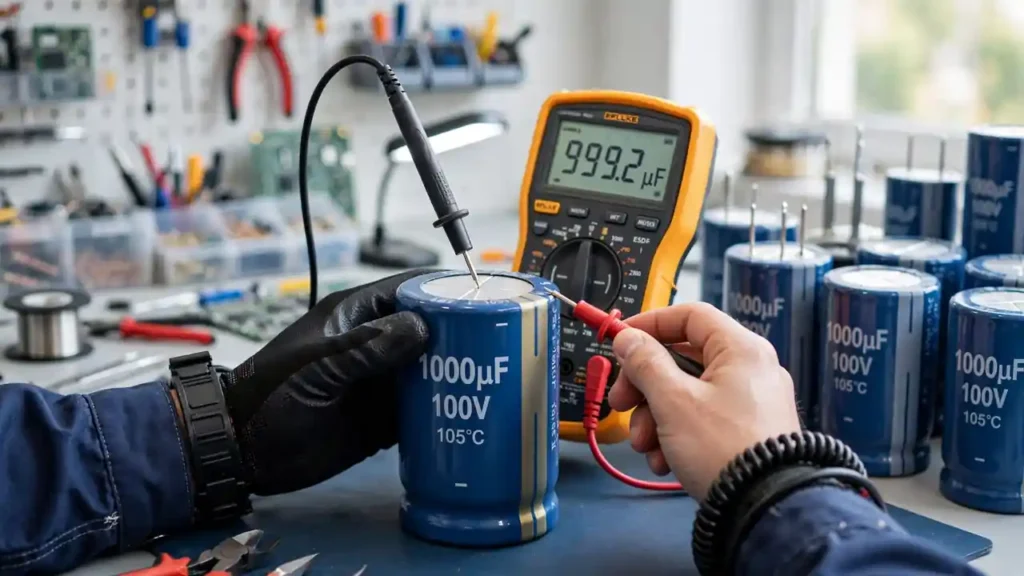
Measure capacitance. Multimeter on capacitance mode. Acceptable range is roughly 66uF to 98uF (±20 percent). Well below 66uF indicates dried electrolyte and end of life.
Check resistance behavior. On ohms mode, expect the reading to climb toward infinity as the capacitor charges from the meter. A fixed low reading means internal short.
Bonus Tip: An ESR meter gives the earliest warning. For an 82uF high-voltage electrolytic, ESR should be in the low single-digit ohms. Rising ESR means the capacitor is aging even while capacitance still reads within tolerance — replace on high ESR to prevent the failure rather than reacting to it.
Replacement: Getting It Right
Power isolation comes first — disconnect every source (mains, solar, battery) and verify zero volts at the capacitor with your meter. Photograph the original for polarity reference.
Match the specifications: 400V rating minimum (never lower; higher is acceptable if it fits), capacitance 82uF (100uF acceptable in most filtering roles), 105°C temperature rating, and physical dimensions that fit the footprint.
Polarity is non-negotiable. The striped side goes to the negative-marked pad. Double-check against your photograph before soldering. Reversed electrolytics on 400V rails fail violently.
Solder cleanly with adequate iron heat — the pads for this size of capacitor sink significant thermal energy. Seat the component flush, trim leads, and inspect joints under good light.
Test under load after replacement: normal startup, stable operation, and a fifteen-minute loaded run with the new capacitor staying barely warm to the touch.
Buying Genuine in Charsadda
Printing quality is your first filter — sharp, aligned sleeve text suggests genuine manufacture. Blurry or skewed printing suggests otherwise.
Vent scoring on the top should be crisp and symmetrical. This is a safety feature; its absence on a supposed high-voltage capacitor is a serious red flag.
Weight comparison against a known-good sample can reveal counterfeits with skimped internal material.
Series and datasheet. Ask the seller for the manufacturer series. Genuine distribution chains can answer this question; grey-market sellers often cannot.
For verified genuine stock, visit SunTech Mall and browse the electronic parts section. Related high-voltage guides — the 450V 330uF and 450V 100uF, 400V 47uF, and solar equipment articles — cover the neighboring values you will encounter on the same boards.
Ripple Current: The Specification Most Buyers Ignore
Ask a buyer what matters in a capacitor and they will say capacitance and voltage. Ask a design engineer and they will add a third: ripple current rating. For the 400V 82uF working in PFC and switching positions, this specification can matter more than the other two combined.
Ripple current is the AC component flowing through the capacitor as the circuit switches. Every ampere of ripple through the capacitor’s internal resistance (ESR) becomes heat: P = I²R. A capacitor rated for 1A ripple forced to carry 2A generates four times the internal heat. That heat dries the electrolyte, raises ESR further, and the spiral tightens.
Here is the practical problem: two capacitors marked “400V 82uF” from different series can have ripple ratings differing by a factor of two or more. The cheaper series saves money at purchase and costs far more in early failure. This is why the series designation — not just the headline values — belongs on your purchasing checklist.
When replacing, the rule is simple: the replacement’s ripple current rating must meet or exceed the original’s. If you cannot find the original’s datasheet, choose a reputable 105°C series from an established manufacturer — their ripple ratings are honestly specified and generally generous. Avoid no-name parts in high-ripple positions entirely; the savings are imaginary.
Note: Oversizing capacitance slightly (82uF → 100uF) in the same series usually increases ripple current capability, since larger cans in a series are rated higher. So the common 100uF substitution does double duty: acceptable capacitance and better ripple handling. One more reason it is the standard field substitution.
Frequently Asked Questions
Can I replace 82uF with 100uF?
In most filtering and smoothing positions, yes — 100uF is within a reasonable range and the circuit will tolerate it. In timing-critical or resonant positions, match the original value. When uncertain, match exactly.
Why 400V and not 450V?
The designer selected 400V as adequate for the actual working voltage with proper derating. If the working voltage stays below 320V, 400V is correct and 450V is unnecessary — though a 450V replacement is always acceptable if it fits physically.
How long should this capacitor last?
A quality 105°C part, operated within ratings in reasonable ventilation, typically gives years of service. Heat, excessive ripple current, and operation near maximum voltage all shorten life. In hot installations, lifespan can drop dramatically.
Can I test it without removing it from the board?
Visual inspection works in-circuit, but capacitance and ESR measurements need at least one lead isolated — parallel components corrupt the readings. Desolder one lead for a trustworthy test.
What if the new capacitor fails quickly?
Rapid repeat failure points to a circuit problem rather than bad parts: excessive ripple current from a failing switching device, overvoltage from a regulation fault, or extreme ambient heat. Investigate the circuit instead of installing a third capacitor.
Does ESR really matter for this value?
Yes, especially in PFC and switching supply positions where ripple current is high. A capacitor can read correct capacitance while its ESR has tripled — and that elevated ESR causes the heating that finishes it off. An ESR meter is one of the best investments a repair technician can make.
Final Thoughts
The 400V 82uF capacitor exemplifies the components that keep power electronics running while attracting zero attention — until they degrade, and then the symptoms masquerade as everything except a capacitor problem. Unstable output, thermal restarts, and PFC faults all belong on its suspect list.
Your toolkit is now complete: read the markings, understand the derating logic, test before replacing, observe polarity religiously, and buy genuine 105°C parts. These habits turn capacitor replacement from guesswork into reliable repair.
When you need verified genuine stock, check the electronic parts at SunTech Mall, or reach us at info@suntechmall.com / +92 306 2244820 for specification help.