
Discover Genuine Hybrid Solar Inverter Parts Website In Pakistan
Genuine parts come from good makers. They fit perfectly and don't waste energy. If you're looking for hybrid solar inverter parts Pakistan, always choose real ones. SunTech Mall has them all. They…

How Do You Buy Genuine Hybrid Solar Inverter Parts in Pakistan?
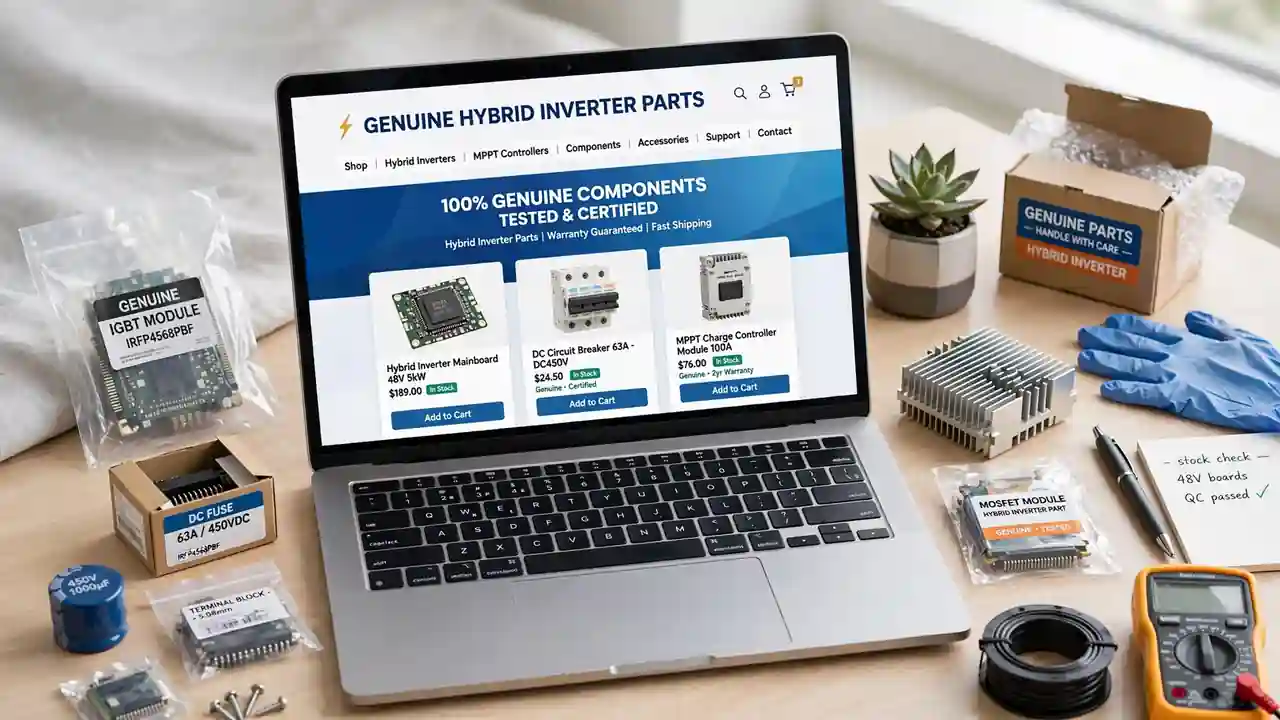
Buy genuine hybrid solar inverter parts Pakistan repair shops trust by matching the exact part number and datasheet, buying from a seller with a traceable chain, and testing the part before you solder it. A fake MOSFET can look right, work for a short while, then fail shorted and damage the board around it. This guide shows you which parts fail most, how to spot fakes, what a workshop should stock, and how to order with care.
Why do genuine parts matter more than a low sticker price?
Inside a real MOSFET, the silicon die is full size for its datasheet rating, so it handles its rated current and voltage with margin. Inside a common fake, the die is often smaller: a lower-rated part sanded down and relabelled. It works on the bench at low load. It dies in real service, often by failing shorted — stuck on, with current rushing through without control.
That kind of failure rarely stays small. It can burn tracks, crack the board, kill neighbouring parts, and in the worst case create a fire risk inside a home. Then comes the callback cost. Every failed repair returns to your bench, and you redo it for free. One callback wipes out the saving from many cheap parts. And reputation follows the same path: repairs that last get recommended, repairs that die in weeks get warned about. A genuine part costs more at the counter and far less everywhere else.
Which inverter parts fail most often?
Power MOSFETs
These are the top failure point. They switch DC to AC at high current and speed, so heat, voltage spikes, and gate-driver faults kill them. One shorted MOSFET often takes its neighbours with it, so always check the full bank, not just the burnt one. When you replace them, replace the bank as a matched set from the same batch. Mixing old and new parts, or parts from different makers, can cause uneven current sharing, and the weakest part dies first.
IGBTs
These do similar work in higher-power stages. Heat and spikes kill them too, and they sit among the most counterfeited parts, so source them with extra care. Match voltage, current, package, and gate traits from the datasheet, never by shape alone. For the five numbers that decide a power switch match, see the power MOSFET selection guide.
Electrolytic capacitors
Heat dries these out, above all in hot cabinets. A weak capacitor causes faults that come and go: random shutdowns, unstable output, and fault codes that vanish when you look for them. They are cheap parts whose failure can mimic an expensive fault, so techs check them early. Check for bulging tops and leaking seals, and test with an ESR meter where you can, since a capacitor can fail on resistance before it shows a clear loss of capacitance.
Bridge rectifiers
These sit at the AC input and take the first hit from every mains surge. When one shorts, fuses blow and the inverter goes fully dead. Test with a multimeter in diode mode before you condemn the rest of the board.
Cooling fans
A seized fan is a quiet killer. It overheats the whole power stage and can kill MOSFETs, capacitors, and rectifiers together. Spin fans by hand at every service. A stiff or noisy fan is a future failure, and it is one of the cheapest fixes you can make.
Control cards and driver ICs
These fail less often but hurt more. A faulty gate driver can destroy new MOSFETs in seconds by driving them wrong. If MOSFETs keep dying after replacement, suspect the driver stage before you fit another set.
| Part | Common symptom | First check |
|---|---|---|
| Power MOSFETs | Dead unit, or shutdown under load | Full bank test, not just the burnt one |
| IGBTs | Dead or tripping high-power stage | Datasheet match, driver stage |
| Electrolytic capacitors | Random shutdowns, unstable output | Visual check, ESR test |
| Bridge rectifiers | Fully dead, blown fuse | Diode-mode multimeter test |
| Cooling fans | Overheating, then wider failure | Spin by hand, listen for noise |
| Driver ICs | New MOSFETs die again fast | Gate drive signals, driver supply |
Heat and power stress kill parts in groups. A good tech checks everything that shared the failed part’s stress. That habit separates professionals from part-swappers.
How do you spot a fake part before it burns you?
- Check markings first. Real parts carry crisp laser-etched print: full part number, logo, and date and batch codes. Fakes show blurry inkjet print, missing logos, wrong fonts, or no date code. Compare against a known-good part when you can.
- Feel the weight and package. A real TO-220 MOSFET has a solid metal tab and clean moulding. Fakes feel lighter, with rough edges. For capacitors, a hollow feel and wrinkled sleeves warn you off.
- Look at the leads. Real leads are evenly tinned with a clean finish. Fakes may show dull, uneven plating or misaligned legs.
- Test electrically. A multimeter diode test catches crude fakes: a “MOSFET” that is really a relabelled transistor behaves differently. Comparing readings against the datasheet takes minutes and has saved many workshops.
- Distrust impossible prices. When a branded part sells far below the normal market band, you are not getting a bargain. You are likely getting a reject, a relabel, or a fake.
- Buy from sellers with something to lose. A specialist serving professionals guards its name. An anonymous stall with no return route has nothing to lose by selling fakes.
Build a reference set of known-good parts: one real MOSFET, one IGBT, and one capacitor from a trusted source. Compare suspect batches side by side. Your eyes and fingers learn faster than any guide.
What should a repair workshop stock?
Start with your most-replaced parts and grow from your own usage log. After a few months, that log is the best stocking guide you will ever write.
- Power MOSFETs: the workhorse N-channel types in TO-220 and TO-247 that cover most 1 to 5 kW hybrids. Keep several of each, since they fail in groups and you need matched sets.
- IGBTs: the popular types for higher-power stages. Fewer varieties than MOSFETs, but each one costs more, so buy genuine and store them well.
- Bridge rectifiers: the GBU series covers most input-stage needs and is cheap to stock.
- Electrolytic capacitors: common values for control circuits and larger high-voltage values for DC bus filtering, always in the 105°C grade. Rotate stock, since capacitors age on the shelf.
- Fast-recovery and Schottky diodes: these appear in charger and auxiliary circuits, and a small assortment covers most repairs.
- Cooling fans: the common 12V and 24V sizes. A seized fan is a five-minute fix if you hold the part, and a dead inverter if you do not.
- Fuses, NTC thermistors, and varistors: cheap protection parts that blow often. Holding them turns a two-day repair into a two-hour one.
- Gate-driver ICs and optocouplers: for deeper repairs, where MOSFETs keep dying and the driver stage is the suspect.
Source genuine hybrid solar inverter parts Pakistan workshops rely on from one trusted supplier where you can. Splitting orders across random sellers is how fakes slip in.
How do you order the smart way?
When you order genuine hybrid solar inverter parts Pakistan technicians fit every day, match the datasheet, not just the shape. Two TO-220 MOSFETs can differ widely in voltage, current, and gate traits. Match the part number, or a verified cross-reference, and read the datasheet before you solder.
Replace in matched sets, as noted above. Buy the surrounding parts too: a blown MOSFET often stresses its gate resistor, driver IC, and nearby capacitors. Ordering the full set saves a second round of shipping and bench time when the “repaired” inverter fails again.
Check package and pinout. Number suffixes can mean different packages, and a MOSFET in TO-220 will not fit a TO-247 footprint. Confirm before ordering, above all online. Keep records of which part went into which repair. When a customer returns months later, you will know exactly what was replaced.
When does repair stop making sense?
Repair makes sense while the damage stays local: one failed stage, a sound board, and parts that match the model. It stops making sense when several major sections are damaged, the board is widely burnt, or parts for a very old model are no longer available. A straight tech will tell you which side of that line you sit on, rather than selling you parts for a board that cannot be saved.
Safety also sets a limit. Inverters hold dangerous charge even when unplugged. Disconnect all power sources — solar, battery, and AC — before you open a unit, and let capacitors discharge. If you lack the tools or the training for a high-voltage stage, hand the job to a trained tech. A cheap repair is never worth an injury.
Frequently asked questions
How can I be sure a MOSFET is genuine?
Check crisp laser-etched markings with logo and date codes, solid weight, clean moulding, and even lead tinning. Compare against a known-good sample and verify behaviour against the datasheet. Above all, buy from a seller with a traceable chain.
Are all cheap components fake?
No. Some budget brands are fair products. But a branded part far below the normal market price is a strong warning sign, since real parts carry real making costs.
Can a fake part damage other components?
Yes, and that is the real danger. A shorted fake MOSFET can destroy tracks, neighbouring MOSFETs, driver ICs, and capacitors in milliseconds. The knock-on damage often costs far more than the genuine part.
Should I replace all MOSFETs in a bank or just the burnt one?
Replace the full bank as a matched set. Survivors have suffered stress, and mixing old with new causes uneven current sharing. Matched replacement is standard practice.
How should I store sensitive components?
Keep MOSFETs and ICs in anti-static packaging until use. Store capacitors in a cool, dry place, since heat ages them even on the shelf. Keep stock labelled and organised. A tidy stock shelf is a fast repair shelf.
What if I order the wrong part?
Double-check part number, package, and pinout before ordering. If you are unsure, contact the seller with the original part number and a board photo, and ask for help matching it before you pay.
Your next step
Audit your current stock of genuine hybrid solar inverter parts Pakistan this week. Pull out the suspect parts, check the rest against their datasheets, and rebuild your bench around parts you can verify. For the wider repair picture — which parts sit inside an inverter and how repairs work end to end — see the solar inverter spare parts guide. For the part that powers the inverter’s own brain, see the chopper transformer guide.
SunTech Mall supplies spare parts and everything you need at wholesale prices across Pakistan.
Parts you need
Read more:
Related Products & Categories
Related Technical Guides
 Category:
General
Inverter Relay Clicking Sound 2026: What That Click-Click Means and How to Fix It
A repeated click-click from your inverter usually means the transfer relay is trying to switch between grid, battery, and solar power but…
 Category:
General
Inverter Display Blank 2026: Why Your Screen Goes Dark and How to Fix It
Your inverter display is blank because it has lost power, or the display itself has failed. Check the status lights. If the…
 Category:
General
SPD and Voltage Protection 2026: Save Your Solar Inverter From Power Surges
An SPD, or surge protection device, guards your solar inverter from voltage spikes caused by lightning and grid switching. It sends the…
5 Comments
[…] actually own. The megawatt world fascinates, but revenue comes from home and shop hybrids — our genuine inverter parts guide tells you what to […]
[…] check the parts that share the same heat, read the genuine solar inverter parts guide and the guide on why inverter MOSFETs burn in Pakistan. For the small ceramic capacitors that work […]
[…] read the 50V 104 ceramic disc capacitor guide. For help judging sellers and genuine stock, see the genuine solar inverter parts guide. Check current availability there before you order, and match capacitance, voltage, temperature, […]
[…] read the Power MOSFET selection guide. For help judging sellers and genuine stock, see the genuine solar inverter parts guide. Check current availability there before you order, and match value, wattage, tolerance, and build […]
[…] buying by shape alone. For the parts that fail most in inverters, and how to order them, see the genuine hybrid solar inverter parts guide. For the part that powers an inverter’s own control circuits, see the chopper transformer […]