
Best and Reliable Electronics Component Store in Pakistan
In the rapidly evolving world of technology, finding the best electronics component store in Pakistan can make all the difference for hobbyists, engineers, and businesses alike. Whether you're building a DIY project,…

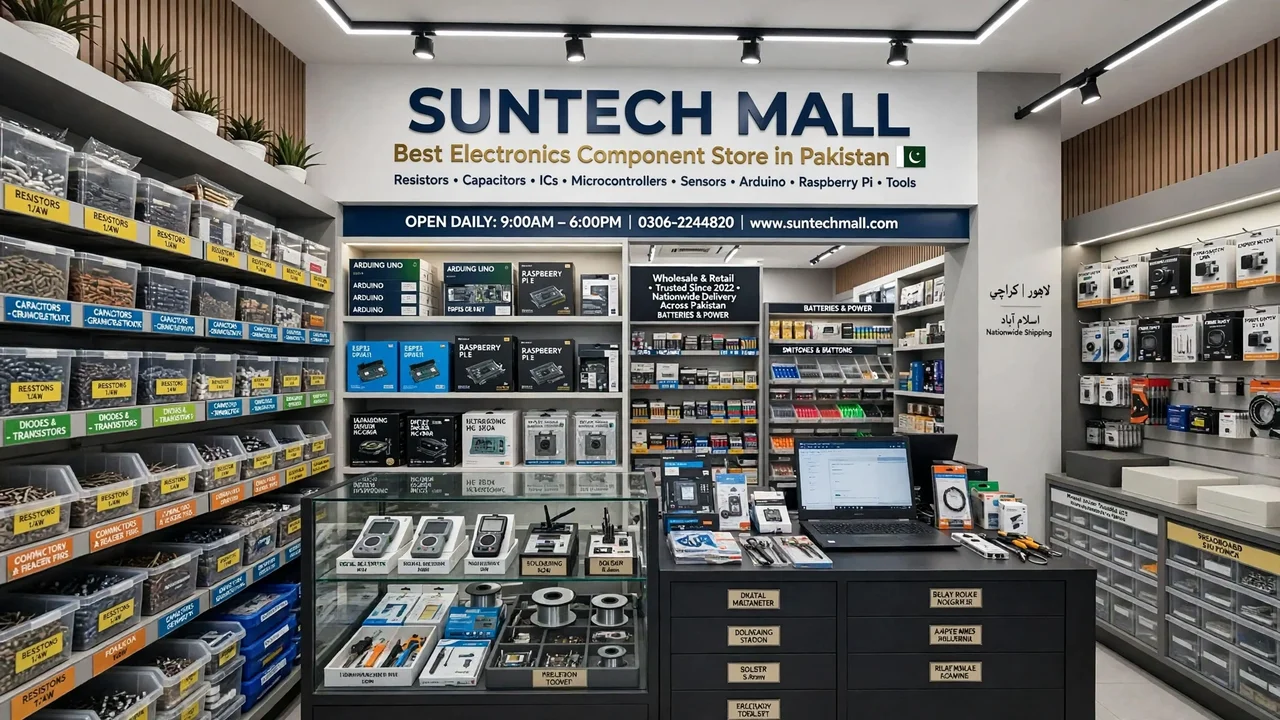
How Do You Pick a Reliable Electronics Component Store in Pakistan?
A reliable electronics component store is one you can check before you trust: it states where its parts come from, shows real specs and datasheets, gives a clear way to reach a human, and stands behind what it ships. Use the five checks in this guide on any reliable electronics component store Pakistan has, including SunTech Mall, and you will spot weak sellers in about ten minutes.
Why does the store matter as much as the part?
A fake part can look right and still fail early. It may carry the right print and the right shape, yet hold a smaller die, a thinner film, or a lower rating inside. On the bench it may work. Under load, in heat, it dies — and it can take nearby parts with it. The repair then costs more than the part ever saved: rework time, damaged neighbours, and a customer who loses faith in the repairer, not in the part.
That risk is why sourcing matters. A store with a traceable chain — maker or authorised distributor to shelf to buyer — takes much of that risk off you. A seller with no sourcing story leaves the risk with you. None of this means every market seller is dishonest. Many are hardworking traders. It means that without traceability, you carry the check yourself, and you should check before you buy.
What is the five-point check for any store?
1. Can the store say where the part comes from?
Ask plainly: is this part maker-direct, from an authorised distributor, or from an importer with a paper trail? A specific answer is a good sign. A vague answer — “do not worry, it is original” — is a warning sign. A good store can name the chain, or at least explain it in terms you can follow up.
2. Do listings show real specs?
Open a product page. Does it list voltage, current, package, and part number, or only a name and a short sales line? Engineers shop by specs. A store that publishes specs and links datasheets respects the buyer. A store that hides specs forces you to guess, and guessing is how wrong parts get ordered.
3. Is there a clear return and support route?
Parts arrive damaged. Wrong parts get ordered. A sound store states its return route in writing and gives a real contact route. Before you order, find that route and test it with a question. If a store will not give you a straight way to reach a human, do not give it your money first.
4. Does the store serve buyers like you?
A hobbyist needs small amounts and guidance. A repair shop needs steady stock month after month. A business needs bulk supply and clear invoices. A good store says who it serves, in plain words. If it claims to serve everyone yet stocks nothing in depth, treat that as a gap, not a strength.
5. Does the price make sense?
Compare the part across two or three sellers. Real parts sit in a fairly narrow band, because making them costs real money. A small discount is normal. A steep discount on a branded part is a warning sign, not a bargain. Price alone never proves a fake, but a price far below the normal band should trigger the other four checks.
| Check | Good sign | Warning sign |
|---|---|---|
| Sourcing | Named chain, maker or authorised route | Vague claims, no trail |
| Specs | Voltage, current, package, datasheet | Name only, no specs |
| Returns and contact | Written route, real contact | No route, no reply |
| Buyer fit | Clear fit for hobbyist, shop, or business | Claims to serve all, stocks little |
| Price | Inside the normal band | Far below the normal band |
Run the same test on any reliable electronics component store Pakistan offers, including SunTech Mall. Browse the listings, read the specs, check the return route, and compare prices. A store sure of its sourcing will not flinch at being checked.
How do you spot a fake part before it reaches your bench?
Start with your eyes and a magnifier. Real parts carry crisp, even print in the maker’s font, with the right logo, part number, and date code. Watch for misspellings, wrong fonts, crooked text, logos that differ from the maker’s mark, or print that wipes off with a light solvent rub. Date codes should make sense: not in the future, not impossibly old, and in the maker’s format.
Then check the body and pins. The body should match the datasheet in size, shape, and material. Sanded surfaces, rough edges, or a coating that hides old print point to remarking. Pins should be clean, even, and evenly spaced. Pre-soldered pins, dull or patchy plating, and bent leads can mean a pulled part sold as new. Packaging matters too: real makers use branded reels, tubes, or anti-static bags with labels. Loose parts in a plain bag with a handwritten label deserve a closer look.
Then test electrically, where you can. Measure the part against its datasheet. A capacitor far from its marked value, a diode with an odd forward voltage, or a transistor that behaves unlike its type tells you something is wrong. Keep a known-good sample for side-by-side comparison. Your eyes and fingers learn fast when they have a real part to compare against.
Visual checks catch most fakes, but not all. The most skilled fakes need lab tools such as X-ray inspection to expose. That is why the store check matters more than any single inspection trick. Buy from a traceable source and you rarely need to play detective.
What should you ask before you place an order?
- “Is this part new and unused?” Pulled parts are common in grey markets. A refurbished part is fair if the seller says so and prices it that way. The problem is a used part sold as new.
- “Can you share the datasheet?” Every real component has a maker datasheet. If the store can link it or send it, it knows what it sells.
- “What happens if the part arrives dead?” You are asking about the dead-on-arrival route. Sound stores replace or refund without a fight. Evasive answers mean you will fight for every rupee.
- “Do you offer repeat-order or bulk supply?” If you run a repair shop, this question separates hobby shops from professional suppliers.
- “How long will delivery to my city take, and what does it cost?” Get a straight answer before you order, not after — above all outside the big cities.
None of these questions is rude. Professional buyers ask them as routine. A good supplier welcomes them.
Should you buy online or from a local market?
Neither route wins for every buyer. A local market wins on speed: you walk out with the part today, you can haggle, and you can inspect the part before you pay. For one resistor this afternoon, the market is hard to beat.
An online store wins on range, specs, traceability, and reach. No single stall holds thousands of part types, and a small-town repair shop often cannot find specialised parts such as gate driver ICs or IGBTs locally at all. Online listings with full specs help you order the right part the first time.
Most serious buyers use both: the market for urgent small needs, and a reliable electronics component store Pakistan buyers trust online for planned buys, bulk orders, and any job where authenticity decides the outcome. Inverter repair sits firmly in the second group. “Probably genuine” is not good enough when a customer’s inverter is on your bench.
How do you place a first order with low risk?
- Start small. Order a handful of common parts you know well. This tests packing, delivery time, and spec accuracy with little money at stake.
- Inspect on arrival. Run the visual checks: markings, pins, body, packaging. Measure a few parts against datasheet values if you can.
- Test in a real circuit. Fit the parts in a non-critical project first and confirm they behave as expected.
- Scale up only after the test order passes. Repeat buyers get better support and faster answers, and they earn that standing by method, not by a leap of faith.
Keep a simple record as you go: supplier, part number, date, and batch. If a part fails months later, that record tells you whether you faced a bad batch or a one-off fault. Five seconds of habit, years of payoff.
What about parts for solar inverters in particular?
Inverter parts carry higher stakes than hobby parts. A fake MOSFET in an inverter can fail shorted, damage the board, and create a fire risk in a home. That is why inverter buyers should apply the five checks with extra care when they pick a reliable electronics component store Pakistan based, and why they should match part numbers and datasheets exactly rather than buying by shape alone. For the parts that fail most in inverters, and how to order them, see the genuine hybrid solar inverter parts guide. For the part that powers an inverter’s own control circuits, see the chopper transformer guide.
Frequently asked questions
How can I tell if a component is genuine?
Check crisp markings, correct logos and fonts, plausible date codes, clean even pins, and proper branded packaging. Then verify the part electrically against its datasheet. The strongest shield, though, is a traceable supplier — inspection is your backup, not your main defence.
Why are some components much cheaper from certain sellers?
At times the reason is fair: bulk buying or lower overhead. But a branded part priced far below the normal band is the most common warning sign of a fake. Compare two or three sellers before you decide a deal is real.
Is it safe to buy components online in Pakistan?
Yes, if you vet the store first: sourcing, specs, return route, and contact details. Start with a small test order and build trust by results, not by claims.
What should I do if I receive a suspect part?
Do not fit it. Photograph the markings, packaging, and test results. Contact the seller for a replacement or refund. If the seller refuses, warn your community, and for branded parts, tell the maker. Never install a suspect part just because you paid for it.
Do I need branded parts for every project?
Match authenticity to the stakes. For mains voltage, batteries, solar inverters, or a customer’s device, use genuine parts. For a personal breadboard prototype, the stakes are lower, and the choice is yours.
What is a franchised distributor?
An authorised distributor that buys direct from the maker under contract, with a clean chain of custody. Independent sellers source from many places, which can be fine but carries higher risk. For critical parts, authorised channels are the safest route.
Your next step
Do not take any store’s word for it — not even ours. Run the five checks on your next supplier, start with a small test order, and keep the record. A store that passes those checks earns repeat business. A store that fails them has told you all you need to know before you spend more.
Start with the genuine hybrid solar inverter parts guide to see how the same checks apply to inverter repair stock, then judge SunTech Mall by what arrives at your door.
SunTech Mall supplies spare parts and everything you need at wholesale prices across Pakistan.
Parts you need
Read more:
Related Technical Guides
 Category:
General
Inverter Relay Clicking Sound 2026: What That Click-Click Means and How to Fix It
A repeated click-click from your inverter usually means the transfer relay is trying to switch between grid, battery, and solar power but…
 Category:
General
Inverter Display Blank 2026: Why Your Screen Goes Dark and How to Fix It
Your inverter display is blank because it has lost power, or the display itself has failed. Check the status lights. If the…
 Category:
General
SPD and Voltage Protection 2026: Save Your Solar Inverter From Power Surges
An SPD, or surge protection device, guards your solar inverter from voltage spikes caused by lightning and grid switching. It sends the…
1 Comment
[…] SunTech Mall shop, or reach us at info@suntechmall.com or +92 306 2244820. You can also read our guide to choosing a reliable electronics component store. We would be glad to help you find the exact part your UPS […]