



Best Deal On 22nF 22000pF MYLAR Capacitor In Peshawar
When it comes to selecting the right capacitor for your electronic projects, the 22nF 22000pF 0.022uF (223) 250V MYLAR Capacitor stands out as one of the best options. Whether you're working on…

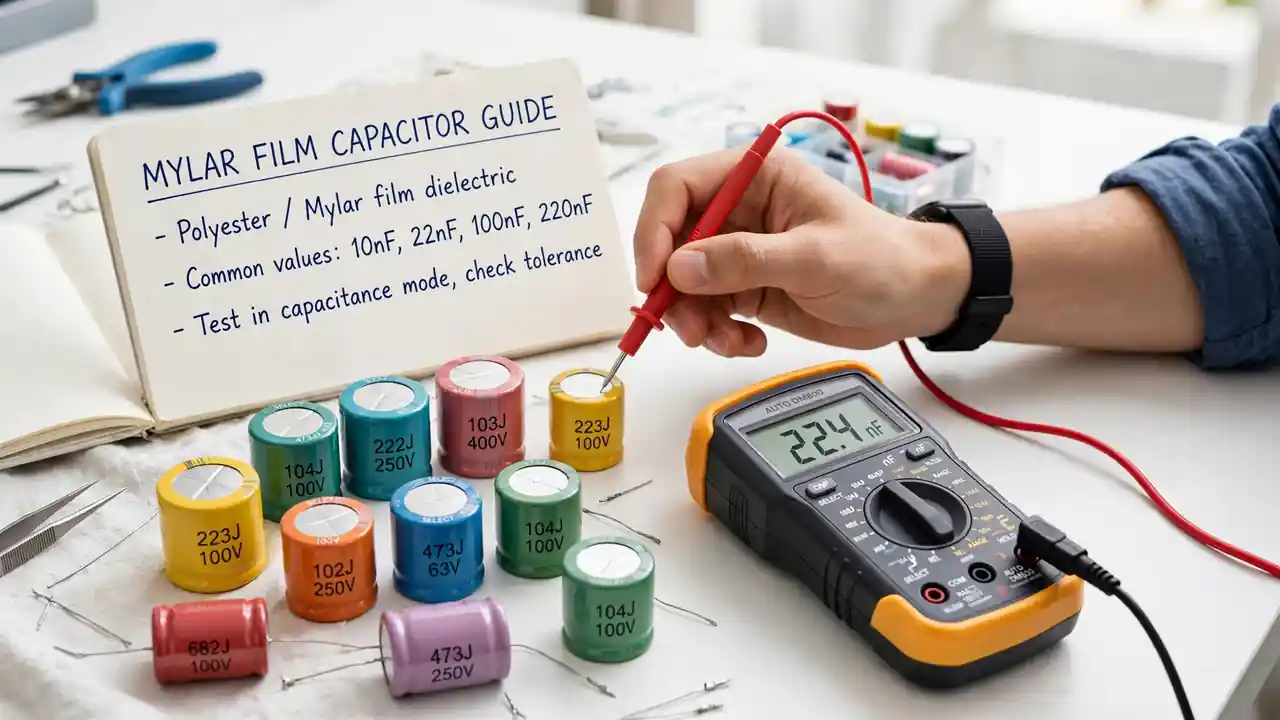
I keep a small box of film capacitors on my bench, and the little 22nF MYLAR is the one I reach for most. It shows up in audio tone circuits, timing networks, and snubbers across inverter boards. My stake in this guide is straightforward: at SunTech Mall we sell these to hobbyists, audio builders, and repair technicians, and I want you to pick the right type instead of learning the hard way.
You can trust this because it comes from the counter where real projects get built. We hear which capacitors customers come back for and which circuits they are fixing. We have seen what happens when someone substitutes the wrong capacitor type in a timing circuit — the timing drifts and the builder blames everything except the part. Your fear is fair: capacitor codes like “223” look cryptic, and the wrong choice changes how your circuit behaves.
Here is my exact promise. By the end of this guide, you will decode the 223 marking in seconds, understand why MYLAR (polyester film) capacitors are trusted for stability, know exactly where a 22nF film cap belongs, and install one correctly. Let us crack the code first.
A quick honest note: this guide shows you how to verify capacitor markings and ratings yourself, so you never depend on a seller’s word alone. If a part’s markings do not add up, reject it. When they do, buying a 22nF MYLAR capacitor from SunTech Mall gets you one that passed those same checks.
In This Guide: What You Will Be Able to Do
- Decode capacitor codes instantly — 223, 22nF, 22000pF, and 0.022uF are one and the same
- Understand MYLAR/polyester film construction and why it means stability and low loss
- Place 22nF film capacitors correctly in audio, timing, RF, and inverter snubber circuits
- Choose film over ceramic or electrolytic (and know when not to)
- Respect the 250V rating properly — including the AC mains trap most beginners miss
- Solder and handle film capacitors without damaging them
- Order genuine parts confidently from a supplier that knows components
Cracking the Code: 223 = 22nF = 22000pF
The first time I saw “223” printed on a capacitor, I assumed it was a part number. It is actually the value, written in a compact code that the whole industry uses. Learning it takes thirty seconds and pays off forever.
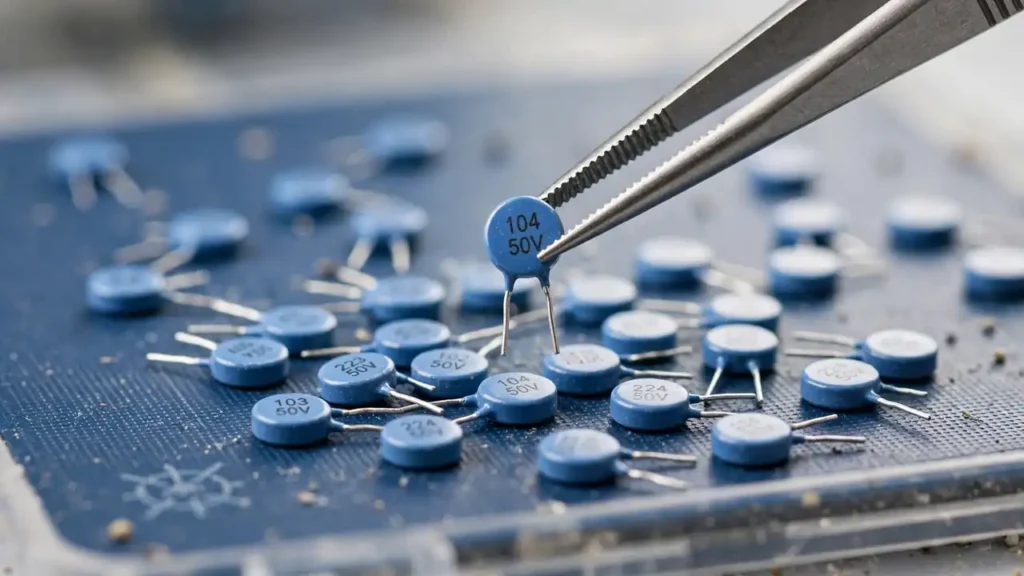
Here is how the three-digit code works. The first two digits are the value and the third digit is the number of zeros to add, with the result in picofarads. So 223 means 22 followed by three zeros: 22,000 picofarads.
Now convert it to friendlier units. 22,000pF equals 22nF, which also equals 0.022uF. Same capacitor, four names. When a listing says “22nF 22000pF 0.022uF (223)”, it is describing one part, not four options.
The 250V in the name is the maximum DC voltage rating. The part can handle up to 250 volts DC across its terminals. Exceed that and the thin film insulation inside can break down.
Bonus Tip: practice the code on parts you already own. A capacitor marked 104 is 100,000pF, or 100nF. A marking of 473 is 47,000pF, or 47nF. Once the pattern clicks, you will read capacitor values as fast as resistor color codes.
What “MYLAR” Actually Means for Your Circuit
MYLAR is a trade name for polyester film, and in electronics it has become shorthand for polyester film capacitors. Inside, thin layers of polyester film sit between conductive layers, all rolled or stacked into a small box or dipped package with two leads.
This construction gives you three practical advantages. First, excellent stability: the capacitance stays close to its marked value across temperature changes and over time. Your timing circuit keeps its timing and your filter keeps its tuning.
Second, low loss. Film capacitors waste very little energy as heat, which matters in high-frequency and switching circuits where every bit of efficiency counts. This is one reason they appear in inverter snubber networks alongside resistors like the 47 ohm 0805 SMD resistor — read our 47 ohm resistor guide to see how the pair works together.
Third, non-polarized design. There is no positive or negative lead. You can install a MYLAR capacitor either way around, which removes a whole category of wiring mistakes that plague polarized electrolytics.
Many metallized polyester types are also described as self-healing: a tiny internal fault can burn away cleanly instead of shorting the whole part. It is not magic armor, but it adds a layer of forgiveness that ceramics and electrolytics do not offer in the same way.
Note: MYLAR capacitors resist humidity and environmental stress well, which is why they survive in outdoor and industrial equipment. Still, keep them away from sustained extreme heat — no film capacitor enjoys being baked.
Where the 22nF Film Capacitor Earns Its Keep
A customer once brought in a guitar amplifier with a harsh, fizzy tone. The tone stack capacitor had drifted far off value. A fresh 22nF film capacitor went in, and the amp sang again. That is the thing about film capacitors: when they are right, you hear it.
Audio Circuits: Tone Control and Coupling
In audio equipment, 22nF film capacitors shape tone control networks and couple signals between stages. Their stability means the tone you dial in today is the tone you get next year.
Audio builders prefer film over ceramic here for a reason. Some ceramic types change capacitance with applied voltage, which can add subtle distortion. Film stays honest. If clean, predictable audio matters to you, film is the right call.
Timing Circuits
Oscillators and timers depend on stable RC time constants. A drifting capacitor means drifting timing. The 22nF polyester film capacitor holds its value steadily, so your 555 timer or microcontroller oscillator behaves the way the math says it should.
Snubbers in Inverters and Switching Supplies
Across switching transistors, voltage spikes need somewhere safe to go. A 22nF film capacitor paired with a small resistor forms an RC snubber that absorbs those spikes and protects expensive MOSFETs and IGBTs. In solar inverter repair, these little networks save boards worth far more than the parts themselves.
RF and High-Frequency Bypass
At radio frequencies, the 22nF value offers a low-impedance path that shunts unwanted high-frequency energy to ground. You will find these in decoupling positions on RF boards, transmitters, and receivers where stable high-frequency behavior is non-negotiable.
Film vs Ceramic vs Electrolytic: A Simple Way to Choose
Beginners often ask which capacitor type to use. The honest answer is that each type has a job it does best. Here is the simple version I give at the counter.
Choose film (MYLAR/polyester) when you need stability, low loss, and predictable behavior — audio, timing, filters, and snubbers. The 22nF value in this guide is a classic film-capacitor application.
Choose ceramic when you need tiny size and low cost for general decoupling, and the circuit tolerates some value drift. Be aware that many common ceramic types lose effective capacitance under DC voltage — always check the datasheet if the exact value matters.
Choose electrolytic when you need large capacitance in a small space, like bulk filtering on power rails. Accept that they are polarized, age with heat, and eventually need replacement. Our guides to the 450V 68uF capacitor and the 450V 10uF capacitor cover those in depth.
Bonus Tip: never substitute types blindly in timing or filter circuits. A 22nF ceramic in place of a 22nF film cap may behave differently enough to detune the circuit. Match the type the designer chose, not just the number.
The 250V Rating and the AC Mains Trap
Here is a mistake I want to save you from. A 250V DC rating does not mean the capacitor is safe on 230V AC mains. It is not, and the reason is simple math.
AC mains voltage is quoted as RMS, but the actual peaks are higher. 230V AC peaks at about 325V, which already exceeds a 250V DC rating. Add normal mains spikes and the margin disappears completely.
So where does the 250V rating fit? It suits DC circuits and low-voltage AC signal paths where the actual peaks stay comfortably below 250V — audio equipment internals, timing circuits, control boards, and snubbers on lower-voltage rails. Always compare the rating against the peak voltage, not the RMS number.
Note: for direct mains-connected positions, you need capacitors specifically rated for mains use (X or Y safety types), not general-purpose film capacitors. When in doubt, ask before you buy — that is what info@suntechmall.com and +92 306 2244820 are for.
Handling and Soldering Without Damage
Film capacitors are tougher than they look, but they still deserve care. I have seen cracked bodies from pliers gripped too hard and melted cases from irons held too long. Both were avoidable.
Because the part is non-polarized, orientation does not matter — place it either way. Keep the leads reasonably short in high-frequency circuits to minimize stray inductance, but do not stress the body by bending leads right at the case.
Solder quickly and confidently. Two to three seconds per joint with a properly heated iron is plenty. Let the joint cool before moving the board. A disturbed joint while the solder is molten creates a cold, unreliable connection.
Bonus Tip: in snubber positions, mount the capacitor close to the switching device it protects. Long traces add inductance that weakens the snubber’s effect. Proximity is performance.
Where to Get Genuine 22nF MYLAR Capacitors in Pakistan
SunTech Mall stocks the 22nF 22000pF (223) 250V MYLAR capacitor for audio builders, students, and repair technicians. Check the live listing for current stock and packaging.
Explore the full electronic parts category and the main shop for companion components — from the 450V 68uF electrolytic for bulk filtering to high-voltage ceramics like the 220PF 1KV DIP capacitor covered in our 220PF 1KV guide. Fresh repair guides land regularly on the SunTech Mall blog.
Frequently Asked Questions
What does 223 mean on a capacitor?
It is a three-digit value code. The first two digits are the value and the third is the number of zeros, measured in picofarads. So 223 means 22 followed by three zeros: 22,000pF, which equals 22nF or 0.022uF.
Is a MYLAR capacitor polarized?
No. MYLAR (polyester film) capacitors are non-polarized, so you can install them in either direction. This makes them easier to use than electrolytic capacitors, where reversed polarity causes failure.
Can I replace a 22nF ceramic capacitor with a 22nF MYLAR capacitor?
Often yes, and in audio or timing circuits the film type usually performs better due to its stability. But check the circuit’s requirements first — size, lead spacing, and voltage rating must all fit. Do not swap types blindly in tuned circuits.
Can I use a 250V capacitor on 230V AC mains?
No. 230V AC peaks at roughly 325V, which exceeds a 250V DC rating. For mains-connected positions you need capacitors specifically rated for mains use, such as X or Y safety-rated types.
What is the difference between MYLAR and ceramic capacitors?
MYLAR (polyester film) capacitors offer better stability and lower loss, making them ideal for audio, timing, and filter circuits. Ceramic capacitors are smaller and cheaper but many types drift in value with temperature and applied voltage.
Do MYLAR capacitors go bad with age?
They age far more gracefully than electrolytics. They do not dry out like electrolytic capacitors do. Physical damage, sustained overheating, or voltage overstress are the usual killers — not the calendar alone.
How do I test a 22nF capacitor with a multimeter?
Use a meter with a capacitance mode, test the part out of circuit, and expect a reading close to 22nF. In-circuit readings are unreliable because surrounding components interfere. A reading far off value or an open/short means replacement time.
Final Thoughts
The 22nF MYLAR capacitor is small, humble, and quietly excellent at its job. Now you can decode its markings, explain why film beats ceramic in the circuits that matter, dodge the mains-voltage trap, and install one with confidence. That is practical electronics knowledge you will use for years.
Congratulations — capacitor codes will never confuse you again, and your audio, timing, and snubber circuits will thank you. The next time a tone sounds wrong or a timer drifts, you will know exactly which little part to check.
When you need the part, get genuine 22nF MYLAR capacitors from SunTech Mall and build with confidence. Questions about values, ratings, or bulk orders? Email info@suntechmall.com or call/WhatsApp +92 306 2244820. Follow our component guides on Facebook, X, Instagram, and YouTube.

1 Comment
[…] Paired with a capacitor, a 47 ohm resistor forms an RC snubber that eats voltage spikes across switching devices. In inverter repair, the resistor often survives while the capacitor dies, so check both. A quality film capacitor such as a 22nF MYLAR capacitor is a common snubber partner for this resistor — learn more in our guide to the 22nF 22000pF MYLAR capacitor. […]