
450V 68uF Capacitor: What It Does, Why It Fails, and How to Replace It Safely
When it comes to powering high-performance systems like solar inverters, selecting the right components is critical. One such component that plays a significant role is the 450V 68uF aluminum electrolytic capacitor. This…

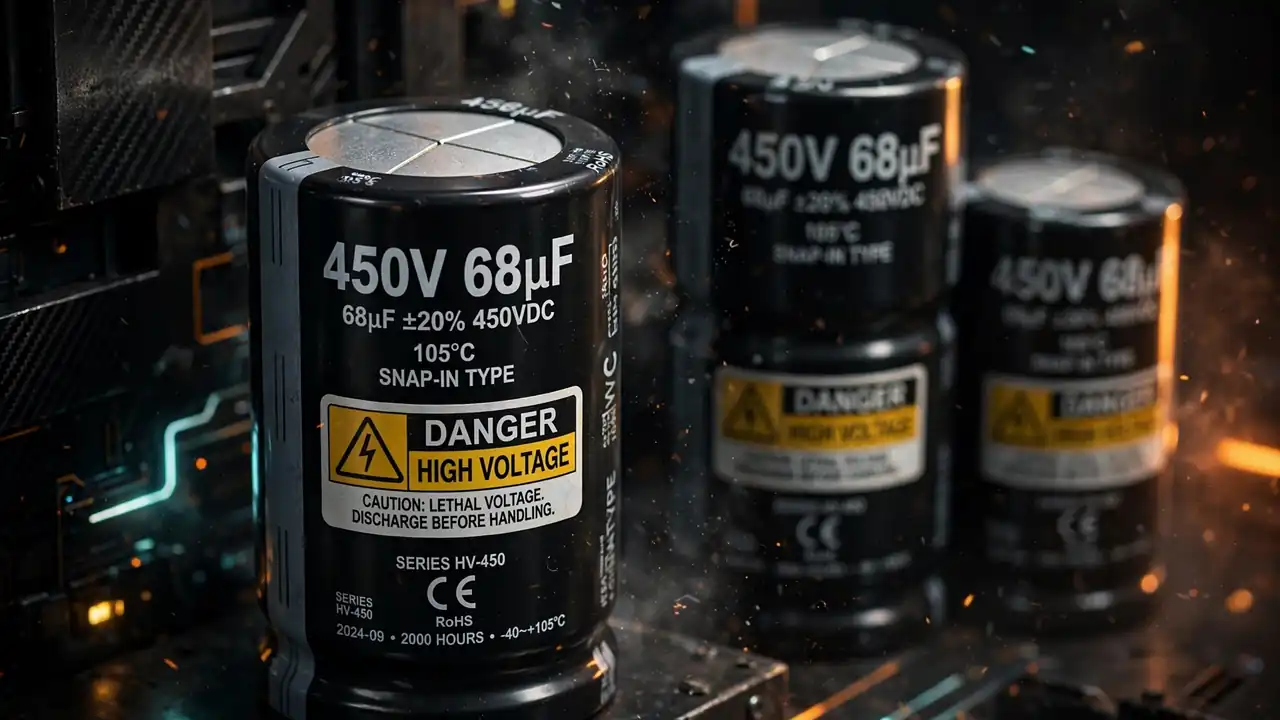
A 450V 68uF aluminum electrolytic capacitor smooths the high-voltage DC bus inside a solar inverter or power supply. Match its voltage, its capacitance, and its polarity, and check its ESR and ripple rating before you fit it. A part that looks the same on the outside can still be the wrong part inside.
What does a 450V 68uF capacitor do?
It stores charge and releases it again, many times a second. Think of it as a small tank that fills on the peaks and empties in the dips. The result is a steadier DC voltage for the circuits that follow it.
In a solar inverter, it sits on the DC bus after the mains are rectified or after solar DC is boosted. The inverter stage then chops that steady DC into AC for your home. You will find the same job in switch-mode power supply input stages and in power factor correction circuits. Any place where a few hundred volts of DC must stay steady is a place where this value can appear.
This is an aluminum electrolytic capacitor, so it is polarized. One lead is positive and one is negative. The stripe on the sleeve marks the negative lead. Fit it the wrong way round on a high-voltage bus and it can vent or burst. Always match the marking on the board.
Which specs matter when you pick a replacement?
Datasheets list many numbers. In repair work, five checks decide most replacements. Check them in this order, and check them on the datasheet for the exact series you plan to buy. Ratings vary by maker and series, so do not copy one series number onto a different part.
| Check | What it means | What to do |
|---|---|---|
| Voltage rating | The highest DC voltage the part should ever see. Here it is 450V. | Never fit a lower voltage. You may fit a higher voltage only if the part fits the space and the leads match. |
| Capacitance | How much charge the part stores. Here it is 68uF. | Match the original value. A much larger value can stress the rectifier at switch-on. A much smaller value gives weaker filtering. |
| ESR | Equivalent Series Resistance, the hidden resistance inside a real capacitor. | Pick a low-ESR part for switching circuits. High ESR turns ripple into heat. |
| Ripple current rating | How much AC current the part can carry all the time without overheating. | Match or beat the original rating. If heat killed the old part, a higher ripple rating is a real upgrade. |
| Temperature and life | The rated temperature, often 105°C for inverter work, and the rated life in hours at that temperature. | Read both from the datasheet. A part rated for a hot cabinet lasts longer in a hot cabinet. |
Two more facts help you read a datasheet with care. First, general aluminum electrolytic datasheets commonly state capacitance tolerance as plus or minus 20 percent, measured at 120 Hz and 20°C. That means a new 68uF part can read a little above or below 68uF and still be in spec. Second, ESR and ripple ratings are given at a stated frequency, often 100 Hz or 120 Hz. A number without its frequency tells you very little, so always read the frequency with the number.
As one worked example of why series matters, a distributor listing for one EPCOS-TDK series part, the B43540 68uF 450V snap-in type, states 1.42 ohms ESR at 100 Hz and 800 mA ripple current at 100 Hz, with a 10,000-hour life at 85°C. That is an example from that series only. It is not a claim about every 450V 68uF capacitor, and it is not a claim about any one shop's stock. Your replacement needs its own datasheet line.
Why do these capacitors bulge and fail?
Heat is the main killer. Heat dries out the liquid electrolyte inside the part. Ripple current adds more heat from inside. Years pass, pressure builds, and the safety vent on top domes upward. At the same time, capacitance falls and ESR climbs.
Look for these warning signs:
- A bulging top, where the flat vent area domes upward instead of sitting flat
- Crusty or wet residue around the base or the vent
- A can that tilts or lifts off its seat
- A sleeve darkened by sustained heat
- An inverter that restarts, drops output, or hums, with no other clear cause
A capacitor can also be dead while it looks fine. A meter may still read near 68uF while ESR is so high that the part is useless in a switching circuit. That is why repair techs test ESR, not capacitance alone. Test out of circuit where you can: desolder at least one lead first, because parts wired in parallel on the board can fool an in-circuit reading.
A second failure route is a voltage surge. A spike above the rating can damage the thin oxide layer inside, even if the part looks fine at first. If a board has surge damage, fitting the same rating again without finding the surge source can lead to a repeat failure. Check the bus voltage under load, check ventilation, and check for loose or damaged wiring before you close the case.
How do you replace one safely?
A charged 450V capacitor can give a dangerous shock long after power is removed. Treat every large electrolytic as charged until you have proved it is not. Work in this order:
- Disconnect all power and wait a few minutes for internal discharge circuits to work.
- Discharge the capacitor with a properly rated discharge tool or a high-wattage resistor across the terminals. Never short the terminals with a screwdriver. The flash can damage the part and spray debris.
- Confirm zero volts with a multimeter before you touch anything.
- Photograph the board so you have a record of the original polarity and position.
- Remove the old part cleanly and clear solder from the holes.
- Fit the new part with the correct polarity. Match the stripe to the board marking exactly.
- Check lead spacing and height so the part sits flat without stress on the leads.
- Power up and check for stable output, excess heat, and strange smells.
If the new part runs hot, stop. Heat on a new part means the circuit is stressing it. Check the ripple rating, check ventilation, and check for a fault elsewhere on the board before the new part becomes the next failure.
When is a 450V 68uF part the wrong choice?
It is the wrong choice when any of these is true:
- The voltage rating is below the original rating.
- The capacitance is far from the original value and you do not understand the circuit well enough to judge the change.
- The datasheet is missing, so you cannot check ESR, ripple current, or temperature rating.
- The part is physically too tall or the lead spacing does not match, so it sits under stress.
- The old part failed from heat and the new part has a lower ripple rating or a lower temperature rating.
In each case, the safe move is to stop and find a part whose datasheet answers all five checks in the table above.
Frequently asked questions
Does polarity matter on a 450V 68uF capacitor?
Yes. Aluminum electrolytic capacitors are polarized. The stripe marks the negative lead. Fit it backwards on a high-voltage bus and the part can vent or burst. Match the board marking exactly.
Can I replace a 450V capacitor with a 400V one?
No. The voltage rating must never go below the original. Use 450V or higher, only if the part fits. Keeping margin above the working voltage is the safe habit, not cutting it close.
Can I use a 100uF capacitor instead of 68uF?
Only if you understand the circuit. A larger part draws higher inrush current at switch-on, which can stress rectifiers and fuses. Match the original 68uF value unless you have a clear circuit reason to change it.
Why did my capacitor bulge?
Heat and age are the usual causes. Sustained heat dries the electrolyte, pressure builds, and the vent domes upward. High ripple current speeds the process. A bulging capacitor should be replaced, never reused.
Do I need to discharge the capacitor before handling it?
Yes. A large high-voltage capacitor can hold a dangerous charge after power is removed. Discharge it through a resistor-based tool and confirm zero volts with a meter before you touch the terminals.
Can I test the capacitor without removing it from the board?
In-circuit readings are unreliable, because parallel parts confuse the meter. For capacitance and ESR checks you can trust, desolder at least one lead first.
Final thoughts
A 450V 68uF capacitor does quiet work for years, then decides whether an inverter runs or stops. Read the datasheet, match voltage and value, respect polarity, and test ESR as well as capacitance. That routine turns a scary high-voltage repair into a careful, repeatable job.
When you need the part, check the live listing on SunTech Mall for the current 450V 68uF capacitor and read its stated specs before you order. For the small resistor work that often sits next to this repair, see our guide to the 47 ohm 0805 SMD resistor.
Sources: manufacturer aluminum electrolytic datasheet families and distributor series listings consulted during research (see notes.md). Ratings vary by series; always read the datasheet for the exact part you buy.
Related Products & Categories
Related Technical Guides
 Category:
General
How to Test a MOSFET With a Multimeter 2026: Find a Bad MOSFET Before It Burns Your Board
Last month, a technician brought me a dead inverter board. He had already fitted a new MOSFET. The board died again in…
 Category:
General
Inverex Nitrox Fault Codes 2026: Technician’s Complete Decode List for F01 to F64
Inverex Nitrox Fault Codes 2026: Technician’s Complete Decode List for F01 to F64 One evening, a shop owner called me. His Inverex…
 Category:
Solar Inverter Repair
Solar Inverter Error Codes in Pakistan 2026 – Complete Troubleshooting Guide
Solar inverter showing an error or warning? This complete Pakistan-focused guide explains common fault categories, safe troubleshooting steps, Fronus code examples, repair…