

Best 35V 680uF aluminum electrolytic capacitor in Islamabad
When working on electronic circuits, especially those involving power regulation or filtering, choosing the right capacitor can make all the difference. Among the most commonly used components is the 35V 680uF aluminum…

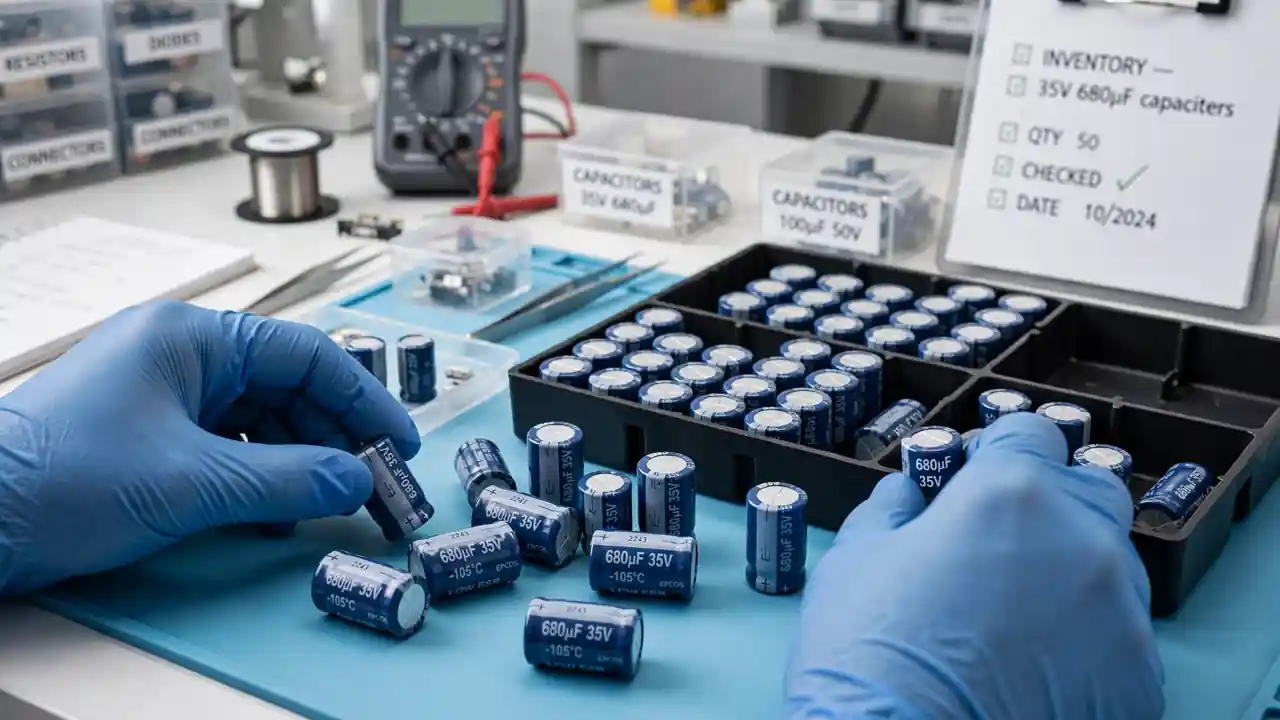
>Not every important capacitor works at terrifying voltages. Some of the most failure-prone capacitors in a solar inverter sit on the low-voltage side, quietly filtering the rails that feed the microcontroller, the display, and the gate drivers. The 35V 680uF aluminum electrolytic capacitor is one of these — unglamorous, hardworking, and disproportionately responsible for “weird” faults.
At SunTech Mall, we supply original electronic components across Pakistan. The 35V 680uF is a control-board staple: high capacitance at modest voltage, exactly what low-voltage logic and driver circuits need for clean, stable power. When it degrades, the symptoms look like software bugs, display failures, or random resets — everything except a capacitor problem.
The trap is assuming low voltage means low importance. A failing 35V rail capacitor can make a thousand-dollar inverter behave like it has a firmware problem. Technicians have replaced entire control boards over a two-rupee capacitor.
This guide explains the 35V 680uF’s role, how to test it, how to replace it, and how to buy genuine ones in Islamabad. Low voltage, full knowledge.
A Quick Note Before You Trust This Guide
Low-voltage does not mean no-voltage — standard safety practices still apply. And as always, these methods work with parts from any honest seller. The knowledge is yours to keep.
In This Guide: What You Will Be Able To Do
- Decode the 35V 680uF markings
- Understand its role on low-voltage rails
- Test it quickly and reliably
- Recognize the subtle failure symptoms
- Replace it with correct specifications
- Source genuine parts in Islamabad
Reading the Markings
680uF capacitance — a generous value for a 35V part. High capacitance at low voltage is the classic recipe for filtering logic supply rails, where the circuit needs substantial charge reserve to ride through load transients — the sudden current demands when a microcontroller wakes peripherals or a gate driver fires.
35V maximum DC voltage. Derated 20 percent, the reliable working ceiling is about 28V. Common rails in this family: 24V, 15V, 12V, and 5V (often via further regulation). A 35V capacitor on a 12V rail has enormous margin — which is exactly why these parts last so long when they are genuine and fail so confusingly when they are not.
Aluminum electrolytic, polarized. Stripe is negative. ±20 percent tolerance is standard. At this voltage and capacitance, ESR is often the more important parameter than exact capacitance — low ESR keeps the rail clean under transient loads.
Temperature rating: 105°C remains the right choice even on low-voltage rails inside hot enclosures. The inverter’s interior does not care that your capacitor is only seeing 12V — heat ages electrolyte regardless.
Bonus Tip: On low-voltage rails, designers sometimes parallel a large electrolytic (like this 680uF) with a small ceramic capacitor (like 100nF). The electrolytic handles low-frequency ripple; the ceramic handles high-frequency noise. If you are troubleshooting rail noise, check both — replacing only the electrolytic while the ceramic is cracked leaves the problem half-fixed.
Where It Works: The Low-Voltage World
Microcontroller supply rails. The brain of the inverter runs on 3.3V or 5V, derived from higher rails. The 680uF steadies the intermediate rail (often 12V or 15V) feeding those regulators. A noisy intermediate rail becomes a noisy logic supply, and digital circuits with noisy supplies do unpredictable things — the “software bug” that is actually a capacitor.
Gate driver supplies. The drivers that switch the big power transistors need clean, stiff voltage to slam gates on and off crisply. A degraded filter capacitor here softens gate drive, increasing switching losses and heat in the power stage — a capacitor problem that manifests as transistor overheating.
Display and communication boards. LCDs, WiFi modules, and RS485 interfaces all hang off low-voltage rails. Flickering displays, dropped communications, and garbled readings often trace to rail capacitors.
Fan and relay drivers. The 12V or 24V rail running cooling fans and relays benefits from bulk capacitance to handle the inrush when a fan starts or a relay pulls in.
Note: Because these rails feed everything, a single bad 680uF can produce multiple simultaneous symptoms — display flicker plus random resets plus comms dropouts. When several “unrelated” faults appear together, suspect the common supply rail before suspecting multiple independent failures.
Failure Symptoms: The Subtle Saboteur
Random resets and lockups. The microcontroller browns out when the rail dips during a transient, resets, and restarts — looking exactly like a firmware crash. If resets correlate with load changes (fan kicking on, relay engaging), the rail capacitor is suspect number one.
Display anomalies — flicker, missing segments, garbled characters — that come and go. The display is often the most visible victim of a noisy rail because humans watch it continuously.
Communication failures — WiFi dropping, Modbus errors, monitoring app disconnects. Digital communication is sensitive to supply noise; marginal rails cause marginal comms.
Gate driver weakness — power transistors running hotter than expected, or switching waveforms that look soft on the oscilloscope. The capacitor is far from the transistors, but its influence reaches them through the driver supply.
Visual signs still apply: domed top, leaking seal, discolored sleeve. But low-voltage capacitors often fail without visible symptoms — the lower electrical stress means less dramatic failure modes. Test, don’t just look.
Testing: Quick and Definitive
Safety: 35V is low, but discharge the capacitor before handling anyway — good habits protect you on the day you forget which capacitor you are holding. A quick short through a 1K resistor is plenty at this voltage.
Visual inspection for bulging, leaking, or discoloration.
Capacitance measurement: expect roughly 544uF to 816uF (±20 percent). Below 544uF indicates drying. These large-value capacitors take a few seconds to charge from the meter — be patient and let the reading settle.
ESR check is particularly valuable here. A 680uF low-voltage capacitor should show very low ESR — well under one ohm for a good low-ESR series. Elevated ESR on a rail-filtering capacitor directly translates to rail noise under transient load.
Bonus Tip: For rail-noise diagnosis, an oscilloscope on the rail (AC coupled) shows what the multimeter cannot: the actual ripple and transient dips. A healthy filtered rail shows small, clean ripple. A rail with a dead filter capacitor shows large spikes correlated with load switching. If you have a scope, use it — it turns suspicion into certainty.
Replacement: Specifications That Matter
Voltage: 35V minimum; higher is fine (50V is a common and excellent upgrade if it fits). Never lower.
Capacitance: 680uF nominal; 560–820uF acceptable in filtering roles. On rails with specific regulator stability requirements, stay close to the original.
ESR grade matters here. If the original was a low-ESR series (common for switching supply outputs), replace with low-ESR. A general-purpose capacitor in a low-ESR position will run hot and fail early — the specifications look the same on the sleeve, but the internal construction differs. Check the series if you can; when uncertain, choose a 105°C low-ESR part as the safe default.
Temperature: 105°C. Polarity: stripe to negative, verified twice. Fit: 680uF at 35V is a moderately sized can — confirm diameter and height against the footprint and neighboring components.
Verification: power up, confirm clean startup, check the rail voltage with a meter, and if possible scope the rail for noise. Run under varying loads — the transients that troubled the old capacitor should be gone.
Buying Genuine in Islamabad
Specify the series, not just the value. “680uF 35V” is not a complete specification — the ESR grade and temperature rating matter. Sellers who understand this distinction are the ones worth buying from.
Inspect and test. Sharp markings, flat top, clean seal — then a capacitance and ESR check on arrival. For low-voltage parts, testing is fast and easy; there is no excuse for skipping it.
Beware the too-cheap. Quality low-ESR electrolytics cost more to manufacture than general-purpose ones. A price far below market usually means general-purpose (or counterfeit) parts dressed as low-ESR. In rail-filtering service, the difference matters.
SunTech Mall stocks genuine electrolytics with full series specifications in the electronic parts section. Related reading: our 35V 470uF guide and 35V 4200uF guide cover the neighboring values on the same low-voltage rails, and our solar section stocks the inverters they serve.
Bonus Tip: When scoping a rail, compare the noise signature before and after replacement and keep a photo log. Over time you will build an intuitive sense of what “healthy” looks like for common rails — 12V driver supplies, 5V logic rails, 24V fan rails. That pattern recognition turns future diagnoses from investigations into instant recognitions.
Frequently Asked Questions
Can I use a 50V 680uF instead of 35V?
Yes — higher voltage rating is always acceptable if the part physically fits. The 50V part will have even more margin and typically longer life. This is one of the safest substitutions in electronics.
What is the difference between low-ESR and general-purpose?
Internal construction: low-ESR capacitors use optimized foil etching and electrolyte chemistry to minimize internal resistance. They run cooler under ripple current and filter more effectively. They cost more. In switching supply and rail-filtering positions, the premium is justified.
Why do rail capacitors fail without visible signs?
At low voltage, the failure mode is usually gradual ESR rise and capacitance loss from electrolyte drying — neither of which bulges the can. The capacitor looks fine and meters “close enough” on capacitance while its ESR has tripled. This is why ESR meters exist.
Can one bad rail capacitor really cause all these symptoms?
Yes, because the rail is common to everything it feeds. A noisy 12V rail simultaneously upsets the microcontroller, the display, the comms module, and the gate drivers. Multiple symptoms, one cause — the best kind of fault once you recognize the pattern.
Should I replace all the rail capacitors or just the bad one?
On an older board, replacing the set of low-voltage electrolytics on the affected rail is sensible preventive maintenance. They share the same age, temperature exposure, and operating hours. The parts are inexpensive; the labor of reopening the unit is not.
How tight should the replacement fit be?
Snug is fine; forced is not. Do not bend neighboring components to accommodate an oversized capacitor, and do not leave a capacitor floating on extended leads. If the ideal part does not fit, find the same specifications in a smaller can rather than compromising the mechanical installation.
Final Thoughts
The 35V 680uF capacitor operates in the shadows of the low-voltage rails, far from the drama of the high-voltage bus — but its influence reaches every corner of the inverter. Random resets, flickering displays, dropped communications, overheating transistors: all can be the work of this single degraded component.
You now know its roles, its failure signatures, how to test it properly (ESR included), and what specifications actually matter in the replacement. The next time an inverter behaves like it has ghosts in the firmware, check the rails before you blame the code.
Genuine 35V 680uF capacitors and full low-voltage ranges are available in the electronic parts section at SunTech Mall — or contact info@suntechmall.com / +92 306 2244820 for help.

1 Comment
[…] with published series specifications in our electronic parts section. Companion guides: the 35V 680uF and 35V 4200uF articles cover the neighboring rail capacitors, plus our solar equipment […]