
What Is a 35V 4200uF Capacitor, and How Do You Replace One Safely?
In the fast-growing electronics and solar energy markets of Pakistan, particularly in Charsadda, one component that plays a vital role in power stability is the 35V 4200uF aluminum electrolytic capacitor. This specific…

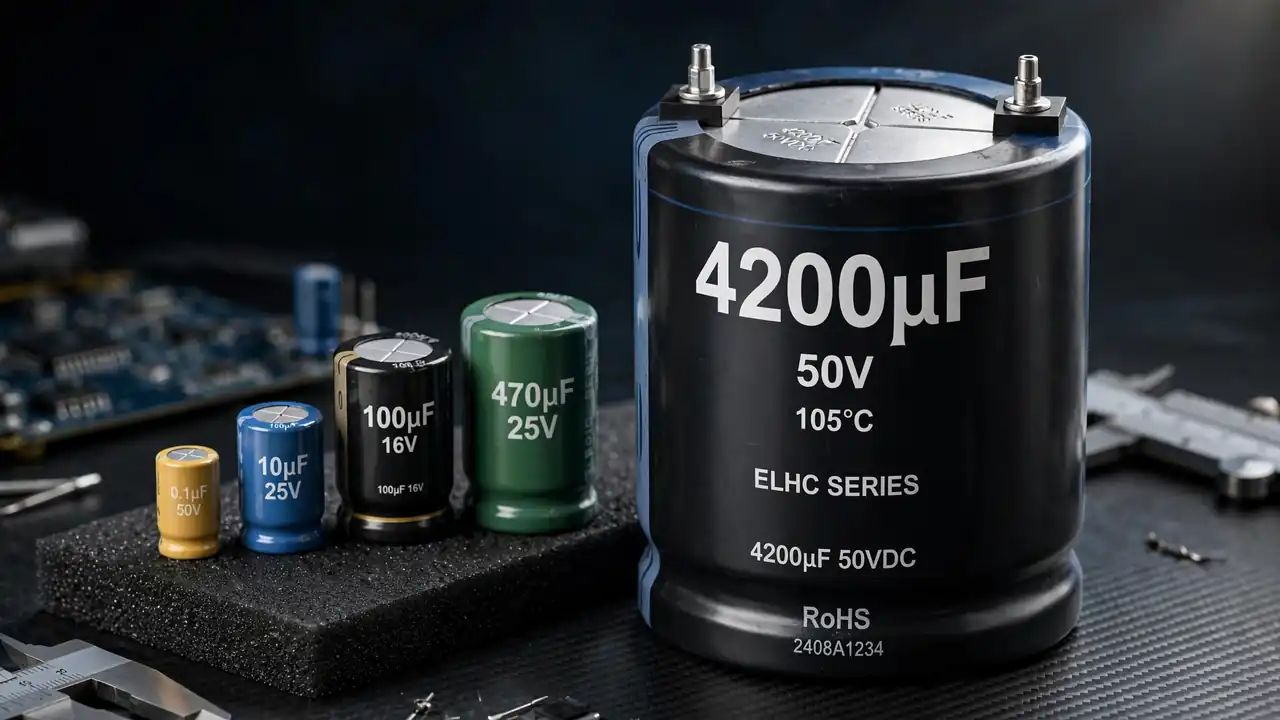
A 35V 4200uF aluminum electrolytic capacitor is a large bulk storage part. It holds a deep reserve of charge for low-voltage, high-current circuits, and it stores enough energy to demand real care when you handle it.
What do the numbers mean?
| Marking | What it means | Value for this part |
|---|---|---|
| 4200uF | Capacitance | 4.2 millifarads, a very large value for general electronics |
| 35V | Rated DC voltage, max | Never run it above 35 V |
| Aluminum electrolytic | Type | Polarised: the stripe marks the negative end |
| Tolerance, standard | How far the real value may sit from nominal | Usually ±20%, so 3360uF to 5040uF is a good part |
To see the scale, 4200uF holds about nine times the charge of a common 470uF output filter. Stored energy follows the formula energy equals half times capacitance times voltage squared. At 35 V, a 4200uF part holds about 2.6 joules. That is enough to give a painful shock, weld a small tool tip, or harm a circuit if you discharge it with no care.
Typical jobs run at 12 V or 24 V, well below the 35 V rating. That margin helps life, but heat and ripple current still set the real life of the part, so a cool, well-matched part lasts far longer than a hot, overworked one.
Where does bulk storage matter?
- UPS battery rails and DC links. During a switch between mains and battery, or during a sudden load step, the battery cannot deliver instant current fast enough. Bulk capacitors fill that gap. Weak bulk storage here causes output dips during transfers: the UPS seems to work, but the gear it guards still sees glitches.
- High-current, low-voltage supplies. Supplies that deliver tens of amps at 12 V or 24 V, for motor drives, RF amplifiers, or industrial controls, need a deep reservoir to hold voltage steady during current peaks. The 4200uF, often in parallel sets, gives that reservoir.
- Audio power amplifiers. Class AB amplifiers draw current that jumps with the audio signal. Bulk capacitors feed those peaks. Weak bulk storage causes clipping, distortion, and soft bass.
- Hold-up and ride-through. In some designs, bulk capacitance gives milliseconds of ride-through during a brief input break, enough for an orderly response instead of a crash. Hold-up time rises in direct step with capacitance.
Note: When bulk capacitors sit in parallel, they must match: same value, same series, and same age. Mismatched parallel parts share ripple current unevenly. The lowest-resistance part hogs current, overheats, and fails first, and the rest then follow.
How do you handle and discharge a large capacitor safely?
Treat a charged 4200uF part with the same respect you would give a small battery. Never assume it is empty because the gear is off.
- Switch the gear off and unplug it.
- Discharge through a proper power resistor, at least 1K ohm and 5W, across the terminals. Give it a full ten seconds.
- Check zero volts with your meter.
- Discharge again, then check again. Large capacitors can show dielectric absorption, where a small voltage creeps back after discharge as trapped charge moves. That recovered voltage can still surprise you, so short the part through the resistor right before you handle it, even if you discharged it minutes ago.
Never discharge a large capacitor by shorting it with a screwdriver. That dumps all the stored energy at once, and it can weld metal, spray material, and harm the part and you.
How does a large capacitor fail?
Failure runs from slow to sudden:
- Gradual drying. The common end. Capacitance falls, internal resistance (ESR) rises, and the reservoir gets shallower over years. Signs creep in: slightly worse response to load steps, rare dips, shorter hold-up time. The gear still works, but its safety margins have worn thin.
- Thermal runaway. Rising ESR means more internal heating, since heating follows current squared times resistance. More heat speeds drying, which raises ESR further. In high-ripple jobs, this spiral can move from slightly warm to venting in a short time once it passes a tipping point.
- Venting. The pressure relief opens and lets out electrolyte vapour with force: a loud pop and a mess to clean. Severe overvoltage, reverse polarity, or end-stage thermal runaway causes it. That is why correct voltage rating and polarity are safety matters, not just performance matters.
- Mechanical stress. Large cans are heavy. Their mass strains solder joints when a board flexes or vibrates, and a tall can can lever against nearby parts. In mobile or industrial gear, check the mounting. Some designs add glue or brackets for large electrolytics, and a replacement should keep that support.
How do you test a large electrolytic?
- Discharge with care, as above, twice, and confirm zero volts.
- Look at it. Check the top for bulging, the base seal, the sleeve, and whether the part still sits firm with no rocking in its solder joints.
- Measure capacitance. Expect 3360uF to 5040uF for a ±20% part. Large capacitors take many seconds to charge from the meter test current, so start the test and wait for the reading to settle. A rushed test gives a falsely low reading.
- Measure ESR. This is the earliest age sign for bulk and ripple jobs. A healthy large low-voltage electrolytic shows very low ESR. The exact limit sits in the series datasheet, so judge your reading against that sheet, not against a generic number.
- Test each part in a bank on its own. Lift one lead per part. A bank of four 4200uF parts where one has failed still measures a lot of capacitance in total, enough to fool a quick in-circuit check while the other three carry overload.
Bonus Tip: Leakage testing is an advanced extra step. If you have a current-limited supply, you can charge the part to its rated voltage through that supply and watch the small leftover current after it settles. High leakage points to a worn dielectric. The test takes minutes, but it shows what capacitance and ESR alone cannot.
How do you pick a replacement?
Match the electrics first, then the body:
- Voltage: 35 V minimum. A 50 V part is fine if it fits, but check its ripple current rating too, since a higher-voltage part in the same family can carry a lower ripple rating.
- Capacitance: 4200uF nominal. Bulk storage forgives some drift, so staying inside the ±20% band is the rule. Do not halve the value.
- Temperature: pick a 105-degree rated part for enclosed, warm gear when the original used one.
- Ripple current: match or beat the original rating at the same test frequency. Ripple current drives internal heating, and heating sets life. A replacement with a weaker ripple rating will run hotter and fail early.
- ESR grade: match or beat the original. If the original was a low-ESR grade, the replacement must be too.
- Body and leads: diameter must fit the pad spacing, height must clear covers and nearby parts, and the lead style, radial or snap-in, must match the board. A part that is right on paper but will not mount is the wrong part.
- Bank jobs: replace all parts in a parallel bank together with identical new parts. Mixed ages and ESR values guarantee uneven current sharing.
For new-old stock that sat unused for years, think about reforming: applying voltage bit by bit through a current-limited supply to rebuild the oxide layer. Skipping this on long-stored parts risks high leakage and heating on first power-up. Fresh stock from active sellers rarely needs it.
How do you buy a genuine one?
Large electrolytics cost enough to attract fakes and cheap swaps. At this size, you deserve a datasheet. The ripple current rating, ESR, and life figures should be printed in that sheet and match your job. Check the date code too: large electrolytics age on the shelf, slower than small ones, but they still age, so prefer fresh stock. A genuine 4200uF part has real heft. Compare it with a known-good sample, and check the vent scoring, the seal, and the even print on the sleeve. Buy from sellers who can tell you where their stock came from.
Frequently asked questions
Can I use two 2200uF parts in parallel instead of one 4200uF?
Yes. Two 2200uF 35V parts in parallel give 4400uF at 35V, inside the tolerance band. Use identical parts, same series and same age, for even current sharing. This swap is often easier to source, and it can even perform better, since the combined ESR drops.
Why is the replacement smaller than the original?
Capacitor tech improves over time, and modern series reach the same ratings in smaller cans. Smaller is fine on paper, but verify the ripple current rating matches, since some compact series trade ripple ability for size. Also make sure the smaller can mounts firm in the larger footprint.
How do I discharge it without a power resistor?
A mains-rated incandescent bulb will flash bright and fade, but a proper resistor is low-cost and safer, with no glass and no hot spot. For a part this size, use at least a 5W resistor and give it time.
Can a bad bulk capacitor harm the battery in a UPS?
In a roundabout way, yes. Poor bulk filtering forces the battery to handle faster current spikes than it was made for, which adds internal heating and plate stress. It will not kill a battery overnight, but long under-filtering shortens battery life.
What is dielectric absorption, and should I worry about it?
It is the habit of a discharged capacitor to build back a small voltage as trapped charge moves. On a 4200uF part, the recovered voltage can reach a few volts, enough to surprise you. Always discharge through a resistor right before handling, even if you discharged it minutes ago.
How long do large capacitors last?
It depends on heat and ripple more than on calendar age alone. A good 105-degree part in cool, fair-ripple service lasts many years. The same part in hot, high-ripple service lasts far less. The single best life extender is keeping it cool, since life roughly doubles for each 10-degree drop in core temperature, as maker life guides state.
Final thoughts
The 35V 4200uF capacitor is the deep reservoir that lets power electronics absorb real-world punches: motor starts, transfer glitches, and audio peaks, without flinching. Its size matches its job, and its care should match its size: strict discharge habits, single-part testing in banks, matched replacements, and genuine parts from traceable sellers. Handle the big cans with big respect.
Next step
For the smaller rail capacitors that sit on the same boards, read the companion guide: 35V 470uF Capacitor Guide. Before you order, confirm the capacitance, voltage, ripple rating, ESR grade, and body size with SunTech Mall so the part you get fits your board and your job.
Sources: aluminum electrolytic replacement guides (voltage, ripple, ESR, and life matching); capacitor energy math from the stated 4200uF and 35V values; large-capacitor discharge and testing practice. Full source list is in notes.md.
Related Products & Categories
Related Technical Guides
 Category:
DIY Repairs
Solar Inverter Spare Parts in Pakistan – Easy Repair Guide
Solar inverter spare parts in Pakistan explained in simple words. Learn about repair parts for local, Chinese, and UPS solar inverters.
 Category:
Capacitors
100V 1000uF Capacitor – The Best and Reliable Deal in Peshawar
In the electronics market of Peshawar, finding high-quality components at affordable prices is a priority for hobbyists, engineers, and businesses alike. Among…
 Category:
Capacitors
50V 104pF Ceramic Disc Capacitor – Best Price And Reliable
Welcome to the world of dependable electronic components! If you're searching for a capacitor that delivers outstanding performance and unmatched reliability, the…