
What Is a 30K Ohm 1W 2512 SMD Resistor, and How Do You Test It?
Looking to buy the 30K Ohm 1W 2512 1% SMD resistor in Charsadda? Visit suntechmall.com for a wide selection of high-quality electronic components. With affordable prices, fast shipping, and reliable customer service,…

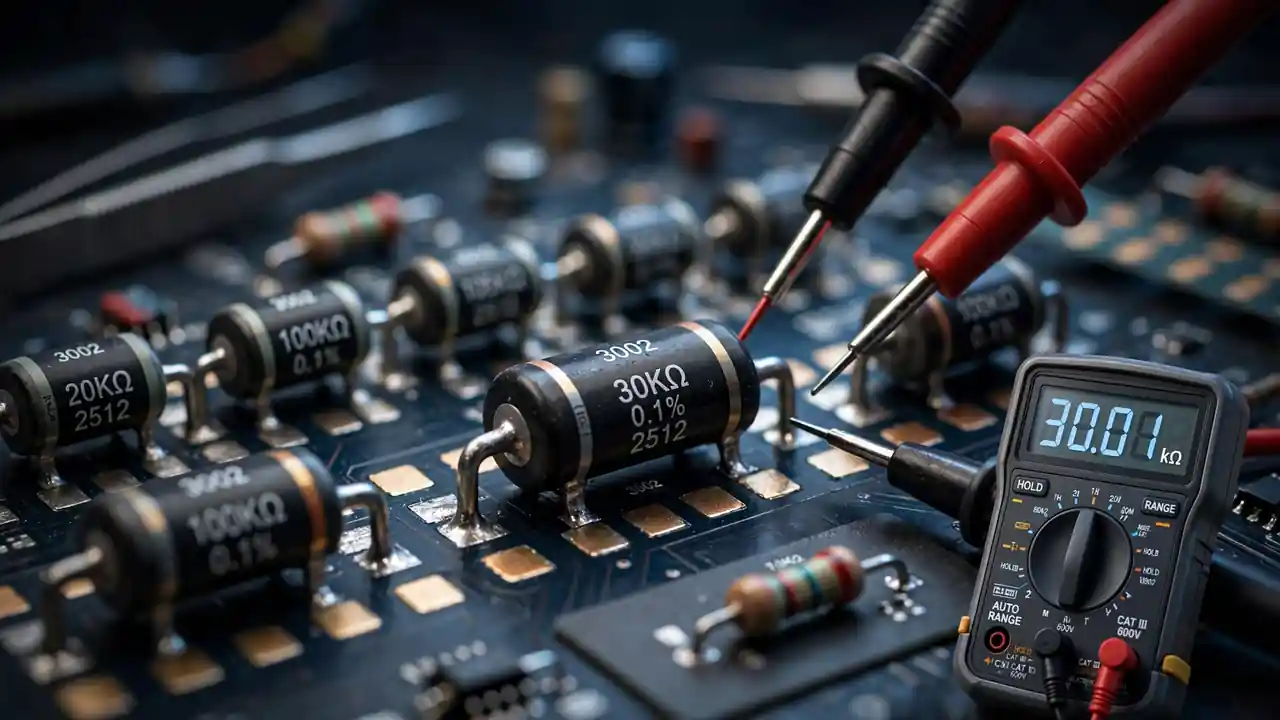
A 30K ohm 1W 2512 SMD resistor is a surface-mount chip resistor with a value of 30,000 ohms, a 1-watt power rating, and a large 2512 body. It suits high-voltage sensing and divider jobs where a small chip would fail.
How do you read the name?
| Part of the name | What it means | Value for this part |
|---|---|---|
| 30K ohm | Resistance value | 30,000 ohms |
| 1W | Power rating | 1 watt, if mounted on enough copper |
| 2512 | Package size | 6.4 mm by 3.2 mm (6432 metric) |
| 1% | Tolerance | Real value between 29.7K and 30.3K ohms |
The size code comes from inches: 0.25 inches long by 0.12 inches wide. That large body is the point. Bigger chips spread heat better, and they are far easier to solder by hand than tiny chips.
The 1% tolerance matters most in divider and sensing jobs. In a divider, the ratio of the resistors sets the measured voltage. A 5% part in that spot would make the reported voltage unreliable, while a 1% part keeps the reading tight.
How do you read the marking?
A 1% chip resistor usually carries a four-digit code. For 30K, expect 3002. The first three digits give 300, and the last digit tells you how many zeros to add: 300 times 10 to the power of 2, which is 30,000 ohms. Some makers print 30K0 instead, using K as the decimal marker.
The marking on a 30K ohm 1W 2512 SMD resistor is large enough to read without a magnifier. Still, verify with a meter. Markings can be misread, and a meter gives you the real value.
Where does a 30K 1W 2512 earn its keep?
High resistance plus real power handling points to a clear set of jobs:
- High-voltage dividers. To measure a high DC bus with a low-voltage microcontroller input, you divide the voltage down. The top resistor of the divider sees most of the bus voltage, so it needs both high resistance and a solid power and voltage rating. You find these in the sensing sections of inverters, UPS units, and power supplies.
- Bleeder resistors. A bleeder drains a high-voltage capacitor after switch-off, so no dangerous charge sits waiting. The bleeder must stand the full bus voltage all the time and shed the heat that comes with it.
- Startup and charging paths. A 30K-class resistor can limit current into a startup capacitor, where the resistor and capacitor pair sets the timing.
- Pull-up and pull-down jobs in high-voltage interfaces. Here the 30K value gives a pull with very little loading.
- Snubber and damping networks. In medium-power switching circuits, tens of thousands of ohms fit where the energy is modest but the voltage is high.
Note: In a divider, the resistor is part of a ratio. A divider that should output 2.5 V but outputs 3.5 V is telling you a story about which resistor drifted. Test the ratio first, then test the single parts.
Why do both power and voltage ratings matter?
This is the mistake to avoid: checking only the watts. A 30K ohm 1W 2512 SMD resistor has a power limit and a working voltage limit, and both apply on their own. A part can pass the power math and still fail if the voltage across it tops its working voltage rating. Working voltage ratings for 2512 parts change by series, so you must read your own series sheet.
Take a plain example. A 30K resistor with 150 V across it sheds power equal to voltage squared divided by resistance: 150 times 150 divided by 30,000, which is 0.75 W. That sits inside a 1W rating, but with little margin, and a warm enclosure would call for a thermal check. Now take 300 V across the same part: 300 times 300 divided by 30,000 is 3 W, far past the 1W rating. The same part, two very different answers. Always run both checks: power and voltage.
How do you test a 30K ohm 1W 2512 SMD resistor without fooling yourself?
Testing a high-value resistor has one classic trap: your fingers. Skin resistance from hand to hand sits in the same range as the part you are measuring, roughly tens of thousands of ohms. If you grip both probes or both ends of the part, your body sits in parallel with the resistor and drags the reading down. A perfect 30.0K part can read 22K just because you held it wrong.
The right way is simple:
- Use clips, tweezers, or probes held in one hand. Never bridge the measurement with your fingers.
- Lift one end out of the circuit for a firm result. Parts still in a circuit sit in parallel with other paths, and even high-value parallel paths shift a 30K reading.
- Expect 29.7K to 30.3K ohms for a good 1% part.
- An open reading, shown as OL, means failure. That is uncommon for 30K parts, but severe overvoltage can arc across the body.
- A reading that drifted high is the more typical age sign. Heat over time nudges the value up. In a divider, a top resistor that drifted high lowers the divided output, so the controller reads a lower voltage than the real bus. That silent shift can let protection limits drift too.
Bonus Tip: For divider diagnosis without desoldering, measure the divider output voltage with power on, taking care around high voltage, and compare it with the expected ratio. If the ratio is wrong, then desolder and test single resistors. That powered check often finds the faulty divider faster than blind part testing.
How do you solder a 2512 chip by hand?
If a 1206 chip is hand-solderable, a 30K ohm 1W 2512 SMD resistor is easy by comparison. The pads are generous, the joints are visible, and the part is heavy enough to stay put under the iron.
- Tin one pad with a small amount of solder.
- Hold the resistor with tweezers and tack it in place on the tinned pad.
- Solder the second end well, then go back and reflow the first joint so both ends show a full, smooth fillet.
- Use an iron tip with good heat capacity. The large body soaks up heat, so a tiny pencil iron will struggle. Work at a normal soldering temperature and finish each joint in a few seconds.
Check the joints with your eyes, and use a magnifier if you have one. Look for full wetting on both ends, no solder balls, and no bridges to nearby parts. In high-dissipation jobs, use enough solder. Good fillets with fair solder volume stand up to heat cycling far better than thin joints.
Note: If the part you replace failed from heat, with a dark board under it or scorched solder mask, look for the cause before you fit the new one. Higher voltage than the design, a drifted partner resistor that changed the divider ratio, or blocked cooling air will kill the replacement the same way.
How do you buy a genuine one?
The larger size helps here. Genuine parts show crisp laser marking, even body colour, and clean ends. Check a sample with your meter, fingers clear, before you commit to a large quantity. Buy on tape from sellers you trust when you can.
Two checks matter most. First, verify the power claim. Some grey-market parts marked 1W are thinner-film parts that cannot hold 1W all the time. Second, confirm the working voltage from the series sheet when the job involves high voltage. A 1W part rated for only a low working voltage is wrong for a high-voltage divider, no matter how good its power handling looks.
Frequently asked questions
Can I use two 15K resistors in series instead of 30K?
Yes. Resistances in series add, so 15K plus 15K gives 30K, and each part sees half the voltage, so the power handling doubles. This is a fair swap when the board has room for both parts. Keep both resistors the same type and tolerance.
Why 1% tolerance for a bleeder resistor?
Bleeders on their own do not need precision, but dividers do, and makers often standardise on 1% across the board to keep stock simple. If the original part is 1%, replace it with 1%. The cost gap is small, and the designer may have had a reason for it.
Can a 2512 chip really handle 1W all the time?
Yes, when it sits on enough copper, since the board pads act as heatsinks. A 30K ohm 1W 2512 SMD resistor floating on tiny pads in still air handles less. Board layout is part of the power rating, and datasheets assume set test conditions. In hot enclosures, derate, which means plan for less than the full rating.
What kills 30K resistors?
Overvoltage that arcs across the body of a 30K ohm 1W 2512 SMD resistor or through the film, long over-dissipation from circuit faults, and cracks from board flex. They rarely fail on their own. When one dies, look for the circuit condition that killed it.
How do I work out dissipation in a divider?
First find the voltage across the resistor, which is the supply voltage times that resistor’s share of the total divider resistance. Then use power equals voltage squared divided by resistance. For 150 V across 30K, that is 0.75 W. Check that result against both the power rating and the working voltage rating.
Is hand soldering reliable for repairs?
Yes, with sound technique. Clean joints on a 2512 are as reliable as reflowed joints. The keys are enough heat, good flux, and full fillets on both ends. Many repair shops hand-solder 2512 parts as their normal method.
Final thoughts
You can now read a 30K ohm 1W 2512 SMD resistor name in full, test it without falling into the finger-resistance trap, solder it with confidence, and judge divider faults in a planned way. The mark of someone who truly grasps high-value power resistors is the last point in this guide: respect both limits, power and voltage, on their own.
Next step
If the same repair also needs a through-hole power resistor for a heavier job, read the companion guide: 33 Ohm 5W Cement Resistor Guide. Before you order, confirm the value, wattage, package, tolerance, and working voltage with SunTech Mall so the part you get matches the board you are fixing.
Sources: SMD package size guides (2512 dimensions and 1W rating); chip resistor marking guides (four-digit code 3002); resistor power and derating guides. Full source list is in notes.md.
Related Products & Categories
Related Technical Guides
 Category:
Electronic Parts
How to Find Genuine UPS Spare Parts Near You in Pakistan
Looking for genuine UPS spare parts in Pakistan? Learn how to check original UPS spare parts and where to buy trusted UPS…
 Category:
Electronic Parts
Most Used Solar Inverter Spare Parts in Pakistan – 2026 Update
Learn about most used solar inverter spare parts in Pakistan in 2026. Find which solar parts fail most and where to buy…
 Category:
Electronic Parts
Top Solar and UPS Spare Parts Suppliers in Peshawar
Looking for solar and UPS spare parts suppliers in Peshawar? Learn how to find trusted suppliers and where to buy original spare…
1 Comment
[…] and power ratings through our electronic parts section. For related component knowledge, our 30K 2512 resistor guide covers the larger 1W package, the solar section has complete systems, and the high-voltage […]