



Buy 33 Ohm 5W 5% Fixed Wirewound Cement Resistor in Peshawar
When it comes to electronic components, resistors play a crucial role in regulating current and voltage within a circuit. Among the various types of resistors available in the market, the 33 Ohm…

I burned my first cement resistor fixing an old amplifier. The smell hit before I saw the smoke, and the little white block had turned an ugly brown. I had grabbed a 33 ohm resistor without checking its wattage, and the circuit needed far more than the resistor could handle. That ten-minute mistake taught me more than any textbook.
I have spent years around electronic parts, with hobbyists and repair technicians. A resistor looks like the simplest part in the world, but the wrong one can burn your board and waste your afternoon.
If you are looking for a 33 ohm 5W cement resistor in Peshawar, you probably have one of three worries: your circuit keeps burning resistors, you are building something and want to get it right the first time, or a repair shop named this exact part and you want to understand it. All three are easy to solve.
My promise: by the end of this guide you will know what this resistor is, how much power it can handle, where it is used, how to install it safely, and how to buy the right one in Peshawar. No engineering degree needed. Grab a cup of chai, and let us walk through it together.
An honest note: this guide is not a trick to make you buy something you do not need. SunTech Mall sells electronic parts, but most of what follows will save you money wherever you shop in Peshawar. A 33 ohm 5W cement resistor costs very little. The real cost is the burnt board and the wasted time. My goal is that you never pay that cost.
What You Will Learn in This Guide
- Learn what a cement resistor actually is and why it looks like a small white brick
- Understand the 33 ohm, 5W, and 5% numbers so you can read any resistor like a pro
- Do the simple power math that stops resistors from burning (it takes 30 seconds)
- See where a 33 ohm 5W resistor is really used in amplifiers, power supplies, and inverters
- Install it the safe way with proper spacing and cooling
- Buy the right part in Peshawar with confidence, every single time
What Is a Cement Resistor, Really?
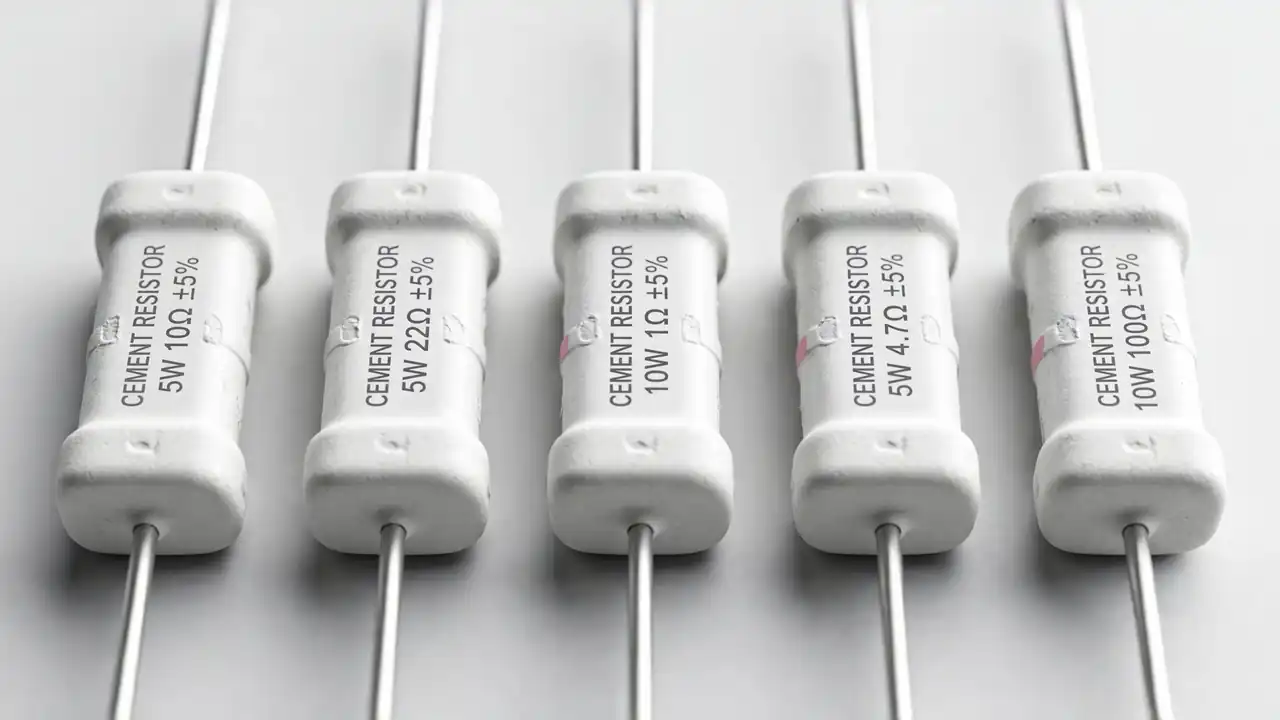
The first time I held a cement resistor, I thought someone had glued a piece of chalk to two wires. It is a small rectangular block, usually white or light gray, with a wire coming out of each end. It looks nothing like the tiny striped resistors on most circuit boards, and that chunky look is the whole point.
Inside that cement block is a wirewound resistor: a thin metal wire wound around a ceramic core, like thread around a spool. The cement coating protects the wire and spreads heat, giving it somewhere safe to go instead of cooking the board underneath.
Fixed just means the resistance never changes. A 33 ohm fixed resistor is 33 ohms today and ten years from now, exactly what you want in a circuit that must behave the same every time.
So 33 Ohm 5W 5% fixed wirewound cement resistor describes one specific part. Let us break each number down, because this is where most people go wrong.
Reading the Three Numbers: 33 Ohm, 5W, and 5%
I once watched a student replace a burnt 33 ohm 5W resistor with a quarter-watt one because “the ohms matched.” The board lit up like a diya. Ohms were never the whole story.
33 Ohm is the resistance value: how much the resistor fights current flow. In a circuit designed for 33 ohms, using 330 ohms would starve it of current and 3.3 ohms would flood it. Always match the ohms exactly.
5W is the power rating: the maximum heat it can safely handle. The rule that will save you forever: you can always replace a resistor with a higher wattage, never a lower one. A 33 ohm 10W works fine where 5W was needed, as long as it fits. The reverse will burn.
5% is the tolerance: how far the real value may drift. Five percent of 33 is 1.65, so anything from 31.35 to 34.65 ohms is perfectly good. For most repairs, 5% is fine.
Bonus Tip: If a resistor keeps burning in the same spot, do not just replace it with a bigger one and walk away. A repeatedly burning resistor is often a symptom, not the disease. Something else in the circuit, like a shorted transistor or a failed capacitor, is pushing too much current through it. Fix the cause, not just the victim.
The 30-Second Power Math That Stops Burns
My burnt amplifier taught me this formula the hard way. It takes thirty seconds, and it answers the most important question in resistor work: is this resistor strong enough for my circuit?
The formula is simple: power = current × current × resistance (P = I²R). For our 33 ohm, 5 watt resistor, the maximum safe current is the square root of (5 ÷ 33), about 0.39 amps. The maximum voltage across it is the square root of (5 × 33), about 12.8 volts.
In plain words: more than about 0.39 amps through it, or more than about 12.8 volts across it, and the resistor is in danger. Treat those numbers as red lines, not targets.
At 5 watts this resistor will be too hot to touch, and that is normal. But it must have air around it. Never bury a power resistor under other parts or wrap it in tape.
Note: These numbers come from basic physics, not from a guess. The same math works for any resistor. If you learn it once, you can check any power resistor in any circuit for the rest of your life.
Where a 33 Ohm 5W Resistor Actually Gets Used
I see this resistor most often in the hands of repair technicians, and there is a reason for that. It shows up in the kinds of circuits that work hard and run hot.
Power supplies use it as a current limiter or a bleeder resistor that drains leftover charge from capacitors after switch-off. Without it, a big capacitor can hold a painful charge long after you unplug the device.
Audio amplifiers use it in output stages and speaker protection circuits. When I repaired that first amplifier, the burnt part was exactly this kind of resistor, sitting where the current was heaviest.
Solar inverters and motor drivers use cement resistors in snubber networks that absorb voltage spikes, like shock absorbers for electricity. If you are repairing an inverter with burnt switching parts, check the resistors around them too. Our 2SK3878 MOSFET repair guide explains what usually fails alongside these resistors.
LED drivers use it to drop voltage or limit current, and dummy loads for testing power supplies use cement resistors because they can turn electricity into heat all day without complaining.
The pattern is clear: wherever there is real power and real heat, cement resistors earn their place. The tiny resistors handle signals. The cement ones handle muscle.
Installing It the Safe Way
A cement resistor has no polarity. There is no positive or negative end. You can solder it in either direction, and it will work exactly the same. That is one less thing to worry about, and beginners love hearing it.
Because heat matters, the first rule is lift it off the board. Do not solder it flat. Leave a gap of a few millimeters so air flows underneath, or the resistor will slowly cook the board and its copper traces. I have seen boards with a brown shadow burned in, shaped exactly like the resistor that sat there for two years.
The second rule is keep flammable things away. Do not let wires, plastic spacers, or cable ties rest against a power resistor. At full load it runs hot enough to soften plastic over time.
The third rule is solder quickly and cleanly. Heat the joint, flow the solder, and get out. Long heating can crack the cement body. If you are new to soldering, practice on scrap wire first. Our 2SC2655 transistor guide has tips for soldering small packages on the same board.
Bonus Tip: After installing a replacement power resistor, power up the circuit and touch the resistor after a minute. Warm is fine. Too hot to touch for more than a second means something is still wrong upstream. Switch off and investigate before it burns again.
Buying the Right One in Peshawar
Walking into an electronics market and asking for “a resistor” is like walking into a bakery and asking for “bread.” You need the full name: 33 ohm, 5 watt, 5%, wirewound cement resistor. Say all four parts and any good shopkeeper will hand you the right thing.
Before you pay, check three things. First, the body: smooth, even coating with no cracks. Second, the size: a real 5W cement resistor is chunky, roughly the size of the last joint of your thumb. If someone hands you something tiny and calls it 5W, walk away. Third, the tolerance marking: 5% is what most circuits need.
One honest warning: the market has fakes, undersized resistors relabeled as higher wattage. They work for a while, then burn. Buy from a shop that checks its stock and stands behind it. At SunTech Mall, our electronic parts are checked before they ship, and damaged arrivals get sorted out.
If your project also involves solar equipment, you will find our electrical and solar section useful, including guides like our 8KW solar inverter buying guide for Peshawar and our solar guide for Charsadda homes. Many of the repair jobs that need cement resistors come from power equipment, so it pays to know both sides.
Frequently Asked Questions
Can I replace a 33 ohm 5W resistor with a 33 ohm 10W resistor?
Yes, absolutely. Going up in wattage is always safe as long as the bigger resistor physically fits on the board and the ohms match. The circuit will only use the power it needs. The extra wattage just means more safety margin and a cooler-running part.
What happens if I use a lower wattage resistor by mistake?
It will overheat and burn, sometimes within seconds, sometimes over days. A burnt resistor can also damage the copper traces on the board and nearby parts. If you are unsure, always go up in wattage, never down.
Does a cement resistor have a positive and negative side?
No. Resistors have no polarity. You can install it in either direction and it works the same. This is true for all fixed resistors, not just cement types.
Why does my resistor get so hot even though it is not burning?
Because that is its job. A resistor turns extra electrical energy into heat. A 5W resistor running near its limit will be too hot to touch, and that is normal. What matters is that it has air around it and the circuit is not pushing it past its rating. Do the 30-second power math from this guide to check.
How do I know if a cement resistor is dead?
First, look at it. Burn marks, cracks, or a swollen body mean it is finished. Then test with a multimeter on the resistance setting: a good 33 ohm resistor should read between about 31 and 35 ohms. If it reads open (no connection) or far off, replace it. Always test with the power off and the resistor removed from the circuit for an accurate reading.
Final Thoughts
A 33 ohm 5W cement resistor is a small, cheap part. But today you learned to read its numbers like a professional, do the power math that prevents burns, install it so heat never becomes a problem, and buy the right one in Peshawar without fear. That skill transfers to every power resistor you will ever touch.
So congratulations. The next time a circuit burns a resistor, you will not panic. You will check the rating, do the math, look for the real cause, and fix it properly.
If you need a genuine 33 ohm 5W cement resistor, or any other electronic parts for your repair, SunTech Mall is here to help. Message us on WhatsApp at +92 306 2244820 or email info@suntechmall.com with your part name and quantity, and we will confirm stock and guide you to the right component. Your repair deserves the right part the first time.