
What Is a 35V 470uF Capacitor, and Why Does It Fail So Quietly?
If you’re building or repairing a solar inverter in Charsadda, one component that plays a silent yet vital role is the 35V 470uF aluminum electrolytic capacitor. This essential piece of hardware helps…

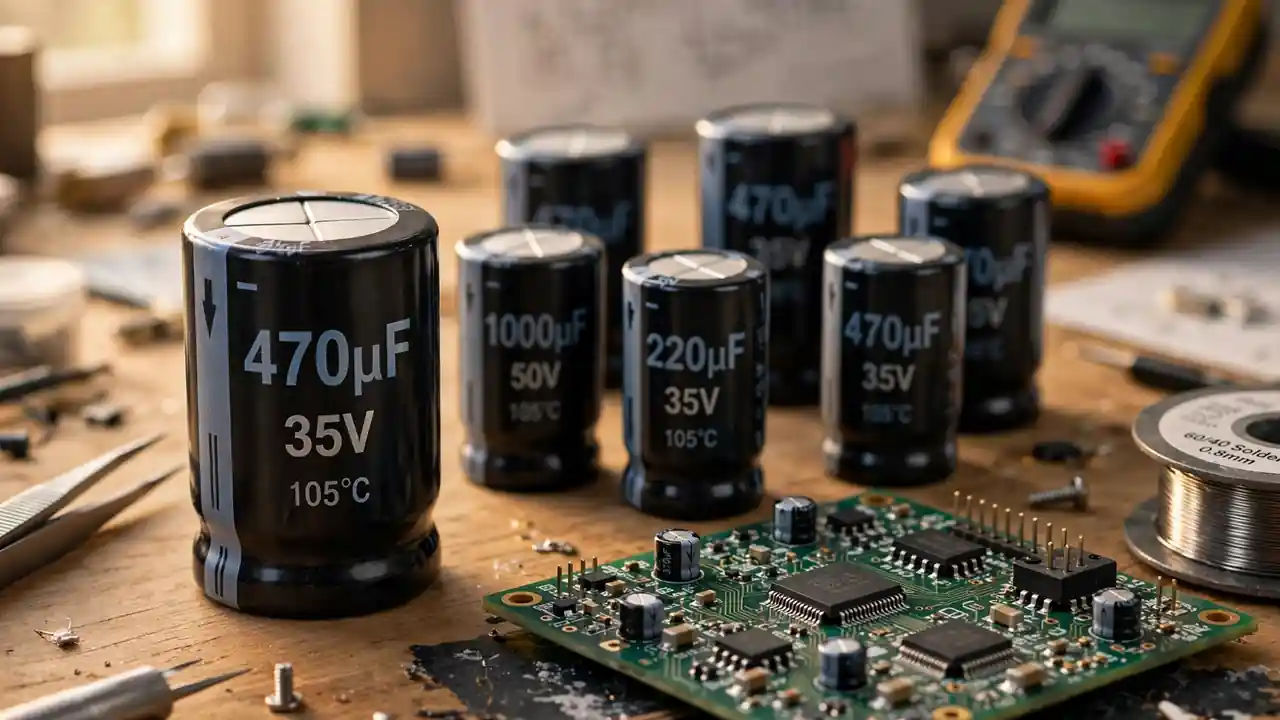
A 35V 470uF aluminum electrolytic capacitor is a common output filter in switch-mode power supplies. It smooths fast switching pulses into steady DC, and when it wears out, the supply still shows voltage while the gear it feeds starts to act strange.
What do the numbers mean?
| Marking | What it means | Value for this part |
|---|---|---|
| 470uF | Capacitance | Nearly half a millifarad, a solid reservoir for a 35V part |
| 35V | Rated DC voltage, max | Never run it above 35 V |
| Aluminum electrolytic | Type | Polarised: the stripe marks the negative end |
| Tolerance, standard | How far the real value may sit from nominal | Usually ±20%, so 376uF to 564uF is a good part |
Output rails in these supplies are often 12 V, 15 V, or 24 V, all well below 35 V. That margin is one reason output capacitors often outlive their high-voltage cousins, and one reason their eventual failure catches people by surprise.
Two more specs matter as much as the headline numbers. The first is the ripple current rating: how much AC ripple the part can carry all the time without overheating. The second is ESR, the part's internal resistance. Both sit in the series datasheet, and both set whether the part will filter well and live long. For switch-mode output filtering, a low-ESR grade is effectively required. A general-purpose part in that spot has ESR too high for the ripple currents involved, so it overheats, dries out fast, and lets ripple pass straight through.
What job does it do?
A switch-mode supply does not make DC directly. It makes high-frequency pulses, and the output capacitor filters those pulses into DC. With a healthy capacitor, the ripple voltage riding on the output stays in the tens of millivolts. With a worn capacitor, it climbs into the hundreds of millivolts or more.
Ripple matters because digital circuits have small noise margins. A microcontroller that expects clean 5 V can misbehave when hundreds of millivolts of switching noise ride the rail. Analog circuits suffer worse: ripple turns into audible hum in audio, visible noise in displays, and errors in sensing.
The capacitor fights ripple two ways. Capacitance gives a bigger tank, so the same pulse makes a smaller ripple. Low ESR gives less ripple voltage across the capacitor itself, since ripple voltage follows ESR times ripple current. Both weaken with age. Capacitance falls as electrolyte dries, and ESR rises for the same reason. The filter gets weaker from both sides at once.
Note: Ripple current heats the capacitor from inside, through heating in its ESR. That is a self-feeding spiral: higher ESR means more heat, more heat means faster drying, faster drying means higher ESR. Once that spiral starts, it does not stop on its own. Early ESR testing is how you catch it.
What are the signs of a worn output filter?
- Too much output ripple. Measured with an oscilloscope set to AC coupling across the output, this is the direct sign. Compare it with the supply's stated ripple, usually tens of millivolts.
- Scattered faults downstream. Logic errors, display noise, audio hum, sensor drift, and comms glitches. Everything fed by the rail suffers in its own way, which is why this fault misleads people.
- A hot capacitor. A filter capacitor should run barely warm. If it feels hot, its ESR has risen and it is burning real power inside. Replacement is overdue.
- Audible noise. In bad cases, the extra ripple turns into whining or buzzing from the supply that changes with load. The capacitor itself may even vibrate.
- Visual signs. Bulging, venting, or leakage show up in late failure. But many output capacitors degrade on the meter long before they show anything to the eye. Do not wait for the can to bulge.
How do you test it?
Capacitance alone is not enough for an output filter. You need both capacitance and ESR.
- Discharge first. Discharge through a 1K resistor. A 35V part needs only modest care, but build the habit for all electrolytics.
- Look at it. Check for a domed top, leaks, discolouration, and loose mounting.
- Measure capacitance. Expect 376uF to 564uF for a ±20% part. Give the reading time to settle, since larger capacitors charge slowly from the meter.
- Measure ESR. This is the test that matters most here. A healthy 470uF 35V low-ESR part measures a fraction of an ohm. Judge your reading against the series datasheet limit: a reading far above that limit means the part has failed for filtering duty, even if capacitance still looks fine.
- Read in-circuit results with care. Parallel capacitors divide the measured ESR, so an in-circuit reading lower than one part's rating is normal for a parallel set. But an in-circuit reading higher than a single part's rating means at least one part in the set is bad. For a firm result on single parts, lift one lead.
Bonus Tip: Output filter spots often use two or three 470uF parts in parallel instead of one large can. Paralleling splits the ripple current and cuts total ESR. If your board holds a parallel set, replace the whole set together. Mixing old and new parts creates uneven current sharing.
How do you pick a replacement?
The one rule above all others: match the ESR grade. A general-purpose 470uF 35V part in a low-ESR spot is a downgrade that will filter poorly from day one and fail fast. The sleeves look nearly the same. The difference sits in the series name. When in doubt, buy a named low-ESR series from a known maker.
Then check the rest:
- Voltage: 35 V minimum. A 50 V part is fine and often helps, but check its ripple rating too, since a higher-voltage part in the same family can carry a lower ripple rating.
- Capacitance: 470uF nominal. Stay inside ±20% unless the design clearly allows something else.
- Temperature: 105 degrees for enclosed, warm gear.
- Ripple current: match or beat the original, at the same test frequency.
- Parallel sets: replace all parts in the set with identical new parts. Do not mix old and new, or different series.
- Body: output capacitors are often the tallest parts in their area. Confirm height clearance under shields or covers. Seat the part firm, solder it clean, and check polarity twice.
- Verify after fitting: scope the output ripple with AC coupling. You should see the ripple fall back to the stated tens of millivolts. That flat waveform is the most satisfying proof in power supply repair.
How do you buy a genuine one?
Demand the series name. Low-ESR 470uF 35V from a named series is a real spec. A bare 470uF 35V label with no series is a gamble, since the series sets the ESR and ripple ratings that make or break output filtering. Inspect the part, check for sharp print and a flat top, then test capacitance and ESR on the bench. For output filters, the ESR reading is the acceptance test.
Price realism helps too. Genuine low-ESR parts cost clearly more than general-purpose ones, since the build genuinely costs more. A price that matches general-purpose stock for supposed low-ESR parts should raise doubt, not excitement.
Frequently asked questions
Can I use a 680uF part instead of 470uF?
Usually yes for output filtering, since more capacitance means less ripple. But check two things: physical fit, and inrush current. A larger capacitance draws a bigger charging pulse at switch-on, which stresses the rectifier and fuse. A modest rise is safe. Doubling the value calls for a check of the parts upstream.
Why does ESR matter more than capacitance here?
Because in switching supplies, the ripple voltage across the capacitor follows ESR times ripple current more than it follows capacitive reactance. A part with fine capacitance but high ESR still makes large ripple. This is the single most misunderstood point about output filter capacitors.
How often should output capacitors be replaced as a precaution?
In gear that runs all the time in warm rooms, five to seven years is a fair precautionary interval for electrolytic output filters. In critical gear, planned ESR testing catches wear before symptoms show.
Can I solder a new capacitor across the old one instead of replacing it?
As a short diagnostic trick, yes: it can prove the filter is the fault. As a repair, no. The old part's high ESR still burns heat, and its eventual failure, such as leakage or a short, can harm the board. Replace, do not piggyback.
What ripple level is acceptable?
It depends on the supply spec and how sensitive the load is. As a rough guide, tens of millivolts peak-to-peak suits logic supplies. If the design once gave 30 mV and you now measure 300 mV, the filter has failed, whatever any absolute threshold says.
Do solid polymer capacitors work as replacements?
Polymer electrolytics give very low ESR and long life, and they can be fine upgrades. But check that the circuit does not need a minimum ESR for stability, since some older regulator designs do. When the datasheet allows it, polymers are a strong long-life choice.
Final thoughts
The 35V 470uF output filter does its job thousands of times per second, turning harsh switching pulses into the smooth DC that everything downstream depends on. Its wear is slow, its symptoms scatter across the system, and its testing needs more than a capacitance reading. Once you grasp that, output ripple faults become some of the most satisfying faults to find and fix.
Next step
For the larger bulk capacitors that feed the same rails, read the companion guide: 35V 4200uF Capacitor Guide. Before you order, confirm the capacitance, voltage, low-ESR series name, ripple rating, and body size with SunTech Mall so the part you get matches the board you are fixing.
Sources: aluminum electrolytic replacement guides (voltage, ripple, ESR, and life matching); output filter testing practice (capacitance plus ESR, parallel-set behaviour). Full source list is in notes.md.
Related Products & Categories
Related Technical Guides
 Category:
Capacitors
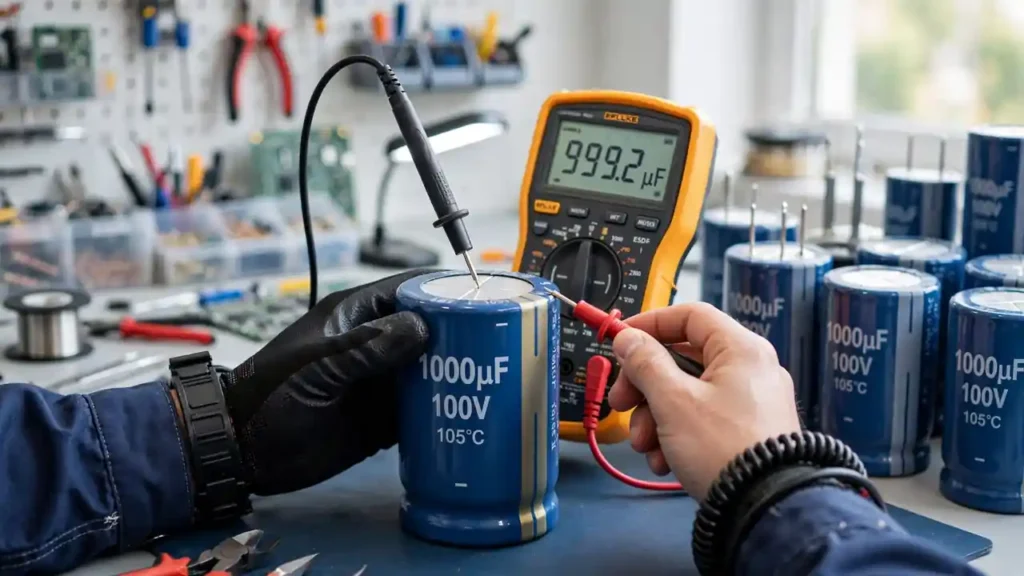
100V 1000uF Capacitor – The Best and Reliable Deal in Peshawar
In the electronics market of Peshawar, finding high-quality components at affordable prices is a priority for hobbyists, engineers, and businesses alike. Among…
 Category:
Capacitors
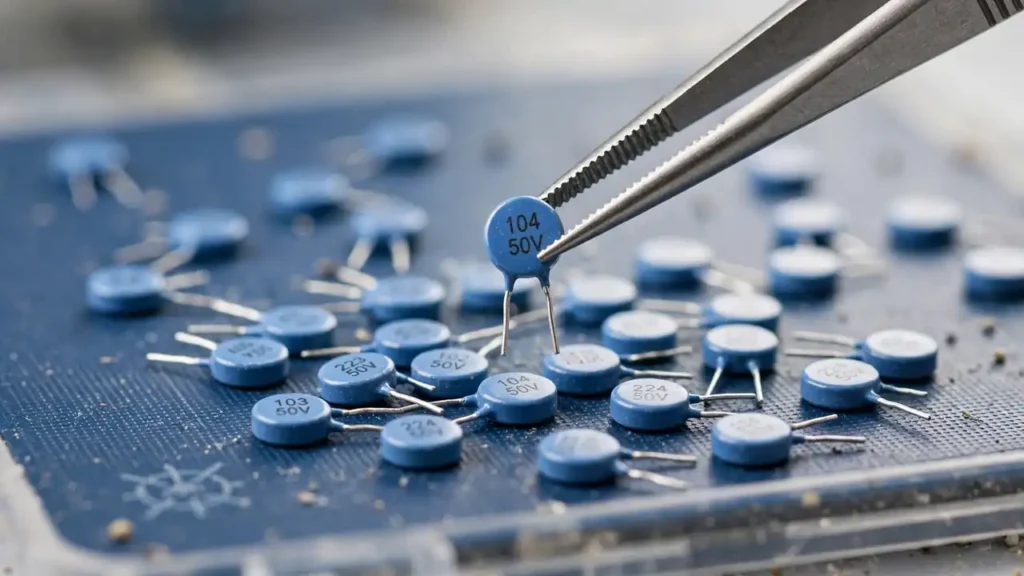
50V 104pF Ceramic Disc Capacitor – Best Price And Reliable
Welcome to the world of dependable electronic components! If you're searching for a capacitor that delivers outstanding performance and unmatched reliability, the…
 Category:
Capacitors
Best 50V 22uF Capacitor in Peshawar: Great Quality, Good Price
Are you searching for a reliable 50V 22uF capacitor to power your solar inverter or other electronic projects? Look no further! At…
1 Comment
[…] electrolytics with full series specifications in the electronic parts section. Related reading: our 35V 470uF guide and 35V 4200uF guide cover the neighboring values on the same low-voltage rails, and our solar […]