
0.1 Ohm 5W 5% Fix Wire Resistor – Best And Reliable
When it comes to building reliable and efficient electronic circuits, selecting the right components is crucial. The 0.1 ohm 5w resistor is a standout choice for hobbyists, engineers, and professionals seeking a…

How Does a 0.1 Ohm Resistor Measure Current?
A 0.1 ohm 5W wirewound resistor measures current by creating a tiny voltage. Put it in series with the load, and the current flowing through it makes a small voltage drop across it. Measure that voltage, divide by 0.1, and you know the current. That is the whole trick, and it sits at the heart of overcurrent protection in inverters, power supplies, and motor drivers.
When a 0.1 ohm 5W resistor fails, the equipment loses its ability to protect itself. A wrong value, a fake power rating, or a cracked body does not just read wrong. It blinds the protection circuit. Overcurrent goes unseen, switching transistors burn, and a cheap repair turns into a dead power stage. Once you can do the simple maths, test the part past the trap of meter lead resistance, and read its markings, you can check this part with confidence.
What is a 0.1 ohm 5W wirewound resistor?
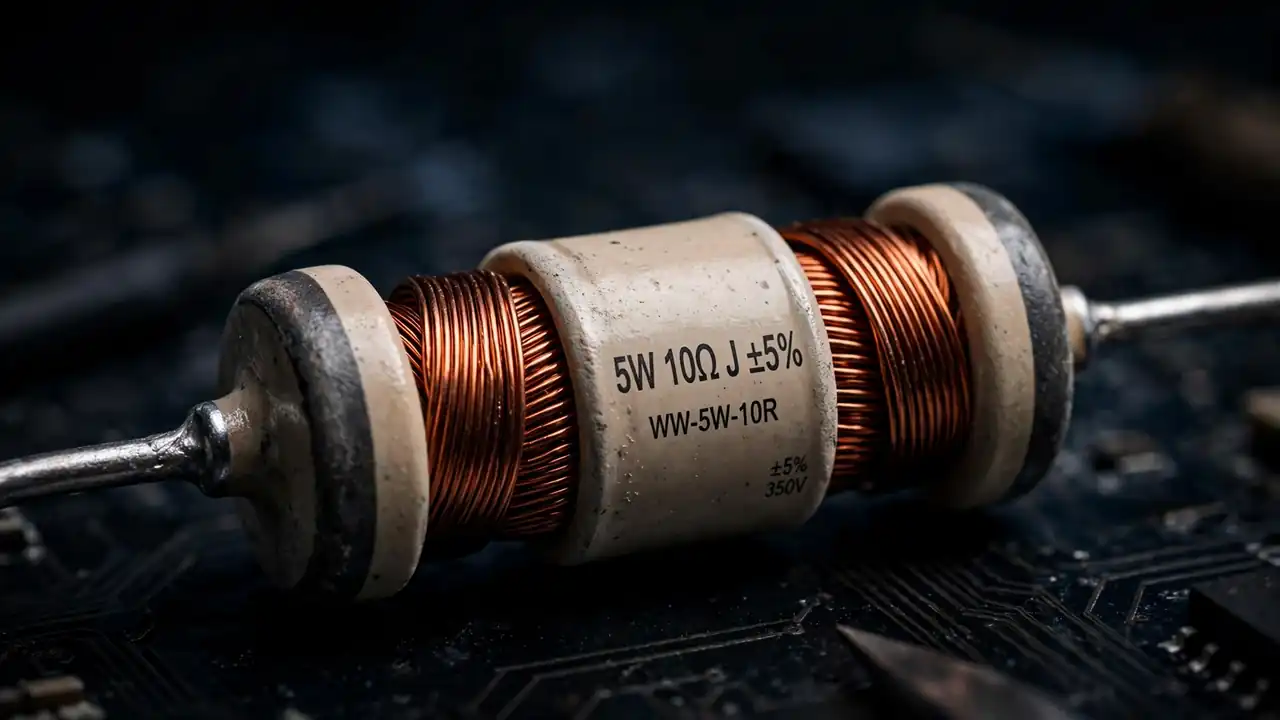
A 0.1 ohm 5W resistor is a wirewound part, built as its name says. A resistive metal wire is wound around a ceramic or fibreglass core, then coated in cement or silicone. The white rectangular cement resistor you see in repair shops is this type.
Its three numbers each mean one thing. Resistance is just 0.1 ohm. Power rating is 5 watts, the most heat it can shed without damage. Tolerance is ±5%, which means the real value sits between 0.095 ohm and 0.105 ohm. For current sensing, that band is usually fine, because the circuit is set around the nominal value, and a 5% shift in a protection threshold is acceptable in most designs. Where tighter accuracy is needed, 1% wirewound parts exist, but 5% is the workhorse.
Why wirewound, and not the film resistors used for normal values? At 0.1 ohm, a film layer would need to be impractically thick to carry several amps. A solid wire carries high current naturally, survives surge overloads that would destroy a film resistor, and stays stable over a wide temperature range. It is the right build for a harsh job.
Why is 0.1 ohm the classic sensing value?
Put a 0.1 ohm 5W resistor in series with the load, and measure the voltage across it. Ohm’s law turns that voltage into a current reading: voltage equals current times resistance, or V = I × R. With R at 0.1 ohm, the maths is almost embarrassingly easy. You just move the decimal point.
| Current through the resistor | Voltage across it (V = I × 0.1) | Power turned into heat (P = I² × 0.1) |
|---|---|---|
| 1 amp | 0.1 volts | 0.1 watts |
| 2 amps | 0.2 volts | 0.4 watts |
| 3 amps | 0.3 volts | 0.9 watts |
| 5 amps | 0.5 volts | 2.5 watts |
| 7 amps | 0.7 volts | 4.9 watts |
The circuit’s controller reads that small voltage, divides by 0.1, and knows the current. When the voltage crosses a set threshold, say 0.7 volts, which means 7 amps, the controller shuts things down before damage happens. That is overcurrent protection, built from one resistor.
Why not use 1 ohm or 10 ohms? Because a larger resistor wastes more power and steals voltage from the load. At 5 amps, a 1 ohm sense resistor would burn 25 watts and drop 5 volts. That is absurd for a sensing job. The 0.1 ohm resistor at 5 amps burns only 2.5 watts and drops just 0.5 volts. It watches the current without disturbing it. That is the whole art of current sensing: measure without interfering.
How much current can a 5W rating really allow?
For a 0.1 ohm 5W resistor, the 5W rating is a heat limit, not a current limit. But current makes the heat, so you can convert one into the other. From P = I² × R, current equals the square root of power divided by resistance: √(5 ÷ 0.1) = √50, which is about 7.07 amps. That is the absolute maximum steady current at room temperature, with the rating fully used.
Absolute maximum is not a target. Good practice derates power resistors to about 50 to 60% of rating for steady duty. At 2.5 watts, which is half the rating, the safe current is √(2.5 ÷ 0.1) = 5 amps, a clean number. The practical rule is simple: this resistor measures current up to about 5 amps steadily, and survives brief surges toward 7 amps.
Surges deserve respect. Motors draw several times their running current at start-up, and a wirewound resistor handles brief overloads well, because the wire’s thermal mass absorbs the hit. Brief means milliseconds to seconds, not minutes. A motor stalled for a minute at 10 amps will cook even a rugged 5W part. Size for the steady current, and let the surge ability cover the short spikes.
Heat also needs an exit path. These resistors run hot by design, so give them air space and keep them away from heat-sensitive parts. A 5W resistor at full load runs too hot to touch. Keep it away from electrolytic capacitors in particular, because heat shortens their life fast.
Where does this resistor work?
Solar inverters are the largest user of the 0.1 ohm 5W resistor. The sense resistor sits in the DC path of the power stage, and the controller watches its voltage to detect overloads and short circuits. When a short occurs, current spikes, the sense voltage spikes, and the controller kills the drive fast, saving the switching transistors. No sense resistor, no protection.
Switch-mode power supplies use the same idea. The controller measures current cycle by cycle, to regulate output and shut down on faults. Motor drivers use sense resistors both for protection and for control: the driver measures winding current to regulate torque. Battery chargers, including chargers for lithium batteries, use sense resistors to enforce charge-current limits.
You also find them in audio amplifiers, for output stage current limiting, and in LED drivers, for steady-current regulation. Anywhere the circuit needs to know the current, rather than just carry it, a 0.1 ohm 5W resistoris the standard answer.
Technicians repairing inverters with burnt switching transistors find these resistors in the current-sense path of the power stage. If the sense resistor itself has drifted or cracked, the protection misreads current, and the new transistors you just fitted can burn again. Always check the sense resistor when a power stage has failed.
What are its strengths, and its one weakness?
Wirewound strengths are real. Surge tolerance: the wire absorbs overloads that kill film resistors. Thermal stability: the value stays steady over a wide temperature range. High power in a small body: 5 watts in a cement block that costs little. Low cost: the part is cheap enough to stock in depth.
The weakness is inductance. A coiled wire is an inductor, and it resists fast current changes, which can distort measurements at high frequencies. For inverters, chargers, and motor drives, frequencies are low enough that it rarely matters. For radio-frequency work or ultra-fast sensing, designers use non-inductive or metal-strip shunts instead. Do not force a wirewound part into a job that needs a fast, non-inductive shunt. Match the build to the speed of the circuit.
The other practical weakness is heat, covered above. A 0.1 ohm 5W resistor runs hot by design, so it must not sit against parts that hate heat. Give it space, give it air, and the strength stays a strength.
How do you test a 0.1 ohm part with a multimeter?
Testing this part has one trap. Your meter leads themselves have resistance. Touch the probes together and most meters read 0.1 to 0.3 ohms. That is more than the part you are measuring. If you ignore lead resistance, every good 0.1 ohm resistor looks wrong.
- Remove the resistor from the circuit, or at least lift one leg. In-circuit readings lie, because parallel paths corrupt the result.
- Touch the probes together and note the reading. Say it reads 0.2 ohms. If your meter has a REL, or relative, button, press it with the probes shorted. That zeroes out the lead resistance.
- Measure the resistor, then subtract the lead reading if you did not zero it. A reading of 0.3 ohms with 0.2 ohms of lead resistance means the part is 0.1 ohms. Good.
- Read failures clearly. Open circuit, shown as OL, means the wire has broken. That is the most common failure after a massive overload. A reading far above 0.105 ohms means partial damage or corrosion.
- Inspect with your eyes too. Cracks in the cement body, scorch marks, or a loose lead all mean replacement, even if the meter reading looks close.
When you replace a 0.1 ohm 5W resistor, match all three specs: 0.1 ohm, 5W, and wirewound build. A film resistor of the same value will not survive the same abuse. Matching value alone is not matching the part.
How do you read the markings?
A 0.1 ohm 5W resistor is large enough for plain printing. You will typically see “0R1” or “0.1Ω” for the value, “5W” for the power, and “5%” or “J” for tolerance. The R-style marking uses R as the decimal point: 0R1 means 0.1 ohm, just as 4R7 means 4.7 ohms.
Cement resistors often print the value directly: “0.1Ω 5W”. If the printing has burnt off, which is common on failed parts, measure as described above, or read the schematic. Never guess a sense resistor’s value. Fitting 1 ohm where 0.1 ohm belongs makes protection ten times too sensitive, with constant false trips. Fitting 0.01 ohm makes it ten times too lax, with almost no protection at all. A factor of ten in the wrong direction is not a small error. It is a different circuit.
Frequently Asked Questions
What is a 0.1 ohm resistor used for?
Mainly current sensing. It creates a small voltage proportional to current, which the circuit measures for regulation or overcurrent protection. It is also used for inrush limiting in motor and power circuits.
How much current can a 0.1 ohm 5W resistor handle?
About 7.07 amps at the absolute maximum, from √(5 ÷ 0.1). Design for about 5 amps steady, to keep the part near half its rating for reliability.
Why does my multimeter read 0.3 ohms on a 0.1 ohm resistor?
Lead resistance. Short your probes and note the reading, often 0.1 to 0.3 ohms, then subtract it, or use the REL button to zero it out. Always measure the part out of circuit.
Can I replace a wirewound resistor with a film resistor?
Not for power and sensing duty. Film resistors cannot handle the same current and surge overloads. Match the build type, not just value and wattage.
What does the 0R1 marking mean?
R is the decimal point: 0R1 means 0.1 ohm. In the same system, 4R7 means 4.7 ohms and 1R0 means 1.0 ohm.
Why did my sense resistor burn?
Usually a massive overcurrent event, such as a shorted switching transistor or a stalled motor, pushed current far past 7 amps. Replace it, but also find and fix the fault that caused the surge, or the new one will burn too.
What to do next
You now understand one of the cleverest tricks in power electronics: measuring amps with a resistor worth a tenth of an ohm. You can do the V = IR maths in your head, you know the 5 amp practical limit, you can test the part properly despite lead resistance, and you know why matching the wirewound build matters.
Check the 0.1 ohm 5W resistor early on your next dead inverter, and check the parts around it too. For how switching transistors fail when protection goes blind, read the guide on why inverter MOSFETs burn in Pakistan. For choosing those transistors correctly, read the Power MOSFET selection guide. For help judging sellers and genuine stock, see the genuine solar inverter parts guide. Check current availability there before you order, and match value, wattage, tolerance, and build type to the original part.
SunTech Mall supplies spare parts and everything you need at wholesale prices across Pakistan.
Parts you need
Check the live price and stock on the product page:
Related Products & Categories
Related Technical Guides
 Category:
Electronic Parts
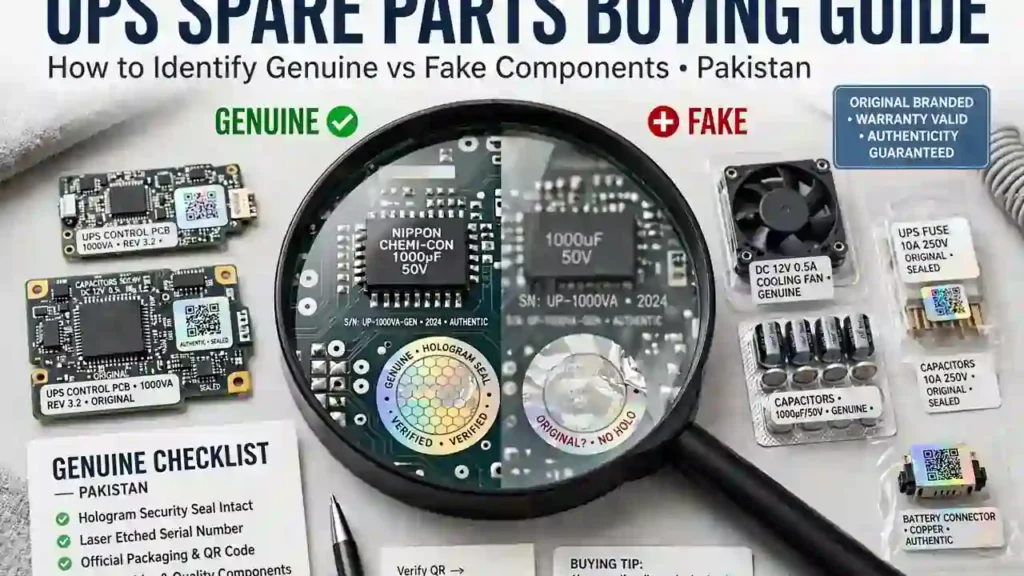
How to Find Genuine UPS Spare Parts Near You in Pakistan
Looking for genuine UPS spare parts in Pakistan? Learn how to check original UPS spare parts and where to buy trusted UPS…
 Category:
Electronic Parts
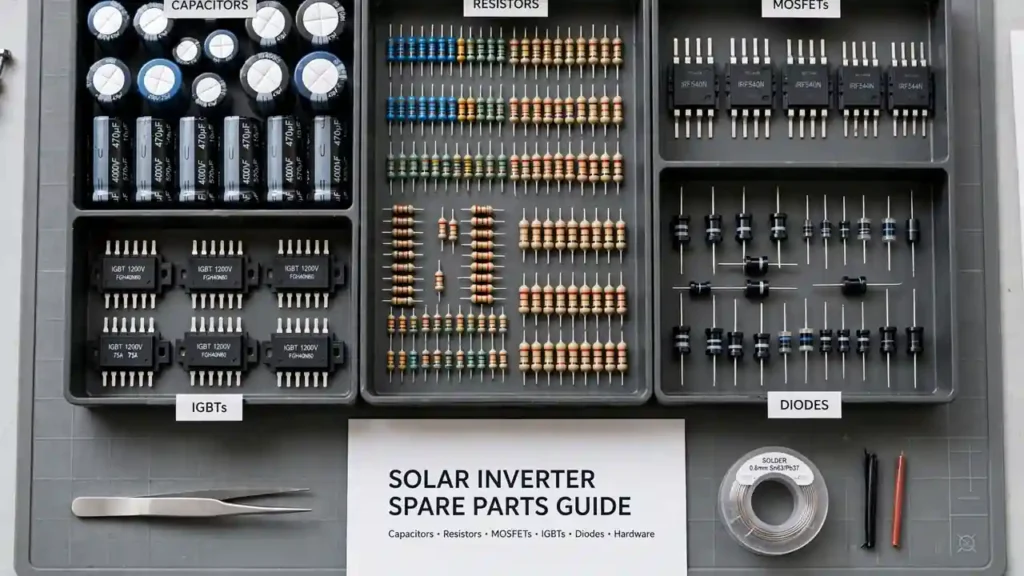
Most Used Solar Inverter Spare Parts in Pakistan – 2026 Update
Learn about most used solar inverter spare parts in Pakistan in 2026. Find which solar parts fail most and where to buy…
 Category:
Electronic Parts
Top Solar and UPS Spare Parts Suppliers in Peshawar
Looking for solar and UPS spare parts suppliers in Peshawar? Learn how to find trusted suppliers and where to buy original spare…