


RHRP1560 Diode: The Hyperfast 600V 15A Part, Explained in Plain Words
When designing high-performance power circuits, efficiency and reliability are crucial. The RHRP 1560 is a 600V, 15A hyper-fast recovery diode, engineered to deliver low switching losses, high-speed operation, and minimal reverse recovery…

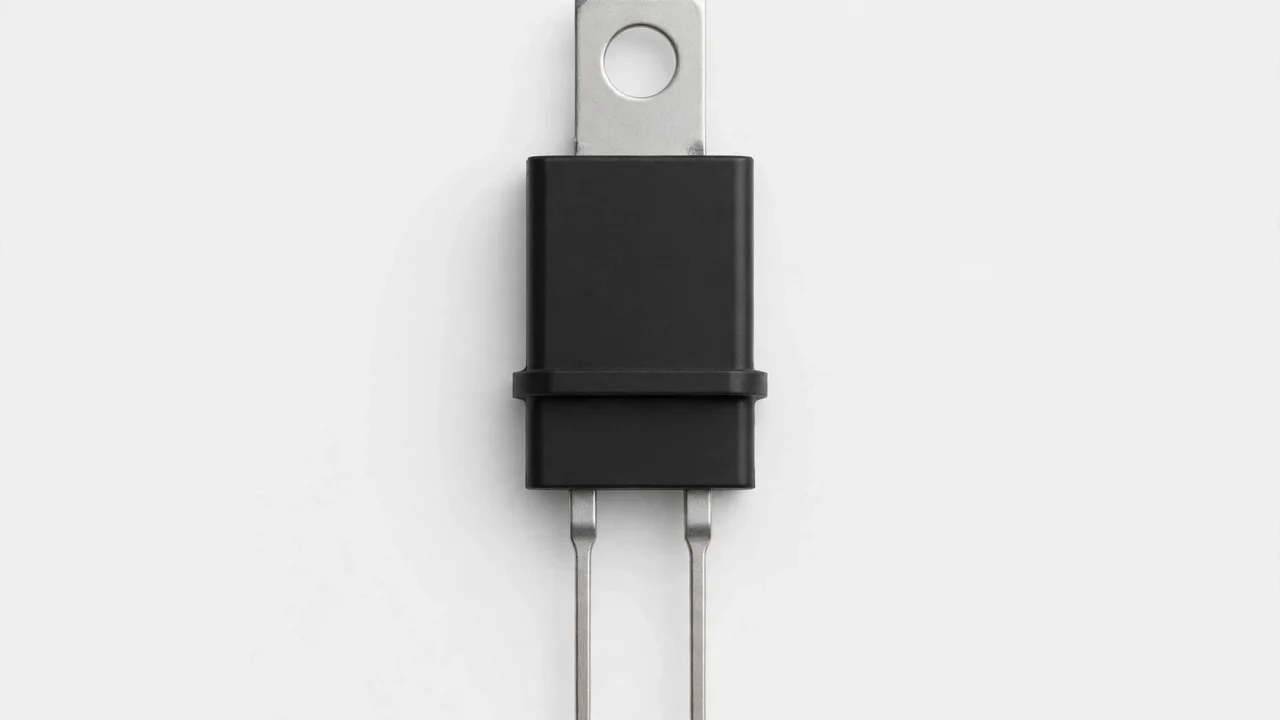
Dek: This guide shows you what the RHRP1560 diode does, where it fits, and how to fit it so it lasts.
Key takeaways: The RHRP1560 is a hyperfast diode rated at 600 V and 15 A. It turns off in about 40 ns, so it wastes less energy in fast-switching circuits. It fits SMPS output stages, motor drives, solar inverters, PFC stages, and UPS units. It is not the best pick for low-voltage rails, where a Schottky diode often wins. At high current it needs a real heatsink, because its forward drop turns power into heat.
In this guide
- What “hyperfast” means
- The specs that matter for your build
- Why 40 ns of recovery time matters
- Where the RHRP1560 fits, and where it does not
- RHRP1560 vs. a standard rectifier
- How to install it right
- How to spot a fake part
- Frequently asked questions
- Verdict
What does “hyperfast” mean?
A diode lets current flow one way and blocks it the other way. The hard part is the tiny moment when it switches between those two jobs.
When current reverses, the diode does not shut off at once. It needs time to clear the charge inside it. That time is called reverse recovery time. It is the most important number on a switching diode.
A plain rectifier can take microseconds to recover. That is slow. The RHRP1560 recovers in 40 ns typical at 15 A, with soft recovery, according to the onsemi datasheet. Soft recovery means it turns off smoothly, not with a hard snap.
A hard snap causes ringing. Ringing is electrical noise, and it stresses the switching transistor next to the diode. A smooth turn-off keeps noise down and helps the whole circuit last longer.
So “hyperfast” is not just a label. It is measured speed: 40 ns, soft, clean turn-off. If your circuit switches at tens or hundreds of kilohertz, that speed keeps losses low.
What are the specs that matter?
Datasheets are long. These are the numbers that should drive your design:
| Spec | RHRP1560 value | What it means for you |
|---|---|---|
| Reverse voltage (VRRM) | 600 V | The most it can block, again and again, without damage. |
| Forward current (IF(AV)) | 15 A | The most average current it can carry, with good heatsinking. |
| Recovery time (trr) | 40 ns typical at 15 A | How fast it turns off. This is the hyperfast part. |
| Forward voltage (VF) | 2.1 V max at 25 °C case | How much voltage it drops while it conducts. |
| Package | TO-220AC-2L | A through-hole part with a metal tab for a heatsink. |
| Build | Silicon nitride passivated, avalanche energy rated | A tough design made for switching power circuits. |
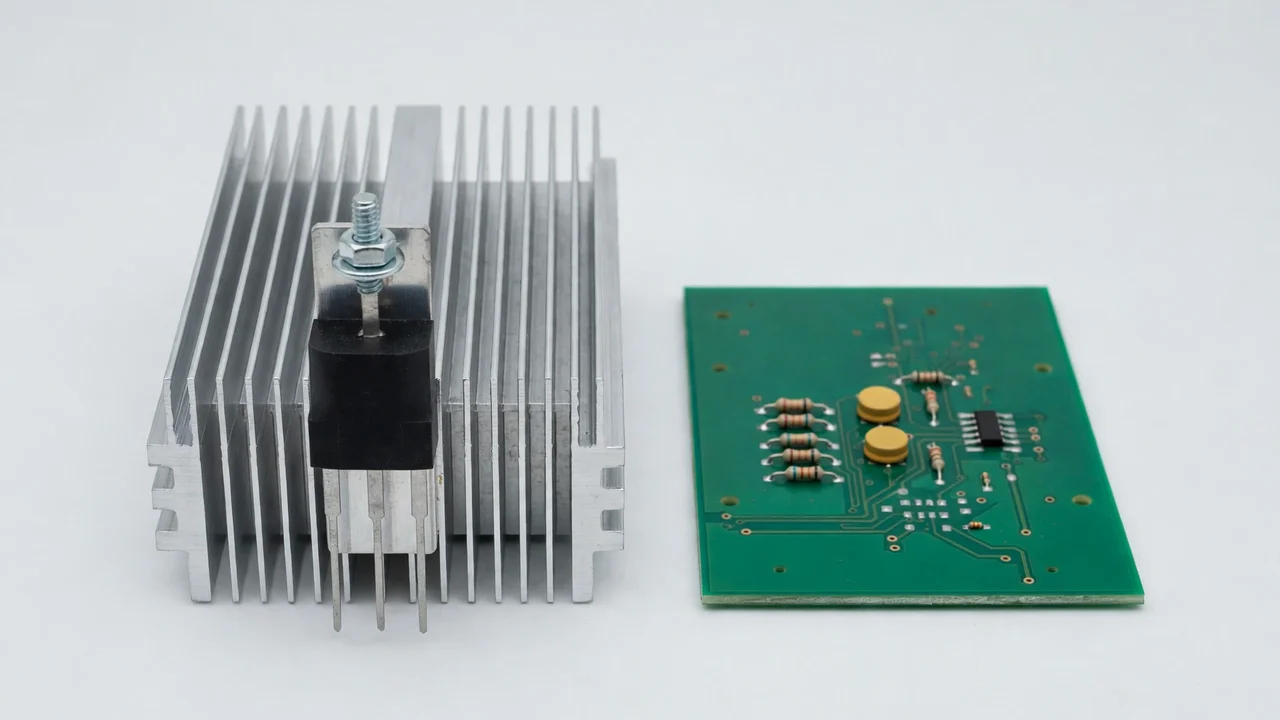
Read the forward voltage line twice. Two volts at 15 amps means about 30 watts of heat while it conducts. That is why the metal tab exists. It must bolt to a heatsink.
Every power part is a trade. This diode gives you speed and 600 V blocking. In return, you must deal with its forward drop and its heat.
You can check the live price on the website for the RHRP1560 600V 15A hyperfast diode.
Why does 40 ns of recovery time matter?
Think of a switching power supply. Each cycle, the diode must turn off before the transistor turns on. If the diode is still conducting when the transistor turns on, current flows the wrong way through both parts at once. That overlap becomes pure heat.
At 50 kHz, each cycle lasts 20 microseconds. A diode that needs 500 ns to recover misbehaves for a real slice of every cycle. A diode that recovers in 40 ns barely registers.
Across millions of cycles, that small difference adds up. Parts run cooler. The supply delivers its rated output without derating. And the transistor next to the diode lives longer.
Bonus tip: If a hot SMPS has a warm switching transistor even at light load, suspect the freewheeling diode first. A slow diode punishes the transistor before it punishes itself.
Where does the RHRP1560 fit best?
I keep this part on the repair bench because it covers so many real jobs. The datasheet points to switching power supplies, power switching circuits, and freewheeling and clamping use. In plain words:
- SMPS output rectification. This is the classic job. The output diode switches at the full converter frequency, so speed is everything.
- Motor drive freewheeling. When an inductive load switches off, its collapsing field needs somewhere to go. This diode catches it fast.
- Solar inverter stages. Boost and buck stages switch hard and run hot. Fast recovery keeps losses down where cooling is hard.
- PFC boost diodes. This is one of the hardest-worked diodes in any supply. A hyperfast part is a natural home here.
- UPS systems. Small, warm boxes need reliable rectification. Low recovery losses help here too.
Where does it not belong? Skip it for small-signal work. And for low-voltage rails under 100 V, a Schottky diode often wins on efficiency, because its forward drop is lower. For top efficiency at 600 V, silicon carbide beats it, but it costs much more. The RHRP1560 is the sweet spot in the middle.
For more repair guides, see the SunTech Mall blog.
RHRP1560 vs. a standard rectifier: which one should you pick?
A fair question from the workshop: why not just use the cheapest 15 A diode in the drawer? Here is the honest answer:
| Question | RHRP1560 | Standard rectifier |
|---|---|---|
| Recovery time | About 40 ns | Microseconds, dozens of times slower |
| Forward drop | About 2 V max | Often lower, near 1 V |
| Cost | Higher | Cheaper |
| Best job | Fast-switching circuits | 50 Hz mains rectifiers |
In a 50 Hz mains rectifier, a standard diode is fine. Nothing switches fast there. The moment your circuit switches fast, the hyperfast diode pays for itself in reliability.
One warning: a hyperfast diode does not fix a bad layout. Long, loopy PCB traces add inductance that slows everything down, no matter how fast the diode is. Keep the diode close to the switching device, with short, wide traces.
How do you install it right?
Too many diodes die from bad fitting, not bad parts. The RHRP1560 handles 15 A only if heat has somewhere to go. Follow these steps:
- Heatsink it. Use thermal compound or a pad. The tab is the cathode, so insulate it with a mica or silicone pad plus a shoulder washer if the heatsink is grounded or shared.
- Keep margin. Stay comfortably below 600 V and 15 A. Aim for at least 20 percent headroom.
- Keep leads short. Keep the diode, transistor, and output capacitor close together. Short, direct links cut inductance and ringing.
- Match its companions. Use low-ESR output capacitors and a transistor rated for your switching frequency.
- Test at full load. The heatsink should warm evenly and stay touchable. If it scalds within a minute, check load current, frequency, and thermal contact.
Bonus tip: When you replace a diode, always test the transistor it works with. A slow diode often takes the transistor down with it. And a weak transistor can kill your new diode in return.
After any diode replacement, run the unit at full load for thirty minutes before you call the job done. Heat failures hide in short bench tests. They show up later, in the customer’s home.
How do you spot a fake RHRP1560?
This part matters most, because popular parts get copied. A fake may be a relabeled slow rectifier in a TO-220 package. It will pass a multimeter diode check. That test cannot measure recovery time.
Fit that fake in a 65 kHz circuit, and the transistor can die within hours. I have seen the aftermath: scorched boards, dead MOSFETs, and customers blaming the design when the part was the culprit.
Genuine parts have correct markings and datasheet behaviour. Buy from a supplier who sources properly and stands behind the parts. We stock the original RHRP1560 at SunTech Mall because our repair customers cannot afford mystery parts. Check the live price on the website. For quantity orders, email info@suntechmall.com.
Frequently asked questions
What is the RHRP1560 diode used for?
It is a hyperfast diode for SMPS, solar inverters, motor drives, UPS units, and PFC circuits. Use it anywhere a diode must switch tens of thousands of times per second at up to 600 V and 15 A, as an output rectifier, a freewheeling diode, or a clamping diode.
What does 600V 15A mean on the RHRP1560?
600 V is the most reverse voltage it can block, again and again. 15 A is the most average forward current it can carry, with proper heatsinking. Stay below both, with a safety margin. Overvoltage risks instant breakdown. Overcurrent overheats the part.
How fast is the RHRP1560’s reverse recovery?
The datasheet gives 40 ns typical at 15 A, with soft recovery. That is roughly half the recovery of ordinary ultrafast diodes. Hence the “hyperfast” name. Soft recovery means smooth turn-off, which cuts ringing and electrical noise.
Can I replace a standard rectifier diode with an RHRP1560?
Usually yes, if the ratings fit. A hyperfast diode works fine at low frequencies too. The main check is forward drop. At 2.1 V max, it drops more than a standard diode, so confirm your heatsinking can handle the extra heat.
Does the RHRP1560 need a heatsink?
At currents above a few amps, yes. At 15 A, the forward drop turns roughly 30 watts into heat. The TO-220AC package is made to bolt onto a heatsink with thermal compound. At very light loads you may manage without one. For serious current, heatsink it.
Where can I buy a genuine RHRP1560 in Pakistan?
Order the genuine RHRP1560 from SunTech Mall with delivery across Pakistan, single pieces or bulk for repair shops. You can also read our IRF3205 MOSFET guide and our IRF3710 MOSFET guide to see the switching parts this diode often works beside, or browse the MOSFET category.
Verdict: should you use the RHRP1560?
Yes, if your circuit switches fast and runs at up to 600 V and 15 A. Its 40 ns soft recovery, tough build, and TO-220 heatsink mounting make it a strong pick for SMPS stages, inverters, motor drives, and PFC circuits.
No, if your rail is low voltage or your circuit switches at mains frequency only. There, a cheaper or lower-drop part may serve you better.
Pick the diode for the frequency, not just the price tag. Fit it with a proper heatsink, keep the layout tight, and buy a genuine part. Do that, and this diode will give you years of quiet service.
Questions? Visit the RHRP1560 product page to check the live price, explore the SunTech Mall blog, or start from the SunTech Mall homepage. You can also message us on WhatsApp through SunTech Mall.
Related Technical Guides
 Category:
Diodes
How the 1N6A10 Diode Contributes to Improve Energy Solutions
The 1N6A10 diode revolutionizes energy solutions with efficient power rectification and high-voltage performance. Ideal for solar inverters and battery charging, it boosts…
 Category:
Diodes
BZT52C39V Zener Diode: How to Use It for Voltage Regulation and Protection
The BZT52C39V Zener diode is a 39V SMD Zener diode commonly used in electronic circuits for Zener diode voltage regulation and Zener…
 Category:
Diodes
UF5M Diode Explained: What This Small 5A, 1000V Part Does in Your Solar Inverter
Solar inverters play a crucial role in converting direct current (DC) from solar panels into alternating current (AC) for household or commercial…