


Battery Charger Kitne Ampere ka Ho 2026: Pick the Right Charger Size Before It Kills Your Battery
For most lead-acid batteries, pick a charger rated at about 10% of your battery size in Ah. A 100Ah battery needs about a 10A charger. A 200Ah battery needs about a 20A…

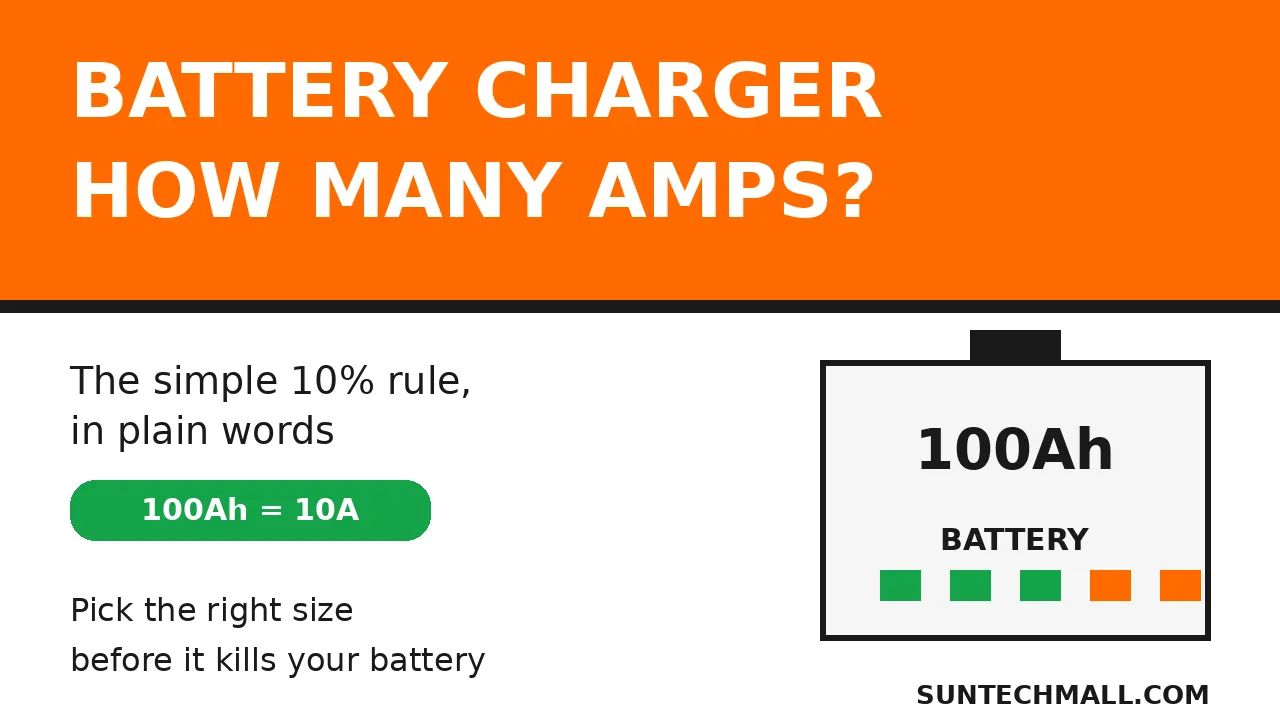
For most lead-acid batteries, pick a charger rated at about 10% of your battery size in Ah. A 100Ah battery needs about a 10A charger. A 200Ah battery needs about a 20A charger. That one rule answers most cases. The rest of this guide explains when to go a little higher or lower, and when the rule does not apply at all.
A customer once came to our repair centre with a dead battery and a brand-new charger. He was angry. He said the charger was faulty. We checked both. The charger was fine. The battery was fine too, at first. The problem was the match. He had a big 200Ah battery and a tiny 5A charger. It charged so slowly that the battery never got full. Day after day, it stayed half empty. A half-empty lead-acid battery dies early. He did not have a bad charger. He had the wrong size charger.
That story is common in Pakistan. People buy a charger by price, or by what the shop has in stock. They do not check the amps. Then the battery dies in one year instead of five, and they blame the battery. In most cases, the battery was killed by slow, incomplete charging, or by charging that was too fast and too hot.
This guide will help you pick the right charger size in five minutes. You will learn the simple 10% rule, a size table you can copy, how battery type changes the answer, and the signs that your charger is the wrong size. You do not need to be a technician. You only need to read the label on your battery.
Trust nudge: SunTech Mall runs its own inverter and UPS repair service centre in Pakistan. We also sell solar inverters, batteries, and chargers to technicians and home buyers every day. So this guide comes from real shop and bench experience, and from the charging guides linked at the end, not from sales talk.
What You Will Learn in This Guide
- How many amps your battery needs, with one simple formula
- A ready size table: battery Ah to charger amps, at a glance
- What happens when the charger is too big, and when it is too small
- How lead-acid, AGM, gel, and lithium batteries change the answer
- Why voltage matters as much as amps, and how to match both
- How long charging really takes, with honest maths
- A 5-step checklist to use before you buy any charger
- The warning signs that you picked the wrong charger
- Which charger size fits which home battery in Pakistan
How Many Amps Charger Do I Need for a 100Ah Battery?
Start with one number on your battery label. It is written as Ah. Ah means amp-hours. It tells you how much charge the battery can hold. A 100Ah battery can give 100 amps for one hour in theory, or 10 amps for ten hours. In real life, you never use it that way. But the Ah number is the key to charger size.
The rule is simple. For a normal lead-acid battery, the charger current should be about 10% of the Ah number. Guides call this the C/10 rate. C means capacity. C/10 means one tenth of capacity.
Charger amps = Battery Ah x 0.10
People also call this a battery charger ampere calculator — put your battery Ah in the formula and you get your charger amps.
Here are three quick examples.
- A 50Ah battery x 0.10 = a 5A charger.
- A 100Ah battery x 0.10 = a 10A charger.
- A 200Ah battery x 0.10 = a 20A charger.
That is the safe middle point. It charges at a good speed. It does not cook the battery. It gives the battery time to absorb the charge fully. Many charging guides agree on this 10% starting point for lead-acid batteries, and the sources at the end of this guide say the same.
Note: The charger amp number is a maximum, not a fixed flow. A good smart charger does not push its full amps all the time. It gives high current at the start, when the battery is empty. Then it slows down as the battery fills up. At the end, it gives only a tiny trickle current. So a 20A charger does not force 20 amps into a full battery. It only offers up to 20 amps when the battery can take it.
Bonus Tip: If you cannot find the Ah number, look for it on the battery label, not on the inverter. The inverter label tells you about the inverter. The battery label tells you about the battery. Take a photo of both labels today, while everything works. That photo saves a lot of guessing later.
The Simple Size Table: Battery Ah to Charger Amps
Use this table as your first map. It uses the 10% rule for lead-acid batteries. It also shows a safe range, because a little higher or lower is often fine. Your battery manual is still the final word. If your manual gives a different number, follow your manual.
| Battery size (Ah) | Safe charger size (lead-acid, 10% rule) | Safe range for most lead-acid batteries | Rough full-charge time from empty |
|---|---|---|---|
| 40Ah | 4A | 4A to 8A | About 10 to 12 hours at 4A |
| 60Ah | 6A | 6A to 12A | About 10 to 12 hours at 6A |
| 100Ah | 10A | 10A to 20A | About 10 to 12 hours at 10A |
| 150Ah | 15A | 15A to 25A | About 10 to 12 hours at 15A |
| 200Ah | 20A | 20A to 30A | About 10 to 12 hours at 20A |
| 250Ah | 25A | 25A to 40A | About 10 to 12 hours at 25A |
Read the table this way. Find your battery size in the first column. The second column is the safe, simple pick. The third column is the wider range that most lead-acid guides allow. The last column is honest time, not sales time. Real charging takes longer than the simple maths, because the last part of charging is slow. A smart charger slows down near full charge to protect the battery. That slow finish is good. It is not a fault.
Note: For a battery bank, add the Ah of batteries wired in parallel. Two 100Ah batteries in parallel make a 200Ah bank, so they need about a 20A charger. Batteries wired in series do not add Ah. Two 100Ah batteries in series at 24V are still 100Ah, but at 24 volts. The charger must then be a 24V charger, not a 12V charger. Voltage and Ah are two different checks. Both must match.
What Happens If the Charger Is Too Big?
A charger that is far too big pushes too much current into the battery. The battery gets hot. The liquid inside can boil. Plates inside the battery can bend or break. In a sealed battery, gas builds up and cannot escape well. The battery loses capacity fast. It may swell. It may fail in months instead of years.
How big is too big? For a normal lead-acid battery, guides warn against going far above 20% to 25% of Ah for regular charging. A 100Ah battery charged at 40A every day is being pushed hard. That is 40% of its size. It will charge fast, but it will pay for that speed with a short life. Some guides allow up to 25% for AGM batteries, which handle current a little better. But even then, fast charging should not be the daily habit. It should be the exception.
There is one more risk with a big charger. A cheap charger with no smart control may keep pushing current after the battery is full. A good smart charger stops or drops to a tiny float current. A bad charger does not. That is why charger quality matters as much as charger size. A big, dumb charger is the worst mix of all.
Bonus Tip: If your battery feels hot during charging, stop and check. A warm battery is normal. A hot battery is a warning. Hot terminals, a hot case, or a strange smell mean something is wrong. Do not keep charging and hope it gets better.
What Happens If the Charger Is Too Small?
A charger that is too small is the quiet killer. It does not burn the battery in one day. It kills it slowly, over weeks and months. The battery never gets full. It stays half charged. Lead-acid batteries hate staying half charged. A chemical layer builds up on the plates. Technicians call it sulphation. Once it builds up thick, the battery cannot hold charge well, even with a good charger later.
A small charger also fails the load-shedding test. In Pakistan, power may come back for only a few hours between cuts. A 5A charger on a 200Ah battery needs about 40 hours to fill it from empty, in simple maths. In real life, even longer. If power comes back for only three hours, the battery gains only a small part of its charge. Then the next cut drains it again. Each day, it sinks a little lower. After a few weeks, backup time is very short. The owner thinks the battery is old. In fact, it was never charged.
Small chargers do have one good use. A tiny trickle charger is fine for keeping a parked car battery topped up, when the battery is already full and no load is running. That is maintenance, not charging from empty. Do not confuse the two jobs. A maintainer keeps a full battery full. A charger must fill an empty battery in a useful time.
Does Battery Type Change the Answer?
Yes. The 10% rule is the starting point for lead-acid batteries. Other battery types have their own safe ranges. Always check your battery manual first. The ranges below come from the charging guides linked at the end.
- Flooded lead-acid (the battery with water caps): About 10% of Ah is the safe, simple pick. Up to about 20% is often allowed. This is the most forgiving type, but it still needs water checks and ventilation.
- AGM (absorbed glass mat, sealed lead-acid): About 10% to 25% of Ah is the range most guides give. AGM handles a bit more current than flooded, but it still needs tight voltage control. Overcharge damages it faster because it is sealed.
- Gel (sealed, gelled acid): About 5% to 10% of Ah is the safer range. Gel batteries are the most sensitive to high current and high voltage. Overcharging can make permanent bubbles in the gel. If you own a gel battery, do not guess. Use a charger with a gel mode, and follow the manual exactly.
- Lithium LiFePO4 (with a BMS): Much higher current is often allowed, sometimes 50% to 100% of Ah, because the BMS watches every cell. But this does not mean any charger works. A lithium battery needs a charger set for lithium voltage and mode. A lead-acid charger on a lithium battery is a common fault. If your lithium battery manual says a maximum charge current, never go above it. The BMS is a safety guard, not a licence to use the wrong charger.
If you are not sure which type you own, read the battery label. It usually says flooded, AGM, gel, or LiFePO4. If the label is worn out or missing, ask your seller or a technician before you buy a charger. A wrong-type charger can damage even a new battery in a short time. A tubular battery is a type of flooded lead-acid battery, so the same 10% rule applies to it, and the battery manual is still final.
12V, 24V or 48V: Which Voltage Charger Do I Need?
Amps alone do not make a charger right. Voltage must match too. A 12V charger cannot charge a 24V bank. A 24V charger on a 12V battery is dangerous. Always match both numbers: volts and amps.
Here is how to check voltage in one minute.
- Read the battery label. It says 12V, 24V, or 48V, or it shows how batteries are wired together.
- Count the bank, not one battery. Four 12V batteries wired in series make a 48V bank. The charger must be 48V. One 12V battery alone needs a 12V charger.
- Read the charger label. It must say the same voltage as your bank. Some chargers switch between 12V and 24V. That is fine, but you must set it to the right voltage before charging.
- Check the battery type setting too. Many smart chargers have a button or switch for flooded, AGM, gel, or lithium. Set the type first, then connect. A right-size charger on the wrong type setting can still harm the battery.
Note: If your inverter already charges the battery, a separate charger is an extra tool, not a replacement. The inverter charger and the separate charger must not fight each other. If you use both, ask a technician how to set them. In most homes, one good charging source, set right, is better than two sources set wrong.
How Long Will Charging Really Take?
Simple maths gives you a starting point. Real life adds extra time. Use this formula for a rough plan.
Rough hours = Battery Ah ÷ Charger amps, then add about 20% for losses.
A 100Ah battery on a 10A charger gives 100 ÷ 10 = 10 hours in simple maths. Add 20% for losses, and you get about 12 hours. That matches the table above. A 200Ah battery on a 20A charger also gives about 12 hours. That is no accident. The 10% rule keeps charging time near 10 to 12 hours for any size.
Why add 20%? Charging is not 100% efficient. Some energy turns into heat. The last part of charging is slow by design, because the charger drops current to protect the battery. A battery that is only half empty takes about half the time. A battery that is fully empty takes the full time, sometimes more if it is old or cold.
Do not trust a claim of a one-hour full charge for a big lead-acid battery from a small charger. That claim breaks the maths. Either the battery was not empty, or the charger was far bigger than stated, or the battery was not really full at the end. A fast top-up is useful in an emergency. It is not the same as a full, healthy charge.
The 5-Step Checklist Before You Buy Any Charger
Use this list every time. It takes five minutes and saves years of battery life.
- Find the Ah number. Read it from the battery label. Add Ah for parallel batteries. Do not add Ah for series batteries.
- Find the voltage. Read the bank voltage: 12V, 24V, or 48V. The charger voltage must match exactly.
- Find the battery type. Flooded, AGM, gel, or lithium LiFePO4. The charger must have the right mode for that type.
- Apply the 10% rule. Multiply Ah by 0.10. That is your safe charger size. Check your battery manual. If it allows a higher range, you may go a little higher, but stay inside the manual range.
- Pick a smart charger with protection. Look for multi-stage charging (bulk, absorption, float), reverse polarity protection, and overcharge protection. A charger that stops or floats at full charge protects the battery when you forget it. Check the live price on the website for the model you pick, because prices change and this guide does not fix a price.
If any step fails, stop. Do not buy on guesswork. A one-minute check with your battery label photo, sent to your seller or technician, is cheaper than a new battery.
Signs You Picked the Wrong Charger
Your battery will tell you, if you watch for the signs. Here are the most common ones.
- Backup time keeps getting shorter. The battery never reaches full charge, or it has lost capacity from heat or sulphation.
- Charging takes far too long. A 100Ah battery on a 5A charger may never finish between load-shedding cuts. That is a size problem, not a battery age problem.
- The battery or charger gets very hot. Heat during charging is a warning, especially if the case is hot to touch or smells strange.
- Water level drops fast in a flooded battery. Fast water loss often means overcharging, or a charger voltage set too high.
- The battery swells or the case bulges. Stop using it. Do not keep charging it. Call a technician. A swollen battery is not safe to push.
- The charger never shows full, or it shows full in minutes. Both are signs of a mismatch. A full reading in minutes on a big, empty battery is almost never real.
If you see any of these signs, check the match first: Ah, voltage, type, and charger amps. In our repair centre, that check solves the mystery in many cases, before any part is replaced. If the match is right and the problem stays, then the battery or the charger itself may be faulty, and a technician should test both.
Which Charger Size Fits Which Home Battery in Pakistan?
Most Pakistani homes use one of a few common setups. Use the table above, and match your setup to it.
- A small car or UPS battery, about 40Ah to 60Ah: A charger near 4A to 6A is the safe pick. A 10A charger is still inside the wider range for many lead-acid batteries, but check the manual first.
- A home UPS / inverter battery, about 100Ah to 150Ah: A charger near 10A to 15A is the safe pick. This is the most common home case, and it is where the SUOER 10A BATTERY CHARGER MA-1210A fits well for the smaller end of this range.
- A big home or solar battery bank, about 200Ah or more: A charger near 20A or higher is the safe pick. This is where the SUOER MA-1240A 40A Battery Charger fits, because it offers adjustable current control, so it can be set to the level your bank needs instead of forcing one fixed current.
- A lithium LiFePO4 bank: Follow the battery manual and the BMS limit first. Do not copy a lead-acid size blindly. Use a lithium-mode charger, and match voltage exactly. For help with bank choice, read Lithium Battery vs Tubular Battery 2026.
Good fitting matters as much as good buying. Use proper 25mm CABLE LUGS FOR SOLAR AND BATTERY and thick enough cables, keep terminals clean and tight, and keep the battery in shade with air flow. Thin cables and loose lugs waste energy as heat, and they make even a right-size charger look weak. For inverter pairing, see the Inverex Nitrox 6KW-3Ph On-Grid Solar Inverter and the inverex yukon II 3500w – 24v Solar inverter, and check that your inverter battery mode matches your battery type before first charge.
Related SunTech Mall Guides
If your inverter shows a fault code, read Inverex Nitrox Fault Codes 2026. For Fronus codes, read Fronus PV 7200 Error Codes 2026. If your inverter will not turn on at all, read Solar Inverter Not Turning On 2026. To test parts before you replace them, read How to Test a MOSFET With a Multimeter 2026. For daytime solar without a battery, read What Is a Day Solar Inverter 2026. For Veyron fault codes, read Veyron II 6KW Fault Codes 2026.
Frequently Asked Questions
How many amps charger do I need for a 100Ah battery?
For a lead-acid 100Ah battery, about 10A is the safe, simple pick. That is 10% of 100Ah. The wider safe range for most lead-acid batteries is about 10A to 20A. Check your battery manual first, because gel and lithium batteries have different limits.
Can I use a 20A charger on a 100Ah battery?
Often yes, for lead-acid batteries, because 20A is 20% of 100Ah, inside the wider range many guides allow. It will charge faster, about 6 hours in simple maths, plus losses. But it will also make more heat. For daily charging, 10A is gentler and kinder to battery life. Use 20A when you need speed, not as the everyday habit, unless your manual allows it.
What size charger do I need for a 200Ah battery?
It will work, but very slowly. Simple maths gives 200 ÷ 10 = 20 hours, plus losses, so about 24 hours from empty. In a home with load shedding every few hours, the battery may never get full. That slow, incomplete charging shortens battery life. A 20A charger is the better match for a 200Ah bank.
Does a bigger charger damage a small battery?
Yes, if it is far too big and has no smart control. A 40A charger on a 40Ah battery is 100% of its size. That is far above the safe range. It will heat the battery and damage the plates. A smart charger with adjustable current can be set lower, which helps. But the safest choice is still a charger sized near 10% of the battery.
Should I charge a lithium battery with a lead-acid charger?
No, not unless the charger has a lithium mode and the battery manual allows it. Lithium batteries need the right voltage and mode. A lead-acid charger may use the wrong voltage curve. Use a lithium-mode charger, follow the BMS limit, and set the type before first charge.
Why does my battery never show full, even after a whole night of charging?
The most common reason is a charger that is too small for the bank, so it never finishes. The second reason is an old or sulphated battery that cannot hold charge. Check the match first: Ah, voltage, type, and charger amps. If the match is right and the battery still never fills, ask a technician to test the battery and the charger separately.
Final Thoughts
Do not buy a charger by price alone. Buy it by match. Read the Ah number. Read the voltage. Read the battery type. Then use the 10% rule. That one habit protects the most expensive part of your system: the battery.
A right-size charger gives you full backup, longer battery life, and fewer repair bills. A wrong-size charger gives you short backup, early battery death, and a blame game between the battery and the charger. The battery usually loses that game, even when it was not at fault.
Check your battery label today. Work out your number. Then check the live price on the website for the charger that matches it, because prices change and this guide does not fix a price.
One clear next step: If your battery is 100Ah or bigger and your charger is far smaller than the 10% rule, start with the SUOER MA-1240A 40A Battery Charger and set its adjustable current to your battery’s safe level — or, for a smaller 100Ah setup, the SUOER 10A BATTERY CHARGER MA-1210A. Need help matching your exact battery? Contact SunTech Mall through the website, or reach us on WhatsApp at 0306-2244820 with a photo of your battery label, and our team will help you match the charger before you buy.
Published: 30 October 2026 | Updated: 30 October 2026 | SunTech Mall — Charsadda/Tangi Office, Tangi, Charsadda, Khyber Pakhtunkhwa
Sources: What Amp Battery Charger Do I Need? ; What Should Be the Charging Current for a 12 Volt Battery ; 12V 40A Fully Auto Digital Battery Charger ; Battery Charging Amp Calculator