



Lithium Battery vs Tubular Battery 2026: The Real 5-Year Cost, in Simple Words
One evening, a neighbour called me. His lights went out again. His inverter was fine. His battery was not. He had bought the cheapest battery he could find. It worked well for…

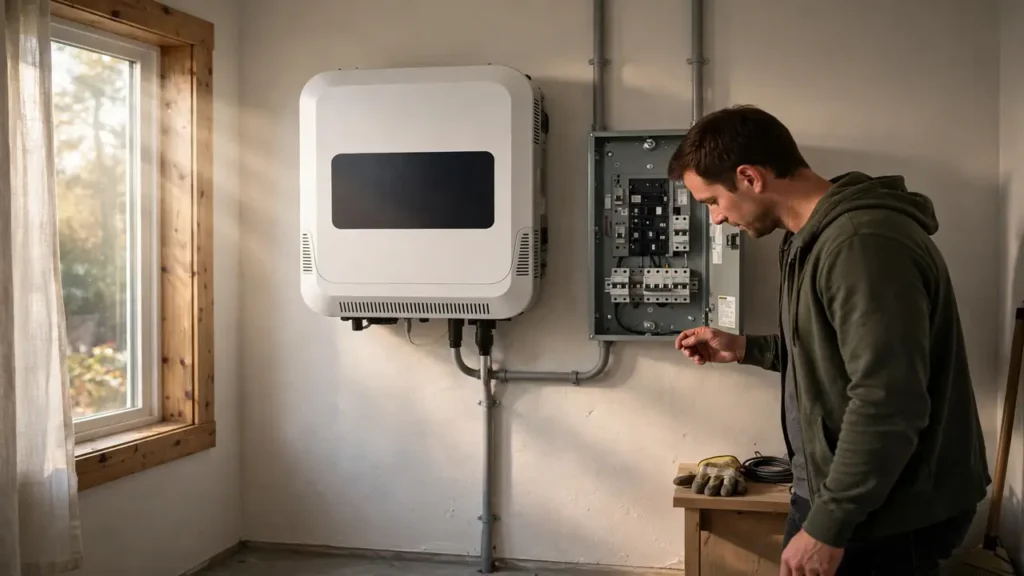
One evening, a neighbour called me. His lights went out again. His inverter was fine. His battery was not.
He had bought the cheapest battery he could find. It worked well for the first year. Then the backup time got shorter. Then shorter again. In the third year, he had to buy a new battery. He paid again. He also paid for water top-ups, for checks, and for the days his home had no backup.
His story is common in Pakistan. Load shedding comes every day in many areas. A battery that works for occasional use can fail fast when it is used every day. This guide will help you avoid that mistake.
This guide is for home owners and for repair technicians. You will learn what a tubular battery is, what a lithium battery is, and how they are different. You will learn how to compare them by usable energy, not just by the label. You will learn how to work out the real cost over five years, without a fixed price table. Prices change, so always check the live price on the website before you buy. At the end, you will know which battery fits your home, your inverter, and your budget.
Trust nudge: SunTech Mall runs its own inverter and UPS repair service centre in Pakistan. Every day, we open inverters with battery faults like these. We test them. We fix them. So what you read here comes from real bench work and from the official guides linked at the end, not from guesses.
What You Will Learn in This Guide
- How to tell a tubular battery from a lithium battery in one minute
- Why a 5 kWh label does not mean 5 kWh of usable backup
- How to work out the real 5-year cost in three simple steps
- Which battery wins for daily load shedding, and which wins for rare backup
- The 6 checks to do before you buy any battery
- The mistakes that kill both kinds of batteries early
What Is a Tubular Battery?
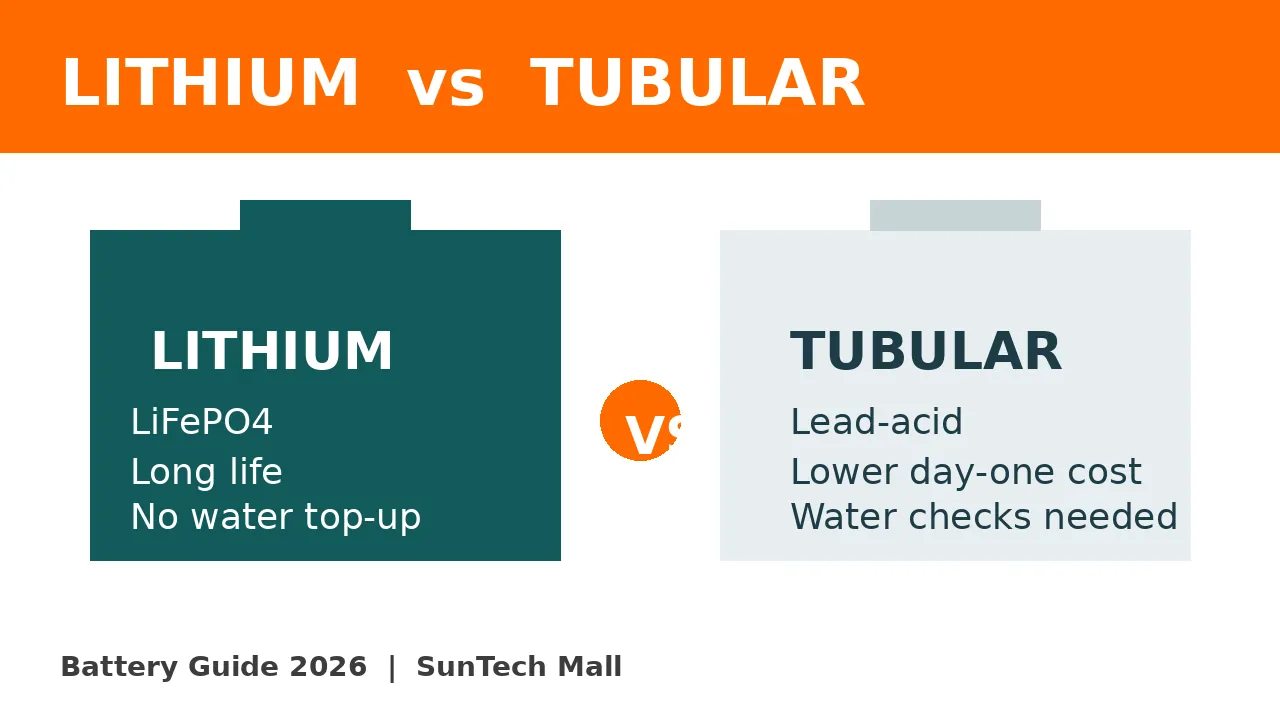
A tubular battery is a type of lead-acid battery. Inside it, there are lead plates in liquid acid. The positive plates are shaped like tubes. That tube shape is why it is called tubular. The tube shape helps the battery last longer than a flat-plate lead-acid battery.
Tubular batteries have been used in Pakistan for many years. Most home UPS systems use them. They are simple. Most inverters and chargers already know how to charge them. They cost less on day one than lithium batteries.
But they need care. You must check the water level. You must add distilled water when it gets low. You must keep the battery in a place with fresh air. When it charges, it can give off gas. You must not let it go too low again and again. Deep discharge shortens its life fast.
A tubular battery is a good worker. But it is not a fit-and-forget battery. If you forget the water, the battery will remind you by dying early.
What Is a Lithium Battery?
A lithium battery for home use is most often a LiFePO4 battery. LiFePO4 means lithium iron phosphate. It is a safe and stable kind of lithium battery for home storage. It is not the same as a phone battery. It is built for daily solar and backup use.
Inside a lithium battery, there is a small computer called a BMS. BMS means Battery Management System. The BMS watches every cell. It stops overcharge. It stops deep discharge. It stops overheat and short circuit. It balances the cells so they age together.
Lithium batteries need almost no care. There is no water to top up. There is no acid to spill. They are lighter and smaller than tubular batteries of the same usable energy. They charge faster. They can give most of their stored energy without damage.
But they cost more on day one. They also need the right inverter setting. A lithium battery must be charged with the right voltage and the right mode. If the inverter is set for lead-acid, the lithium battery may not charge well. Always match the battery type in the inverter menu.
Bonus Tip: Before you buy, take a photo of your inverter model plate and your old battery label. Send that photo to your seller. It takes one minute, and it stops the most common wrong-battery mistake.
The Big Lie on the Label: Usable Energy
This is the most important part of this guide. Read it slowly.
A battery label shows total energy. It does not show usable energy. Usable energy is the energy you can safely use every day without killing the battery.
Think of it like a water tank. The tank can hold 100 litres. But if you are told to use only half the tank each day, you really have 50 litres a day. The rest must stay in the tank.
Tubular batteries are like that tank. Most guides say you should use only about 50% of a tubular battery for regular cycling. Some makers allow a bit more, some a bit less. But the safe daily range is around 40% to 60%. If you use more every day, the battery dies early.
Lithium LiFePO4 batteries are different. Most guides say you can safely use 80% to 95% of the battery. The BMS protects the last part. So you get far more usable energy from the same label size.
Let us do simple maths. No price. Just energy.
- A 5 kWh tubular battery, used at 50%, gives about 2.5 kWh of usable energy.
- A 5 kWh lithium battery, used at 90%, gives about 4.5 kWh of usable energy.
That is almost double the usable backup, from the same label size. To match one lithium battery, you may need almost two tubular batteries of the same label size. That is why a cheap label price can be a costly choice.
Note: These percentages are typical ranges from the guides linked at the end. Your exact battery manual may give a different number. Always follow your own battery manual first.
How Long Does Each Battery Last?
Cycle life means how many full charge and discharge cycles a battery can do before its capacity drops a lot. One cycle is one full use, from full to empty and back to full. In real life, most days are partial cycles, so the count is not exact. But it is still the best way to compare.
Typical ranges from independent guides are:
- Tubular lead-acid: about 800 to 1,500 cycles, or about 3 to 5 years of daily use.
- Lithium LiFePO4: about 3,000 to 6,000 cycles, or about 10 to 15 years in good conditions.
Heat changes these numbers. In a hot room in Pakistan, a lead-acid battery ages faster. Guides note that lead-acid life can halve for every large rise above normal room temperature. Lithium handles heat better, but it still needs air flow and shade. No battery likes a hot, closed box.
This is why daily use matters so much. If you use your battery only a few times a month, a tubular battery can last a long time. The lithium advantage is smaller. If you use it every day for load shedding, the gap grows fast. The tubular battery may need replacement in a few years. The lithium battery may still be working.
The Real 5-Year Cost: Three Buckets, No Fixed Price Table
Do not compare batteries by day-one price alone. That is the mistake my neighbour made. Compare them by three buckets over five years.
Bucket 1: Day-one cost. This is the battery price plus fitting, cables, and any charger or setting change. Lithium is higher here. Tubular is lower here. Check the live price on the website for the exact model you want, because prices change.
Bucket 2: Replacement cost. Ask one question. How many times will I buy this battery in five years? A daily-use tubular battery may need one replacement in that time. A lithium battery often needs none. Each replacement also costs time, fitting, and days without backup. Count that too.
Bucket 3: Running cost. This bucket has three small costs that add up. First, maintenance: water, checks, and cleaning for tubular; almost none for lithium. Second, efficiency: lithium wastes less energy as heat when it charges and discharges, so more of your solar or grid energy reaches your home. Typical round-trip efficiency is about 90% to 98% for lithium and about 70% to 85% for lead-acid, according to the guides linked below. Third, charging time: lithium charges in about 2 to 3 hours in many cases, while tubular can take 8 to 12 hours. If load shedding comes twice a day, a slow battery may never get full before the next cut.
Now add the three buckets. For rare backup use, tubular often wins, because Bucket 1 is low and Buckets 2 and 3 stay small. For daily load shedding, lithium often wins, because Bucket 2 and Bucket 3 save more than the higher day-one price. Do your own maths with live prices. Do not trust a fixed price table from an old article. Prices change. Your use pattern matters more than any table.
Side-by-Side Comparison
| Feature | Tubular Battery (Lead-Acid) | Lithium Battery (LiFePO4) |
|---|---|---|
| Usable energy each day | About 40% to 60% of label | About 80% to 95% of label |
| Typical cycle life | About 800 to 1,500 cycles | About 3,000 to 6,000 cycles |
| Typical life, daily use | About 3 to 5 years | About 10 to 15 years |
| Maintenance | Water top-up, checks, ventilation | Almost none, BMS watches cells |
| Charging time | Slow, often 8 to 12 hours | Fast, often 2 to 3 hours |
| Weight and size | Heavy and bulky | Lighter and compact |
| Efficiency | About 70% to 85% round-trip | About 90% to 98% round-trip |
| Heavy loads | Weakens as it gets low | Holds voltage better under load |
| Day-one cost | Lower | Higher |
| 5-year cost, daily use | Often higher, due to replacement | Often lower, due to long life |
These are typical ranges, not promises for one model. Your manual and warranty terms are the final word for your battery.
Heat, Safety, and Your Battery Room in Pakistan
Pakistan summers are hard on batteries. Keep both kinds of batteries in shade. Give them air flow. Do not put them in a closed box on a hot roof. Do not put them next to a stove or a hot inverter with no air gap.
Tubular batteries need extra care. They give off gas when charging. The room needs ventilation. Keep the area clean and dry. Wipe acid spills with care, and keep children away. Never add tap water. Use distilled water only, and only to the mark in the manual.
Lithium batteries are sealed and give off no acid fumes in normal use. The BMS adds protection. But they are not magic. Do not puncture them. Do not charge them with a wrong charger. Do not use a damaged battery. If a lithium battery swells, smells, or gets very hot, stop using it and call a technician. Do not try to open it at home.
Note: A battery that is too hot, too cold, or badly wired will die early, no matter which type it is. Good fitting matters as much as good buying.
Charging, Heavy Loads, and Load Shedding Twice a Day
Here is a real-life test. Load shedding comes in the morning. Your battery runs your fans and lights. Then power comes back for three hours. Then it goes again.
A tubular battery may still be half empty when the second cut comes. It charges slowly. It also loses more energy as heat. So your second backup is shorter.
A lithium battery charges faster and wastes less. It is more likely to be full before the second cut. It also holds its voltage better when a fridge or motor starts. That means lights dim less and motors struggle less.
This is not just comfort. Deep, slow, hot charging also ages a tubular battery faster. If your area has two cuts a day, charging speed is not a luxury. It is part of the cost.
Which Battery Should You Buy? A Simple Decision Guide
Use this guide, not a slogan.
Buy tubular if: Your budget is tight right now. Your backup use is rare, a few times a month. You have space and you will do water checks on time. Your inverter is already set for lead-acid and you do not want to change settings. You accept that you may replace the battery sooner if use grows.
Buy lithium if: You face daily load shedding. You want fit-and-forget use with almost no maintenance. You have little space. You need fast recharge between cuts. You plan to keep the system for many years. You want more usable energy from a smaller bank.
Wait and check if: Your inverter manual does not list lithium mode. Your charger cannot be set for lithium voltage. Your battery room is very hot with no air flow. In these cases, fix the inverter, charger, or room first. A good battery on a wrong setting is still a bad buy.
Bonus Tip: Size the battery by usable kWh, not by Ah alone. Ah without voltage tells you nothing. A 100 Ah battery at 12 volts is about 1.2 kWh. The same 100 Ah at 48 volts is about 4.8 kWh. Always ask for kWh, then apply the usable percentage above.
6 Checks Before You Buy Any Battery
1. Voltage match. Your inverter battery voltage must match the battery bank voltage: 12V, 24V, or 48V. A wrong voltage can damage the inverter.
2. Inverter battery mode. Check the inverter menu. Does it have a lithium mode, or only lead-acid modes? Set it before first charge.
3. Charger setting. If you use a separate charger, it must match the battery type and voltage. A lead-acid charger on a lithium battery is a common fault.
4. Usable kWh. Work out usable energy, not label energy. Use the percentages in this guide as a starting point, then check the manual.
5. Warranty terms. Read what the warranty covers: cycles, years, or both? What voids it? A long warranty with strict terms is not the same as a long life.
6. Room and cables. Check space, air flow, cable size, and lugs. Thin cables waste energy and heat up. Good cables protect both battery types.
If any check fails, stop and ask a technician. A one-minute check is cheaper than a new battery.
Mistakes That Kill Both Kinds of Batteries Early
- Running the battery to zero every day.
- Using tap water in a tubular battery.
- Putting the battery in a hot, closed box.
- Using thin cables or loose lugs.
- Setting the inverter to the wrong battery type.
- Adding new batteries to an old, weak bank. The old battery drags the new one down.
- Ignoring a swollen case, a hot terminal, or a strange smell.
If you see any warning sign, stop and get help. A battery fault is not a fault to push through.
Where SunTech Mall Fits In
SunTech Mall is Pakistan's online store for original solar inverter and UPS spare parts. We also run our own repair service centre. That means we see both sides: what buyers choose, and what fails on the bench.
If you are choosing a battery system, start with your inverter. Check that your inverter, charger, cables, and battery all match. Then check the live price on the website for the model you want, because prices change and this article does not fix a price.
A plain note about tubular batteries at SunTech Mall: At the time of writing, SunTech Mall's battery range on the website lists lithium and LiFePO4 battery banks, not a tubular battery product. That is why this guide links to lithium banks below, and explains tubular batteries in general terms. If you already own a tubular battery, the care and usable-energy advice above still applies to it. Always check the live shop range before you buy, because stock changes.
Lithium and LiFePO4 battery banks (live, in stock at check time): See the Fronus LifePo4 Platinum series 5KWH 100A battery bank for a mid-size home bank, the smaller Fronus LifePo4 Platinum series 2.5KWH 100A battery bank, or the Inverex power wall 48v 100A 5.1kwh IP21 Battery bank for a 48V system. Check the live price on the website for each model, because prices change.
Chargers, cables, and inverters to match: A charger must match your battery type and voltage — see the SUOER MA-1240A 40A Battery Charger and the SUOER 10A BATTERY CHARGER MA-1210A. For safe fitting, use proper 25mm CABLE LUGS FOR SOLAR AND BATTERY and World Wide 25MM Single Core Cable. For inverters that pair with these banks, see the Inverex Nitrox 6KW-3Ph On-Grid Solar Inverter, the inverex yukon II 3500w – 24v Solar inverter, and the Fronus pv 7200 Infineon reborn solar inverter.
Related SunTech Mall guides: If your inverter shows a fault code, read Inverex Nitrox Fault Codes 2026. For Fronus codes, read Fronus PV 7200 Error Codes 2026. If your inverter will not turn on at all, read Solar Inverter Not Turning On 2026.
Need help choosing? Contact SunTech Mall through the website, and share your inverter model and your daily load. Our team can help you match the battery to your inverter before you buy. You can also reach us on WhatsApp at 0306-2244820 for help with your inverter model and daily load.
Frequently Asked Questions
Is lithium better than tubular for daily load shedding?
In most daily-use cases, yes. Lithium gives more usable energy, charges faster, needs almost no maintenance, and lasts far more cycles. Tubular can still work, but it will need water care and may need replacement sooner under daily use.
Can I replace my tubular battery with lithium on the same inverter?
Often yes, but not always. Check your inverter manual for lithium mode and voltage. Set the battery type before first charge. If your inverter has no lithium mode, ask a technician before you buy.
How do I work out backup time from a battery?
First find usable kWh, not label kWh. Then divide by your load in kW. For example, 4.5 kWh of usable energy divided by a 0.5 kW load gives about 9 hours in theory. In real life, inverter losses and load changes shorten that time. Use it as a guide, not a promise.
Does a lithium battery need a special charger?
It needs the right voltage and mode. Many modern inverters have a lithium setting. A separate charger must also be set for lithium. Never use a random charger. Check the battery manual first.
Why does my tubular battery need water?
Water is lost during charging, as gas. If the level drops below the plates, the plates get damaged. Add distilled water only, to the mark in the manual, and check on a regular schedule.
Is a tubular battery unsafe?
No, when it is fitted and cared for correctly. It needs ventilation, clean terminals, and correct water care. Acid and gas are the risks to manage. Keep children away, and never open or short the battery.
Which battery is cheaper over five years?
It depends on your use. For rare backup, tubular is often cheaper over five years. For daily load shedding, lithium is often cheaper, because you avoid an early replacement and you waste less energy. Do the three-bucket maths in this guide with live prices before you decide.
Final Thoughts
Do not buy a battery by label alone. Buy by usable energy, by cycles, and by how you really use it. A cheap battery that dies in three years is not cheap. A dear battery that lasts twelve years is not dear, if you use it every day.
Check your inverter. Check your room. Check your load. Then check the live price on the website. That order saves more money than any sale slogan.
If this guide helped you, share it with a neighbour who is about to buy a battery. One good choice can save years of backup trouble.
Published: 26 October 2026 | Updated: 26 October 2026 | SunTech Mall — Charsadda/Tangi Office, Tangi, Charsadda, Khyber Pakhtunkhwa
Sources: LiFePO4 vs lead-acid tubular comparison guides — https://www.truepower.in/lifepo4-vs-lead-acid-tubular-inverter-battery-which-lasts-longer-in-india/ ; https://www.oliterenergy.com/news/lifepo4-vs-lead-acid-batteries-for-home-energy-storage.html ; https://www.everexceed.com:443/blog/ultimate-guide-to-base-station-power-selection-lithium-vs-lead-acid-which-battery-fits-your-scenario_b699 ; https://solarinverter.ng/lithium-vs-tubular-battery-for-solar-a-complete-2026-technical-and-financial-comparison/ ; https://www.electrofixure.com/2026/06/lithium-vs-tubular-battery-backup.html