
Best Solar Spare Parts Shop in Mardan – Genuine Components Guide
A few years back, a repair technician I know in Mardan replaced the MOSFETs in a customer’s hybrid inverter. The parts looked fine and the price was good. Three weeks later, the…

A few years back, a repair technician I know in Mardan replaced the MOSFETs in a customer’s hybrid inverter. The parts looked fine and the price was good. Three weeks later, the inverter came back with the same fault — and this time, the burned MOSFETs had taken the driver section with them. The customer paid twice. The technician lost a customer. And the whole mess started with one cheap spare part.
I work with solar repair technicians across Pakistan every week, and I hear this story far too often. Mardan’s solar market is growing fast, but the spare parts market has a dark side: fake components that look real enough to fool careful buyers. That’s your fear, and it’s valid — a fake part doesn’t just fail, it can destroy your inverter.
In this guide, you’ll learn how to tell a genuine part from a fake, the questions that separate honest sellers from smooth talkers, the common parts your inverter actually needs, and where to buy original components with delivery to Mardan. Keep reading — the section on the “acetone test” alone could save you thousands of rupees.
Here’s my honest nudge before we start: every shop claims its parts are “100% original.” That’s why this article won’t ask you to take anyone’s word for it. Everything here is something you can check yourself — with your eyes, a simple wipe test, and five questions. Buy from SunTech Mall or a local Mardan shop; either way, you’ll buy with open eyes.
Your Roadmap: What You’ll Get From This Guide
- Why Mardan’s solar boom makes parts harder to trust — the demand pulling fakes into the market
- The 5 parts that fail most in solar inverters — recognize what you actually need
- How to spot a fake component in 60 seconds — the visual checks that work
- 5 questions that expose a dishonest seller — ask these before paying
- Local shop vs. online ordering: the honest comparison — get the best of both
- Where to buy genuine parts with delivery to Mardan — your safe options
Why Mardan’s Solar Boom Makes Buying Parts Riskier
Last month I counted the solar panels on my cousin’s street in Mardan. Seven houses out of twelve had panels on their roofs. Five years ago, that number would have been zero.
High bills and unpredictable load shedding pushed Mardan toward solar faster than anyone expected. Pakistan’s distributed solar capacity is now enormous — an industry review published in 2026 estimated around 51 gigawatts operating in the country by March 2026. Every one of those systems has an inverter with parts that wear out.
Here’s the problem nobody talks about. When repair demand explodes in one city, fake parts follow the money. Copy MOSFETs, relabeled IGBTs, and counterfeit capacitors flow into busy markets because that’s where the buyers are. A technician under pressure to finish a repair this week will grab whatever is on the shelf. That’s how fakes enter your inverter.
This doesn’t mean every Mardan shop is dishonest — many are solid businesses. But a buyer who can’t tell the difference pays for everyone else’s shortcuts. Let’s make sure that isn’t you.
The 5 Parts That Fail Most in Solar Inverters
Knowing the usual suspects saves you from two mistakes: buying the wrong part, and being sold parts you don’t need.
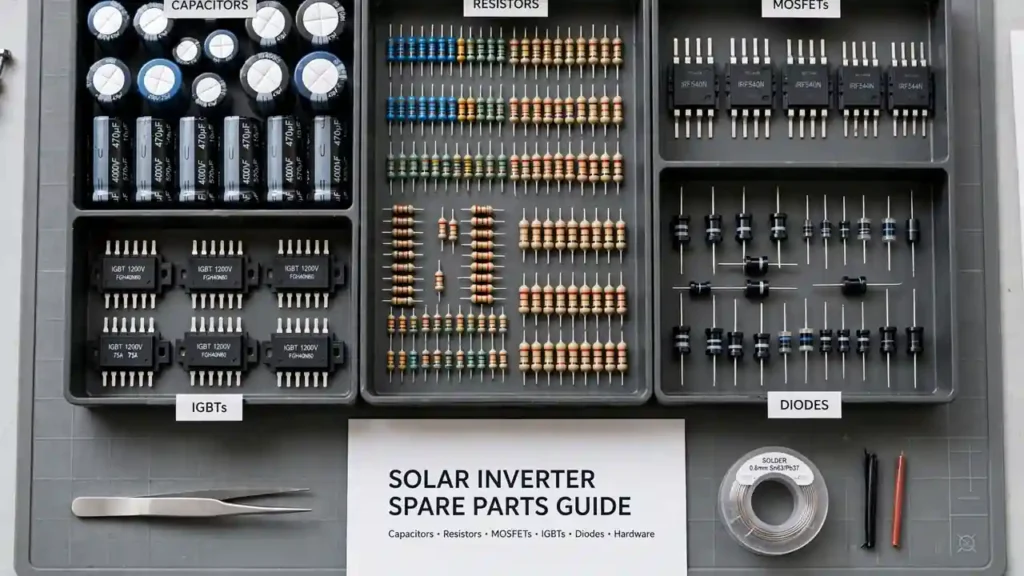
IGBT modules handle the heavy lifting — converting DC from your panels into usable AC. They run hot and work hard, which is why they’re a frequent failure point. When these go, the inverter usually shuts down completely. Browse tested electronic parts options and always match the exact part number before ordering.
MOSFETs do the fast switching in the power stage. A shorted MOSFET often takes neighboring parts with it, turning a small fault into an expensive repair.
Electrolytic capacitors smooth out the electrical flow inside the inverter. Heat is their enemy, and Pakistani summers are brutal. Swollen or leaking tops are a dead giveaway — but counterfeit capacitors can fail silently, with no visible warning.
Driver ICs send the timing signals that tell power parts when to switch. When one fails, symptoms look confusing — random shutdowns or error codes. These rank among the most commonly faked parts in the market.
Cooling fans seem simple, but a dead fan lets heat build until something expensive melts. If your inverter runs louder than it used to, check the fan first. It’s the cheapest part to replace and the most expensive one to ignore.
Note: Always buy parts rated for your inverter’s voltage and current. A MOSFET that “almost matches” is a fire waiting to happen. Check your inverter’s manual or the markings on the old part, and don’t let anyone talk you into a “close enough” substitute. Our solar inverter spare parts guide explains how each part works in simple terms.
How to Spot a Fake Component in 60 Seconds
The first time someone showed me a fake IRF3205 MOSFET next to a genuine one, I was shocked. Side by side, the fake looked better — shinier, smoother, cleaner. That’s the trap. Counterfeits are a global problem, and that unnatural shine is often the giveaway, not proof of quality.
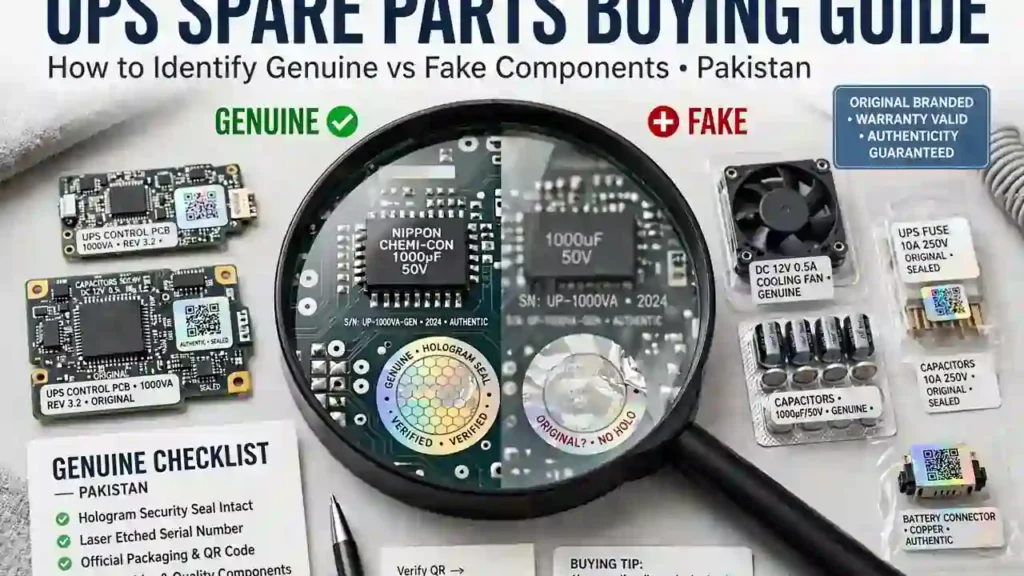
Here’s your 60-second inspection routine. Component experts call the worst fakes “blacktopped” — sanded smooth and recoated so they can be relabeled as something more expensive:
- Read the printing. Genuine makers use laser marking — crisp, clean text that sits flat. Fakes often have fuzzy, uneven, or raised printing. If the text rubs off under your thumb, walk away.
- Check the edges. Real chips have slightly rounded edges from molding. Sanded and relabeled fakes often have sharp, square edges. A magnifying glass may reveal fine sanding scratches.
- Look at the pins. Genuine pins have a dull silver finish — clean but not mirror-shiny. Fake or refurbished parts often have unnaturally shiny pins, bent leads, or scratches from previous soldering.
- Compare the date codes. The date code on the part should match the packaging, and it must be from the past — never the future. A date that doesn’t exist yet is an instant red flag.
- Inspect the packaging. Original parts come in clean, sturdy packaging with proper labels. Fakes arrive in flimsy bags with blurry labels, misspelled brand names, or missing country-of-origin markings.
Bonus Tip: The acetone test catches many fakes. Dab a cotton swab in nail polish remover and rub the part’s printed marking gently. Genuine laser-etched markings won’t budge. Ink-printed fake markings will smear or come off. This one test takes ten seconds and has saved many buyers from expensive mistakes.
5 Questions That Expose a Dishonest Seller
I learned this trick from a technician who buys parts across KP. “The parts all look the same,” he told me. “So I interview the shopkeeper, not the part.” Ask these five questions before you pay — honest sellers answer openly, dishonest ones get evasive.
1. “Is this original or copy?” Direct and fair. A trustworthy seller tells you straight. If the answer is a long story instead of one word, that’s your answer.
2. “What happens if this part turns out faulty?” Reputable sellers have a clear replacement policy. “No guarantee, no return” is fine for budget parts — it’s not fine for parts sold as genuine.
3. “Can you confirm this matches my inverter model?” A knowledgeable seller asks about your inverter’s brand and model first. A shop that sells without asking any questions doesn’t understand its own parts.
4. “How old is this stock?” This matters most for capacitors and batteries. Old stock can look perfect and perform terribly. If the seller can’t or won’t answer, the stock is probably old.
5. “Will you give me a proper receipt?” Receipts protect you. Shops that refuse receipts usually don’t want a paper trail. That tells you everything.
If a seller passes all five, you’ve probably found a good one. If they fail two or more, take your money elsewhere.
Local Shop vs. Online Ordering: The Honest Comparison
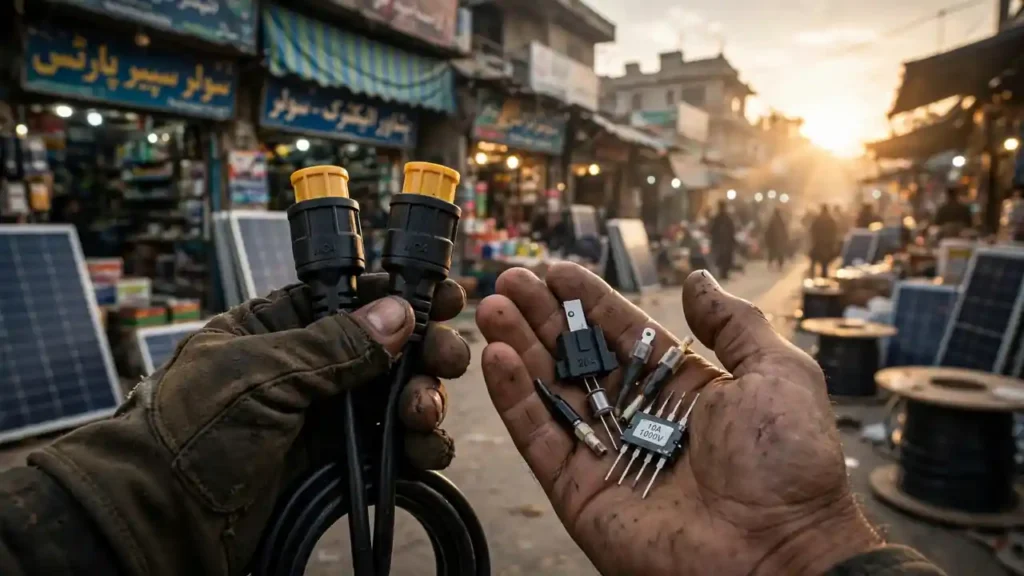
Here’s something most online stores won’t admit: local shops have real advantages. When your inverter is dead and the family is sitting in the dark, you need a part today, not in three days. A good Mardan shop gives you that speed, and you can inspect the part before paying.
But online ordering wins on selection, price transparency, and consistency. Local markets may not stock the exact driver IC or capacitor your inverter needs. Online, you can search the exact part number and compare prices calmly instead of trusting a busy shopkeeper’s memory.
Smart buyers use both. Use local shops for urgent needs — the fan that died, the fuse that blew. Use trusted online stores for planned repairs and hard-to-find components — the IGBT module, the specific control card. Keep a small stock of commonly used parts from online orders, and urgent breakdowns stop being emergencies.
Where to Buy Genuine Parts With Delivery to Mardan
When you buy online, the seller’s reputation is your inspection routine. Look for stores that publish clear product photos, list exact part numbers and specifications, and have a track record with technicians — not just buyers.
SunTech Mall is one option built for this market: genuine solar inverter and UPS spare parts, tested components, proper packing, and nationwide shipping that covers Mardan. Technicians across Pakistan order from us because a fake part costs us customers — our business depends on repeat buyers who check their parts.
Browse electronic components, solar and electrical products, and charger and inverter parts in one place. Unsure which part matches your inverter? Reach out at info@suntechmall.com or +92 306 2244820 before ordering — buying the wrong genuine part is almost as bad as buying the right fake one.
Bonus Tip: Before your first order from any online store, place a small test order. Check the packing quality, part markings, and how they handle your questions. A seller that treats a small order well will treat a big order well too.
Related Guides Worth Reading
- Where to Buy Inverter Repair Parts in Peshawar
- Solar Inverter Repair Components in Islamabad – Expert Buying Guide
- How to Find Genuine UPS Spare Parts Near You in Pakistan
- Solar Inverter Spare Parts in Pakistan – Easy Repair Guide
Frequently Asked Questions
How do I know if a shop sells genuine parts?
Ask local technicians — they know which shops sell originals. Inspect part markings with the checks in this guide, and ask about the replacement policy. Genuine sellers welcome scrutiny because they have nothing to hide.
What is the most commonly faked solar inverter part?
MOSFETs, IGBTs, and driver ICs top the list — high-value and easy to relabel. Counterfeit capacitors are also common and dangerous since they fail without visible warning. Always verify markings before installing.
Can a fake part really destroy my inverter?
Yes. A counterfeit MOSFET with lower specs than labeled can short under load, sending damaging current through the driver section and control board. A cheap part replacement can end with a dead inverter — the most expensive “saving” in solar repair.
Should I buy spare parts online or from a local market?
Use both. Local markets win for urgent needs when you can’t wait. Online stores win for exact part numbers, hard-to-find components, and planned repairs. Order common parts online in advance, and emergencies stop being emergencies.
Do online stores deliver solar parts to Mardan?
Yes. Established online suppliers deliver across Pakistan, including Mardan. Confirm delivery time and charges before ordering. SunTech Mall ships genuine parts nationwide with packing designed to protect components in transit.
How can I test a part before installing it?
A multimeter catches many problems — check MOSFETs for shorts between terminals and capacitors for correct capacitance. Compare readings against a known-good part when possible. Many technicians keep one verified genuine part as a visual reference.
Is it worth paying more for original parts?
Almost always. An original MOSFET costs more once; a fake one costs you the part, the labor, the parts it destroys, and the customer’s trust. For power parts, driver ICs, and control cards, original is cheaper over the inverter’s lifetime.
Final Thoughts
Here’s what I want you to take away. Mardan’s solar boom is a good thing — cheaper electricity and less load shedding for thousands of families. But every boom attracts shortcuts, and fake spare parts are the shortcut that hurts honest people.
You don’t need an engineering degree to protect yourself. You need the 60-second inspection, the five questions, and the habit of buying from sellers who earn your trust. Congratulations — you now know more about spotting fakes than most buyers walking into a market today.
Ready to order with confidence? Browse SunTech Mall’s shop for genuine, tested solar spare parts delivered to Mardan. And if you ever hold a part and aren’t sure about it, message us at info@suntechmall.com or +92 306 2244820. We’d rather help you verify a part than sell you one you don’t need. That’s how trust is built — one honest answer at a time.