



50V 4.7nF 0603 SMD Capacitor: What It Does and How to Pick One
A board that keeps resetting for no clear reason can drive you mad. You swap the chip, you check the code, and still it fails.

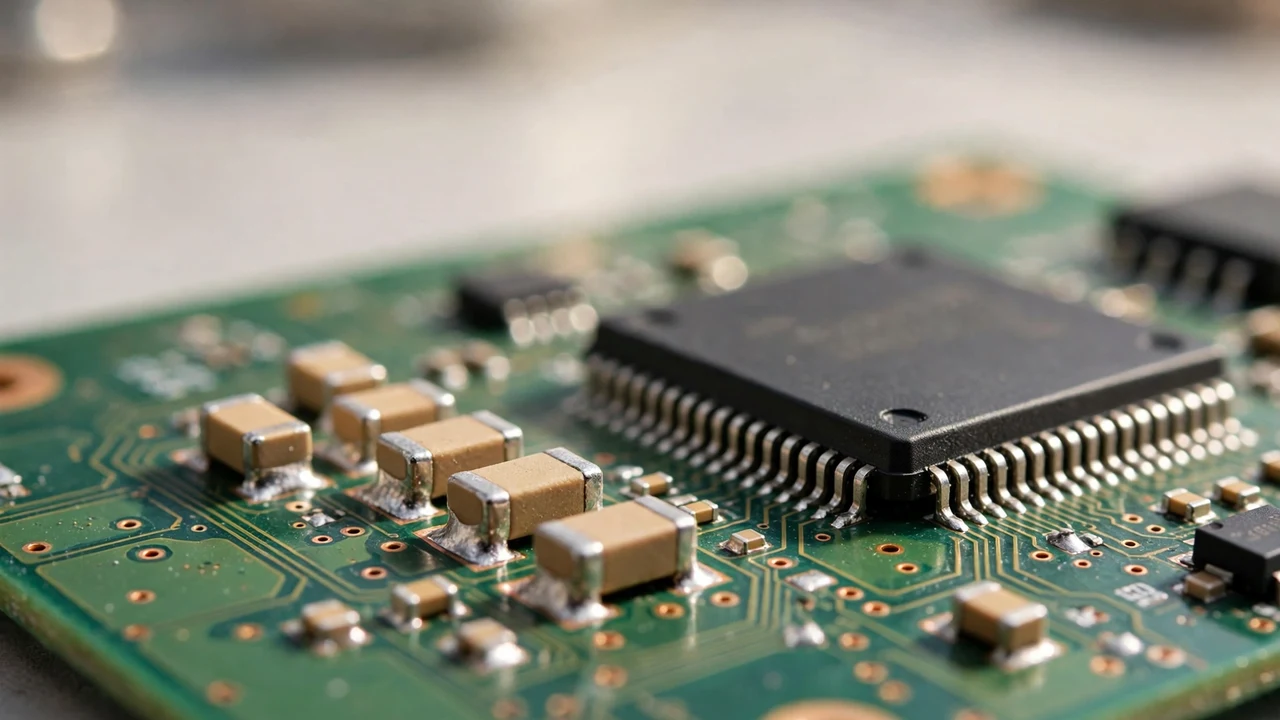
A board that keeps resetting for no clear reason can drive you mad. You swap the chip, you check the code, and still it fails.
Very often, the real fault is far smaller. A missing or wrong decoupling capacitor next to a power pin can cause exactly that kind of random fault.
This guide explains one small part that prevents a lot of that pain: the 50V 4.7nF 0603 SMD capacitor. You will learn what every number in its name means, where it is used, and how to pick the right type.
Key takeaways
- 50V is the top voltage rating, 4.7nF is the capacitance, and 0603 (imperial) is a 1.6 × 0.8 mm package.
- The code 472 on a part means 4.7nF, because 47 followed by two zeros is 4700 pF.
- Use X7R for everyday decoupling and filtering, and C0G for timing and tuned circuits.
- A higher voltage rating than your circuit needs helps the part keep more of its labelled value in use.
- Always confirm the size in millimetres before you order, because 0603 means two different sizes in the two naming systems.
What does 50V 4.7nF 0603 actually mean?
Each part of the name is a fact about the part. Once you can read one name, you can read most capacitor listings.
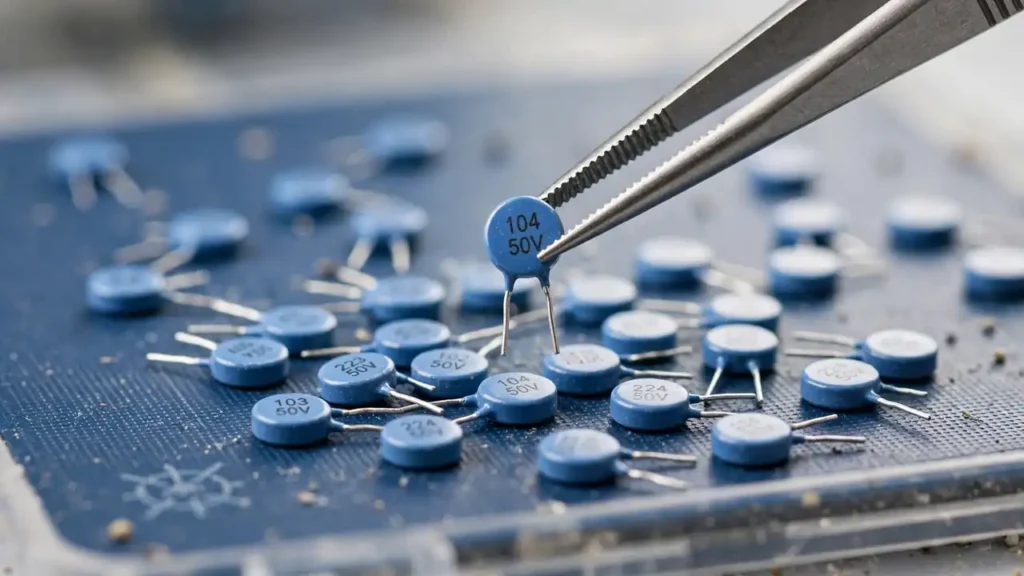
4.7nF is the capacitance. That is 4.7 nanofarads, which is the same as 4700 picofarads. On the part itself, you will often see the code 472. The first two digits give the value, and the third digit tells you how many zeros to add, in picofarads. So 47 plus two zeros gives 4700 pF, which is 4.7nF.
50V is the highest DC voltage the part is rated for. Think of it as a ceiling, not a target. Good design keeps your real circuit voltage well below that ceiling. A 50V rating gives you comfortable headroom on common 12V and 24V rails.
0603 is the package size, in the imperial system. It means 0.06 by 0.03 inches, which is 1.6 mm by 0.8 mm. Here is the trap. In the metric system, this same part is called 1608. And a metric 0603 is a much smaller part, just 0.6 by 0.3 mm. When a supplier says 0603, they almost always mean the imperial size, but the millimetre size removes all doubt.
| What the name says | What it means | Why it matters to you |
|---|---|---|
| 50V | Maximum DC voltage rating | Gives headroom above 12V and 24V rails |
| 4.7nF (472) | Capacitance, equal to 4700 pF | Sets filtering and timing behaviour |
| 0603 imperial / 1608 metric | 1.6 × 0.8 mm package | Small size fits dense boards, but check the millimetres |
Note: Always confirm package size in millimetres before ordering. The imperial and metric uses of 0603 have caused more wrong orders than any other naming mix-up in SMD parts.
Why is this tiny capacitor so widely used?
This part is an MLCC, a multi-layer ceramic capacitor. Inside its tiny body, many thin ceramic layers are stacked together. That build gives it three strengths that designers love.
First, it has low ESR, which is a short way of saying it wastes very little energy as heat when it charges and discharges. Second, its small body keeps it useful at high frequencies, where noise lives. Third, it is made in huge numbers, so it is easy to find and lasts for years in normal use.
You will find parts like this across SunTech Mall, because they are the quiet backbone of so many boards, from phone chargers to solar inverters.
Where does a 50V 4.7nF 0603 capacitor actually work?
How does it stop a chip from resetting?
This is its number one job, and it is called decoupling. Every chip with a power pin wants a small capacitor sitting right next to that pin, joining power to ground. When the chip suddenly needs current, the capacitor gives it at once. Without it, the voltage dips, and digital chips do strange things. They reset, they glitch, or they corrupt data.
If a board works on the bench and fails in real use, missing decoupling is one of the first things to check.
How does it clean up a noisy signal?
Capacitors block DC but pass AC, which makes them good filters. A 4.7nF capacitor to ground sends high-frequency noise away, while it leaves the wanted signal alone. You will see this at the inputs of audio circuits, sensor lines, and communication ports.
Where does it set timing?
Paired with a resistor, a capacitor sets how fast a circuit charges and discharges. That timing is the heartbeat of oscillators, delay circuits, and debounce circuits for push buttons. The 4.7nF value sits in a sweet spot for many of these jobs, which is one reason it is so widely stocked.
Where does it help in power equipment?
In chargers, UPS systems, and solar inverters, small ceramic capacitors handle snubbing and high-frequency bypassing around switching parts. The 50V rating gives useful headroom on the lower-voltage control rails inside that equipment.
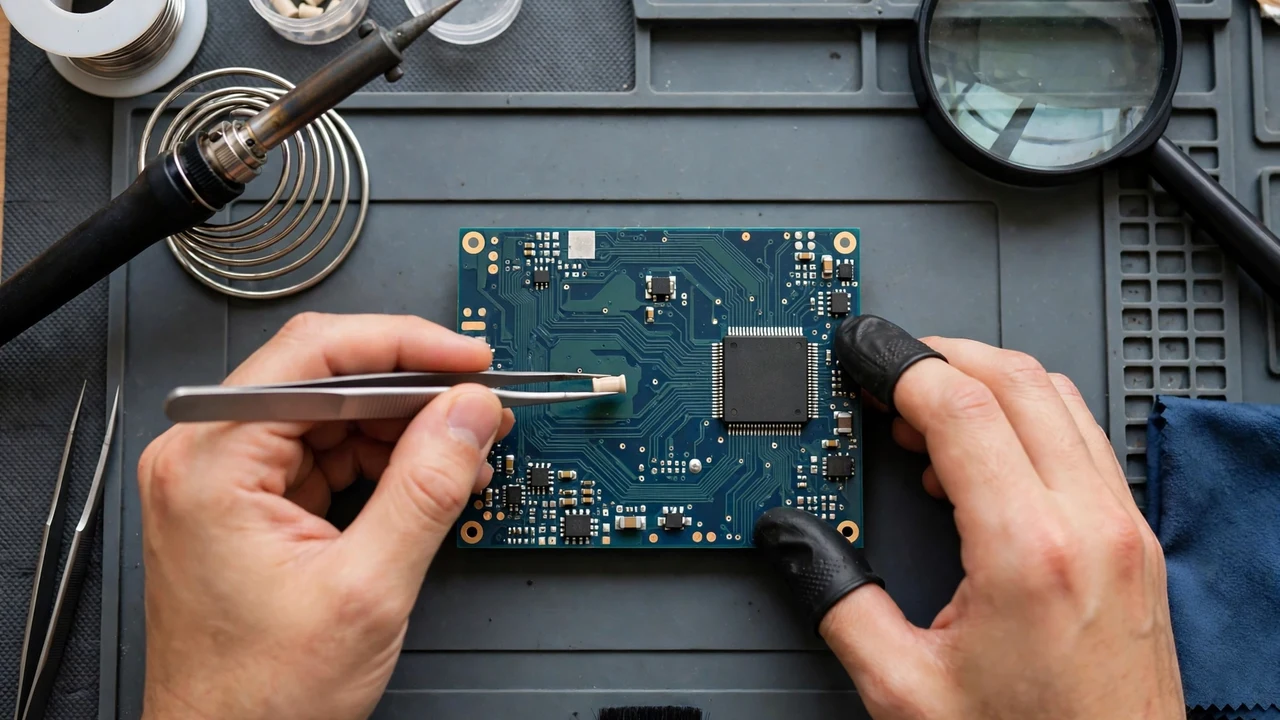
Bonus tip: When you repair a board with odd, random faults, look at the small ceramic capacitors near chip power pins first. A cracked MLCC from board flex or a drop can act exactly like a dead chip. These parts are cheap to replace, and they are often the real fault.
What is the DC bias trap you should know about?
Here is the part most short guides skip, and it matters. A ceramic capacitor’s real capacitance falls when DC voltage is put across it. This is called DC bias derating, and it is normal physics for high-dielectric ceramics like X7R and X5R.
In plain words, your 4.7nF capacitor may act like less than 4.7nF when it sits at a high DC voltage near its rating. The closer the applied voltage gets to the rated voltage, the worse the effect. That is why skilled designers pick a 50V part for a 12V or 24V circuit, instead of a 16V or 25V part. The higher rating means the part works far from its limits, so it keeps more of its labelled value.
Does this matter for your circuit? For rough decoupling, usually not much. For tuned filters and timing circuits, where the exact value matters, yes, it matters a lot. The fix is simple. Use a higher voltage rating than you think you need. For precision jobs, choose a C0G dielectric, which barely changes at all with voltage.
Derating data comes from each maker’s capacitance-versus-voltage curves. It varies with dielectric, package size, and rated voltage. Treat it as a real design factor, not a defect. The capacitor is not broken. It is just physics.
Should you pick X7R or C0G?
The dielectric is the insulating ceramic inside the capacitor. It decides how stable the part is. The two types you will meet for this value are X7R and C0G, also called NP0. Both are good. They are good at different things.
| Dielectric | Best for | Stability | Trade-off |
|---|---|---|---|
| X7R | Decoupling, bypassing, general filtering | Good, within about ±15% over −55°C to +125°C | Value drifts with temperature and DC voltage |
| C0G / NP0 | Timing, oscillators, tuned filters | Near-zero drift with temperature and voltage | Costs a little more, less capacitance per size |
X7R is the all-rounder. It gives good capacitance in a small package at a low cost, with fair stability. For decoupling and general filtering, X7R is the default choice, and the right one. Most 50V 4.7nF 0603 capacitors you find are X7R.
C0G is the precision option. Its value barely moves with temperature or voltage. That makes it ideal for timing circuits and tuned filters, where the exact value decides whether the circuit works. If your circuit’s frequency or timing must be exact, pay for C0G and sleep well.
A simple rule to keep above your bench: decoupling and bypassing, choose X7R; timing and tuning, choose C0G.
How do you pick the right one before you buy?
Run through these five checks, in order.
- Capacitance. Confirm 4.7nF, code 472, matches what your circuit needs.
- Voltage rating. 50V gives comfortable margin for most low-voltage rails. Never design right at the limit.
- Dielectric. X7R for general use, C0G for precision work.
- Tolerance. Common options are ±5% or ±10%. Tighter tolerance costs more, so match it to the job. Decoupling does not need ±5%. A tuned filter might.
- Genuine sourcing. Fake MLCCs exist, and a fake part can crack, drift, or short. Buy from suppliers who publish real specs and stand behind them. Check the live price on the website before you order, through SunTech Mall.
If you also work with jumper parts, our companion guide on the 0 ohm 1W 2512 SMD resistor follows the same plain approach for another tiny part that is easy to underestimate.
Frequently asked questions
What does the 472 marking on a ceramic capacitor mean?
It is a three-digit code for the capacitance in picofarads. Take the first two digits, 47, and add the number of zeros given by the third digit, two zeros. That gives 4700 pF, which equals 4.7nF.
Is 0603 the same as 1608?
Yes. 0603 is the imperial name, in inches, and 1608 is the metric name for the same 1.6 by 0.8 mm part. The confusion comes from metric 0603, a much smaller 0.6 by 0.3 mm part. When in doubt, ask for the millimetre size.
Can I use a 50V capacitor in a 5V circuit?
Yes, and it is often smart. A higher voltage rating gives safety margin and reduces DC bias derating, so the capacitor acts closer to its labelled value. There is no electrical downside for most circuits.
Why did my circuit work on a breadboard but fail on the PCB?
Very often the answer is missing or misplaced decoupling capacitors. Place a ceramic capacitor as close as possible to each chip power pin, with short traces to ground. Decoupling is always step one for stability.
Where can I buy genuine 50V 4.7nF 0603 capacitors in Pakistan?
Choose a supplier that lists the full specs: capacitance, voltage, package size, dielectric, and tolerance. SunTech Mall stocks SMD capacitors with clear specs for repair shops and builders across Pakistan. Check the live price on the website, and reach the team through the website if you need help matching a part.
Verdict: should you stock this capacitor?
Yes, if you build or repair boards, keep a strip of these on your bench. You now know how to read every number in 50V 4.7nF 0603, you know the DC bias trap that fools even skilled builders, and you know when to choose X7R and when to pay for C0G.
That is the difference between boards that work first time and boards that haunt you with random resets. The next time a board acts up for no clear reason, check the decoupling first. You will usually be right.
Stock up through SunTech Mall, and check the live price on the website before you order.

5 Comments
[…] insurance, and the 2512 size keeps the option open even for power-carrying features. Our guide on SMD capacitor selection follows the same practical approach for another tiny-but-critical […]
[…] For clean supply rails around the driver, see our 50V 4.7nF SMD capacitor guide. […]
[…] input filtering helps too. Our 50V 4.7nF SMD capacitor guide explains why a quieter rail means the zener works less […]
[…] For clean power around the reference, see our 50V 4.7nF SMD capacitor guide. […]
[…] From a dedicated components supplier. Check the live price on the website in the electronic parts range at SunTech Mall, or reach the team through the website for larger quantities. For a related small-part guide, see our 50V 4.7nF 0603 SMD capacitor guide. […]