
Description
If your board needs a 0 ohm jumper in an axial through-hole body, and the old part is a 1W carbon film jumper, this is the part to order. It is a 0 ohm resistor in name, but it works as a wire link: it bridges two points on a board with almost no resistance, so it carries current instead of limiting it. It fits PCB trace routing, board options, and repair jobs where a connection must be made or changed without redrawing the board. It does not fit any job that needs real resistance — if your board list calls for 1 ohm or more, this part is the wrong pick. Check the checks below before you order, so the value, the body, and the current all match your board.
This is an original, high-quality part.
What it does
A normal resistor limits current. A 0 ohm jumper resistor does the opposite job: it joins two points on a board with a neat, solderable link, the way a short piece of wire would, but in the same axial body as the other resistors on the board. Repair techs use it to bridge a gap in a PCB trace, to select one of two circuit options at build time, to route a signal around a damaged track, or to ground a point that needs a solid connection. Because its resistance is near zero, the voltage drop across it is near zero too, so it does not change the circuit the way a real resistor would.
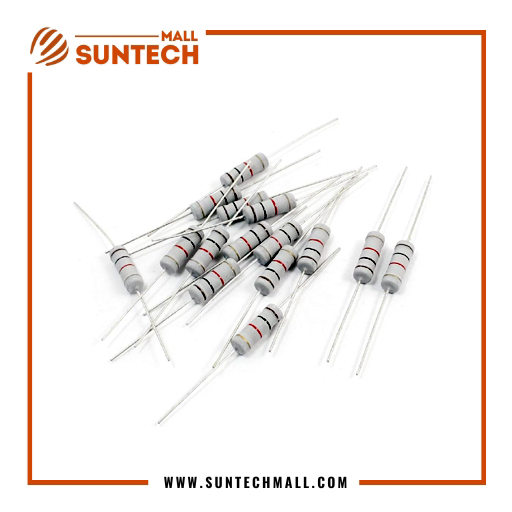
This 0 ohm 1w resistor is built in the same carbon film axial body as the 1W resistors in this family, with the same leads and the same mounting, so it fits the same holes and the same board layouts. Its single black band marks it as a 0 ohm part. It is an axial resistor in form, but a jumper in function — judge it by its current, not by its power rating.
Key features
- 0 ohm nominal — a jumper link, not a resistance value
- 1W body size class (CFR100) at 70°C ambient
- Carbon film axial body for through-hole mounting on PCBs
- Single black band marking
- Wide temperature range: −55°C to +155°C
- Voltage proof on insulation 1000V (series figure)
- Axial leads for easy mounting, same form as the family resistors
Checks before you order
- Value: your board list must call for 0 ohm. If it calls for any real resistance — even 1 ohm — this part is the wrong pick, because a jumper passes current almost freely while a 1 ohm part still drops voltage. Do not order this part as a stand-in for a low-value resistor.
- Current, not power: the limit that matters for a jumper is current, not watts. The 1W in the name is the body size class — it does not tell you how much current this link can carry, and the series documents state no current rating for this 0 ohm part. Check the current in your circuit against the board’s original part, and keep it well inside what the original link carried. If your circuit carries heavy current, stop and check the board design before you order. A 330 ohm part in the same 1W body is a resistor, not a jumper, and is a different job.
- Do not use it as a fuse: a 0 ohm jumper is not a fuse and must never be fitted where a fuse belongs. It will not break the circuit at a set current, so a fault will pass straight through it. If the old part was a fuse, order a fuse.
- Tolerance: the 5% in the name means nothing at 0 ohm — 5% of zero is zero. What matters is that the real resistance is very small; the series documents state no maximum value, so treat this part as a link and nothing else.
- Body and fit: your board must take an axial through-hole body. Measure the old part and match it against the holes and the space on your board. The series normal-style body for a 1W part is about 11.5 mm long and 4.5 mm across — if your old part is much smaller, check the board list again before you order.
- Fit for the job: a surface-mount 0 ohm chip is the same idea in a different form, but it solders onto pads, not through holes — do not order a chip jumper for a through-hole board. Match the form first, then the value.
Specifications
All figures below are from the maker series documents for this resistor family. No figure here was guessed. Two figures buyers usually want — the maximum resistance and the rated current — are NOT stated in the series documents for this 0 ohm part, so they are left out on purpose rather than guessed. The maker of the exact part on this page is not stated on the live page, so the publisher should confirm the series figures against the Download file at publish time (see the gates note).
| Type | 0 ohm jumper (zero-ohm link) in a carbon film axial body, through-hole |
| Resistance | 0 ohm nominal — a jumper, not a resistance value |
| Body size class | 1W (CFR100) |
| Maximum working voltage (series) | 500V |
| Maximum overload voltage (series) | 1000V |
| Voltage proof on insulation | 1000V |
| Temperature coefficient | Not stated for 0Ω — omitted |
| Maximum resistance | Not stated — omitted |
| Rated current | Not stated — omitted |
| Operating temperature range | −55°C to +155°C |
| Marking | Single black band |
Other names for the same part (good to know)
Shoppers and repair techs call this same part by a few names. 0 ohm resistor is the plain name from its value. 0 ohm jumper resistor is the name buyers use when the jumper job matters. 0 ohm 1w resistor is the name buyers use when the body size matters. Carbon film resistor is the name for its construction type. Axial resistor is the name for its lead style. If your board list calls for 0 ohm in an axial through-hole body, this page is the right match. Do not judge by size alone — check that the board really needs a jumper, not a resistor.
Frequently Asked Questions
Is a 0 ohm resistor really zero ohms?
Not exactly zero. It is a link with a very small resistance, close enough to zero that the circuit treats it as a wire. The exact small value is not stated in the series documents, so it is sold as a jumper, not as a measured resistance.
What does 1W mean for a 0 ohm part?
It is the body size class — the same 1W body as the 1W resistors in this family. It is NOT a current limit. For a jumper, current is the limit that matters, and no current rating is stated in the series documents, so check your circuit against the original part.
What does 5% mean for a 0 ohm part?
Nothing useful — 5% of zero is zero. The 5% comes from the family naming, not from a real tolerance band on this part. Do not treat it as a resistance range.
Can I use this part instead of a wire?
Yes, that is what it is for — it bridges two points on a board the way a wire link would, but in a neat axial body that solders like the other resistors. Use it for trace routing, board options, and grounding links.
Can I use this part instead of a fuse?
No. A jumper will not break at a set current, so it gives no protection. If the old part was a fuse, order a fuse of the right rating.
What is the price of this part?
Check the live price on the website. The price shown on the product page is the current one.
Use note kept from the old page: this part was listed before as a specialized component for circuit bridging, jumpers, and PCB trace routing in solar inverter repairing and other electronic applications, working as a convenient electrical connection that simplifies PCB layouts and removes the need for extra traces, for design flexibility, signal routing, debugging, and grounding, in power circuits, without changing the board layout — and that use still stands.
Reviews

Top class quality and fast response.

Zabardast experience aur behtareen quality.

Wonderful experience, highly recommend

Amazing quality, super fast delivery
Great deals and fast shipping
Fantastic shopping experience
Very happy with the quality
The product was exactly what I needed
Top-notch customer support
Product arrived in perfect condition
Fantastic prices and quick shipping
Excellent packaging and fast shipping
The product was exactly what I needed


