
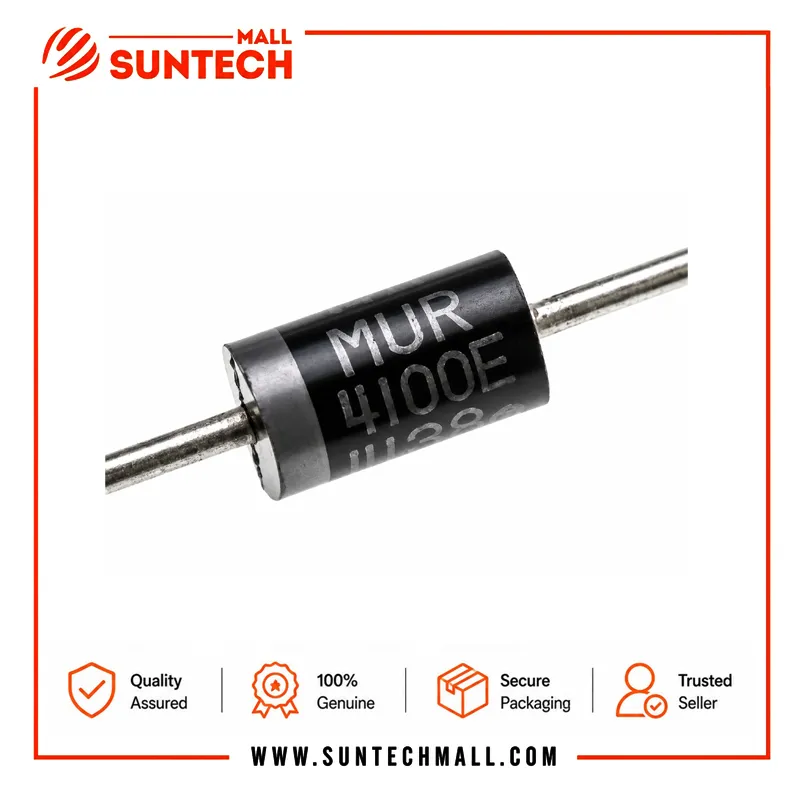
If your board needs a 1000V 4A diode that switches off very fast, and the old part on the board is marked MUR4100, this is the part to order. It is a single ultrafast diode DO-201 part with two axial wire leads, built for fast switching work in power circuits. It fits switching power supplies, inverters, chargers, and converters where a freewheeling diode must carry up to 4 A and stop fast. It does not fit jobs that need more than 1000 V, more than 4 A of steady current, or a surface-mount body. Check the checks below before you order, so the voltage, the current, the speed, and the body all match your board.
This is an original, high-quality part.
What it does
A diode lets current flow one way and blocks it the other way. An ultrafast diode does that job and then stops passing current very fast when the current flips. This MUR4100 part recovers in 75 ns at most on the standard low-current test, so it keeps up with fast switching work and wastes less power as heat than a slow rectifier would. Its glass-passivated junction and 20 mJ avalanche energy rating give added protection against voltage spikes in switching inductive loads.
Repair techs use this kind of part as a freewheeling diode, which gives inductive current a safe path when a switch turns off, and as a switching power supply diode for output rectification in fast power circuits. It is a 1000V 4A diode, so it suits high-voltage work where a lower-voltage diode would fail at once, while still being a small axial part that solders into through holes.
Key features
- 1000 V reverse voltage limit
- 4 A steady forward current, rated at 35 °C ambient
- Ultrafast recovery: 75 ns at most on the standard test
- Forward voltage: 1.85 V at most at 4 A
- Low reverse leakage: 25 µA at most at rated voltage, 25 °C
- Surge limit: 70 A one-off surge
- Avalanche energy rated: 20 mJ
- Axial DO-201 body with wire leads for through-hole boards
- Band on the body marks the cathode end
- Wide temperature range: −65 °C to +175 °C
Checks before you order
- Part number: the body must show MUR4100. If your old part shows a different number, stop and check your board list again. Do not judge by size alone — other axial diodes in the same body do a different job.
- Package: your board must take an axial DO-201 body with two wire leads through holes. This is not a surface-mount part. Measure the old part and match it against the holes on your board.
- Voltage: the peak reverse voltage on your circuit must stay at or below 1000 V. Above that, this part is the wrong pick.
- Current and heat: the steady current must stay at or below 4 A, and that 4 A figure counts on the mounting and ambient conditions in the table below — as the board gets hotter, the safe current drops, so check the derating for your real cooling. Work out the heat from your real current and the forward voltage (up to 1.85 V at 4 A).
- Speed: your circuit must need ultrafast recovery. If the old part was a slow rectifier and the circuit never switches fast, a fast part still works, but check the forward voltage and surge limits all the same. If the old part was ultrafast, do not swap in a slow part — it will run hot.
- Fit for the job: if your circuit needs far more current in a large body, that is a different job — a large high-current diode is not a swap for this small axial part. Match the current and the voltage first, then the speed, then the body.
- Polarity: the band on the body marks the cathode end. Fit the new part with its band in the same place as the old part’s band. A diode put in backwards will block the current it should pass.
Specifications
All figures below are for the MUR4100 part at +25 °C unless noted. No figure here was guessed.
| Type | Single ultrafast rectifier, glass-passivated junction |
| Package | Axial lead, CASE 267 (DO-201 family), 2 leads, through-hole |
| Body marking | MUR4xxx series marking (MUR4100 for this part) |
| Peak repetitive reverse voltage | 1000 V |
| Working peak reverse voltage | 1000 V |
| DC blocking voltage | 1000 V |
| Average rectified forward current | 4.0 A at 35 °C ambient (square wave, mounting method #3) |
| Non-repetitive peak surge current | 70 A (halfwave, single phase, 60 Hz, at rated load) |
| Forward voltage, max | 1.85 V at 4.0 A, 25 °C; 1.75 V at 3.0 A, 25 °C; 1.53 V at 3.0 A, 150 °C |
| Reverse current, max | 25 µA at rated DC voltage, 25 °C; 900 µA at rated DC voltage, 150 °C |
| Reverse recovery time, max | 75 ns (0.5 A test); 100 ns (1.0 A, di/dt = 50 A/µs) |
| Forward recovery time, max | 75 ns |
| Controlled avalanche energy | 20 mJ |
| Thermal resistance, junction to ambient | 28 °C/W (mounting method #3, 1/2-inch leads) |
| Operating and storage temperature | −65 °C to +175 °C |
| Polarity mark | Band = cathode |
Other names for the same part (good to know)
Shoppers and repair techs call this same part by a few names. MUR4100 is the full part number, and it is also the code printed on the body. 1000V 4A diode is the plain name from its two headline limits. Ultrafast diode DO-201 is the name buyers use for its speed and its body. Freewheeling diode is the job name for how it is used when a switch turns off. Switching power supply diode is the plain name buyers use when they need the fast switching with high voltage. If you see MUR4100 on a small axial body, and your circuit needs 1000 V at 4 A with ultrafast recovery, this page is the right match. Do not judge by the body size alone — check the part number and the limits too.
Frequently Asked Questions
What does ultrafast mean for this diode?
It means the diode stops passing current very fast after the current flips — 75 ns at most on the standard test for this part. That fast stop keeps switching circuits cool and efficient.
What voltage and current can this part handle?
It handles up to 1000 V in reverse and up to 4 A of steady forward current, rated at 35 °C ambient, with short surges up to 70 A. Stay inside all of those limits at the same time, and derate the current as the board gets hotter.
What is a freewheeling diode?
A freewheeling diode gives inductive current a safe path when a switch turns off, so the voltage spike has somewhere to go instead of damaging the switch. This part is made for that job in switching power supplies, inverters, and similar circuits.
Which way round does this part go?
The band on the body marks the cathode end. Fit the new diode with its band in the same place as the old diode’s band. If it goes in backwards, it will block the current it should pass.
Can a slow rectifier do this job?
No, not safely in a fast switching circuit. A slow diode keeps passing current too long after the flip, so it runs hot and wastes power. Match the speed as well as the voltage, the current, and the body.
What is the price of this part?
Check the live price on the website.
Use note kept from the old page: this part was listed before as a high-speed rectifier diode for fast switching and reliable power control, used in power supplies, inverters, chargers, converters, and general electronic repair work, with a 1000 V reverse rating and 4 A current capacity for stable performance in high-voltage circuits, in a DO-201 axial package that is easy to install on boards — and that use still stands.


Nasir Ahmed
Experience bohot hi acha raha hai.
Zouq Ali
Great quality, exactly what I needed.
Bilal Maqsood
Reliable service and genuine items.