
Description
If your board needs a 430k ohm resistor, and the old part is a 1% 0.1W chip in a 0603 body, this is the part to order. It is a 430k ohm resistor in a small rectangular surface-mount body, built for stable voltage division and signal work in solar inverters and other electronic circuits where a steady high value must hold. It fits voltage regulation, signal conditioning, and power control jobs that need a fixed 430K value at up to 0.1W. It does not fit jobs that need a different resistance value, a through-hole body, or more than 0.1W of power. Check the checks below before you order, so the value, the power, the voltage, and the body all match your board.
This is an original, high-quality part.
What it does
A resistor limits current and drops voltage in a circuit. A chip resistor does that job as a small flat part that solders straight onto the pads of a board, with metal ends that make the contact. This 430k ohm 1% resistor holds its 430K value within 1%, so a board that calls for 430K gets between 425.7K and 434.3K. The high value is the point here: at the same voltage, a 430K part passes far less current than a low-value part, which is why it fits voltage division and signal work rather than heavy load work. The 0603 body is only about 1.6 mm long, so it fits boards where space is tight.
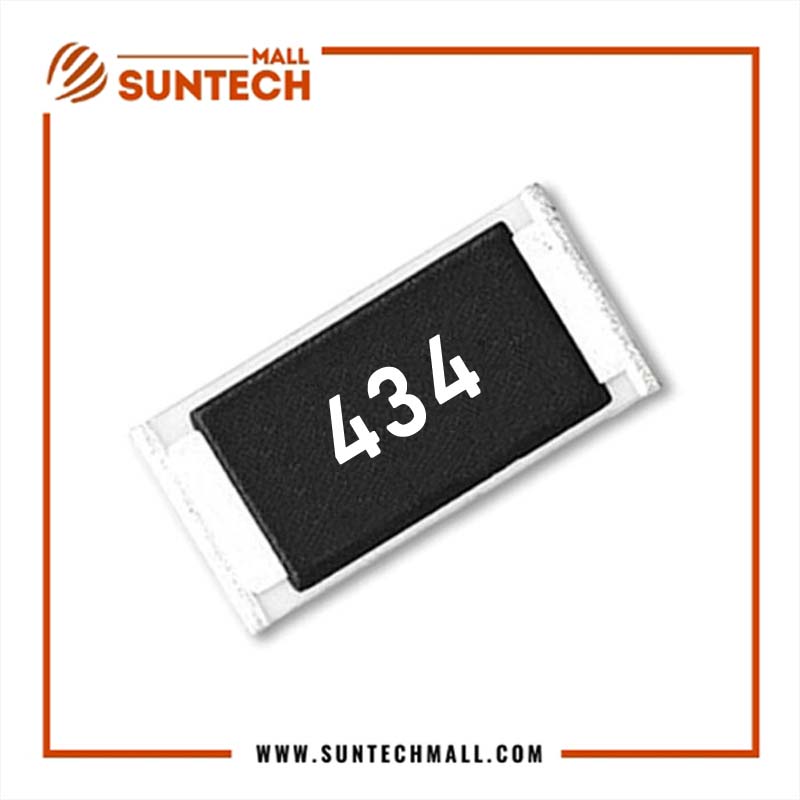
Repair techs use a part like this as a 430k ohm 0603 resistor for voltage division, where it takes a share of the voltage so the next stage sees the right level, and for signal conditioning, where a fixed high resistance shapes a signal without loading it down. It also fits power regulation, where a steady high value keeps a supply stage stable. You can check the value from the marking: the 4-digit value code for this part is 4303, which reads as 430 followed by 3 zeros, or 430,000 ohm. The 3-digit code for the same value is 434.
Key features
- 430K Ohm fixed resistance, ±1% tolerance
- 0.1W power rating at 70°C ambient
- Thick film chip construction, surface mount
- 0603 body: about 1.60 mm × 0.80 mm × 0.45 mm
- Maximum working voltage 75V (series limit — this is the cap that binds for this value)
- Temperature coefficient ±100 ppm/°C
- Wide temperature range: −55°C to +155°C
- 4-digit value code 4303; 3-digit code 434
Checks before you order
- Value: your board list must call for 430K. A nearby value is not the same part — if your board needs a different value, stop and check the board list again. A 510 ohm part in the same 0603 body is a different value for a different job, not a swap for this one.
- Power and heat: the power this part turns into heat must stay at or below 0.1W, and that 0.1W counts only up to 70°C ambient — above that, the safe power drops, so check the derating for your real working temperature. Work out the power from your real voltage and current (power = voltage × current) and keep it inside 0.1W with room to spare.
- Voltage: the voltage across this part must stay at or below the 75V series cap. From power alone the figure would be higher (about 207V at 0.1W), so the 75V cap is the limit that binds — stay below it. Above that, this part is the wrong pick.
- Tolerance: the real value may sit up to 1% away from 430K. If your circuit needs tighter than 1%, this part is the wrong pick — do not hope the part you get sits near the middle.
- Body and fit: your board must take a 0603 surface-mount body. Measure the old part and match it against the pads and the space on your board. The series body is about 1.60 mm long, 0.80 mm wide, and 0.45 mm high — if your old part is much bigger, check the board list again before you order. A 2K part in the same 0603 body is a different value for a different job, not a swap for this one.
- Fit for the job: if your circuit only needs a fraction of a tenth of a watt, this part still works. Match the value first, then the power, then the body — a through-hole resistor is the wrong shape for a surface-mount board, even if the value matches.
Specifications
All figures below are from the maker series documents for this chip resistor family. No figure here was guessed. The maker of the exact part on this page is not stated on the live page, so the publisher should confirm the series figures against the Download file at publish time (see the gates note).
| Type | Thick film chip resistor, surface mount |
| Resistance | 430K Ohm (430,000 Ω) |
| Tolerance | ±1% (425.7K to 434.3K) |
| Power rating | 0.1W at 70°C |
| Maximum working voltage | 75V (series limit; this cap binds for this value — the power formula alone would allow about 207V) |
| Maximum overload voltage | 150V |
| Dielectric withstanding voltage | 150V (see the gates note — the second series source gives 100V) |
| Temperature coefficient | ±100 ppm/°C |
| Operating temperature range | −55°C to +155°C |
| Marking | 4-digit value code 4303; 3-digit code 434 (see the gates note) |
| Body | 1.60±0.10 × 0.80±0.10 × 0.45±0.10 mm |
| Derating | Full power to 70°C; derate above 70°C |
Other names for the same part (good to know)
Shoppers and repair techs call this same part by a few names. 430k ohm is the plain name from its value. 430k ohm resistor is the name buyers use with the unit spelled out. 430k ohm 0603 resistor is the name buyers use when the body size matters. SMD resistor is the name for its surface-mount style. 430k ohm 1% is the short name that carries the value and the tolerance together. If your board list calls for 430K at 0.1W with 1% tolerance in a 0603 body, this page is the right match. Do not judge by size alone — check the value, the power, and the tolerance too.
Frequently Asked Questions
What does 430K mean?
It means 430,000 ohms of resistance. K stands for kilo, which means one thousand, so 430K is 430 × 1,000 ohms.
What does 1% mean, and what does 0.1W mean?
1% is the tolerance: the real resistance may sit up to 1% above or below 430K, so between 425.7K and 434.3K. 0.1W is the power rating: the most power the part can turn into heat without damage, rated at 70°C ambient, with less allowed as it gets hotter.
What is the 4303 marking on the body?
It is the 4-digit value code for this part: 430 stands for the digits 430, and the last 3 means three more zeros, so 4303 means 430,000 ohm. The 3-digit code for the same value is 434. There is no EIA-96 code for this value, because 430 is not an E96 series value.
Can I use this part above 75 V if the power is small?
No. The maximum working voltage is 75 V, and it applies even when the power is tiny. At 430K the current is always small, so voltage, not power, is the limit to watch.
How do I fit a 0603 chip resistor?
Solder it onto the matching pads on the board — it has no leads, so it sits flat on the pads. Check the pad spacing against the 1.6 mm body before you solder, use a fine tip and a small amount of solder, and do not overheat the part. A magnifier helps, because the part and its marking are very small.
What is the price of this part?
Check the live price on the website. The price shown on the product page is the current one.
Use note kept from the old page: this part was listed before as a 430K ohm 0.1W 0603 SMD resistor, a high-precision component for solar inverter applications, for reliable performance in power regulation and signal conditioning circuits, in a compact package for compact PCB designs, with thermal stability and low tolerance variation, a 0.1W resistor made for high efficiency with minimal power loss in demanding electronic systems, engineered for durability to strict quality standards for optimal functionality in renewable energy systems, a precision resistor with 1% tolerance for accurate resistance values, reducing circuit fluctuations, with a compact design for PCB layout flexibility, for advanced solar inverters — and that use still stands.
Reviews

Fast delivery and premium packaging.

Dil khush ho gaya original cheez dekh kar.

Impressed with the quality and service
Impressed with the fast shipping
The product was just as described
Very happy with the quality
Amazing quality, super fast delivery
Excellent experience from start to finish
Great deals and fast shipping
Fast shipping, great product
My order arrived earlier than expected
Amazing service and quick delivery


