
Description
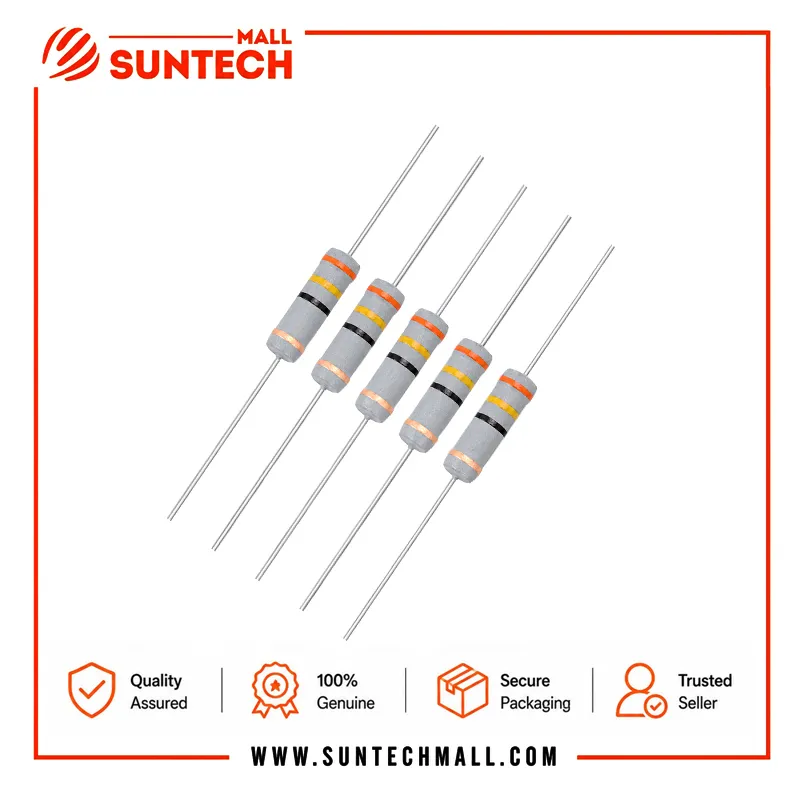
If your board needs a 51K ohm resistor that can handle real power, and the old part is a 2W carbon film part with 5% tolerance, this is the part to order. It is a 51K ohm resistor in an axial through-hole body, built for current limiting, voltage dropping, and biasing work where a small resistor would run too hot. It fits power supplies, signal work, and general repair jobs that need a fixed 51K value at up to 2W. It does not fit jobs that need a different resistance value, a surface-mount body, or more than 2W of power. Check the checks below before you order, so the value, the power, the voltage, and the body all match your board.
This is an original, high-quality part.
What it does
A resistor limits current and drops voltage in a circuit. A carbon film resistor does that job with a thin carbon layer on a ceramic rod, which gives steady, low-noise performance for standard circuit work. This 51k 2W resistor holds its 51K value within 5%, so a board that calls for 51K gets between 48.45K and 53.55K. The 2W rating is what sets it apart from the small resistors used for signal work only — it can turn more electrical power into heat without damage, as long as the cooling and the voltage limits below are respected.
Repair techs use a part like this as a 51K ohm resistor for current limiting, where it holds current to a safe level, and for voltage dropping, where it takes a share of the voltage so the next stage sees the right level. It also fits biasing circuits, which set the working point of a transistor stage, and signal conditioning, where a fixed resistance shapes or scales a signal. It is an axial resistor, so it mounts through holes on a board, not on the surface.
Key features
- 51K Ohm fixed resistance, ±5% tolerance
- 2W power rating at 70°C ambient
- Carbon film construction for steady, low-noise work
- Axial leads for through-hole mounting on PCBs and breadboards
- Maximum working voltage 500V (see the power-based limit in the checks)
- Temperature coefficient ±350 ppm/°C
- Wide temperature range: −55°C to +155°C
Checks before you order
- Value: your board list must call for 51K. A nearby value is not the same part — if your board needs a different value, stop and check the board list again. A 150K part in the same family is a different job, not a swap for this one.
- Power and heat: the power this part turns into heat must stay at or below 2W, and that 2W counts only up to 70°C ambient — above that, the safe power drops toward zero at 155°C, so check the derating for your real working temperature. Work out the power from your real voltage and current (power = voltage × current) and keep it inside 2W with room to spare.
- Voltage: the voltage across this part must stay inside the limits in the table. From power alone, the working voltage for a 51K part at 2W is about 319V, and the series cap is 500V — stay below both. Above that, this part is the wrong pick.
- Tolerance: the real value may sit up to 5% away from 51K. If your circuit needs tighter than 5%, this part is the wrong pick — do not hope the part you get sits near the middle.
- Body and fit: your board must take an axial through-hole body. Measure the old part and match it against the holes and the space on your board. The series normal-style body for a 2W part is about 15.5 mm long and 5.0 mm across — if your old part is much smaller, check the board list again before you order.
- Fit for the job: if your circuit only needs a fraction of a watt, this big part still works, but a small 1/2W carbon film part is a different job, not a swap for this one. Match the value first, then the power, then the body.
Specifications
All figures below are from the maker series documents for this resistor family. No figure here was guessed. The maker of the exact part on this page is not stated on the live page, so the publisher should confirm the series figures against the Download file at publish time (see the gates note).
| Type | Carbon film fixed resistor, axial leads, through-hole |
| Resistance | 51K Ohm (51,000 Ω) |
| Tolerance | ±5% |
| Power rating | 2W at 70°C |
| Maximum working voltage | 500V |
| Maximum overload voltage | 1000V |
| Voltage proof on insulation | 1000V |
| Temperature coefficient | ±350 ppm/°C |
| Operating temperature range | −55°C to +155°C |
| Derating | Full power to 70°C; derate above 70°C to zero at 155°C |
Other names for the same part (good to know)
Shoppers and repair techs call this same part by a few names. 51K ohm resistor is the plain name from its value. 51k 2W resistor is the name buyers use when the power rating matters. Carbon film resistor is the name for its construction type. Axial resistor is the name for its lead style. 51k ohm 5% is the short name that carries the value and the tolerance together. If your board list calls for 51K at 2W with 5% tolerance in an axial body, this page is the right match. Do not judge by size alone — check the value, the power, and the tolerance too.
Frequently Asked Questions
What does 51K mean?
It means 51,000 ohms of resistance. K stands for kilo, which means one thousand, so 51K is 51 × 1,000 ohms.
What does 2W mean, and what does 5% mean?
2W is the power rating: the most power the part can turn into heat without damage, rated at 70°C ambient, with less allowed as it gets hotter. 5% is the tolerance: the real resistance may sit up to 5% above or below 51K, so between 48.45K and 53.55K.
Can I use a different value, like a nearby kilo-ohm part?
No, not without checking the circuit. A resistor value sets the current and the voltage drop, so a different value changes how the circuit behaves. Only swap in a different value if the circuit design allows it — otherwise match the board list exactly.
Can a small low-power resistor do this job?
No, not if the circuit pushes real power through it. A small part rated for a fraction of a watt will overheat and fail where a 2W part is called for. Match the power rating as well as the value.
How do I fit an axial resistor?
Push the two leads through the matching holes on the board, bend them flat on the back if the board needs it, and solder them. Check the spacing of the holes against the body length before you solder, and keep the body clear of parts that cannot take heat.
What is the price of this part?
Check the live price on the website. The price shown on the product page is the current one.
Use note kept from the old page: this part was listed before as a durable through-hole resistor for reliable resistance control, used for current limiting, voltage dropping, signal conditioning, biasing circuits, power supplies, and general electronic repair work, with carbon film construction for standard circuit work and axial leads for easy mounting on PCBs, breadboards, and custom projects, in consumer electronics, industrial circuits, DIY electronics, and maintenance work where stable fixed resistance is required — and that use still stands.
Reviews

Quality ka koi muqabla nahi hai inka.

Bohot hi zabardast aur mayari item.

Bohot hi umda aur shandaar quality.


